Self love is
born of humility,
reached via
that narrow
avenue between
honor and self
pity.
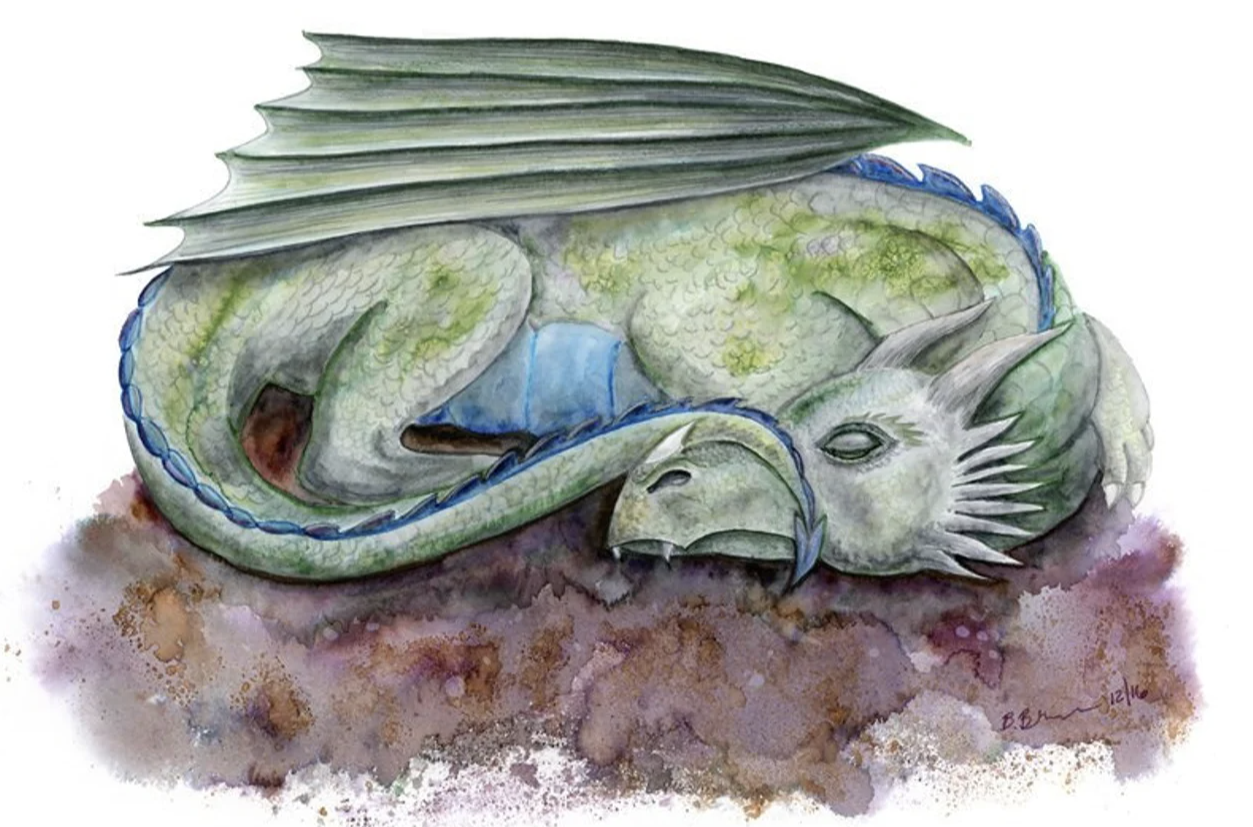
I glimpse myself
as god sees me:
a feisty toddler,
a sailor with
no map.
– Louisa P.
.

Self love is
born of humility,
reached via
that narrow
avenue between
honor and self
pity.
I glimpse myself
as god sees me:
a feisty toddler,
a sailor with
no map.
– Louisa P.
.

Filed under Adult Children of Alcoholics, Faith, happy, joyous, & free, Health, Recovery
Going to AA meetings and working the 12 steps with a sponsor can transform our lives. But in my experience, having taken the 3rd step involves conceding the fallacies of my own “reflex” thoughts on a daily basis. My mind is still set to certain defaults established in childhood or whenever, and those patterns are frequently, though not always, the first inclinations that come to mind.
Yeah, yeah, as I come up on 30 years’ sobriety (on 1/29), the 11th Step promises have mostly come true. That is, “we find that our thinking will, as time passes, be more and more on the plane of inspiration. We come to rely upon it.” But keep in mind that such reliance is possible only because we’ve made a habit of “ask[ing] God for inspiration, an intuitive thought or decision” (86-7).
In Step 3, I acknowledged that my own brain, when detached from god, is busted. Let’s remember where my own best thinking and determination to seek happiness and thrive on my own terms led me again and again: incomprehensible demoralization, deep despair, and suicidal ideation. Drinking was only one of many great ideas my thinking espoused for how to best navigate life. And it’s STILL busted, my brain. What I’ve “come to rely upon” is guidance from a higher power, not my ego-tainted perspective.
So here I am on my beautiful 5 acres in rural Oregon. Everything my angel foretold has come to pass. Somehow, my city house sold in three weeks – for less than I’d wanted, but within 24 hours of the deadline set in my contingency offer. Naïve about closing costs, I found myself many thousands short of the new house price, but my mother’s estate, which had been hung up in probate for over a year, came through 6 hours before I’d have lost the new house. These are little miracles. In other words, I’m pretty sure I’m where I’m supposed to be, but by none of my own doing — other than moving ahead in faith.
Those of you who’ve moved after age 50 know this shock of not knowing where you are. My mental map of Seattle was incredibly detailed; here, I knew the way from my home to the store, beach, and a few trails.
But that’s where Step 3 comes in. For vague reasons, I felt hesitant to show up at any new AA meetings. I would look them up online, even put them on my calendar with great resolve, but once it got pitch dark out – and I do mean pitch dark – I’d be scared to leave my cozy little house. So I didn’t go to meetings for a month. Not even Zoom ones.
ISOLATING. That’s what I was doing, with my 2 cute dogs, a fireplace, deer outside the window, and coyotes and raccoons I’d sent packing, while I threw myself into UN-packing, putting off AA always just one more week. By grace, I knew this was my alcoholic brain’s will for me, not god’s direction for growth. Meanwhile, my addiction was rubbing its evil hands together in anticipation of a relapse.
So I did what I could: I called a friend from my old home group and confessed all the above. She made me promise I’d go to an AA meeting the next day, so I promised. Then I broke that promise… because yada, yada. But after she texted me, DID YOU GO?? and I had to sheepishly reply NO, my ego, I suppose, got prodded from the other side. I’m supposed to be all wise and shit, but here I was acting like a backassward chickenshit. So the next week, I set out in utter darkness and sheets of rain, relying solely on my high-beams and GPS to get me somewhere. Eight miles later, I walked into a cozy room with a fireplace, Christmas tree, and cushy chairs filled by six fellow alcoholics.
I was home. I was safe. And before I even spoke a word, I was loved.
I thought, “Of course! Of course! How could I have been so timid, so stupid, so gullible as to isolate for over a month?!” But I also knew: fear had taken me offline. Fear had slid me backward into my own reflexes. Louisa’s broken brain had been telling me that staying home alone was playing it safe. It was wrong — as always.
Well, those alcoholics had me download an AA app very that night and recommended three more meetings nearby. I started going, meeting more alcoholics, making new friends, being of service, even going out for coffee! My routine now is three AA and one Al-Anon meeting per week, all in person. For my 30th sobriety birthday, a woman I’d never laid eyes on in November is bringing a homemade carrot cake for the celebration, and everyone’s excited for me.
What’s more, these people possess a mosaic of experiences that mirror everything I’m struggling through. They remember being new here, wanting to isolate, feeling baffled by power outages, wells, and septic systems, and many feel shocked to find themselves at various thresholds of old age. Not only have they told me about gym facilities, parks, trails, garden clubs, community email, and less expensive stores, but at every meeting I hear profound insights that allay my fears and enrich my experience of living.
Pick one. |
![]() |
Whenever I don’t WANT a new sponsee, don’t WANT to drive someone to a meeting, or chair one, or stay after to break down the room, etc., god’s inspiration reminds me how I didn’t WANT to go to AA in the first place, didn’t WANT to get a sponsor, REALLY didn’t WANT to throughly work steps 4 through 9, or to change “everything” about my approach to living. But going against my own thinking has brought me a joyous life I could never have built myself. Day by day, I can either screw it all up by trusting my defaults, or reach beyond them to continue on this amazing spiritual path toward new adventures.
![]()
PS: Just for fun… Deer and coyote from inside my house.
Filed under AA, AA fellowship, Alcoholic relapse, Alcoholics Anonymous, Happiness, Meetings, Recovery, Step 3
For so much of my youth, through so much of my active alcoholism, I believed I was supposed to do and be certain ways to be cool. I saw signals everywhere meant to teach me what was expected of me from the sector of society I wanted to emulate.
These signals took on a life of their own in my psyche. They became my own measures of success, and I knocked myself out trying to fulfill them.
One of the biggest gifts of having been sober a few decades is freedom from all those supposed-to’s. I can choose the parts of life where I want to push myself, and the parts about which I don’t give a flying duck.
I don’t have to…
have little clue what they’re doing. Gear that’s been put to good use shows “cred” — short for credentials. My whole life shows cred, so I feel the same way about my household stuff, clothes, car, etc. It’s been around.

Filed under living sober, Recovery, Sober holidays, Sober passions, Twelve Steps
What are you feeling right now? Really feeling?
Can you look underneath that feeling and identify another? Can you take the time to let that underfeeling dilate and express itself? The degree to which you can do that might be an indicator of your emotional sobriety.
Long before we had the term “mindfulness,” the elders of early AA
talked about “emotional sobriety.” For a long time, I assumed emotional sobriety meant just not acting out. Active and newly sober alcoholics do such crazy stuff, fomenting drama like a dishwasher with the wrong kind of soap, spewing it onto all who come in contact with them. Bad relationships, bad communication, bad decisions, bad consequences, and back reactions to those consequences: we dig our trench of pain and isolation ever deeper.

Not indulging in that stuff, I used to think, was the key to emotional sobriety. Self-restraint.
Of course, I was wrong. When we tap the wisdom of the 12 Steps and god’s guidance, we actually outgrow these behaviors. How? By learning to notice WTF is going on, WTF we’re feeling, and WTF we’re telling ourselves that is not necessarily true.
A long-distance friend, 13 years sober, recently Marco-Poloed* me that she’d been asked to speak for an hour at a large AA venue — but had yet to commit.
“I don’t know that I can offer a positive message,” she said. “I still struggle with feelings; sometimes I can’t tell what’s real and what’s my feelings. I struggle with the scary kind of sadness; I get irritated by petty things; I feel resentments. I do have a lot more peace now than in the past and I do know what the solution is, but it’s not picture perfect.”
I promptly Poloed back, “Speak! Tell them exactly what you just told me! You don’t even THINK about all the trauma you’ve overcome because you’ve overcome it!”
The testimony to my friend’s emotional sobriety is twofold. One is that she knows she’s struggling, she can give names to her emotions and is always on the lookout for her part — i.e. 4th column / her side of the street. The other is the beautiful life she enjoys, helping people via her profession and working on deep trust in her marriage. “Picture perfect” is simply not compatible with being human.
The term “mindfulness” is associated mainly with Buddhism and meditation.
Meditation opens the space to notice the thoughts our brain is constantly churning out while we intend to detach from them. Every time we notice a thought has waltzed into the spotlight and seized the mic to start telling us what to pay attention to, we cut the amp and gently escort it offstage. This happens again and again. Gradually, we get to know the wizard behind the curtain, the monkeybrain constantly ushering these acts onstage. We learn its tricks and are not “hooked” by the thoughts, worries, and imperatives it generates.
Out in life, we can practice this same process. When we feel put on the spot, inadequate, awkward, angry, needy, infatuated or whatever, we can detach from the thoughts that drive these feelings. We can see which performer has nabbed the mic and unmask it as a feeling rather than objective truth.
This process is never seamless. It’s never easy, but the lifelong work of doing this stands at the core of sobriety. Feelings present a reality all their own: INTERNAL reality. When we can distinguish that INTERNAL reality from some form of objective EXTERNAL reality, we are practicing emotional sobriety.
To do so is a struggle for everyone, but especially for us as recovering addicts. For decades, usually during parts of life when our non-alcoholic peers were honing this skill of sorting what was on the table in any difficult situation, we did the opposite.
We swiped everything off the table with one simple move: choosing to numb.
When we choose to numb, to take the edge off, or to ride a destructive feeling, we choose NOT to seek WTF is actually going on. We choose self-centeredness, navel-gazing, and all the coping skills developed when we were kids navigating in dysfunctional families. “Let’s just run with this faulty tool again,” we say. That’s why many alcoholic addicts continue to behave like children well into old age.
I myself practice meditation only sporadically. I realized this morning, though, that I do practice a form of morning centering with daily consistency.
Two and a half years ago, I adopted Alice, a deeply traumatized puppy. She’d been abused by cruel owners who eventually dumped her and her littermates in the Rio Grande desert to starve, as most of them did. Every morning, Alice would awaken in terror of absolutely everything, including me. So I would spend a few minutes each morning holding her on my lap, giving her scritchies and kisses, murmuring and telepathically telling her she was loved. I would focus, focus, focus on this message:
“I love you, and I will keep you safe.”
Alice has indeed grown to love me and feel safe, to be strong and happy when not triggered.
However, she’ll never let me abandon what I now call her “medicine.” Each morning she sits directly in front of me while I fiddle with my phone or laptop, waiting permission to jump in my lap. I realized only this morning as I focused on our message that I was connecting with my higher power as well, that the love went both ways: god loves me as I love Alice.
The key is that each morning, she asks that I take the time to open my heart. Once it’s open, I feel what I’m actually feeling. Right now, that’s a lot of grief — for the loved ones I’ve recently lost. Tears come. Countless other feelings are in the mix, and I become aware of them. Without this practice, I would proceed with my day on autopilot, numbed by busyness.
To be awake takes practice, but it’s the key to a rich and genuine life.
![]()
.
Filed under meditation, mindfulness, Recovery, Spirituality
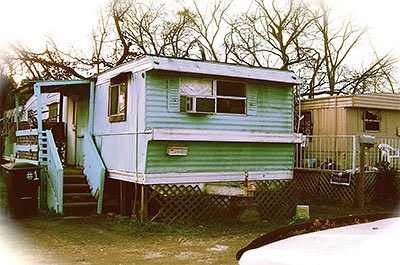
On a dark, rainy winter’s evening about ten years ago, I found myself in a run-down urban trailer park trying to find a particular trailer. I don’t remember how I was supposed to identify it, but I do remember a man stepping in front of me whose face I couldn’t see in the dark. “I got some stuff. You want some?”
“No, thanks,” I replied, moving on. By the light of trailer windows, I saw more shadowy figures moving about in the downpour, and I remember holding my AA Big Book in front of my heart like a shield, asking god to keep me safe. I was on a full-fledged 12th-step call, one of only a handful in my life.
Twelfth-step calls are less common today because treatment centers tend to be a first stop for addicts wanting help, but the woman whose trailer I was seeking had just been released from the most labor-camp-like detox/treatment center in Seattle – Sedrunar. A friend had called me about her. “Lena doesn’t have a car to get to meetings. She’s got two kids, and she’s gonna lose them if she uses again.”
I called Lena, though I was going to insist she take the bus to my house. But Lena, like any addict, was persuasive. She didn’t know anyone in the trailer park she could trust to watch her kids – who were seven and two. Could I please come just this once?
The seven-year-old opened the trailer door. She stared at me from eyes circled with dark shadows, silent as a spook. I heard yelled from inside: “Let her in!” I tried to greet the child cheerily, though to inhale the stinky, steamy air in there felt like an assault. On the floor was an old TV with a beanbag chair in front of it – that and piles of clothes. Bare walls. In came Lena, the toddler on her hip naked besides his diaper, food all over his face. Lena was a bit shorter than me and chunky, about 25. She shook my hand, apologizing for the mess, and handed the boy off to her daughter, pretty much barking at her to go in the bedroom and shut the door so she could talk to this lady – me.
We sat down at the yellow kitchen table. On the stove, mac & cheese dribbled from a saucepan
in a way that reminded me of vomit, and smeared noodles dotted the table. Lena sat across from me and folded her hands expectantly as though I were about to recite poetry.
All I could say was, “Does that window open?” I gestured toward a dark pane at the the table’s end, the glass dripping with condensation.
Lena looked perplexed. “I’m trying to save heat.”
“I’d really appreciate it.”
Reluctantly she rose and slid the moldy aluminum frame aside about an inch. While she was up she grabbed a sponge and wiped away most of the noodles at my place, apologizing that she’d just fed her son.
I’d made up my mind that I would stay 30 minutes only. I began as I always do, by asking Lena to briefly tell me her story. Clearly practiced from treatment, she launched right into it – how she’d grown up picking crops in Yakima in a Hispanic community; how she’d gotten into meth as a teen. She was proud that both kids had the same father, but he was a drug dealer. She’d lost them twice to CPS – once for leaving them in the car outside a bar.
“I’m clean, now, 60 days. The judge told me this is an extra chance with my kids. I shouldn’t even have them now. I gotta stay clean. I gotta stay sober.” Here she changed, muscles in her face and throat working hard. She looked right at me and spoke distinctly: “I can’t… lose… my kids.”
“Well, you’ll need to find a sponsor,” I breezed, “but, unfortunately, I’m full.” This was somewhat true – I had a few sponsees. But, of course, I really said it to push away all this squalor. I wasn’t even sure whether this woman should have her kids. All I knew was that only 21 minutes stood between me and escape.
I sketched my own story briefly, Lena nodding attentively at every phrase. I explained that I couldn’t not drink on my own, but by working the 12 steps I’d accessed a higher power that had removed my craving for alcohol and kept me sober eleven years.
“Eleven years!” Lena marveled. “That’s what I want! I wanna know how you did that!”
I was starting to explain how I’d worked with a sponsor when we heard a ruckus and the squalling toddler, chased by the spooky girl, burst out of the bedroom. Hardly taking her eyes from me, Lena scooped her son into her lap and held him close. She gave the crown of his head tiny kisses and asked him if he wanted a bottle.
Right then – that’s when the voice started. Not really a voice, but an urging: Help her. Sponsor her. Love her.
No fucking way! my ego countered.
I was busy. She was hopeless. Just eight minutes and I’d be outta this dump, back to the fresh air and my nice, clean life!
Lena nodded toward her son. “He don’t talk,” she said. “They told me he’s disabled, but it ain’t true. It’s just all he been through.” Watching the boy’s eyes, the way they moved from Lena to me and back again, I sensed she was right. Meanwhile the spooky girl joined us with a coloring book, promising to be quiet and asking where her crayons were. Lena grabbed them from the same box that had held her Big Book.
“It’s not me,” I heard myself telling her. “God has given me a life better than I ever dreamed of.” Some of the people who’d helped, giving me time and guidance, flashed through my mind. “I’m not the same person I was.” Lena nodded intently. She was not begging. She was not pleading. But every cell in her body was straining to hear me.
Just help her. Just love her.
But I was helping, dammit! I was steering her toward the program, right? Just not toward me. Anyone but me. But, with just three minutes to go, I made a big mistake. I looked into Lena’s eyes. Really looked. I saw there desperation and terror, but even more, a fierce love for her children. My own son was five. How were we any different?
The wall crumbled, compassion washing over me. “Okay, I’ll sponsor you,” I heard myself saying. Lena’s face lit up. “But not here! You’re gonna have to come meet me at a coffee shop!”
The rest of the story is like a fairy tale. Lena and I met every Friday to
read the Big Book at a Starbucks while a sober neighbor watched her kids, after which I’d drive us to a meeting. She had a job riding in a municipal truck, collecting garbage, and within a couple of months she qualified to drive that truck. She moved into a shitty apartment not far from the trailer park, where I met with her for a while until she found childcare. She bought a crappy car and started driving herself to meetings. Whenever I showed up at her homegroup, her kids would ambush me either in the parking lot or when I came in – the little girl now beautiful and clear-eyed, the little boy talking up a storm. Their laughter still seemed incredible to me – a miracle.
In a little more than a year, we’d progressed to Step 9 when Lena, who was apprenticing as municipal gardener, leased a nice apartment too far north for us to keep meeting. I drove up and visited her there once. It was near Christmas. I remember white carpets, a new sofa, pictures on the walls. I remember the children bringing me a gift from under the Christmas tree and grinning while I opened it, and my own embarrassment that I had nothing for them. But I had given them something – and we all knew it.
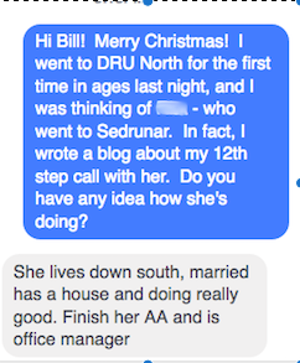
Last night after eight years I went again to that meeting – Lena’s old home group. But she wasn’t there. Where she’s gone, what she’s doing, I don’t know. But I’m hopeful. I sent them prayers. Today, I’m so grateful that god opened my heart, and that it’s still opening.
![]()
…
Republished from 12 /2016
Filed under Addiction, Alcoholics Anonymous, Alcoholism, Recovery, Sobriety, Sponsorship, Twelve Steps
Yes, the brains of alcoholics and addicts are indeed broken. We can resolve not to do the thing, we can mean it with every fiber of our being, and then — BOOM! — we’re doing it: we’re getting drunk, popping pills, acting out, smoking whatever we meant not to. “Did I do it AGAIN? Dammit! Well, just this one last time…”
Of the 14 years I drank to excess, I spent the first 2 college years content with my frequent bouts. For the last 12, however, I was caught in this cycle:
Step A: WAKE feeling like absolute shit.
Step B: RESOLVE to not drink (or whatever you do) for X amount of time.
Step C: DETOXIFY just a little, feel less shame/guilt
Step D: Imagine as a FINE IDEA yourself enjoying a lovely cocktail or single cold beer (or whatever)
Step E: PICK UP a drink (or whatever)… and soon decide to have more, and more, and more…
Revisit Step A with just a skosh more shame, remorse, and self-disgust.

I rehashed this cycle literally thousands of times. THOUSANDS. And every time I reached Step D, I convinced myself this time I’d manage better. To grasp that it’s not our true selves but our addiction itself compelling this “choice” seems pretty extreme, almost like a split personality. Aren’t we the masters of our own behavior?
In fact, we are NOT. Addiction overrides even the most heartfelt resolve.
Last November, I woke in the night to find my house full of smoke. I dashed down from the attic, where I sleep, to the basement, which I rent out, and pounded on the door. My new tenant, the 29-year-old half-brother of a friend, opened it. Winnie — his nickname — was calmly cooking, the whole apartment opaque with smoke.
“What happened?!” I said.
“Oh, there was something on the burner.” He gazed at me with beautiful, innocent eyes.
When I objected that my home was full of smoke, he corrected himself: There’d been some spilled food in the drip pan. He just hadn’t seen it. He was so sorry. It took about a month for me to arrange a mini-intervention with Winnie’s mom, who lives in Florida, via video on my phone, much to Winnie’s shock and horror. “Sweetheart, do you want to live or die?” she asked him point blank. To my astonishment, Winnie wept. He nodded, wiping tears and struggling to contain his sobs. “I want to live,” he managed.
He brought from his room a bottle of benzos. Since abrupt withdrawal from such drugs can be fatal, Winnie agreed to inpatient treatment, and I began the process of finding him a bed. About a week later, in the midst of cooking French toast, he suffered a seizure. With the basement door open, my son somehow heard his head hit the concrete floor. I burst in, found him convulsing without breath, and dialed 911. By following the dispatcher’s instructions to prevent his suffocation, my son and I both got potentially exposed to COVID-19 before the paramedics arrived. My son said the first thing Winnie did when he recognized his surroundings was sit up and switch off the French toast.
I rented him a storage unit, and on a Saturday while he stayed in a hotel that his mother paid for, Winnie’s half-brother, my son, and I transported all his belongings. Only months later, when he’d finished treatment and came by to pick up the storage unit key, did I understand that Winnie was going to die — and soon. He was surly, even as he uttered polite thank you’s.
Last week I got the news: Winnie’s father found him dead in the bathroom with a syringe still in hand. He’d just turned 30.
DIVINE RESCUE is a partnership.
How did I know Winnie would die? It was his energy. He gave off a vibe of “I’ve done what everyone wanted; now I’ve got this.” He did not look at me, really. He had no interest in seeing me, in seeing anyone. Spiritually, he was still at a Cartmanesque ground zero: “I do what I want!”
He had not absorbed in treatment what I somehow began to pick up in my first AA meetings, what working the 12 steps in conjunction with life pulling me through pain, loss, and joy has taught me: of myself, I am nothing.
God can help us only when we pry open our armor, cast off our god-repulsing sheath of self-sufficiency. We open in two ways: 1) by asking for god’s loving, compassionate help and 2) by regarding other living things with that same loving compassion. Once we begin to intuit that god is within us, animating our cells and fueling our very consciousness, we begin to realize that we are no more separate from god than a plant is from the Earth.
Addiction is the almost inevitable outcome of attempting to live as a picked flower. Without connection to god, we languish and grasp for quick fixes, even knowing they’re poison. In truth we are designed to absorb love from god and radiate it to others; once we make practicing this way of life paramount, addiction loses its luring power. We become immune.
Remember: “What we really have a daily reprieve contingent on the maintenance of our spiritual condition. Every day is a day when we must carry the vision of God’s will into all of our activities” (85).
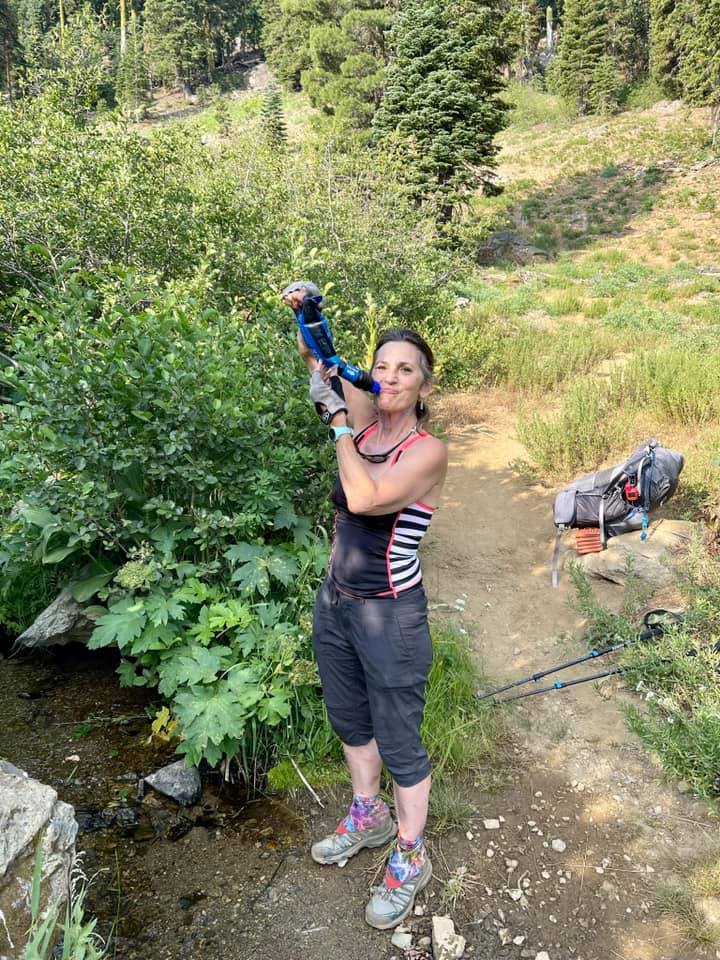
For me, carrying that vision led me last week to hike over 100 miles in the mountains of Northern California (despite the threat of fires), where I connected not only with glorious nature but with countless wholehearted PCT hikers coming the other way. It led me to return to my AA home group in person this past Friday and take joy in seeing my fellows again after a year and a half.
I remember trying to articulate this way of life to Winnie just before he left for treatment. Our RING camera actually recorded my urging voice and his impatient acknowledgements. The enormous gift I cannot give to others is my unshakeable understanding that meeting weekly with those neighborhood ex-drunks to contemplate yet again the themes from our hokey 1939 book is indeed what channels me the god-power to love others and savor life’s far-reaching beauties.


Video of our hike: https://youtu.be/m-d-LWGA21Y
![]()
Filed under Addiction, Alcoholics Anonymous, Alcoholism, happy, joyous, & free, Recovery
Now and then a serious drinker, being dry at the moment says, “I don’t miss it at all. Feel better. Work better. Having a better time.” As ex-problem drinkers, we smile at such a sally. We know our friend … would give anything to take half a dozen drinks and get away with them. He will presently try the old game again, for he isn’t happy about his sobriety. He cannot picture life without alcohol. Some day he will be unable to imagine life either with alcohol or without it. Then he will know loneliness such as few do. He will be at the jumping-off place. He will wish for the end.
— Chapter 11, Alcoholics Anonymous
I hit bottom on 01/29/95. On that day, I could no longer imagine life either with or without alcohol, and I truly wished for the end. The August prior, I’d quit alcohol for 30 days just to show I didn’t have a problem. I was staying in a friend’s vacant apartment because my partner had banished me from our home, having read my journal and discovered some of the sickness I’d been concealing. But oh, well.
I hung a calendar on my friend’s kitchen wall and drew a big X through each day
I passed without a drink. I felt healthier, had more energy, was cheery at work. But LOVE not drinking? What are, you, nuts? I could hardly wait for the month to be over so I could drink again, because any life without drinking struck me as beyond dull — it would, I knew, be brash, relentless, barren, and joyless. Alcohol, I felt, was the oil in the engine of my life.
So on September 1st — cheers! — I was back at it. But by 01/29/95, much had changed. A thick, murky self-disgust filled my consciousness; I saw no hope of ever enjoying life; and alcohol, almost inconceivably, no longer helped. There’s an explanation for what was going on at the brain level, but all I knew was that, no matter how much I drank, I felt no levity. The world had gone devoid of all color and charm; other people seemed self-sufficient judging machines. I just couldn’t deal anymore.
My idea of a fine suicide was guzzling a gallon of vodka — a scheme I knew my stomach would allow. But FIRST, because I couldn’t do it after, I dialed the number a sober friend had scrawled for me on a scrap of paper, and that night I went to my first AA meeting. I no longer gave a shit whether life was brash, relentless, barren, and joyless. All I knew was that nothing I’d tried could render it tolerable, and several people had claimed AA would.
If you’d told me then that in 25 years, sobriety would comprise the gem of my life,
that I’d love my AA homegroup as my dear, motley family, and that pretty much all my friends would be in AA or NA, I’d have said, “You must be talking about somebody else.” And you would have been, because the psychic change that comes with thoroughly working the steps through several iterations over the years has transformed who I am.
What Happened?
To realize that we hold a limited perspective, I think, goes against the basic nature of human consciousness. Our brains tell us that the world is what it is and that we’re perceiving it accurately. If there’s a problem, it must be with the world, not how we process or think about the world.
Even at that “let’s kill ourselves ’cause it’s a good idea” rock bottom, my perspective felt both certain and precious to me. My pride was rooted in it. My attitudes and values had built up over my 34-year lifetime, crafted through countless efforts to deal with the tricks and pains of living. I truly believed they were me. To say they were distorted was to steal all I’d worked for. And to say that in some outdated white-guy book and in church basements full of strangers, a better perspective could be attained — well, that was just plain shallow.
NO ONE likes to think that other people have answers we lack. If millions of sober people tell us they struggled with the god thing but it eventually became the foundation of their happiness, we feel we’re different, put up a wall, and say, “They must be simpletons.”
My first months without alcohol did indeed prove brash and relentless — a place where many stay stuck. Yet for me, they proved not altogether barren and joyless because I’d begun the long process of growth. Through incremental acknowledgement, over and over, I began to see that my ways kept leading me toward depression and emptiness, whereas each time I tried a little more of their way, life got better. Two years in, I worked the steps whole hog.
Rather than being brainwashed, I found I became more me — little Louisa was still in there, and she was cute and creative and love-filled, and all the things she’d been before she lost the key to life: loving from the source of god and sharing goodwill with others. Children do this without needing a reason. Yet at some point I’d changed to one who wants from others, and it nearly killed me.
I understand now that one drink will inevitably lead me to thousands, and that whenever I’m drinking, I’m cut off from god like a plant inside a box. To drink, for me, is to wither spiritually, even if my outsides are puffed up with false revelry.
Willingness is the key. For me, that meant relinquishing my grip on being right, knowing best, and being a smarty-pants in general, because otherwise, I stayed locked in my old perspective. And the relinquishing never ends.
Today, when I say I love my sobriety, what I’m really saying is that I love this life — its fleeting beauties, its inevitable struggles, its poignant fragility. Sobriety is the honesty that lets me behold it.
![]()
Filed under God, Happiness, living sober, Recovery, Sobriety, Spirituality
For the first three and a half decades of my life,
I tried super hard to find happiness outside myself. If I could just get with the right people, afford the right stuff, and be seen in the right places, with just the right amount of a buzz or high, I’d clinch it! But all I did was fuck up my life — and others’.
I was smart as measured by standardized tests, landing jobs, or publishing stories, and good-looking enough for a mostly-successful seduction record, but dumb as a stump in terms of emotional wisdom — so I just wanted to die. Life hurt so badly! (See my lengthy addiction memoir for details galore.)
Attaining happiness is never an easy quest; every day we have to bushwhack through pretty much the same undergrowth of FOMO, discontent, victimhood, and boredom as well as self-inflicted criticism, shame, and pity to arrive beneath the open sky of awareness. During a pandemic, such as is in full swing as I write this, the way gets even thicker and swampier — doesn’t it? Surely, we think, we’re missing out on some better life we ought to be living!
Growth
Now, I may be getting on in years, but I have recently met, both in person and virtually, some folks my age who are still every bit as lost as teenagers. For decades they’ve repeated over and over the same cycles of addiction — one with booze, the other with codependent romance. They have yet to step off the merry-go-round of “I know best,” so they keep finding themselves back at square one.
In early addiction, all of us believe our heads. Our thinking tells us it’s a fine idea to _____ (shop, starve, drink, “fall in love,” etc.), and we trust that thinking. Little do we suspect that our brains have been hijacked; we’re caught in a loop of stimuli and the reward centers they trigger.
Later, once we become aware of our addictions, we try to temper them with resolve and decisiveness — say, by swearing off drugs or getting married or moving. We’ve noticed the pattern and, darn it, we’re not gonna do that shit anymore! I see this so tragically among pregnant addicts at a rehab center near my home. These women will hug their distended bellies and say, “I’ve lost three kids to the foster care system, but I’m not losing this one! I am SO DONE with drugs and alcohol! And I’m gonna get all my babies back, and we’re gonna be a family…”
By this point, they’re usually too overwhelmed with emotion to go on. No one could be more sincere. No one could want and yearn and hope more fervently for what they’re saying to be true. And yet I know, sitting in that circle, that chances are they will use again, and they will lose this baby, along with all the others because addiction always wins — short of a miracle.
.
Half that miracle is god — a power greater than ourselves that empowers us to accomplish what no human will can bring about. The other half is the inward miracle of letting go — ceasing to believe what our brains tell us, trusting instead what others have to teach us, and learning to listen for direction from our deepest hearts, from the goodness in our core that’s connected to all life.
The rest of recovery — including that daily schlepp toward happiness — comes down to 1) expanding the range of this miracle, 2) mapping our thought paths, 3) revering our consciousness/spirit, and 4) odd as it may seem, making friends with all those misguided inner voices.
2) We begin to realize we are not our thoughts — we entertain them. Or maybe it’s better to say they entertain us! That is, they enter stage-left, tap-dance a while before our awareness with urgent banners and songs and imperatives, and eventually exit stage right. We learn to watch them without getting snagged, knowing they’re impermanent reactions to stimuli more often than realistic assessments of what is. Practicing meditation hones this skill.
3) We begin to realize that we’re not our brains or bodies — we inhabit them. We’re all spirits that, for whatever reason, have chosen to incarnate and play a role in the unfolding of the physical world. Ultimately, our mission is to help each other by taking actions rooted in love and compassion. As one Near Death Experiencer was told, what matters is not what you do each day but what wake you leave behind, whether each person you meet is left a tiny bit happier by the encounter — because every other being is a part of you.
4) The same love and compassion we extend outward, we learn to offer ourselves, generously steeped in humor. Humor is the taproot of true humility, which is indispensable to a happy life. Did I wake up this morning anxious, dismayed by the state of the world, worried about the same dumb shit I always worry about? Yup! That’s me — failing to be grateful that I’m not trapped in some war-torn, starvation-ravaged country or suffering some vast pain or grief. Yup, it’s just me and my buddies insecurity, envy, fear, and vanity, hangin’ out and doin’ what we do! Come on, gang — let’s toddle into our cozy kitchen and get some luscious tea!
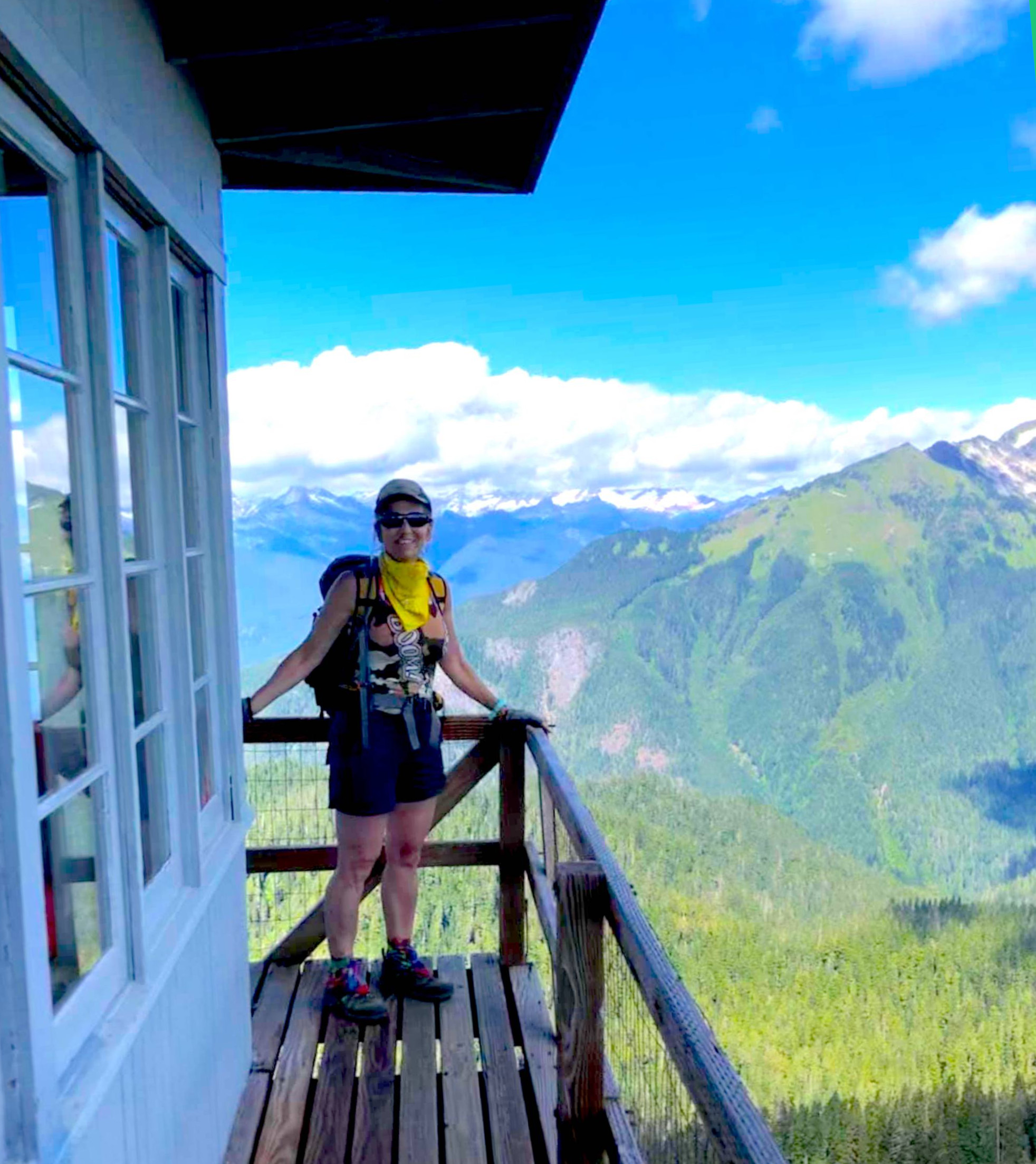
I often don’t see how I deserved to be guided to my first AA meeting, but I’m the one who said, “I can’t do life. I give up. Teach me.” And the rest has unfolded like a wildflower in the mountains.
![]()
Filed under Happiness, happy, joyous, & free, living sober, Recovery, Spirituality
“The god part” is, without question, the biggest hurdle of the AA program for countless sick and dying alcoholics and addicts. For me it certainly was, because when I read that word “God” coupled with “He” in the 12 steps, I immediately thought of religion, of versions of God as a humanoid king or judge. And that image made me barf. It seemed extremely inconvenient that the only thing AA could offer to save my life was something so hokey as a higher power.
At the time when I was hitting bottom and, thanks to countless contingencies I now see as guidance, finding myself in my first AA meeting, I was an atheist. An avid, even rabid one. However, I was also trying to bracket some extremely weird shit that had been happening to me — inexplicable experiences our culture would label delusional or make-believe.
What sort of weird shit do I mean?
During an early morning rain storm, I saw an old man on an ocean beach in Gloucester, MA, dressed in what appeared to be antique rain gear and walking from the dunes on my left toward the waves on my right, perpendicular to my solo progress. I made up my mind to ask, as soon as I got close enough to communicate over the strong wind and thundering waves, where he’d found such authentic-looking yellow Mackintosh garb. But as I got closer I saw he was staring toward the horizon as if in some intense emotional pain. I tried to look for what he might be seeing, but the clouds hung so low over the water, there was nothing to see. So, when he crossed directly in front of me, close enough that I saw the fine wrinkles and red capillaries on his face, I said only “How’s it going?” He did not reply, and when I had walked a ways further, I looked back, angered by his rudeness, only to see — no one. An empty beach. I tried to figure out where the old guy could have got to so fast. But when I went back to look for his tracks, I could find none but my own. This happened five years after my Near-Death Experience.
A few years later, I knew my unborn nephew was destined to die, and that my brother was going to plunge into profound sea of grief at his loss. Then exactly that happened.
Weeks before I hit bottom, I’d driven home absolutely hammered, speeding along winding woodland roads, threading the needle amid a blur of reflectors on a narrow bridge. When I reached my house and stood congratulating myself, hanging onto the door for support, a voice shot through me like a bolt of knowing: This is the last time I can help you.
A few weeks later when my dog got hit by a truck and foiled my plans to attend a “vodka-slamming party” and just not drink, that same voice addressed me again: Look! My eyes at the moment were on the blood trickling over the asphalt from under my dog’s body, and the message was that my future would involve something similar if I didn’t cut the shit.
So that’s some weird shit, right?
Then I walked into an AA meeting (actually, the dog incident happened after my first half-assed prayer when I was 2 weeks sober) and I read “Came to believe in a Power greater than ourselves that could restore us to sanity.” I made absolutely no connection between those words and the voice that had, so to speak, hacked my consciousness.
Why not?
If you’re an alcoholic or any type of addict in recovery, then you know firsthand the isolating effect of relying on ego to navigate life. Ego tells us we are different. It sometimes tells us we’re special and better than others, but it can also tell us we’re worse than others, and that our various struggles are unique. In fact, living in ego’s lonely “I” rather than the heart’s “we” is what generates the pain we drink to escape.
But of course I did not know that.
I classified all my paranormal experiences as something I should keep to myself just as I did my obsessive infatuations or harshly manipulative thoughts of using mildly cool people to connect with their hella cool friends. The inner workings of my mind were a source of shame, and so these woo-woos, I felt, were shameful. They might point to a fried brain or neurosis, but certainly not to an active spirit world that could free me from addiction.
My own journey to arrive at working model of god has been long. Weird woo-woos continued to befall me until I broke down in about 2004 and accepted the spirit world as real. That acknowledgement eventually led me to seek out fellow NDErs in the Seattle chapter of the International Association of Near-Death Studies (IANDS).
What goes on in an NDE is that the spirit leaves the body; consciousness exits the brain. I recently heard a fascinating interview with Dr. Bruce Greyson*,a psychologist who’s been researching NDEs for about 40 years. Greyson theorizes that the brain acts as not only an interpreter of sensory input but also a filter against cosmic and spiritual input. Its primary function, he reasons, is our physical survival, so anything extraneous to that gets filtered out. We see and hear only those ranges of light and sound that are useful for filling our terrestrial needs. Input from an alternate plane of reality, Greyson theorizes, would distract us from those needs and thus detract from our chances of survival, so we evolved means to exclude it. The brain’s filtering capacity can, however, be suppressed by psychedelic drugs or even damaged by NDEs so that it ceases to work effectively, thus allowing spiritual energies to enter.
Greyson’s theory both differs from and aligns with my own. I believe that conscious beings are encapsulated in what I call a “god-phobic energetic membrane” analogous to the hydrophobic fatty membranes that encapsulate living cells. In other words, to function individually as a water-based mechanism in a water-based environment, each cell requires a membrane that repels water. Similarly, as we are bits of god swimming in god-energy, we need a god-repelling membrane in order to function independently. If we leave the body during an NDE, we somehow rupture the membrane, which closes faultily after our return so that other spirit energies can seep in. A medium is basically someone with a leaky energetic membrane.
My first IANDS meetings in 2012 felt very much like my first AA meetings. Just as in AA I marveled every time a fellow alcoholic articulated experiences I’d assumed to be mine alone, so at every IANDS meeting, I heard bits of “my story” told by others and came to realize I’m just a garden variety NDEr. Many, many NDErs had experienced a “voice” like the one I “hear” — which by that time had saved my life on multiple occasions — and referred to it simply as their guardian angel. One NDEr, upon reviving from death, had been able for a short while to see beings behind the people helping him — beings who were “helping them help me.” For lack of a better word, he said, he calls them angels.
Once I started to think of the voice randomly hacking my thoughts as my guardian angel rather than god itself, a lot of stuff began to make sense. I began to see that my angel greeted me on the other side, sent me back to Earth to accomplish something, and stays with me constantly. Sometimes my mind seems to hit the right “frequency” to pick up messages my angel conveys — often a variant of c’mon, you can be more honest! Rarely does my angel bust through apropos of no request, unless I’m in mortal danger or he has a life lesson to tell me in the moment.
I wish I could pass on to fellow alcoholics and others my certainty that the spirit world is real — but I can’t. Each life must ask directly, I’ve been told. Seek a god of your understanding. What weird things have happened to you? What synchronicities, what surprisingly accurate intuitions? Do not let the cultural construct of religion “deter you from honestly asking yourself what [spiritual terms] mean to you.” [p. 47]. You wouldn’t have read this far if you did not sense, at some level, leaks in your own filter or membrane allowing in wisps of the spirit world.
![]()
*Dr. Bruce Greyson starts at 23:10 in THIS VIDEO
Resources: NDE video channels:
Tricia Barker’s Healed by the Light: https://www.youtube.com/channel/UCyIstVbBhilo1gdUmazkReQ/videos
Peter Panagore’s Facebook NDE video page: https://www.facebook.com/groups/NearDeathExperienceVideo/
Filed under Faith, God, NDE, Near Death Experience, Recovery, Spirituality