Category Archives: Alcoholic relapse

Cunning, Baffling, Powerful

A nice woman came to my AA homegroup a while back – let’s say maybe late 50s, thin grey hair parted down the middle. She’d first attended a few months earlier, then suffered a “slip,” and now she was back. During that first meeting, she’d told us about the ending up in a hospital and the horrid embarrassment of asking loved ones to help remove the huge pile of empties outside her house. 

Then she stopped coming. I live in a small town now, so during her “slip” I heard gossip about her escapades at the local tavern — the same stuff I used to do 31 years ago.

Now here she was back at my homegroup and just incensed. The loved ones were secretly checking up on her! The nerve! She’d caught them at it here and also there, lurking in their cars. And that place where she’d detoxed, they were urging her to attend outpatient treatment twice a week. She didn’t need outpatient, any more than she needed checking on. She was done with drinking. She’d learned her lesson.

That was a couple of months ago, and I don’t know what’s become of this person. What I do know is this: she was not sane at that last meeting, claiming she was done with drinking but failing to grasp that drinking was not done with her. Countless vain attempts had proved she could not control her drinking with willpower, yet she believed the very thing that had failed her all her life was now suddenly going to work.

Consensus reality is defined as “the generally agreed-upon version of reality within a community or society.” There’s another term, conditioned reality, meaning a concept of reality arrived at through social and educational conditioning. Objective reality, as many philosophers have pointed out, is entirely unavailable to us. We have only experiential reality, which is by nature subjective. But when enough subjects agree that their subjective experiences coincide, we collectively subscribe to that common view as seeming objective.

There are two points where I break with consensus reality in the U.S.:

  1. the conviction that any person can overcome alcohol addiction the same way they might any other bad habit, and
  2. the notion that ghosts, spirits, angels, and demons do not exist, any more than god itself does.

I’m going to talk mainly about point 1, but also a bit about 2.  My subjective experience contradicts both, and I’ve found communities for both, where enough of us agree to form our own consensual reality.

To buck society’s consensus is a big no-no. These beliefs form the foundation of all social constructs, so nobody wants to look at the idea that the foundation itself is a construct. We punish outliers by labeling them crazy and stupid. I do this, too. For instance, I consider flat-earthers both crazy and stupid, though I myself have never viewed the Earth from space. I nevertheless share firmly in the larger consensus that it’s a globe.
Applying this concept to alcoholism, it makes conventional sense that when someone makes up their mind to NOT do something, as the 50-some visitor to my homegroup had done, they can follow through. These days, lots of online influencers and for-profit organizations are pushing the idea that Alcohol Use Disorder is no different from a tendency to overeat, overshop, hoard, smoke, avoid exercise, or any other bad-for-you habit (in fact, many of these can become addictions also). If you just make up your mind and start a new practice, you can overcome it. 

However, the first 100 AA members, through shared experience, developed a DIFFERENT consensual reality — one that flies in the face of the mainstream consensus. They defined 3 distinct “classes” of drinkers.
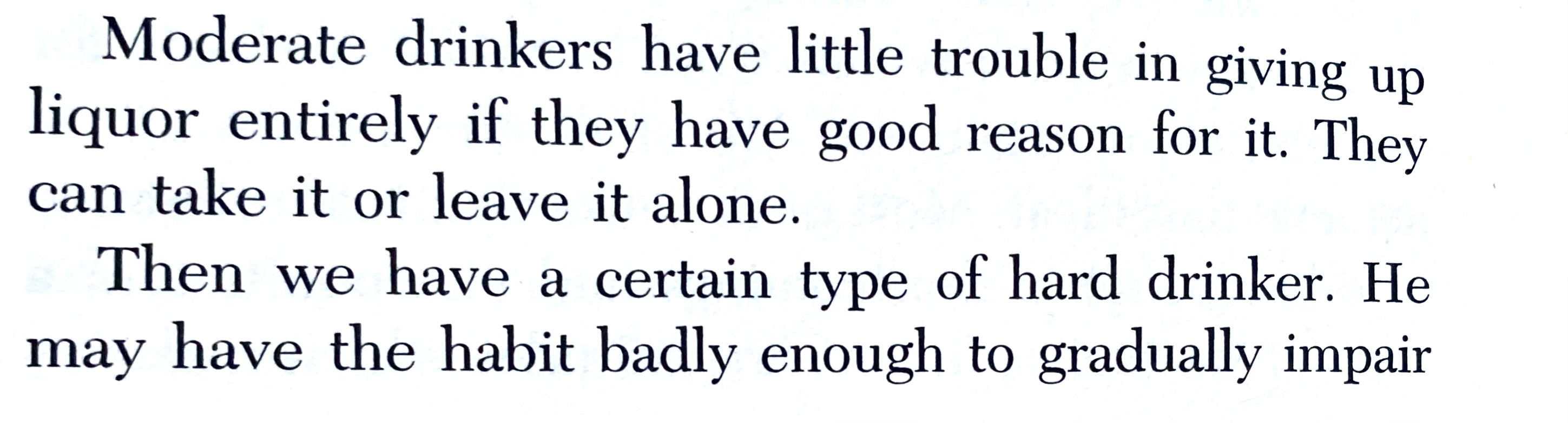
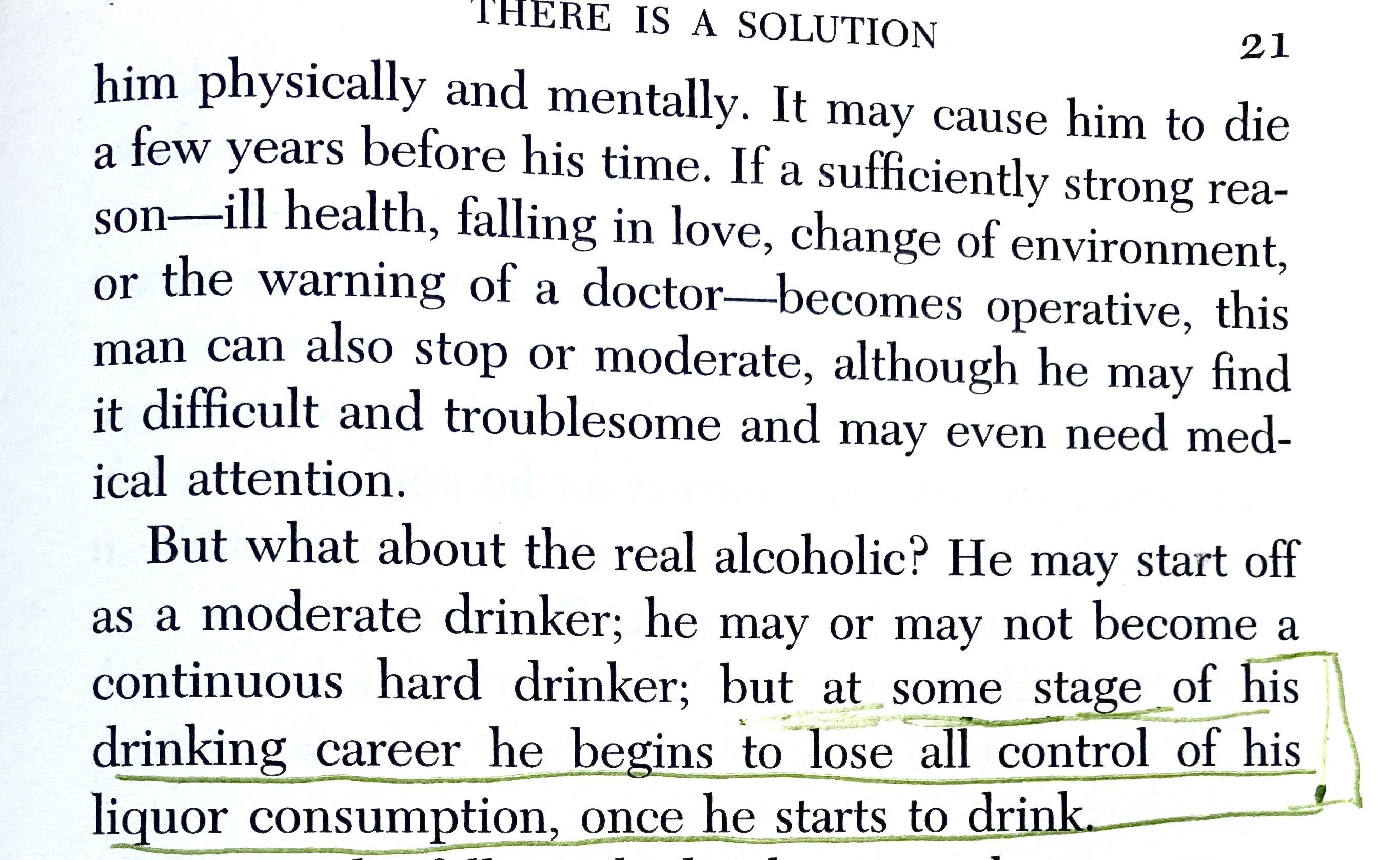


People who refuse to believe a 1939 text can teach them anything do not read the Big Book, so they don’t consider this distinction. In fact, AA is not for moderate drinkers who want to further moderate. It is not for heavy drinkers, either. A heavy drinker may drink their besotted ass off for decades, but once they decide they’re done drinking, they’re done. And, as the 1939 text says, “our hats are off to [them].”

For me, however, and the generations of ancestors on my dad’s side who died young from this thing, there is no willpower strong enough to save us. For me, and maybe for you, as soon as we take even one drink, alcohol becomes our all-out master. As for getting us to take that first drink, the addiction, that rogue part of our brain seeking its goal, is incredibly cunning, baffling, and powerful.

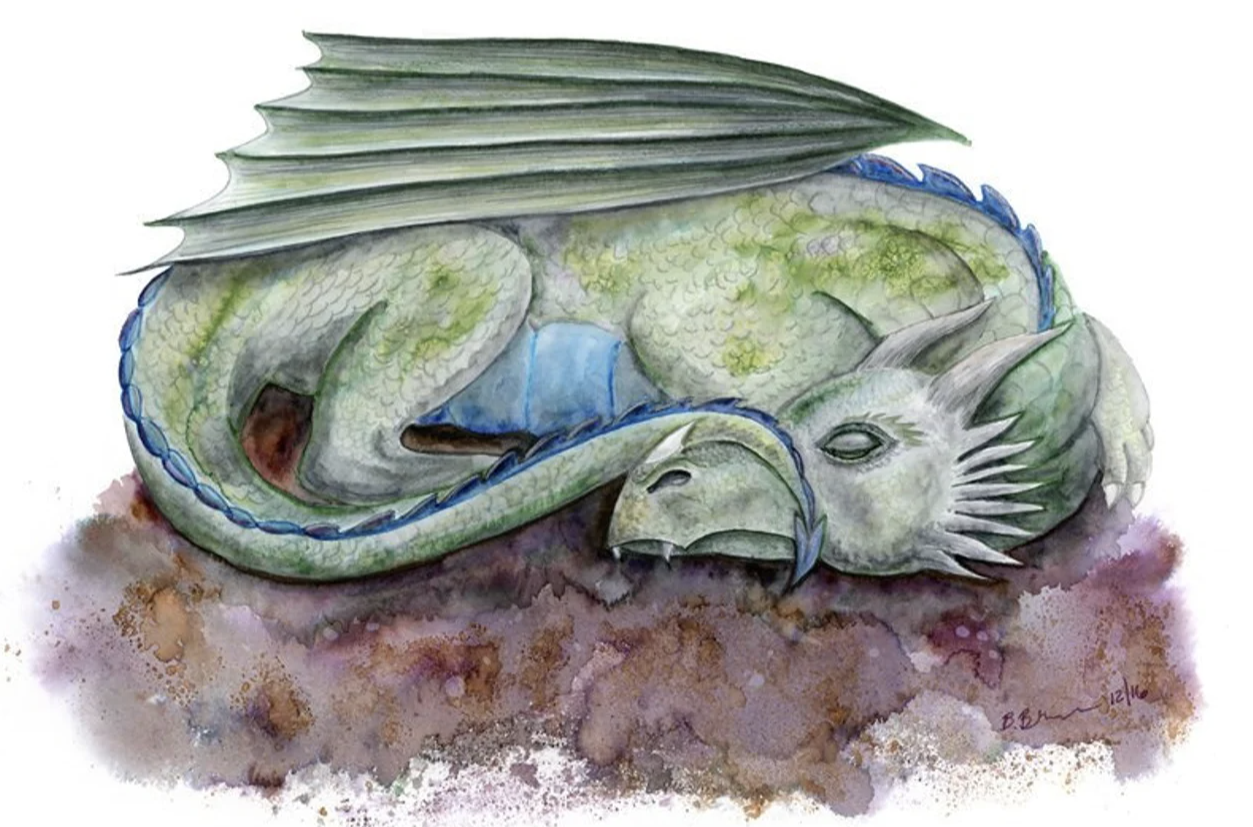
In the case of my ex-boyfriend, dead now from alcoholism, addiction convinced him he could try a beer with tomato juice in it. Another friend thought he could drink vanilla extract. Another went out on kombucha. Another on cough syrup. The list goes on and on. The first drink wakes the sleeping dragon, one way too powerful for our human resources to fight.

AA is for people like that. We know something contrary to consensus reality. We know we have broken brains. 

We also know that asking a higher power for help, opening ourselves to the spirit realm in whatever form we conceive it, can provide the missing power to avoid that first drink. God, source, Gaia, nature, the universe — whatever we want to call it. We ask for support, and we get it. We get it also from our fellows in AA meetings who have had experiences similar to ours.

Which brings me to point 2. I’m coming up on a thousand words here, so I’ll keep this short. But even within this enclave of nonconformists, I am an outlier. Having had a Near-Death Experience that opened me to gobs of paranormal aftereffects that I tried my damndest to dismiss, I know now that we all have spiritual teams. Helping you stay sober, I would say, are your dead loved ones as well as spirit energies in many forms, including angels who’ve hung out with you in various lifetimes and the power nexus of all that is, which I’d call god. 

If that kind of talk falls outside your experience and therefore your beliefs, no problem. But if you’re an alcoholic and point 1 falls outside your beliefs, you’re going to suffer a lot — maybe enough to recast your idea of reality.

.

Leave a comment

Filed under AA, Addiction, Alcoholic relapse, Alcoholics Anonymous, Alcoholism, AUD, Recovery

People Do Die from This Thing

There’s a unique pain in losing someone we love to alcoholism (or any addiction) because it feels like the thing that took them away from us was a cross between insanity, suicide, and disease.

Insanity, because denial is a primary symptom of alcoholism, the loved one remaining fixated on their next drink in the face of clear evidence that it’s killing them. They insist they’re okay, that we’re being overly dramatic in saying they’ll die, that they’ll definitely drink less in the future.

Suicide, because it is they themselves that administer their poison, they themselves who get it and choose to swallow it again and again.

Disease because, to anyone who knows anything about alcoholism, we can see how they perfectly fit the symptomatology that has killed so many, destroyed so many lives, brought about so much unhappiness and desecration of everything inspiring, wise, or respect-worthy in people with the same condition.

AA works because, when we see OUR OWN symptoms replicated in OTHERS, we begin to realize they are symptoms, not lifestyle choices. And if we’re open-minded, we accept that we’re in the grips of something far more powerful than willpower, resolve, or a slew of solemn oaths.

Those of you who’ve been following this blog more than a decade might recall this post from 2015, when I discovered my boyfriend, who I knew had relapsed, was unfaithful. (Duh…) Those having followed since 2023 might recall this post about his death.

This week, I finally finished a video tribute to him. It’s 15 minutes, very personal, pretty woo-woo, and undeniably mushy. No recipe for how to get sober; just a tragic example of what can happen if we don’t. Remember, after retirement (which he’d looked forward to for all his working life), Gerard drank only beer and believed he was safe.

Despite what I know of Al-Anon, my heart still aches whenever I see his last text asking if we could talk. I said no, and I can’t help wondering whether, had I said yes, I could have magically saved him. I said no because A) I was in an AA meeting, B) my sponsor, who is also my Al-Anon sponsor, was sitting right next to me and, just by her expression, indicated talking to a drunk person would help nothing, and C) I knew it would pain me to hear a loved one I’d respected so deeply slurring his words while sloppy drunk.

But what if? What if I’d said the magic words and changed his course?

It helps me to think of his daughter, who, in her mid-20s, flew four times from Virginia out to Seattle, rented cars, and ferried to his home on remote Whidbey Island, trying again and again to get her dad sober. The two of them were close; she was the apple of his eye. Saying goodbye at the end of her last visit, after he’d refused to go back into treatment, she said, “I’m scared this might be the last time I see you.” He waved aside her words saying, “I’m fine.”

I could not have done more than she did. Only his higher power could have. She and I believe that, having binge-drunk from age 11 when his mother suffered a catastrophic stroke, he damaged his brain in a way that made socializing extra stressful. AA meetings were like running a social gamut, so he could accept no help from his fellows.

Alone, he had no brakes, no defense, no way out.

Leave a comment

Filed under Addiction, Afterlife, Alcoholic relapse, Alcoholism, AUD, Denial, Drinking, Near Death Experience

Broken Brain vs. Inspiration: Which do I rely on?

Going to AA meetings and working the 12 steps with a sponsor can transform our lives. But in my experience, having taken the 3rd step involves conceding the fallacies of my own “reflex” thoughts on a daily basis. My mind is still set to certain defaults established in childhood or whenever, and those patterns are frequently, though not always, the first inclinations that come to mind.

Yeah, yeah, as I come up on  30 years’ sobriety (on 1/29), the 11th Step promises have mostly come true. That is, “we find that our thinking will, as time passes, be more and more on the plane of inspiration. We come to rely upon it.” But keep in mind that such reliance is possible only because we’ve made a habit of “ask[ing] God for inspiration, an intuitive thought or decision” (86-7).

In Step 3, I acknowledged that my own brain, when detached from god, is busted. Let’s remember where my own best thinking and determination to seek happiness and thrive on my own terms led me again and again: incomprehensible demoralization, deep despair, and suicidal ideation. Drinking was only one of many great ideas my thinking espoused for how to best navigate life. And it’s STILL busted, my brain. What I’ve “come to rely upon” is guidance from a higher power, not my ego-tainted perspective.

So here I am on my beautiful 5 acres in rural Oregon. Everything my angel foretold has come to pass. Somehow, my city house sold in three weeks – for less than I’d wanted, but within 24 hours of the deadline set in my contingency offer. Naïve about closing costs, I found myself many thousands short of the new house price, but my mother’s estate, which had been hung up in probate for over a year, came through 6 hours before I’d have lost the new house.  These are little miracles. In other words, I’m pretty sure I’m where I’m supposed to be, but by none of my own doing — other than moving ahead in faith.

Those of you who’ve moved after age 50 know this shock of not knowing where you are. My mental map of Seattle was incredibly detailed; here, I knew the way from my home to the store, beach, and a few trails.

But that’s where Step 3 comes in. For vague reasons, I felt hesitant to show up at any new AA meetings. I would look them up online, even put them on my calendar with great resolve, but once it got pitch dark out – and I do mean pitch dark – I’d be scared to leave my cozy little house. So I didn’t go to meetings for a month. Not even Zoom ones.


ISOLATING. That’s what I was doing, with my 2 cute dogs, a fireplace, deer outside the window, and coyotes and raccoons I’d sent packing, while I threw myself into UN-packing, putting off AA always just one more week. By grace, I knew this was my alcoholic brain’s will for me, not god’s direction for growth. Meanwhile, my addiction was rubbing its evil hands together in anticipation of a relapse.

So I did what I could: I called a friend from my old home group and confessed all the above. She made me promise I’d go to an AA meeting the next day, so I promised. Then I broke that promise… because yada, yada. But after she texted me, DID YOU GO?? and I had to sheepishly reply NO, my ego, I suppose, got prodded from the other side. I’m supposed to be all wise and shit, but here I was acting like a backassward chickenshit. So the next week, I set out in utter darkness and sheets of rain, relying solely on my high-beams and GPS to get me somewhere. Eight miles later, I walked into a cozy room with a fireplace, Christmas tree, and cushy chairs filled by six fellow alcoholics.

I was home. I was safe. And before I even spoke a word, I was loved.

I thought, “Of course! Of course! How could I have been so timid, so stupid, so gullible as to isolate for over a month?!” But I also knew: fear had taken me offline. Fear had slid me backward into my own reflexes. Louisa’s broken brain had been telling me that staying home alone was playing it safe.  It was wrong — as always.

Well, those alcoholics had me download an AA app very that night and recommended three more meetings nearby. I started going, meeting more alcoholics, making new friends, being of service, even going out for coffee! My routine now is three AA and one Al-Anon meeting per week, all in person. For my 30th sobriety birthday, a woman I’d never laid eyes on in November is bringing a homemade carrot cake for the celebration, and everyone’s excited for me.

What’s more, these people possess a mosaic of experiences that mirror everything I’m struggling through. They remember being new here, wanting to isolate, feeling baffled by power outages, wells, and septic systems, and many feel shocked to find themselves at various thresholds of old age. Not only have they told me about gym facilities, parks, trails, garden clubs, community email, and less expensive stores, but at every meeting I hear profound insights that allay my fears and enrich my experience of living.


Pick one.

Whenever I don’t WANT a new sponsee, don’t WANT to drive someone to a meeting, or chair one, or stay after to break down the room, etc., god’s inspiration reminds me how I didn’t WANT to go to AA in the first place, didn’t WANT to get a sponsor, REALLY didn’t WANT to throughly work steps 4 through 9, or to change “everything” about my approach to living. But going against my own thinking has brought me a joyous life I could never have built myself. Day by day, I can either screw it all up by trusting my defaults, or reach beyond them to continue on this amazing spiritual path toward new adventures.


PS: Just for fun…  Deer and coyote from inside my house.


4 Comments

Filed under AA, AA fellowship, Alcoholic relapse, Alcoholics Anonymous, Happiness, Meetings, Recovery, Step 3

Why do Sober Alcoholics Relapse? How can we not?

Recently a visitor to my AA homegoup shared that at 19 years sober, he’d joined coworkers at a business conference and, since cocktails were free and everyone at his table was ordering, decided to have just one. Six long years later, after losing his job, destroying his marriage, impairing his health, and

Sleeping Dragon

Alcoholism only sleeps; 1 drink awakens it

having scrabbled at the brink of sobriety in baffled despair as he fell back again and again into drunkenness, he somehow made it back. Sober again four years as he spoke to us, he’d gained a profound respect for the insanity of alcoholism. 

Why does this happen? How can we avoid it?

I myself have never relapsed since my first AA meeting on January 29, 1995, so I cannot speak directly to the inner experience of deciding to drink. Instead, I asked a friend in my homegroup who knows the cycle well to offer you guys some insights. Here is Clark’s story. He left out the trauma of his childhood with a Vietnam vet step-father, but trust me, there was plenty.

“I got my second DUI in back 1982 when I was 19, but I really didn’t want to be sober. I was court ordered to go to AA, so I gave it a half-hearted try, but I wasn’t willing to follow directions. Both my mom and sister were in the program, but I’m incredibly stubborn. I thought, ‘AA is for weak people.’

“By my late 20s, I was making great money. I had a wife and kids, a lakefront home, a speedboat, a Harley, all sorts of toys — and all of it felt meaningless. I was miserable and wanted to kill myself. Booze had quit working. My cousin and best friend were doing heroin, though, so I thought, I’ll try that! In a way, it saved my life; heroin kept me from killing myself; but it also took my addictions to a new level.

“I’ve never officially counted how many times I’ve relapsed, but I’d guess about 20. Every time I was in pain or something bad happened, I’d run back to AA because deep down I knew that was the solution. But again, I wouldn’t follow directions. In 1986 I found crack cocaine, and it completely destroyed my life. I checked myself into treatment and stayed sober about 3 months, but my wife gave me a hard time about being away from home for meetings.

“The main recurring theme of my relapses has been that I forget. I forget how bad things got, and I remember the good times — ’cause there were good times. In 1990, I’d left my wife, stayed up all night smoking crack with a girl I knew from high school, and to get money for more crack we decided to rob a gas station. After I eventually got caught, I went back to AA to avoid jail time. That time, I stayed sober about 6 months, and it was some of my best sobriety up to that point. I actually got a sponsor and cracked open the [Big] Book. But then I met a girl in AA, we were both new, and we got drunk.

“In 1997, I started selling crack myself, but pretty soon I became my own best customer, and before long I ended up in prison. I got clean with my second wife, until she died at 26 giving birth to our daughter. After that, I didn’t even try to get sober for years. I just had too much pain.

“Still, the cycle kept repeating. One thing about relapse, with me anyway: it starts days before I actually take a drink or drug. My thinking gets bad, I’m frustrated about something, in some kind of pain. I wasn’t good at reaching out to people, so I’d convince myself that THIS TIME, things were going to be different! I’d manage it. I’d control it. I’d keep it to weekends.

“This last time, I had a cocaine-induced heart attack, went to the ER, got shocked back to life 6 times, and stayed in a coma for 2 weeks. My poor sister, who is not religious at all, went to the [low-bottom AA hall] and asked them to pray for me. I came out of the coma, but within 2 weeks I was back to drinking and smoking crack. Right about then I got a pretty sizable inheritance, so I proceeded to smoke it — about $500 worth every day. I wanted another heart attack. Dying, I’d not gone to the light, but to a darkness completely painless, and I wanted that again.

“I’d wake up mornings feeling I absolutely could not stand another day. The book talks about ‘the jumping off point’ when we can’t imagine life with or without alcohol. I saw a choice between getting sober and dying, and I chose dying — because I didn’t think I could get sober. I’d tried so many times and failed. I never left my place except to meet the drug dealer in the driveway or to get cash at 7-11. I wasn’t showering; I wasn’t eating. I was a wreck, utterly isolated and alone.

“But… my sister kept coming over. She has 38 years, and we’d always been close. She had me write a will; she made me write a letter to each of my children to explain why I was dying. I could see the pain in her eyes. And I decided, for her sake, I’d give this thing one more try.

“Thank god, two or three days later, it dawned on me that I’d never given AA a fair shot. There’s that line in ‘How it Works’: Those who do not recover are people who cannot or will not completely give themselves to this simple program… That was me. Every time, I’d do a little bit of this and a little bit of that, I’d grudgingly drag myself to 2 or 3 meetings a week, but I’d never given it the whole deal. And this time, I decided to give it the whole deal. And it’s been the difference of night and day.

“I went to 2 or 3 meetings a day for 16 months. After about 90 days, my brain began to clear, and I decided I was going to pray, I was going to get sponsor, and I was going to work the 12 steps out of the book with him. And I did all those things. I’ve prayed every day since. I can’t point to one of those three things because I think they’re all integral, but my life has changed because of that decision. I’m so grateful for what I have today that I keep doing those three things. People I’d known in AA for over 40 years, they always welcomed me back. Given a choice, I wouldn’t pick me as a friend because I was so slippery. But they were always there for me.

Port Angeles

“Today at 2 years and one month sober, my life is completely different. I just got back from an AA Roundup in Port Angeles, and I loved it! I went to meetings, fellowshipped with friends, went out to dinner, walked on the beach. It’s a blast. I’m still kind of shy about making new friends, but I feel I belong.

“I never had a higher power before, but praying and really listening in meetings to how other people were approaching the higher power thing, that opened the door. I have some decidedly un-Christian views (pro-choice, pro-gay rights, etc.) but I’ve found a liberal church where I’m welcome and we don’t talk about those things. Prayer centers me.

“If someone wants to get well, I would say, ‘Give yourself to AA completely. Do the work laid out in the 12 steps.’ Not in your first week! But you can’t keep putting it off, either — working the steps with a good sponsor to the best of your ability.

“My happiness and equanimity are at a level I’ve never had in my life. Ever! I have so much gratitude. Finally being done, having a life that is manageable, friends who care about me, being able to look at myself in the mirror, not feeling like a piece of shit, sleeping good every night. I have a life today that I never could have imagined. I still go to a meeting every day, sometimes two. I walk my little dog — she loves me. I’ve steered away from relationships so far, but I figure when I’m ready, God will give me one.

“Every day is an amazing journey.” ❤

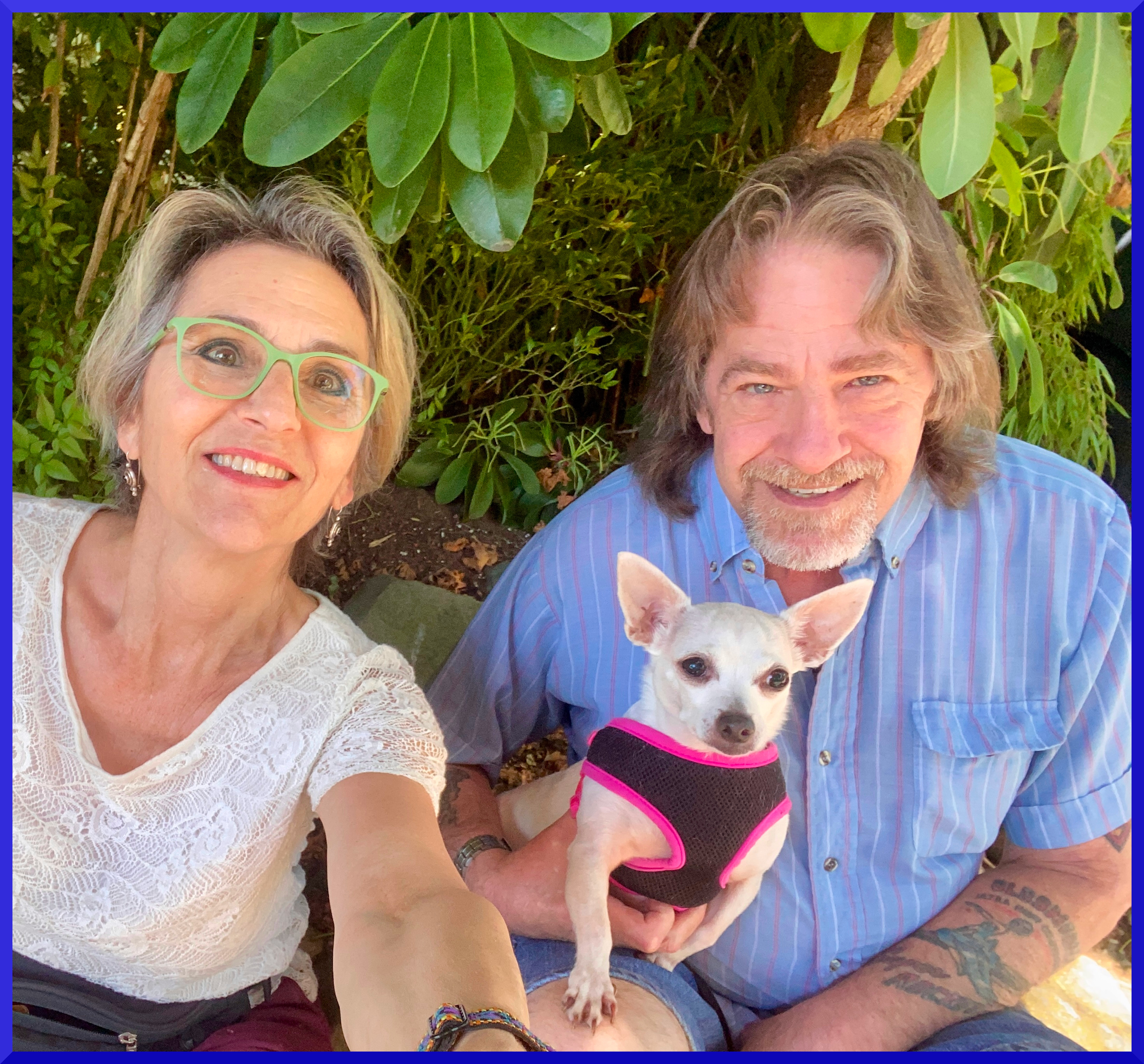
Me, Sweet Pea, and Clark

1 Comment

Filed under AA, Addiction, Alcoholic relapse, Alcoholics Anonymous, Alcoholism, Drug relapse, Recovery