A nice woman came to my AA homegroup a while back – let’s say maybe late 50s, thin grey hair parted down the middle. She’d first attended a few months earlier, then suffered a “slip,” and now she was back. During that first meeting, she’d told us about the ending up in a hospital and the horrid embarrassment of asking loved ones to help remove the huge pile of empties outside her house.
Then she stopped coming. I live in a small town now, so during her “slip” I heard gossip about her escapades at the local tavern — the same stuff I used to do 31 years ago.
Now here she was back at my homegroup and just incensed. The loved ones were secretly checking up on her! The nerve! She’d caught them at it here and also there, lurking in their cars. And that place where she’d detoxed, they were urging her to attend outpatient treatment twice a week. She didn’t need outpatient, any more than she needed checking on. She was done with drinking. She’d learned her lesson.
That was a couple of months ago, and I don’t know what’s become of this person. What I do know is this: she was not sane at that last meeting, claiming she was done with drinking but failing to grasp that drinking was not done with her. Countless vain attempts had proved she could not control her drinking with willpower, yet she believed the very thing that had failed her all her life was now suddenly going to work.
Consensus reality is defined as “the generally agreed-upon version of reality within a community or society.” There’s another term, conditioned reality, meaning a concept of reality arrived at through social and educational conditioning. Objective reality, as many philosophers have pointed out, is entirely unavailable to us. We have only experiential reality, which is by nature subjective. But when enough subjects agree that their subjective experiences coincide, we collectively subscribe to that common view as seeming objective.
There are two points where I break with consensus reality in the U.S.:
- the conviction that any person can overcome alcohol addiction the same way they might any other bad habit, and
- the notion that ghosts, spirits, angels, and demons do not exist, any more than god itself does.
I’m going to talk mainly about point 1, but also a bit about 2. My subjective experience contradicts both, and I’ve found communities for both, where enough of us agree to form our own consensual reality.
To buck society’s consensus is a big no-no. These beliefs form the foundation of all social constructs, so nobody wants to look at the idea that the foundation itself is a construct. We punish outliers by labeling them crazy and stupid. I do this, too. For instance, I consider flat-earthers both crazy and stupid, though I myself have never viewed the Earth from space. I nevertheless share firmly in the larger consensus that it’s a globe.
Applying this concept to alcoholism, it makes conventional sense that when someone makes up their mind to NOT do something, as the 50-some visitor to my homegroup had done, they can follow through. These days, lots of online influencers and for-profit organizations are pushing the idea that Alcohol Use Disorder is no different from a tendency to overeat, overshop, hoard, smoke, avoid exercise, or any other bad-for-you habit (in fact, many of these can become addictions also). If you just make up your mind and start a new practice, you can overcome it.
However, the first 100 AA members, through shared experience, developed a DIFFERENT consensual reality — one that flies in the face of the mainstream consensus. They defined 3 distinct “classes” of drinkers.
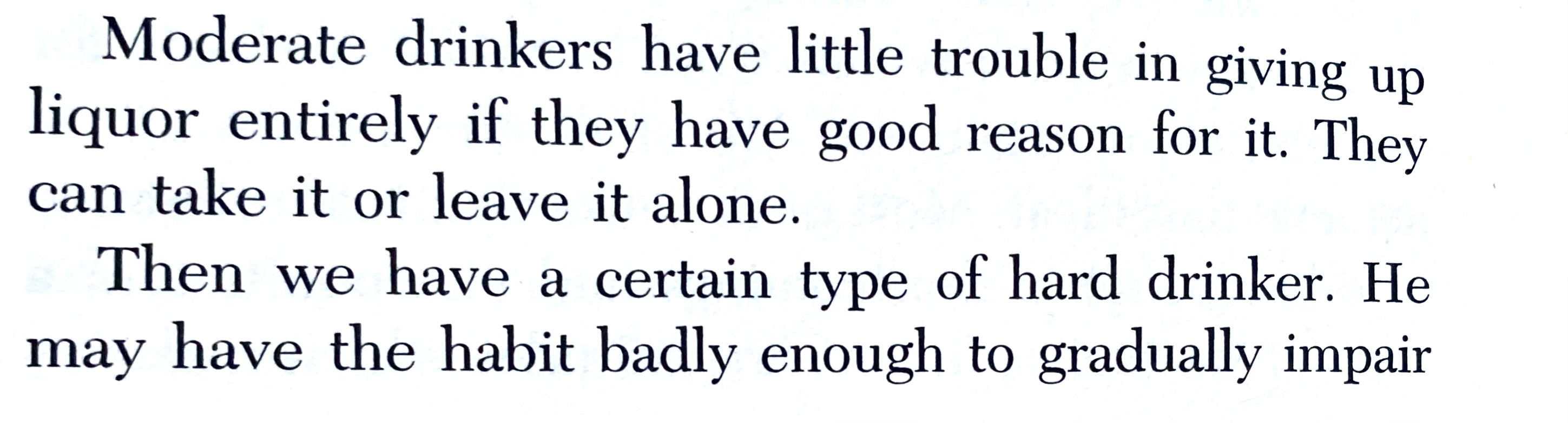
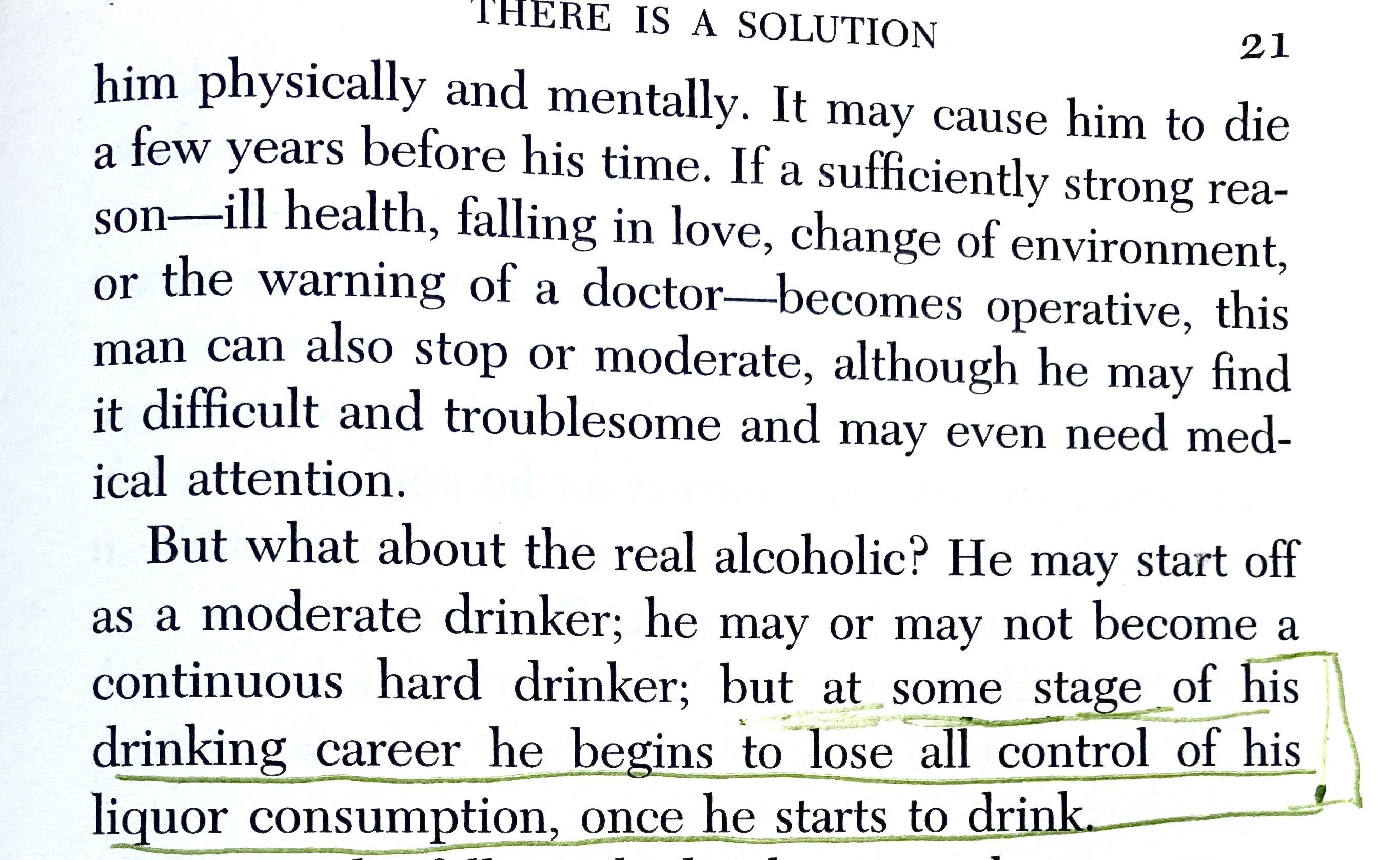
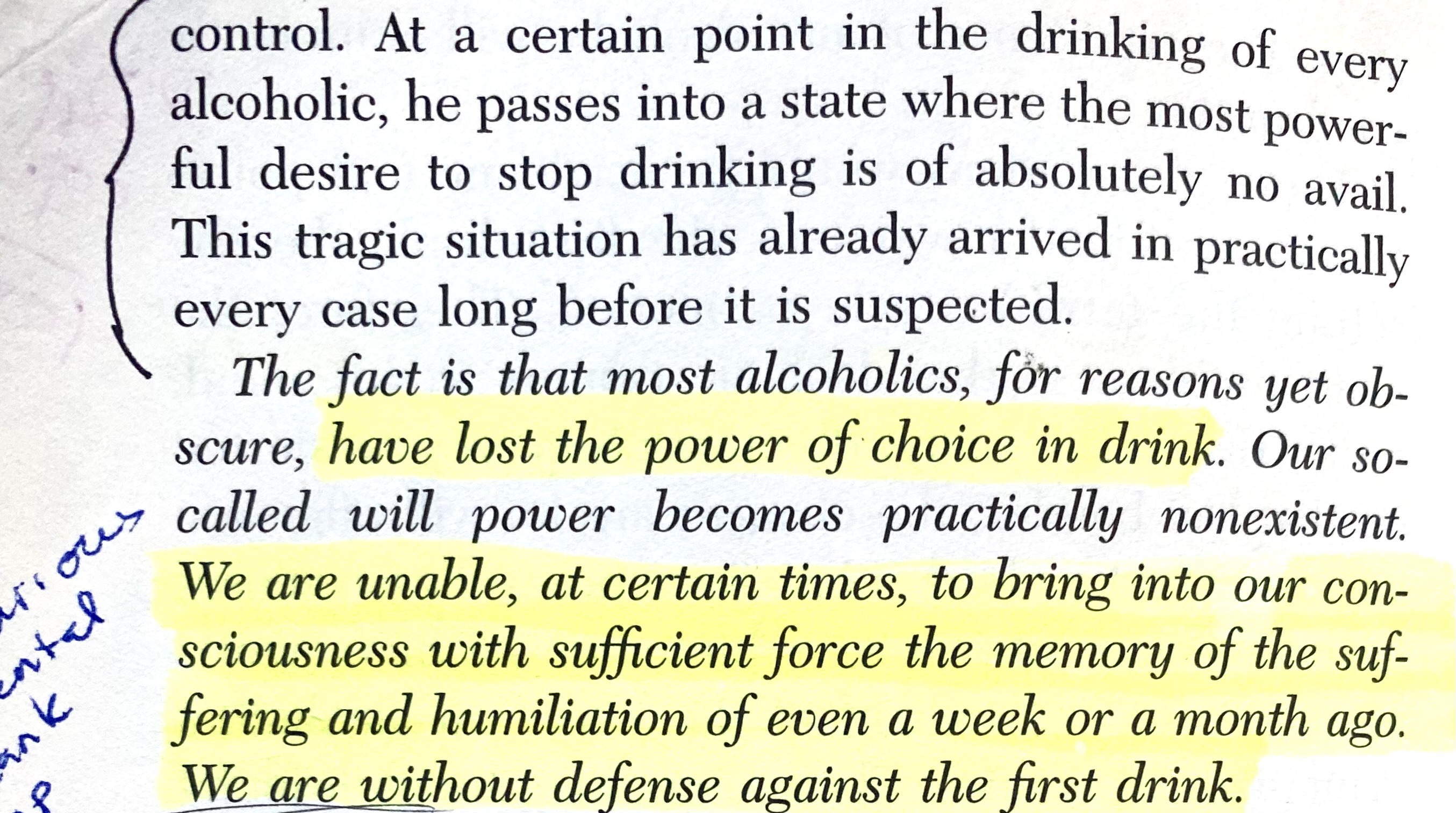
People who refuse to believe a 1939 text can teach them anything do not read the Big Book, so they don’t consider this distinction. In fact, AA is not for moderate drinkers who want to further moderate. It is not for heavy drinkers, either. A heavy drinker may drink their besotted ass off for decades, but once they decide they’re done drinking, they’re done. And, as the 1939 text says, “our hats are off to [them].”
For me, however, and the generations of ancestors on my dad’s side who died young from this thing, there is no willpower strong enough to save us. For me, and maybe for you, as soon as we take even one drink, alcohol becomes our all-out master. As for getting us to take that first drink, the addiction, that rogue part of our brain seeking its goal, is incredibly cunning, baffling, and powerful.

In the case of my ex-boyfriend, dead now from alcoholism, addiction convinced him he could try a beer with tomato juice in it. Another friend thought he could drink vanilla extract. Another went out on kombucha. Another on cough syrup. The list goes on and on. The first drink wakes the sleeping dragon, one way too powerful for our human resources to fight.
AA is for people like that. We know something contrary to consensus reality. We know we have broken brains.
We also know that asking a higher power for help, opening ourselves to the spirit realm in whatever form we conceive it, can provide the missing power to avoid that first drink. God, source, Gaia, nature, the universe — whatever we want to call it. We ask for support, and we get it. We get it also from our fellows in AA meetings who have had experiences similar to ours.
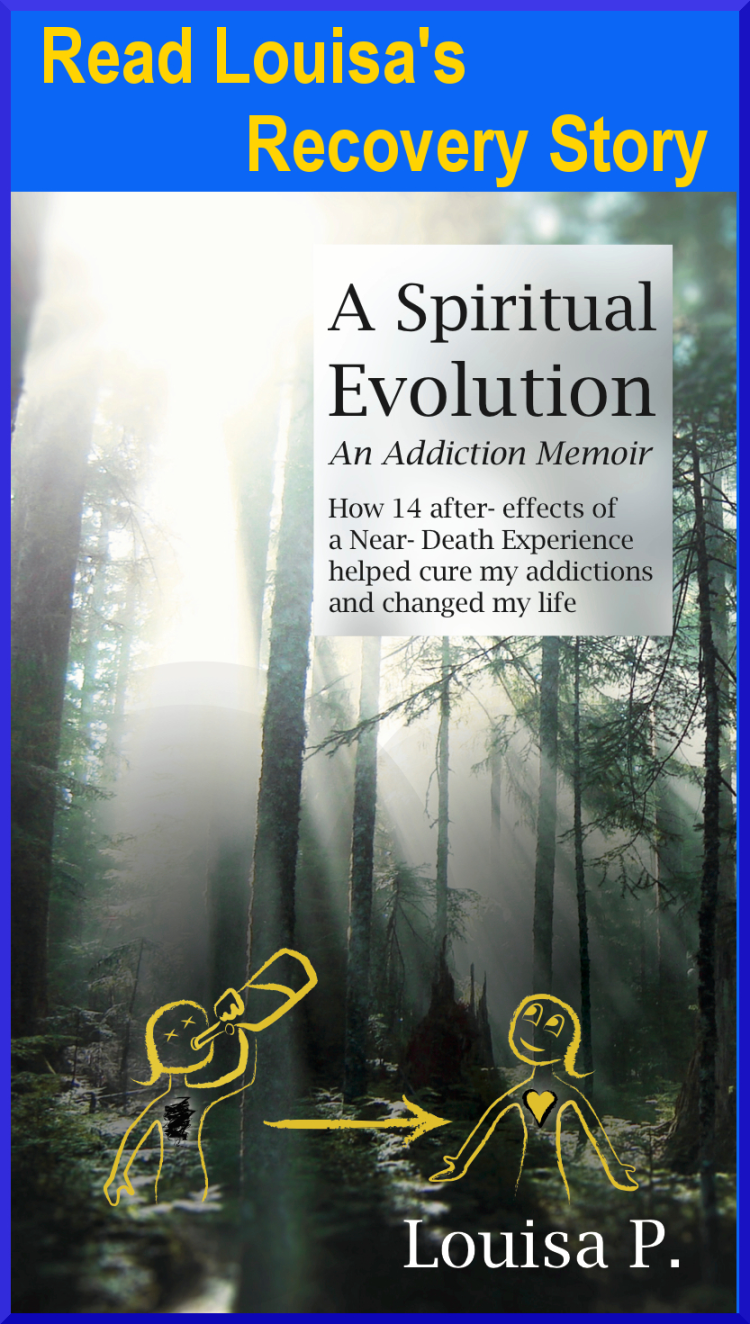
Which brings me to point 2. I’m coming up on a thousand words here, so I’ll keep this short. But even within this enclave of nonconformists, I am an outlier. Having had a Near-Death Experience that opened me to gobs of paranormal aftereffects that I tried my damndest to dismiss, I know now that we all have spiritual teams. Helping you stay sober, I would say, are your dead loved ones as well as spirit energies in many forms, including angels who’ve hung out with you in various lifetimes and the power nexus of all that is, which I’d call god.
If that kind of talk falls outside your experience and therefore your beliefs, no problem. But if you’re an alcoholic and point 1 falls outside your beliefs, you’re going to suffer a lot — maybe enough to recast your idea of reality.
.