Category Archives: Twelve Steps

Like me, like me (!): Neediness vs. god

Leaving an event recently, in the parking I saw the most charismatic (gay) guy from the group chatting with a woman who wasn’t me, and I became filled with jealousy.  Not romantic jealousy; like-me jealousy.  I thought: “He thinks she’s special! He thinks I’m boring!  Dammit!!  How can I make him like me?!  What if I…”

Then — because for 22 frickin’ years I’ve been working a program — I flagged my own attention, informed myself I was temporarily insane, got in my frickin-ass car and drove off.

Really, ego?!” I thought, driving.  “Will you never stop this shit?  It’s older than high school, older than one of Mary Ann’s banana cream pies in the face–but you keep on!”  I resolved to not care.

But it was hard.  I still felt mad at the woman for “winning,” mad to be denied the fix I wanted — that big fat hit of dopamine from feeling liked and appreciated by someone who “counts” (because, as we all know, that shit is DOPE) — but at the same time, mad at my ego for leading me back into this dumb game of hungering parasitically for worth.

Okay, I’m human, a social primate.  I have instincts around “belonging” deeply linked to survival.  That’s normal.  We all need to have friends, feel loved, etc..

But as a recovering alcoholic/ love addict, I still have needy ego that can wreak havoc with instincts and gratification. When I used to guzzle alcohol and whip up huge love-addiction crushes, I’d  take frickin’ baths in the imagined admiration of whomever I’d idolized.

When the magic one liked me, my brain would release these motherload hits of dopamine and endorphins — which I experienced as a thrilling glow of self-worth and delicious excitement — from what I imagined that magical person thought about me. The “good stuff” seemed to come from that person, though in reality it came from my brain’s model of their favorable impressions of me.  In other words, it was my brain triggering my brain to flood itself with feel-good neurotransmitters — meaning I gave myself permission to get internally high as a kite.

People, that’s not love.  That’s not even admiration.  If we want to be nice, we can call it codependent self-worth; and if we want to be harsh, we can call it projected narcissism.

Either way, this is a totally ass-backward way of living.  It’s
parasitic and delusional.  The trouble is, because I grew up in an alcoholic home, that’s how my brain is wired!  Because the supply of affection waxed and waned depending on whether my parents were drunk or hungover, and because I assumed the variable was, not the presence of absence of a drug, but me, I developed a core, bone-deep belief that I had to perform to win love — which does not serve me now that I’m a sober adult.

Here are the steps not to take:

Step 1: Elevate someone.  Decide they’re “cool.”  Make them larger than life, overflowing with charisma.  Now (sweet!) you have a stash to chase: their “good stuff.”

Step 2: Chase the “good stuff.”  If the attraction is sexual, try like hell to seduce them.  If it’s social, show off how fuckin’ exciting and funny you are.  If it’s business, find ways to impress them with your amazing knack for getting shit done.

Outcome: You’ve whored out your worth.  Even when you seem to win, you’ve lost.  Regardless of whether you’ve come off as hoped, someone else holds the keys to your human value.  Your dignity is in the goddam toilet.

What’s the alternative?  Here I go again!  It’s god.

When I say god, I mean not only a connection to the energy of life, but all the shifts in ways of living and thinking that connection brings about — if it’s real.  The whole purpose of the 12 Steps is to help us achieve a psychic change (p. xxix) that will reverse the direction of our “flow.” We go from being black holes of neediness, trying to suck okayness out of people, places, & things, to becoming more and more a channel or outlet of the warmth and energy loaned to us by our higher power: unconditional love.

The 12 steps to this change are in our Big Book, but here’s a quick-check version:

Step 1: Seek humility.  Give up the fuck up chasing anyone or anything.  Let be.  Hurt if you’re hurting. Mourn if you’re lost.  But acknowledge that you are powerless over people, places, & things.  Only one source can you count on: your higher power’s Love for your simple, confused, inherent goodness.

Step 2: Love with intention.  Forgive.  Practice gratitude (loving your life and nurturing your little inner garden).  Embrace yourself with all your flaws and look for ways this admittedly flawed self can do good, help others, and “pack [more] into the stream of life.”

Outcome: A worthiness built from the ground up.  You and god know your worth.  No one else needs to.  You slowly grow self esteem from doing estimable acts.

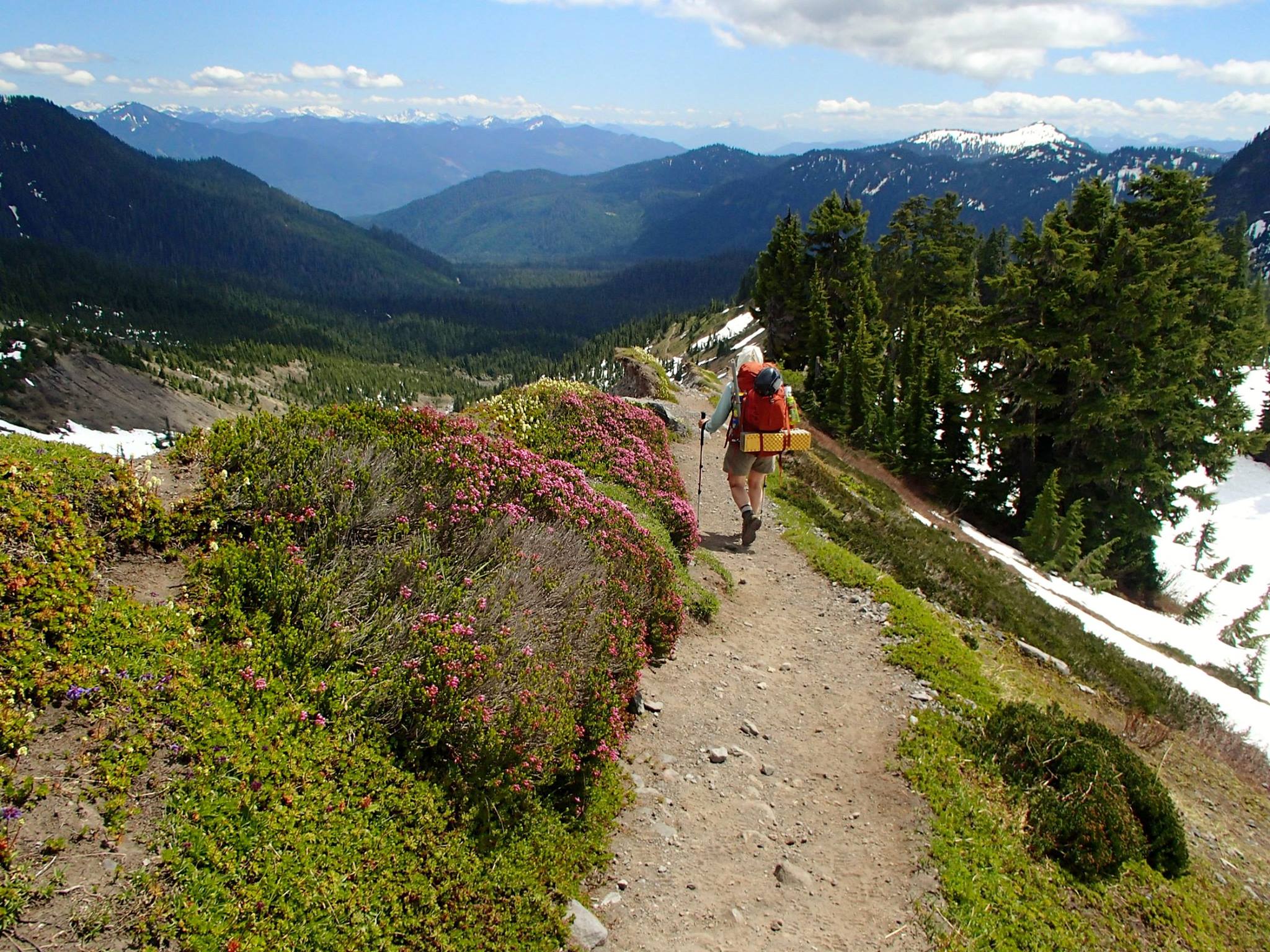
I just can’t say enough about the freedom of humility.  Dude.  Whenever I hike in the wilderness for a week or so, the inner gem I polish is humility — to understand I am just a critter.  I need to drink & eat and pee & shit.  I need to stay warm in my little nest for the night.  I get to laugh with my friend and witness god in a wealth of meadows, forests, and towering peaks.  I GET TO live!  That is wisdom.

When I come back to city life, hanging on to that same humility gets tricky, but I can still try.  I talk & listen and think stuff’s important & screw up.  I can glimpse god in the vulnerable humanness of friends and strangers, all of us trying to feel okay.  I GET TO love!  That is spirituality.

Near Death Experiencers (people revived from death who bring back memories) frequently report having been shown a representation of the spiritual connections uniting all living beings.  They perceived countless “golden threads” or “beams of light” interconnecting our hearts.  The bottom line, they’re told, is that we’re each a unique expression of the same god/life energy, like countless leaves on a huge tree, or countless cells in a single leaf.

No one is higher.  No one is lower.  All depend on each other, on the whole, which is god.  I’ll never forget how my first sponsor wrapped up my first major 4th step 20 years ago.  Alongside my character defects, she drew a No-Stepladder symbol.  As she put it, “Whenever you want to rank people, think of the night sky.  You may gravitate toward one constellation more than another — sure.  But you can’t rank the stars.”

1 Comment

Filed under AA, Codependence, Near Death Experience, Recovery, Self-worth, Sobriety, Twelve Steps

Of Mountains and Miracles

I come from a long line of alcoholics, pioneers and midwives and professors who knew they didn’t want to drink as much as they did, yet were sucked down into the bottle time and time again.  I’m cut from the same cloth but haven’t had a drink for twenty-two years.  What’s up with that?

When I used to dry out between binges I was an insecure, socially phobic, jealous, frightened, depressed woman who would pretend to be whatever might impress you.  Anticipating drinks brought me hope.  Starting to drink steadied me.  Rolling through drinks, I found courage and gusto and release — sweet release! — in the dopamine flooding my neurons. Some day, I’d pull off great feats!

At first, sobriety robbed me of a desperately needed escape. I’ll never forget a certain unremarkable morning in ’95.  I’d been dry about six months without a spiritual program.  My partner was driving us along a curving freeway ramp while some implacable panic rose higher and higher in my chest with every breath I took and every random object that struck my brittle brain — building, guard rail, pavement, cars.

I thought-screamed, I CAN’T STAND IT!!!!!

But today, I flourish.  My brain is happy, and I’m living a life I love.  What’s up with that?

Here’s me day before yesterday:

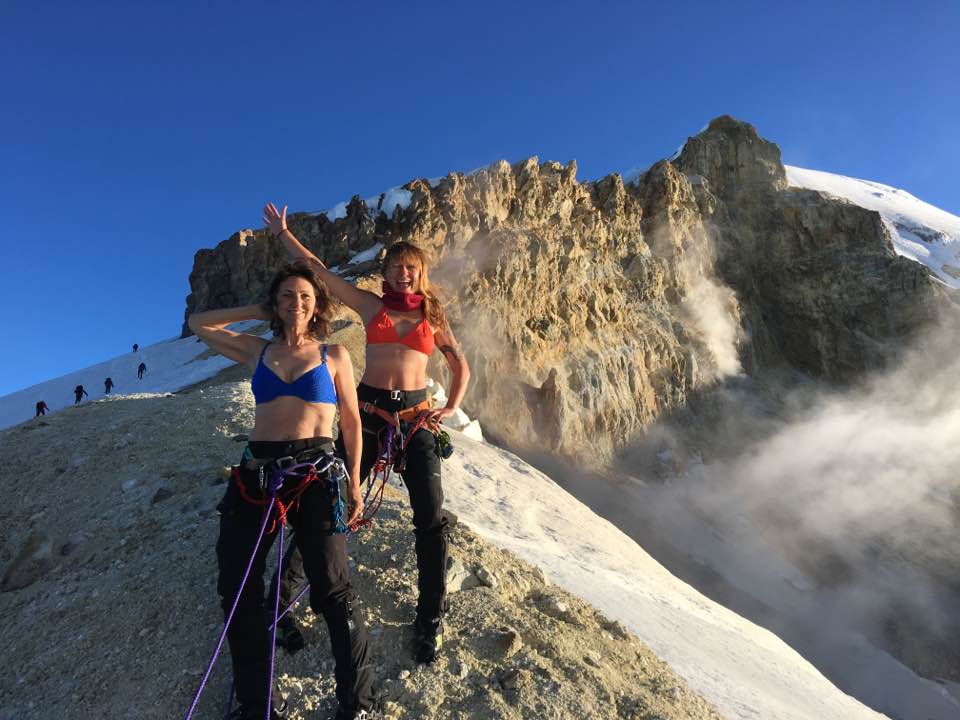
Crater of Mount Baker at dawn

.

I’m on the right.  This is a photo of a frickin’ miracle.  I’ve recently turned 57.  I’m standing at 9,800 feet at 5:00 a.m. beside the hissing, venting crater of a live volcano with my best friend wearing frickin’ bikini tops in temperatures close to freezing.  We are… the Baker Birthday Bikini Bitches!

I got here through hard work.  The work of healing a broken brain and twisted psyche is extensive, yet all compacted down into 12 simple, trite little steps listed in Chapter 5 of AA’s Big Book — steps I dismissed as worthless at my first AA meeting after reading them off the wall in less than a minute.

It takes a good sponsor, one “armed with the facts” about him/herself, to unpack those steps and open up each like one of those expandable sphere toys so that the sponsee is confronted again and again with the challenge of either seeking greater honesty or cycling through their tired lies again.

I’ve worked these steps not once, not twice, but through enough iterations that their perspective has become the lens through which I view everyday life.  To express that in detail, I’ve surrendered all illusions that I can drink normally (1); I recognize that alone my thinking is warped (2); I ask god to guide it minute by minute (3); I seek out the selfish distortions in my interpretations of people, places, and things (4); I tell on myself to trusted others, increasingly with humor (5), and pray for the clarity to quit thinking/acting that way (6-7).  If I’ve offended, I own it and amend it (8-10), because I want to meet my god without defenses every day (11) so I can be useful to others (12).  That is how I effing live.

How does that get me up the mountain?

There is something.  You can call it whatever you like.  Currents of energy course through and radiate from everything that lives, and their frequency is affected by each loving or fear-based thought that every one of us generates from one moment to the next.  And those currents converge in some nexus of intelligence that loves far beyond our brains’ comprehension and yet is not beyond us, because we are of it.  We are a shard, a fragment, a ray of that immensity, and when we ask, it resonates within us, filling what was empty, healing what was hurt.

The kicker is that condition: when we ask.

And we can’t ask just once — like for a piece of gum or something: “Hey, god, this deal sucks, can ya help me out?”  Nope.  We ask in layer upon layer upon layer.  We ask every frickin’ day, in everything we do: “Help me.  Be with me.  Move my heart and mind toward goodness and beauty.”

And if we do this long enough and sincerely enough, do you know what happens?

CRAZY SHIT.

So many miracles, I don’t know where to begin!  Living by the 12 Steps has brought me to a place where I can be my authentic self among worthy others and trust that I am loved.

Daily honesty with god has given me the mindset to become the person I longed to be — to quit smoking, stop over-eating, cease tolerating abuse; to pay the bills and provide for my kid; to really get it that, if something’s going to improve in my life, I have to try for it (a lot easier when you know god’s there to catch you).

Humility has let me accept that if I want to do something immense, like climbing a mountain or writing a memoir or opening a business, I have to start with measly, pathetic little steps… and keep at it.

And beautiful things unfold as a result.  Here we are again from a different angle.

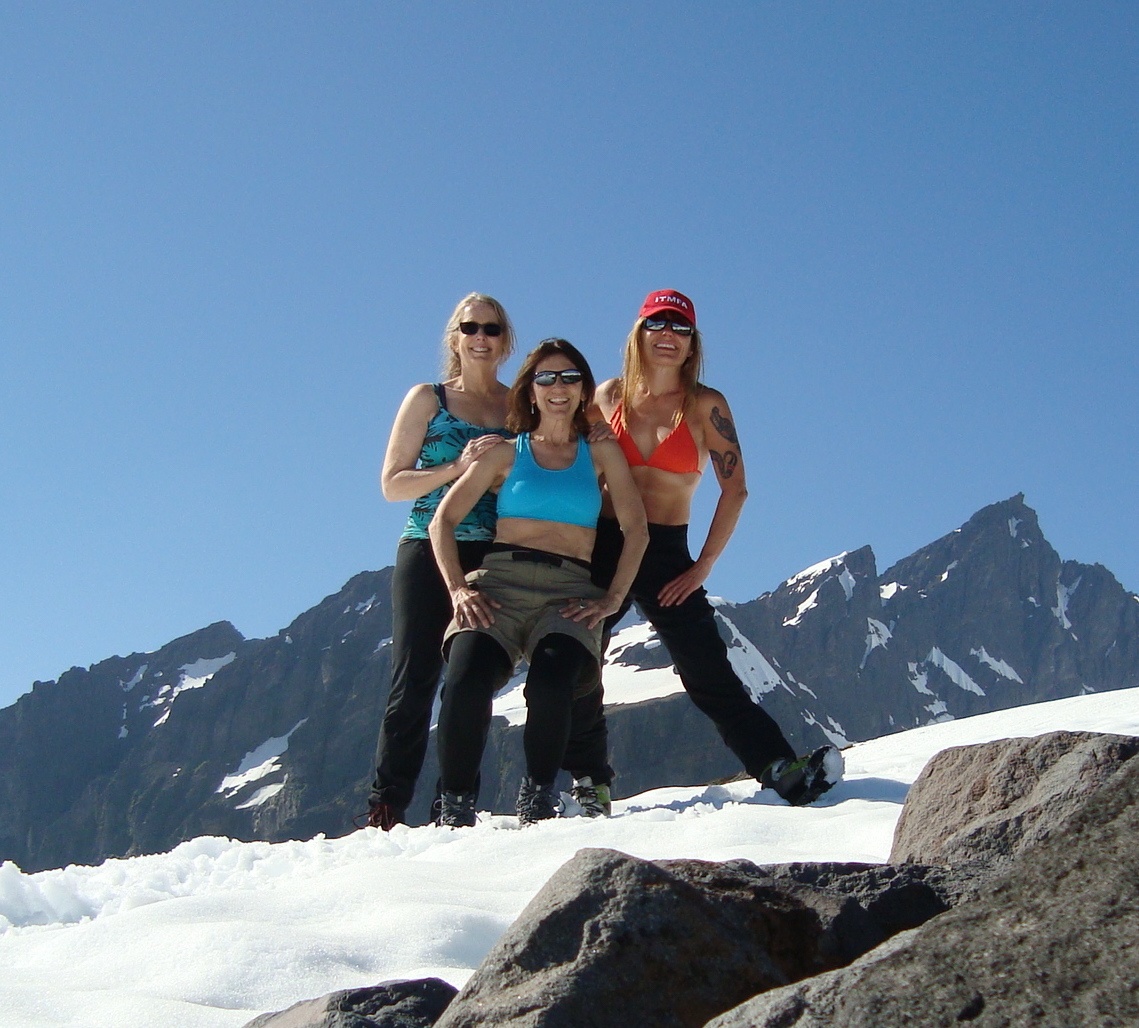
Bikini bitches! (click to enlarge)

.

Are we in good shape?  Sure.  But this photo doesn’t show what’s really there: the strength of LOVE.  The love between my friend and me lets us speak of anything — anything! — and frees us to laugh about much of it.  I know of my friend’s horrific childhood and years of cocaine addiction.  She knows the compulsions that warped my past.

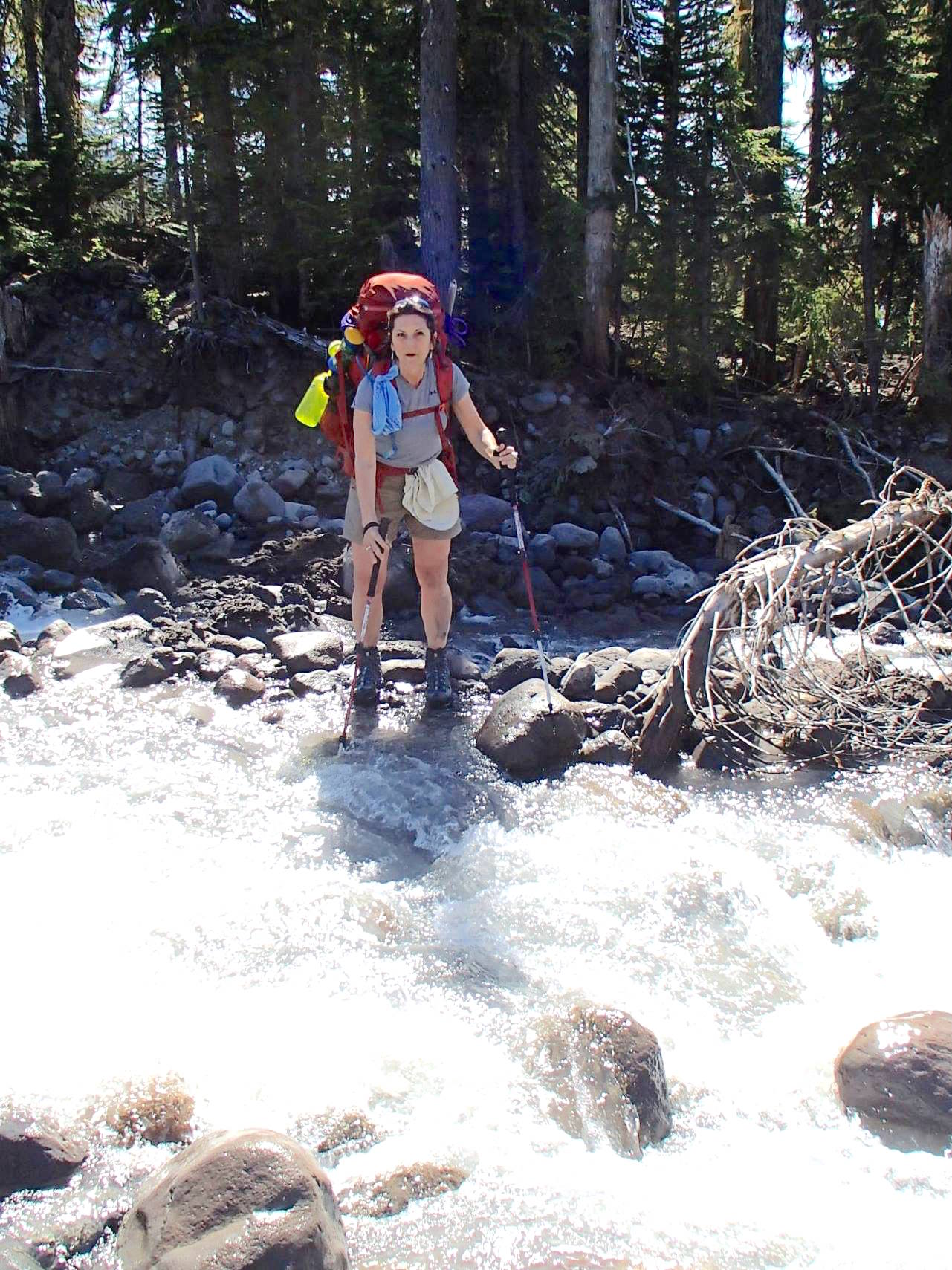
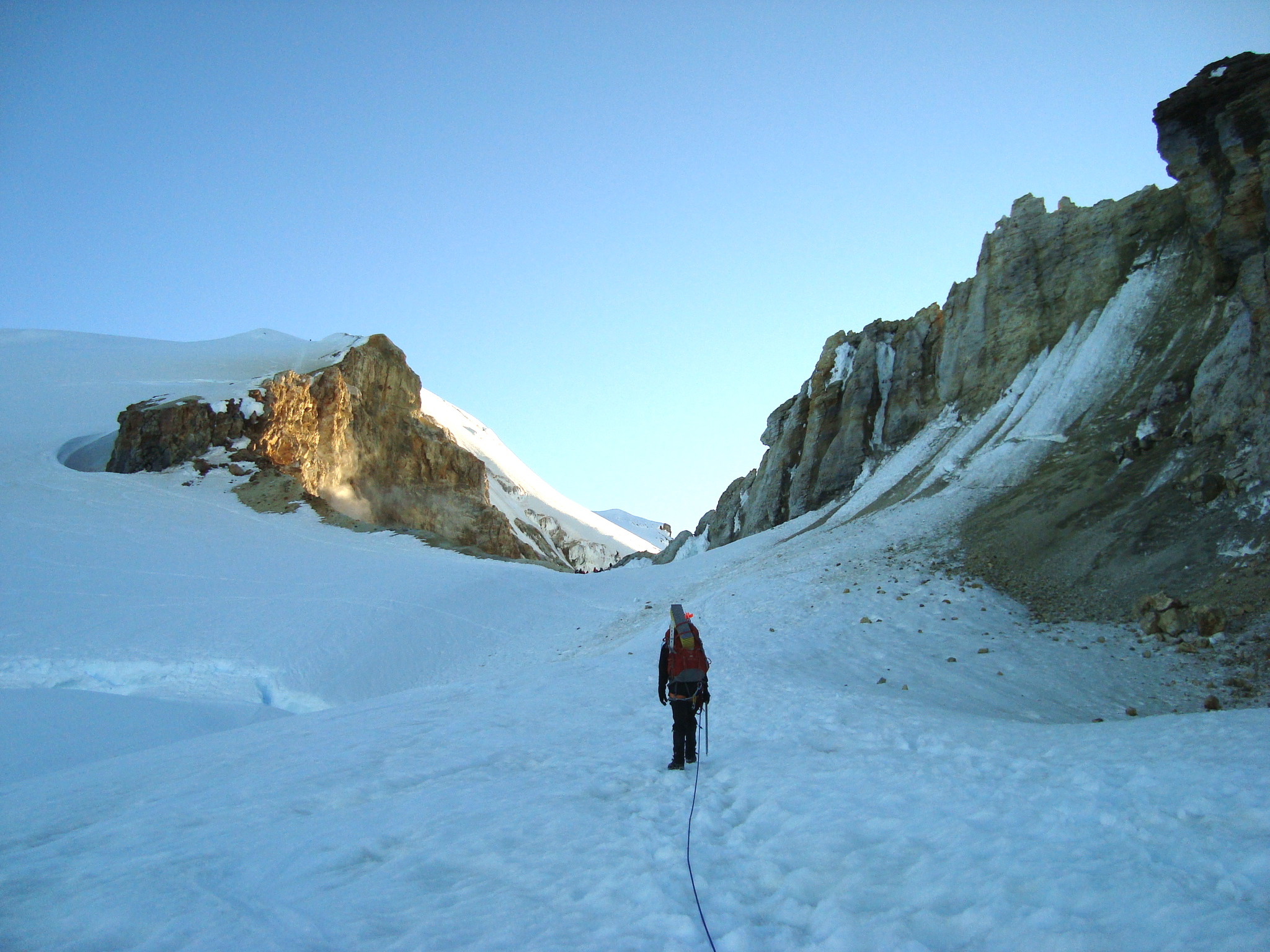
There’s also the love of fellow alcoholics who taught us our mountaineering skills, much as sponsors taught us life skills.  When we started up at midnight from our base camp, where our third friend stayed behind with her ankle sprained from a creek crossing, we felt small and scared. The hulking glow of Baker’s ancient glaciers loomed a mile above us in the moonlight.  It was just we two roped together to arrest falls as we wended our way by headlamps among yawning, deep crevasses, sometimes cussing like sailors.

We did it.  We’re sober miracles.  And, for each of us who gets there, for every alcoholic who reaches that precious freedom granted by true sobriety, it all began with that first little word of AA’s First Step, the first time it really sank in: We.


.

A few more images (click to enlarge)…

Mount Baker from a distance – second most heavily glaciated in the contiguous 48 states


Baker halfway up – crater our revised goal after Sally’s injury (originally the summit)


Me crossing where Sally slipped – 40lb pack doesn’t help!


Base camp self-timer shenanigans


Supper at 4, in bed by 5, wake-up at 10:30pm, geared & climbing by midnight


About 2,000 feet above base, dawn approaches. Canadian climber’s lamp a few hundred feet below


Mount Baker’s enormous dawn shadow cast across mountains and sound to the horizon


Me beyond a crevasse – but now at least we can SEE ’em!


K. approaching the crater after 4,000 feet gained in 5 hours


Descending – I’m just past a snowbridge between two crevasses.


Homeward bound – car and big fat beanburger, here I come!


7 Comments

Filed under AA, Alcoholism, Recovery, Sobriety, Spirituality, Twelve Steps

What’s Normal Drinking?

Suppose I give you an algorithm to figure out whether or not you’re a normal drinker.  I tell you to take the number of drinks you’d consume on an average Tuesday, multiply it by a rough estimate of times you’ve “had too much” and divide that by the number of drinks that would qualify as a “binge” for you; next add the number of times you’ve felt utterly disgusted with yourself the morning after.  If the square route of this number is less than 3, you’re fine – go ahead and drink!  If it’s over 3 – sorry!  You’ve got a problem.

Here’s the real test:  Did you read that whole paragraph, dude?  Did you even consider trying to estimate some of those crazy numbers?  Then, guess what?  You are sooo not normal!  Not only do normies — people with a normal relationship to alcohol — not even have numbers for most of those inputs, they don’t give a rat’s ass about how much they drink or whether they get to.

Try the whole thing again substituting “strawberries” or “croissants” for drinks and you’ll see through a normie’s eyes:  “Take the number of strawberries you’d consume on an average Tuesday…”  Who cares?  Eat ’em or don’t – it doesn’t matter!

Alcoholics love to marvel at normie behaviors like not finishing a drink or leaving half a bottle of wine in the fridge for weeks, behaviors that strike us as incomprehensible.  But getting a handle on how weird our thinking is – why we see normal as strange – is not so easy.

“The idea that somehow, someday he will control and enjoy his drinking is the great illusion of every abnormal drinker.  The persistence of this illusion is astonishing.  Many pursue it to the gates of insanity or death.”  (Big Book p. 30)

Before lasting sobriety, we keep trying and trying to find a way to drink normally.  But the effort itself precludes normalcy.  For instance, here’s a story from my Big Book study group, just after we read the above passage.  Dana – a repeat relapser who works from home – claimed to be able to control her drinking:

“The trouble is, I can control and enjoy my drinking for a long time. I’m really careful.  I’ll drive in the morning to the gas station near my house and buy just one of those little airplane bottles of Jack [Daniels].  I’ll drink it in the car and fucking enjoy the hell out of it.  Then I go home and get the kids off to school; I’m nice and not grouchy.  I’ll get set up for work, go have another little bottle, work for hours, chat with clients – I’m great. Before the kids get home, I’ll zip out and have another.  Maybe one before dinner and bed.  NEVER do I have two!  I’m just calm, smooth, efficient – doin’ my thing for weeks and weeks!  But then one day, I’ll get bombed and mess everything up.  Then I come back to AA.”

About ten of us made up the circle that day, but the room fell silent.  We all looked confused and befuddled, each lost in their own thinking. She did seem to be managing her drinking extraordinarily well!  To me it was like someone able to walk on a super-slick surface, keeping her balance and never slipping.  Dana was drinking and living a normal life as a functional working mom!  Wasn’t that what we all wished we could pull off?

A few of us asked about logistics.  Dana answered confidently.  I recall feeling a subtle mix of jealousy — Dana was able to drink! — and fear that I might decide to try something like that.  But most of all, I recall a fuzzy, confused inability to think clearly, to see something that was right on the tip of my brain’s tongue, so to speak.  I felt as though my mind were stuffed with wool.

Nora, another group leader, inquired tentatively, “How far is the gas station?”

“Five minutes,” replied Dana.

Nora’s forehead knitted. “And you make five trips a day?”

“About an hour out of my day, yeah.”

Nora spoke haltingly: “So isn’t… the alcohol controlling you, rather than… you controlling alcohol — ?”

As if awakening from a trance, we all shifted, seeing that Nora on the brink of something.

“That’s true,” said Dana.  “I never thought of it that way.  I guess I’m not really the one calling the shots!”

Suddenly I could see it – Dana’s system was madness!  She was arranging her entire life around her addiction so she could function in the world.  At that moment, everyone, including Dana, saw it. We also saw that some blindness in our relationship to alcohol had kept us from seeing it.

Brantly, our third leader, spoke up animatedly:  “This is not how normal people behave, you guys!  Arranging our whole life to maintain a buzz because we can’t do life as life?!  That is crazy. For normal people, alcohol is not the answer, so getting it’s not a question!  That’s why we need meetings, why we need the steps and god – because our brains make the insane sound totally normal!”

We were all laughing by this time, at ourselves, at ten people’s incredible alcoholic brain fart.  Brantly held up his phone: “I don’t need an app to tell me it’s been 5,057 days since my last strawberry!”

Here’s the bottom line.  If you hope desperately to find a reason you’re not an alcoholic, you’re an alcoholic.  If you point proudly to periods when you’ve drunk normally, you’re not normal.  Normal drinkers may hide from life in other ways, but not through booze, so they simply don’t care. We for whom alcohol has been a lifesaving magic carpet are incapable of not caring.  Hence the fabulously ironic saying, “If I were a normie, I’d drink every day!”

Step one is the realization, an acceptance to the marrow of our bones that no way out of this maze exists on human terms.  Our faulty minds will always, always “choose” drinking — by however contorted a logic.  We can’t not drink.  Our relief must come from a higher power.

.

8 Comments

Filed under AA, Alcoholism, Drinking, Recovery, Step 1

The Disease We Forget We Have

Late to a Seattle AA meeting 12 years ago, I was just backing into a parallel parking space when another driver zipped forward into the spot. I rolled back to make eye contact with the driver, whose stony stare flung back a challenge: “Are you really gonna make a stink about this? Cause it’ll get you nowhere.”  But then we recognized each other!  He was my friend from meetings! Grinning with contrition, he signaled that I could have the space.  I waved back “no big deal” and drove off – though for years I gave him shit about it.

My friend was still toxic – only about a year sober after three decades of relying on booze, pot, and crack to limp through a dark and confused life. Just beneath his jovial exterior he carried a huge chip on his shoulder, a certainty that everyone and everything had fucked him over so badly he’d never be okay.  That parking space was owed to him despite some rival bitch about to score it.

Over the years that followed, though, my friend underwent what I can only describe as a spiritual transformation.  AA became his home and family as he attended meetings almost daily.  When he finished the steps himself, he began to sponsor new guys, reading the Big Book with them and learning what it felt like to truly want good things for someone else.  His heart grew.  He became a man of great empathy and compassion.

And somehow through that process, he developed empathy for himself, an acceptance of his trying past, including all the suffering that had forced him to change and grow.  The chip on his shoulder melted away.  His shares in meetings emanated that elusive calm that evolves only from gratitude and humility.  When he spoke, people listened.
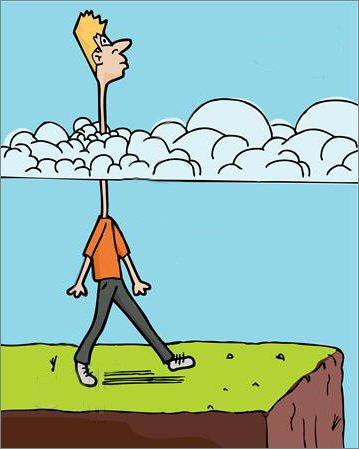

Finally, as a result of all that he had become in recovery, he quit recovery entirely and became desperate and miserable again.

Wait — what did I just say?  Why would someone do that?  Don’t we all know alcoholism is a lifelong affliction?  Doesn’t the Big Book plainly warn us not to ever let up on our spiritual program?

We are headed for trouble if we do, for alcohol is a subtle foe.  We are not cured of alcoholism. What we really have is a daily reprieve contingent on the maintenance of our spiritual condition.  (p.85)

My friend is far from alone in his abandonment of recovery.  Many of us get a good job, meet a good partner, buy a house, maybe pop out a kid or two, and expect to live happily ever after – without AA.  Some manage to, because they’ve found an alternate spiritual community: a congregation, sangha, even volunteer group.  A few die.  But the majority end up in either a tense, anxious day-to-day hell of frustrated ego, or a full-on relapse that promises relief but takes their job, house, family, dignity, happiness, and mental health instead.

So why do people like my friend, granted a beautiful life in AA, turn their backs on the simple regimen of meetings and service that saved them?

I’ll tell you why: we forget it was god who saved our lame, toxic, beat-to-shit asses.  We decide that, really, we did it!  Seriously – we just made a lot of bad choices back then, so amid the turbulence of all that wreckage, it seemed like the light of sanity came from god.  But now that we’re “winning” at life, we can see the change really came from our own smarty-pants-ness.  That’s right: we wised up, grew up, and climbed up.  And now that life has gotten so full and busy, who has time to waste on meetings and sponsees or prayer & meditation and all that 12-step shit?

That’s exactly what happened to my friend of the stolen parking space, who met me for coffee a few weeks ago.  But an unforeseen blow had upended his prosperity, so now he had this and that problem, but even worse, this other thing was about to happen, and then he’d really be in trouble!  He was physically sick, his face was broken out, and I noticed his hands shaking.

I spoke up: “You need to go to meetings.”  He responded as if I’d just suggested he take up embroidery, but, well aware I was an embroidery fanatic, he’d prepared a strong retort.  He cited reason after reason that AA meetings could do nothing for him, even if he had time to get to them.

“Do you remember,” I interrupted, “when you first came to meetings and you could NOT STOP drinking, and you asked god to help you?”  He held my eyes a few seconds with a distaste remarkably similar to that parking space stare of bitter defiance.  “Vaguely,” he mumbled.

Nothing I could say seemed to get through:  “You can’t find answers through isolation.  God works through people.  We need to be connected.  Answers come when you ask.”  I practically begged him to find a moment alone to offer the simple prayer, God, please help me.  He all but winced at my triteness, promised nothing, and left.

So.  Imagine my joy when a couple days ago that friend blew into my homegroup accompanied by two of his best AA buddies and took a seat at my table.  We cracked jokes til the meeting started.  A ways in, I caught the chair’s eye and signaled, so he called on “the gentleman sitting next to Louisa.”  And do you know what my friend shared?  That for years he’d kept relapsing because he refused to admit he was powerless over drugs and alcohol, and today he was just as stubborn about refusing to admit he was powerless over life. “The truth is, I need to be here,” he said, looking around the room.  “I need you guys.”

For me, god is everywhere — in my home, in the wilderness, in every connection I make with another living creature.  But so is my big fat ego, which wants to Edge God Out.  I need meetings, now and forever, to remind me I’m still an alcoholic who, left to my own devices, will still try to fill that perennial empty spot with the wrong things.  Because you wake me up to the divine unity that heals me, I will always need you guys.

3 Comments

Filed under AA, Alcoholism, God, living sober, Meetings, Recovery, Sobriety, Step 1

Compassion’s Spark: a 12th Step Call

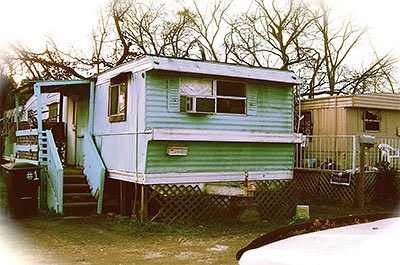
On a dark, rainy winter’s evening about ten years ago, I found myself in a run-down urban trailer park trying to find a particular trailer. I don’t remember how I was supposed to identify it, but I do remember a man stepping in front of me whose face I couldn’t see in the dark.  “I got some stuff.  You want some?”  trailer-park“No, thanks,” I replied, moving on. By the light of trailer windows, I saw more shadowy figures moving about in the downpour, and I remember holding my AA Big Book in front of my heart like a shield, asking god to keep me safe.  I was on a full-fledged 12th-step call, one of only a handful in my life.

Twelfth-step calls are less common today because treatment centers tend to be a first stop for addicts wanting help, but the woman whose trailer I was seeking had just been released from the most labor-camp-like detox/treatment center in Seattle – Sedrunar.  A friend had called me about her. “Lena doesn’t have a car to get to meetings.  She’s got two kids, and she’s gonna lose them if she uses again.”

I called Lena, though I was going to insist she take the bus to my house.  But Lena, like any addict, was persuasive.  She didn’t know anyone in the trailer park she could trust to watch her kids – who were seven and two.  Could I please come just this once?

The seven-year-old opened the trailer door.  She stared at me from eyes circled with dark shadows, silent as a spook.  I heard yelled from inside: “Let her in!”  I tried to greet the child cheerily, though to inhale the stinky, steamy air in there felt like an assault. On the floor was an old TV with a beanbag chair in front of it – that and piles of clothes.  Bare walls.  In came Lena, the toddler on her hip naked besides his diaper, food all over his face.  Lena was a bit shorter than me and chunky, about 25. She shook my hand, apologizing for the mess, and handed the boy off to her daughter, pretty much barking at her to go in the bedroom and shut the door so she could talk to this lady – me.

We sat down at the yellow kitchen table.  On the stove, mac & cheese dribbled from a saucepan stovein a way that reminded me of vomit, and smeared noodles dotted the table.  Lena sat across from me and folded her hands expectantly as though I were about to recite poetry.

All I could say was, “Does that window open?” I gestured toward a dark pane at the the table’s end, the glass dripping with condensation.

Lena looked perplexed.  “I’m trying to save heat.”

“I’d really appreciate it.”

Reluctantly she rose and slid the moldy aluminum frame aside about an inch.  While she was up she grabbed a sponge and wiped away most of the noodles at my place, apologizing that she’d just fed her son.

I’d made up my mind that I would stay 30 minutes only.  I began as I always do, by asking Lena to briefly tell me her story.  Clearly practiced from treatment, she launched right into it – how she’d grown up picking crops in Yakima in a Hispanic community; how she’d gotten into meth as a teen.  She was proud that both kids had the same father, but he was a drug dealer.  She’d lost them twice to CPS – once for leaving them in the car outside a bar.

“I’m clean, now, 60 days.  The judge told me this is an extra chance with my kids.  I shouldn’t even have them now.  I gotta stay clean.  I gotta stay sober.”  Here she changed, muscles in her face and throat working hard.  She looked right at me and spoke distinctly: “I can’t… lose… my kids.”

“Well, you’ll need to find a sponsor,” I breezed, “but, unfortunately, I’m full.”  This was somewhat true – I had a few sponsees.  But, of course, I really said it to push away all this squalor.  I wasn’t even sure whether this woman should have her kids.  All I knew was that only 21 minutes stood between me and escape.

I sketched my own story briefly, Lena nodding attentively at every phrase.  I explained that I couldn’t not drink on my own, but by working the 12 steps I’d accessed a higher power that had removed my craving for alcohol and kept me sober eleven years.

“Eleven years!” Lena marveled.  “That’s what I want!  I wanna know how you did that!”

I was starting to explain how I’d worked with a sponsor when we heard a ruckus and the squalling toddler, chased by the spooky girl, burst out of the bedroom.  Hardly taking her eyes from me, Lena scooped her son into her lap and held him close.  She gave the crown of his head tiny kisses and asked him if he wanted a bottle.

Right then – that’s when the voice started.  Not really a voice, but an urging:  Help her.  Sponsor her.  Love her.

No fucking way! my ego countered.  ticking-clockI was busy.  She was hopeless.  Just eight minutes and I’d be outta this dump, back to the fresh air and my nice, clean life!
“He don’t talk,” Lena told me. “They told me he’s disabled, but it ain’t true.  It’s just all he been through.”  Watching the boy’s eyes, the way they moved from Lena to me and back again, I sensed she was right.  Meanwhile the spooky girl joined us with a coloring book, promising to be quiet and asking where her crayons were.  Lena grabbed them from the same box that had held her Big Book.

“It’s not me,” I heard myself telling her. “God has given me a life better than I ever dreamed of.”  Some of the people who’d helped, giving me time and guidance, flashed through my mind.  “I’m not the same person I was.”  Lena nodded intently.  She was not begging.  She was not pleading.  But every cell in her body was straining to hear me.

Just help her.  Just love her.

But I was helping, dammit!  I was steering her toward the program, right?  Just not toward me.  Anyone but me.  But, with just three minutes to go, I made a big mistake.  I looked into Lena’s eyes.  Really looked.  I saw there desperation and terror, but even more, a fierce love for her children.  My own son was five.  How were we any different?

The wall crumbled, compassion washing over me.  “Okay, I’ll sponsor you,” I heard myself saying.  Lena’s face lit up.  “But not here!  You’re gonna have to come meet me at a coffee shop!”

The rest of the story is like a fairy tale.  Lena and I met every Friday tobig-book read the Big Book at a Starbucks while a sober neighbor watched her kids, after which I’d drive us to a meeting.  She had a job riding in a municipal truck, collecting garbage, and within a couple of months she qualified to drive that truck.  She moved into a shitty apartment not far from the trailer park, where I met with her for a while until she found childcare.  She bought a crappy car and started driving herself to meetings.  Whenever I showed up at her homegroup, her kids would ambush me either in the parking lot or when I came in – the little girl now beautiful and clear-eyed, the little boy talking up a storm.  Their laughter still seemed incredible to me – a miracle.

In a little more than a year, we’d progressed to Step 9 when Lena, who was apprenticing as municipal gardener, leased a nice apartment too far north for us to keep meeting.  I drove up and visited her there once.  It was near Christmas.  I remember white carpets, a new sofa, pictures on the walls.  I remember the children bringing me a gift from under the Christmas tree and grinning while I opened it, and my own embarrassment that I had nothing for them.  But I had given them something – and we all knew it.

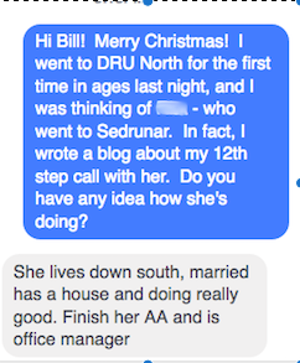
Last night after eight years I went again to that meeting – Lena’s old home group. But she wasn’t there.  Where she’s gone, what she’s doing, I don’t know.  But I’m hopeful.  I sent them prayers.  Today, I’m so grateful that god opened my heart, and that it’s still opening.

scroll

Postscript:  I had to find out…  🙂

screen-shot-2016-12-24-at-5-20-03-pm

8 Comments

Filed under Addiction, Alcoholism, Recovery, Sobriety, Twelve Steps

Acceptance vs. Acquiescence

And acceptance is the answer to all my problems today. When I am disturbed, it is because I find some person, place, thing, or situation—some fact of my life—unacceptable to me, and I can find no serenity until I accept that person, place, thing, or situation as being exactly the way it is supposed to be at this moment…. I need to concentrate not so much on what needs to be changed in the world as on what needs to be changed in me and in my attitudes.

-Paul O. (p. 417, italics added)

My mom called me Wednesday morning on the heels of Tuesday’s election.  crying-faceShe’d just gotten off the phone with my sister, who, she said, was sobbing at such a pitch as to be largely unintelligible: she and her husband would sell the house they just finished buying, pack up all they had just unpacked, and move to Canada.  It was horrible, horrible…

Now, this is by no means a political blog.  But it’s my blog, and I’m going to talk about WTF I want.  I write about living sober in the world, which means dealing with upsets – including politically oriented ones.  I went to bed early Tuesday night because I could not bear to watch my hopes crumble.  “Pray!” my mother had just urged me, so I began — but quickly recalled that outcome-oriented requests boil down to “My will be done” and are actually anti-prayers.  So I prayed simply, “Help us all.”

Waking the next morning, I could feel a sort of terror brewing in my gut.  I sensed my country had fallen into the hands of a megalomaniac who I believe lacks all basic human decency — let alone a shred of wisdom.  A look at my computer confirmed as much.  In fact, the dizzy, reeling shock I felt absorbing this outcome resembled the shock of being told I had cancer – that same dumbfounded realization that what cannot be is: My country has cancer.

Reality intersectionBut here’s the thing.  In both cases, the news alerted me to something already true.  This catastrophe was  merely the manifestation of a reality I’d denied with sugary assumptions — that overt bigotry, misogyny, and denial of scientific facts would render a candidate repugnant to my fellow citizens.  Such simply was not the case.  And accepting that fact is my sole option.  So… what is there “to be changed in me and my attitudes”?
bob-donald-bill

The Twelve Steps entail far more than a means of stopping drinking: for me, they offer a plan for constructive living that applies in all circumstances – even these.  When upset, we must quiet ourselves: hysteria leads to rashness which leads to drinking.  Further, Step 10 instructions tell us:

Continue to watch for selfishness, dishonesty, resentment, and fear. When these crop up, we ask God at once to remove them…  Then we resolutely turn our thoughts to someone we can help.  Love and tolerance of others is our code. (p .84)

My feelings in this case boil down to resentment and fear.  People were supposed to vote my way, and they didn’t.  I fear national and international disasters – that have occurred so far only in my imagination.  I can roll with these emotions toward relapse, or I can ask god to remove them.

As for dishonesty – what footwork did I contribute toward preventing this outcome?  I mean, besides posting stuff on Facebook, donating a little money, and voting?  Basically, nothing.  I don’t protest, march, or rally more than once every five years.  I don’t canvass or make outreach calls.  I don’t volunteer my time or skills for any candidate – ever.

Why not?  Because I’m selfish.  I’m too busy – and I guess lazy.  My civic convictions tend to be of the armchair variety, unless something strikes close to home.

So what about love and tolerance?  Suppose I try thinking of my nation’s voters not as idiots, but as well-meaning people reacting in a culture and society that is slowly evolving by fits and starts?  How many of them felt four and eight years ago exactly as I do now?  They have their own ideas, and they followed them.

Lastly and most importantly, how do I concentrate on what needs to be changed in me and my attitudes?  For me, “resolutely turning our thoughts to someone we can help” happens on a small scale, close to home.  It may not be much, but I give change and friendly conversation to every panhandler I encounter.  I wear my pathetic #blacklivesmatter T-shirt as a symbolic gesture.  I volunteer feeding the homeless.  And I help alcoholics through sponsorship, speaking, and fellowship.  In short, I try to cause every person I interact with to leave me just a little bit happier.  That’s my job.

It’s an effort I can redouble in light of this election.  Yesterday, for instance, I set out my son’s outgrown bicycle with a FREE note that not only listed all its problems but offered condolences on the election and asked the taker to please be extra kind to somebody – just to cancel out a bit of our president elect’s ethos.  Today I wonder what that person thought, where they are, what they did.

At the same time, though, acceptance does not mean acquiescence.  I have to ask myself, at what point would I rise from my armchair?  Would I intercede in racist or homophobic bullying?  Will I march to fight a deeper reliance on fossil fuel?  At what point does the cost of pacivity become simply too high?

beatrice

Beatrice

In the 1940s, my great aunt Beatrice Dohme Siedersbeck played violin in an antique chamber music trio touring Western Europe. When they found their group compelled to entertain the Nazis in various occupied countries, she and her German husband began transporting messages among underground Resistance groups via a code that encrypted words as harmless-looking musical scores.  She also posed as a carefree girlfriend to help disguise an Allied pilot’s escape to Switzerland as a mere joyride.  The plan succeeded – at first.  But the Nazis later caught the pilot, she learned, and lynched him with piano wire.

Could any of us muster that kind of courage if circumstances warranted it?  How much are we willing to tolerate before risking our safety for hard won rights and the health of our planet?  For the first time in my life, I find I have to wonder.  Because sobriety, to me, frames a way of life that calls for integrity in all we do.

scroll

Post to Facebook

4 Comments

Filed under Recovery, Sobriety, Twelve Steps

Thinking in Sobriety: A Suggested Playlist

A thought is harmless unless we believe it.  It’s not our thoughts, but the attachment to our thoughts, that causes suffering.  Attaching to a thought means believing it’s true.   (-Byron Katie)

One of the greatest gifts I’ve been granted in sobriety is a thin layer of mental insulation between having a thought and believing it’s true.  Back when I was drinking or newly sober, I used to experience a barrage of hopeless, self-deprecating, and judgemental thoughts that seemed to come at me from nowhere.

And they still do!  The miracle now is that today I know I’m thinking. I’m also aware that my thoughts are fickle: sometimes they’re guided by my higher self, and others they’re broadcast by that parasitic asshole camped out in my amygdala: Addiction.

Thoughts in themselves are just mental activity – nothing we have to sign on with.  But doing so becomes habit. As Eckhart Tolle explains, “Strictly speaking, you don’t think: Thinking happens to you… Digestion happens, circulation happens, thinking happens.  Most people are possessed by thought… [while] the greater part of [their] thinking is involuntary, automatic, and repetitive. ”

The majority of my thinking, unfortunately, tends to diagnose what’s not right.  (For instance, I’m telling you now what’s not right with my thinking.)  Why is that?  For one thing, as a human I’ve evolved to be on the constant lookout for survival problems. As an academic, I’ve been trained to evaluate everything critically.  Add the fact that, as a codependent, whoamiI’ve always had a hell of a time gauging where I stand relative to you, who I think you want me to be, and my fleeting sense of self.  (Are you disappointed?  Bored?  How do I fix it?)  And lastly, as an alcoholic, I’m prone to self-centered extremes of self-aggrandizement and self-loathing: I’m the best or the worst, totally the shit or a total piece of shit.

Maybe that’s why I experience so much downright back-assward thinking.  I kid you not: this morning I got up for a second cup of tea, and as I crossed the threshold of the kitchen, the thought came to mind that my entire life was a pathetic failure.  Why?  That’s hard to say. My thinking voice was wielding some punishing club, like: “Why do you constantly deny this?!  Why don’t you just quit your strained pretensions and admit you’re nothing but a fuck up?!” Further back I sensed accusations about my lack of material wealth and a relationship, but I didn’t look into them.  Instead I pulled away, thought: “Wow!  Harsh!” and focused on my lovely, cozy tea.

The thing is, I was once addicted to that harsh voice.  I used to grab at those thoughts saying, “AHA!  Now I face the TRUTH!”  Granted, the harsh voice possessed a dismally limited supply of diatribes or, if you will, a chintzy jukebox of dark songs it played over and over.  But I knew them all so well that, whether about your faults or mine, it was great fun to sing along.  For years, they all led to a frame of mind that clearly called for a drink.  I drank not so much to vanquish them as to join with their story: “I don’t give a shit anymore.  Cheers!”

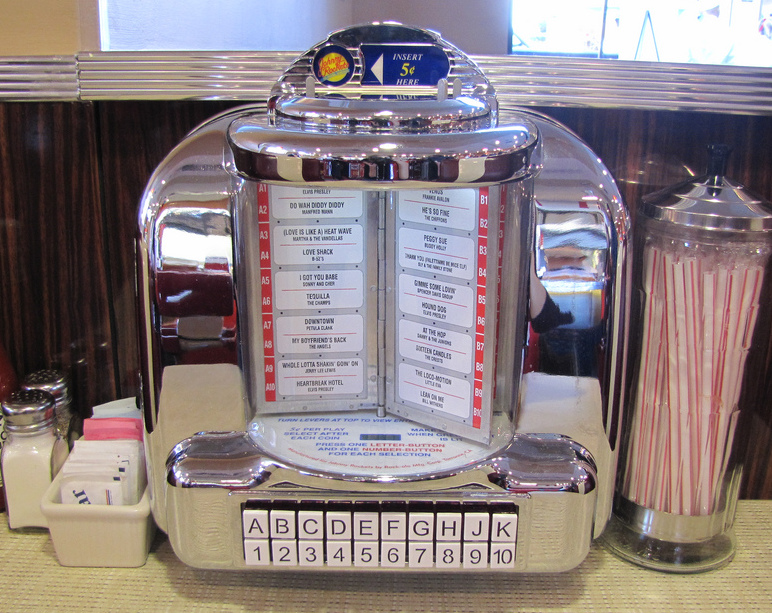
table-jukeboxHere are some of the dark jukebox’s Greatest Hits, sequenced from inner to outer attacks:

  • You Suck  (verses include your life sucks; you’re incompetent; your job/ creativity / social skills suck; no one likes you)
  • You’re Gross  (includes you’re fat; your clothes/ hair/ belongings are stupid; your ____ is too ___)
  • Poor, Poor You~! (includes cruelly denied X;  you’ve tried so hard; never even had a chance; assholes always win; god is frickin’ mean)
  • Your Way’s Right  (includes you told them X ! ; they think they’re so smart; they’ll be sorry; fuck those bastards)
  • That Bitch (includes why is shit so easy for her?; why do all the guys like her?; why won’t she just shrivel up and die?)
  • How D’they Like You NOW??  (includes a myriad of stellar comebacks, snide putdowns, and scathing witticisms to put assholes in their place)
  • Some Day You’ll Show ‘Em (includes Academy Award-winning footage of you accomplishing great things amid vast admiration, or talking thoughtfully with vanquished rivals about your victories)

As I noted above, I still have all these thoughts.  But… by virtue of having worked the steps and listened to a variety of 5th steps, I’ve learned to recognize their hackneyed tunes as part of the human condition – nothing unique to me.  And by a miracle of grace, I’ve actually grown bored of them.

Sometimes, to break a dark train of thought, you need a light one.  The Saint Francis Prayer rocks, of course, but it’s a bit abstract.  Here’s a playlist of thought trains I pursue when I’m having trouble shutting down the jukebox.

  • Be grateful.  I’m not in a war-torn country; I’m healthy; I’m sober; I know my god; I have friends; all I need to live has been gifted to me, plus a wonderful son, home, and abilities.
  • Send love to someone struggling.  I call to mind friends having a hard time and pray for them, maybe text some kind words, or decide on something I could do to help.
  • Plan something happy.  This past kidless weekend I saw the blues coming, so I took my dog, drove 2 hours, and climbed 4,000 feet from old growth forest to a snowy peak – sheer heaven!  All it cost was gas and gumption. I also throw parties, meet for coffee, and play at silly sober stuff (like sober karaoke this weekend).
  • Remember I’m going to die, as are you.  This may sound morbid, but holding in mind that life is finite renders every detail of the present moment infinitely precious.  The more loved ones I lose, the more easily I love all of us – this uppermost layer of humanity like fresh spring grass on an ancient prairie.

Living sober doesn’t mean just not drinking.  It means cultivating a beautiful life with the help of a loving god – and saying no to those habits that drag us back toward our dis-ease.

dsc04697

Me not watching TV alone last weekend (across from Glacier Peak, tagged last summer)

scroll

Post to Facebook

8 Comments

Filed under AA, Addiction, Codependence, Recovery, Sobriety, Twelve Steps

Amends

Rarely do AA newcomers like the sound of steps 8 & 9, where we contemplate the harm we’ve done others and do what we can to set things right.  I know I certainly didn’t plan on completing them early on.

My siblings, who don’t identify as alcoholic, believe I’ve been brainwashed by AA.  Maybe I have – but it was a washing much needed!  Today I simply do not question the wisdom of the 12 steps, and I seek constantly to apply their principles to my life.  That’s why I recently sent off an amends letter for harm I did almost 30 years ago.

bride-lighter

I married at 26 – drunk as I spoke my vows amid a total void of emotion – aside from the guilt of realizing I couldn’t feel.  We were outdoors on a sunny day, and I made myself cry because I wanted the hundred people in attendance to believe I was deeply moved.  The groom had been the object of my sexual obsession toward the end of college.  For over a year his mere presence – or even the thought of him – had spiked my dopamine better than cocaine: he’d been a living drug.  But as we said our vows, I knew his effect had worn off.  He’d been demoted to close friend and source of security.  I appreciated him for that, but love – genuine intimacy – had somehow dropped out of my emotional vocabulary.

As newlyweds we moved to Brookline, MA, so he could attend business school.  I drank.  I was supposedly a writer, since I’d won a big prize in grad school.  I had no friends, no job, no reason for existing – so my compulsive behaviors (described in my book) and drinking simply took over.  The panic attacks I’d experienced in New York City returned with a vengeance.  God, what a nightmare! – that sense of dying amid the obliterating jumble of an indifferent now.  Valium and booze were my only respite.

To rescue myself, I developed a new obsession – a girl, the most popular aerobics instructor at the gym where I’d started work.  Now I had a fresh stash of euphoria to chase after.  There was no physical infidelity because we were both straight – the girl and I – and intensely homophobic.  All I knew was that I wanted to be around her constantly and to reel her into my life as a new fix, a new paradise.  She gave me a little gift – a small metal figure seated on a toilet made from wire, nuts, and washers – that went missing.  I don’t know what drew me to look in the garbage outside, but wrapped in a bunch of paper in a bag within a bag I found it… bent and broken to pieces.

As I looked at it, I registered the magnitude of my husband’s pain and rage.  But with zero compassion – only anticipation that I could show this weird relic to my new friend.  And I did.  I got it out of the garbage a second time.  “Whoa!” she marveled.  “He’s fucked up!” – meaning my husband.  Later, after she’d followed me back to the west coast, we became partners.  It would take another six years for me to repeat the cycle – to betray her for a new host.

Flash forward a dozen years or so to 2000.  By this time I’m five years sober, working through my last amends.  I want to fly out to Boston to see my ex-husband, own my wrongs, and pretty much beg forgiveness – but my sponsor pauses.  She has me go see the rabbi who married us (my husband was Jewish) and ask his advice.  The rabbi ruminated for so long, I worried he’d fallen asleep.  Then he spoke: “You’ve changed little in appearance.  I think seeing you would cause him pain.  prayerStay out of his life.  Pray that he receive all the love and happiness you couldn’t give him.”  When I objected, trying to explain step 9, he reared up powerfully: “This amends would be more for you than for him!  He has a new wife!  Let him be!”

So I did.

Flash forward again, now to the spring of 2015.  As some of you know, I learned that my boyfriend of 9 years, whom I knew to be drinking, had been carrying on an affair with a girl from work five years older than his daughter – for several years.  I saw their texts.  I ended our relationship.  This caused me a great deal of pain.

Now we’re up to about two weeks ago.  In the midst of decluttering my house, chucking piles of once crucial papers into the recycling, I came across some old photos of my husband and me.  Look at us!  So young!  So… innocent!   His energy, his humor and kindness – they flooded back to me.  Sitting there on the floor with remnants of my life scattered about, I felt the grief and regret wash over me like a tsunami.  By the light of my own pain, I ventured down those hallways of memory, myself now in his place.  I saw as never before what I’d done, who I’d been.  And amid that mourning came clear direction from my higher power: The rabbi’s advice has expired.  The right thing to do has changed.

Am I brainwashed?  Maybe so.  But it took me only days to write a letter, tears nearly shorting out my laptop.  I sent it to my sponsor, and with her adjustments, copied it out by hand – again awash in tears.  I owned everything.  I told him I’d not been human – that addiction had turned me into a gaping black hole of selfish need.  I told him there was nothing in my life that I regretted more – that I would always, always, regret having abused his trust.  And I wrote that he was wonderful.

rainbow_heart

I mailed it a week ago with a kiss and a prayer.  I’ve not heard back, but the results are out of my hands – not even my business!  What I know is that I’ve done my best to do the right thing.  That’s how I live now.  I seek insight through prayer and talking with the people I trust most.  And then I act.

In return, I get to hold my head up… and live sober another day.  That’s how it works.

scroll

.

Leave a comment

Filed under AA, Addiction, Recovery, Sobriety, Twelve Steps

Reasons I Wasn’t an Alcoholic

04Julesshakespear73Writing the final exam for my college Shakespeare course, I had to close one eye to read the questions, since I was seeing double.  Not puking also required an occasional surge of resolve, and I had the spins.  All unfortunate.  What concerned me most, though, was my handwriting: it looked more as if a third grader were reflecting on Shakespeare’s intent than a college junior – one who adored his plays and knew many lines by heart – at least, ordinarily.  That exam pulled my final grade down to a B despite many A papers.  I think about it every time I see my transcript.

What was wrong with that picture?  About three hours.  That’s all I needed to sober up. Wisdom acquired?  For an 8:00AM exam, one should stop drinking, not at 3:00AM, as I had, but probably closer to midnight.  Having learned that lesson, I’d manage better next time.  It was a mistake – not a problem.

When a couple years later I drank a fifth of 151 in a few hours and passed out so deeply, nothing could wake me, that was clearly because no one at the housewarming party had warned me about 151 – that you had to drink it slower!  Who knew?!  Another mistake.

When, at my wedding celebration, I hovered a couple of steps behind Michael Dukakis, governor and guest of honor, imitating his every gesture and doubling over with laughter (I might have peed my nylons just a little), it was simply a shamewine_cheese my in-laws lacked a sense of humor!  Though, okay – I might have had a bit much.  But the bride gets to make a mistake, right?

When a few years later I attended a wine and cheese graduate school function with my (new) partner, told inappropriate stories, shattered a fancy wine glass, and passed out face down on the floor of an upstairs room, it was just – whoops! – another mistake.  Good thing I wasn’t lying in my own vomit, because I was a pretty classy English professor!

So I learned to do better next time!  Well, actually, um, not next time, but the time after that.  I learned I really didn’t like getting falling down drunk, so the next time I… got falling down drunk, I didn’t like it again…once it was over, so next time I wouldn’t do it – til I did.

What those people who claimed I had a problem with alcohol failed to realize was this: I loved alcohol.  I adored it.  It fixed me, it fixed you, it fixed the world – so everything could be okay.  How could that be a problem?  I just kept fucking up on the amount, was all.  I just kept overdoing a good thing.  But it was a good thing!  That I knew.  No one was going phase me with this “Louisa, you’re an alcoholic” bullshit.  Maybe I was one but so what?  It was my way.  Nobody has the right to tell you to change that!

So, fuck ’em, I said.

Besides, I could list off a million reasons I wasn’t an alcoholic.  I…

  • Didn’t drink hard booze after I turned 26 – except when I did
  • Didn’t drink in the mornings – except when I started before noon
  • Didn’t lose my job or house – only chose to downsize
  • Didn’t get a DUI – because the cops appreciated my doe-eyed apologies
  • Didn’t black out and wake in strange places – just miraculously back home
  • Didn’t suffer DTs – just shook wildly, maybe a smidge of amorphous terror

As the years rolled by, however, and I continued to make unfortunate mistakes despite my lack of a problem with alcohol, a few liabilities did crop up, so my phrasing had to change a bit, like this:

  • Though I occasionally collided with door frames, I did so reminded of life’s bittersweet irony
  • Though I occasionally fell down, it really didn’t hurt
  • Though I attended keggers in my mid-30s, I did so from a worldly, intellectual perspective
  • Though I hit a car head on, I’d slowed down so much it hardly did anything
  • Though I cheated on partners, I did so secretly so it kind of didn’t happen
  • Though I might enjoy a glass of white wine while I cooked dinner, or perhaps a beer at lunch or while journalling, gardening, vacuuming, folding clothes, building a fence, watching TV, doing the dishes, clipping my nails, or taking a shower, I didn’t drink all the time
  • Though I hated myself, that was my business – and a fine reason to drink more

I could have gone on like that forever, with an answer for everything.  I don’t know why I didn’t.  I guess gradually the old threadbare idea that I’d manage better next time wore thinner and thinner.  At the same time, the prospect of any next time, any next anything, grew increasingly dull and even disgusting.  Though I think what actually defeated me, what drove me to break down and hit bottom and finally say ‘uncle,’ was that last point: hating myself.  The hate grew so intense – such white hot, pure acid, unmitigated and inescapable hate – that I simply could not stand to exist another day – drink or no drink.  So it was suicide or… what the hell, AA.

Meeting snowflake

Those of you reading this sober may know exactly what I’m talking about.  Some reading just a tad hungover may experience a twinge of recognition and whip their Monopoly-style NOT-THAT-BAD card from a back pocket.  No one can diagnose another person’s alcoholism.  But a word I discounted back then was honesty.  Today I know honesty is not a true/false prospect; it’s a matter of excavation.  And digging takes courage.

On January 29, 1995, whatever it is I call god removed my mania for drinking.  I’ve not had a drop since.  What could be more miraculous?  Deep down, just under our hearts, we can all sense our source, our core, our truth beyond knowing.  I used to drink to bury mine.  Today, with the help of my fellows, I strive to live by it.


scroll

1 Comment

Filed under Addiction, Alcoholism, Denial, Drinking, Recovery, Sobriety, Step 1

Doing What We Don’t Want

Almost none of us liked the self-searching, the leveling of our pride, the confession of shortcomings which the process requires for its successful consummation.”  (p. 25)

“To be doomed to an alcoholic death or to live on a spiritual basis are not always easy alternatives to face.”  (p. 44)

Nobody wants to come to AA, but our pain and lack of alternatives shunt us there.Nobody reads over those 12 steps on the wall and thinks, “Oh, I see!  That’ll fix me!”  But they will.

At my first AA meeting, thoughts of irony, disbelief, criticism, and a simple desire to bolt filled my brain.  I saw nothing of value in those simplistic, god-mentioning steps.

Reluctant PeeWeeHerman

Why do we need to live on a spiritual basis?  First, because we’re inherently spiritual beings.  More specifically, because the alternative is to live by self-propulsion, which may work fine for normies but for alcoholics invariably leads to a “choice” to drink, because a disease has commandeered our decision-making process.

What’s so great about the steps?  When we first come in, we’re in a state of spiritual starvation because we’ve shrouded ourselves in a world of lies.  We don’t think so, of course.  But the fact is, we’ve made up stories – about who did what, why, and how – that simply do not square with reality.  The steps have two main purposes: to remove the layers of delusional resentment blocking us from god and to encourage us to grow in connection with that god (who, by the way, removes the drink problem).

Totally unrelated to AA is Seattle IANDS, which features speakers who, like me, have temporarily died and/or left their bodies and brought back memories from the other side.  One speaker I heard a few years ago encountered god as Jesus – as do most Christians (we see what we think of as god).  At that time she was a teen speeding through East LA in bad company.  In the split second before an impending car accident, time stopped.  After she refused a demon at her feet who urged her to come with him and get even with everyone who’d ever wronged her, she left her body.  A guardian angel all but pulled her skyward, where she encountered a swarthy, bearded figure in a robe “of rough cloth somebody had sewn by hand” – whom she knew to be Jesus.

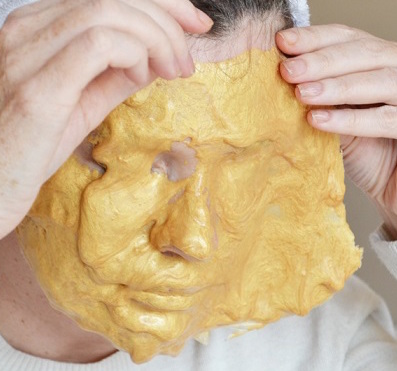
Peel off maskHere’s the best part: Jesus went to embrace her, but just before the embrace made a face of subdued revulsion and turned away.  It was at that point she realized she was coated from head to toe in some utterly disgusting filth, something “like diarrhea.”  Jesus telepathically told her these were her accumulated resentments.  The next parts of her NDE involved ways of shedding them, of learning love as her purpose on earth.

In all the NDE stories I’ve heard, complex spiritual truths are condensed into vivid, resounding images that capture complexities at a glance.  This girl, angry and on the brink of joining gang life, was coated in shit.  Her resentments repelled god’s love.  Yes, her NDE permanently altered the trajectory of her life (today she’s a nurse), but we alcoholics  can learn the same lesson without dying – it’s right there in our Big Book:

“…[T]his business of resentment is infinitely grave. We found that it is fatal. For when harboring such feelings we shut ourselves off from the sunlight of the Spirit. The insanity of alcohol returns and we drink again. And with us, to drink is to die” (p.66).

In my own NDE, which I experienced as an atheist, I plunged into the sun as the source of all life – i.e. the closest thing I knew to god’s embrace – and was surrounded by the Light, a love and bliss more potent than words can convey.  Lately, in going through difficult times, I’ve often found myself praying to feel just a little bit of that Light again.  Please.  Just a little. 

What I was not doing was working my steps.  I didn’t feel like it.  For about six months I’d been not writing a 4th step started on my ex-boyfriend, and more recently on former tenants.  If I was carrying any resentments at all, there was certainly no ire behind them, so why dwell on them with a full inventory?  Why waste the time?  I tend not to see what the steps have to do with the Light, heaven, etc.

Recently, however, my sponsor gently informed me the time had come for me finish that thing and read her my 5th step.  She set a date one week out.  BAM!  So, reluctantly, I dug into the work, listing everyone’s “offenses” and why they hurt me, but then tracing out how I, myself, helped to bring about each one.  I met my sponsor’s deadline for the same reason I still go to meetings: what I don’t want to do, I know deep down, is what I really need to grow in sobriety.

I read her my fifth step.  A wise woman, she pointed out my current character defects:

  • not seeing the truth because I fear loss and prefer my concocted stories
  • not speaking my truth out of fear of conflict or loss
  • not honoring Louisa – failure to act on my own boundaries

These were lesser forms of my same old defects of dishonesty, selfish manipulation, and victimhood from 5th steps past.  Lesser – but they’re still diarrhea!  Since then I’ve prayed, not to feel the Light, but for help releasing my defects and completely forgiving those I’d felt wronged me.  For two weeks, I’ve been repeating out loud, “I completely forgive you, [name], for anything I thought you did.”

Guess what’s happened?

Thinking of my mom the other day (who was not on the inventory), I suddenly appreciated her in a whole new light: I loved her more ever.  Same with my friends, my dog and chickens, and even my messy home.  It’s everywhere, this stuff to love!  Trees!  Chihuahuas!  Passersby!  Loving stuff, I sometimes feel swept into the frothy fringe of something… amazing.  It’s a glow, a tantalizing giddiness at getting to be here: a tiny taste of the Light.

I’ve shed one more layer of shit.  It works only if we do it, this 202 word pathway to a beautiful life!

“We have found much of heaven and we have been rocketed into a fourth dimension of existence of which we had not even dreamed.” (p.25)

scroll

Post to Facebook

1 Comment

Filed under AA, Addiction, Afterlife, Faith, Recovery, Sobriety, Spirituality, Twelve Steps