Tag Archives: Alcoholism

Is Plain Old Living Fun?

Active alcoholics, it seems to me, often crave action, adventure, glamour, and a lot of craziness, usually as ways of getting attention.  johnny-cash-finger-2I know I chased all these things – and loved to mentally flip off anyone who told me to settle down.  I see this tendency still in newcomers and chronic relapsers.  Hell, yeah, mothahfuckah, I’m a bad ass!  I’m wild!  Carpe F-in’ Diem is my middle name!

In my addiction memoir, I talk about the god-inspired (and abrupt dog-death inspired) aha moment when I realized the Pied Piper of the ultimate party, a phantom I’d been chasing all my life, was actually a demon who would lead me to my death.  Another face of that demon is dissatisfaction.  It’s discounting all that you have as not good enough while elevating the lure of something shiny – a party, a romance, a feat, some moment in the spotlight – as the prize that will fulfill you.

I’ve written before about the crisis that washed over me in 2012 with the one-two punch of my siblings venting emailed rage about my memoir (I was a narcissistic, AA-brainwashed liar dishonoring our family) and the news that I had breast cancer, both in the same month.  I’ve also written a bit on the way the intensity of that pain/fear acted on me like a forge, recasting me with a changed outlook.  Pain, the Big Book tells us, is the touchstone of growth, and all of us have to pass through our own to gain wisdom.  But the view from this side is something I can try to describe – something that may be of use.

Back in the day, I was constantly trying to fill the gaping hole in my chest with SOMETHING.  Alcohol, drugs, relationships, excitement, drama-analysis, fglamorood.  I knew my life shouldn’t be what it was.   I could read our culture; I could perceive what was rated glamorous or worthy; I understood the goal.  Media of all kinds broadcast examples of who and what was interesting and enviable.  I internalized all that and judged myself inadequate.

And yet at the same time, I drank to rebel against all that shit.  Drinking made whatever the hell was going on now just fine.  Sitting home alone or at a dive bar, I was a rugged individual who didn’t give a rat’s ass what anybody thought of me.  One of the best magical spells worked by alcohol was its jacking up my ego ipso facto.  I didn’t have to do anything but swallow to render my life a poignant drama worthy of attention.

So… I’ll be 20 years sober in two weeks, on the 29th.  I’ve walked a long road since those days, calling on god and gradually strengthening that relationship, so that while I used to “check in” with god through prayer, now god and me hang out 24/7 (although I think now more in terms of my guardian angel).  In any case, with spirit filling that hole, what life is about becomes a whole lot different.

Beautiful

To love life itself is an active enterprise.  Love flows only one way – from your heart outward.  But the marvelous thing is that it bounces back as reflection, whether from people, physical things, or even memories.  The more you love, the more love fills your life.

At some point, I realized how deeply in love I am with ordinary, boring, day-to-day life.  When I take the time to consciously love it, even the most mundane details reflect back their beauty and infinite preciousness.  Why infinite?  Because life is a chunk of a few decades cast against eternity.  Though I believe our spirits live on beyond our bodies, I also think that being in our bodies – spirit made flesh – is an amazing trip, a hybrid 3-D extravaganza of multi-tiered awareness.  Consciousness itself is a wild ride.

My cancer was caught early.  For a lot of people, like pancakesmy sister and friends, it wasn’t.  I get to be here.  What tremendous fun it is to make a pot of tea!  Will you look at this cozy I crocheted for the tea pot?  It’s yarn of bright colors, blue and yellow, and stained under the spout.  A little slice of living; the way things work. The trees out my window are earnestly being trees – those same things we drew as children, the green ball on the brown stick.  God, I love them!  My rug is worn threadbare from all the life that has tramped through this house – my son and I, friends and sponsees.  I have to go to work.  I don’t like work.  But I love the whole experience – getting to be a person who says, “Shit!  I have to go to work now…”  A person who drives just like everyone else.  Who hopes to be liked Carand to understand things and yet worries.  I buy apples and bring them home.  All the tiny chips of this life mosaic grab my attention one by one – but only for this little chunk of years.

I guess words are failing me as I try to describe this shift from taking everything for granted to seeing it, living it, loving it.  Mindfulness is the noticing of everything.  Gratitude recognizes the good things we have. But to really savor life is to go beyond both: it’s to notice each detail and call it good, delight in the sheer fun of it.  It’s to adore the whole kit and kaboodle.

I still like wild fun and adventure.  It was an adrenaline rush to zipline through a rainforest canopy on my vacation, to be the first in our group to jump from a 200 foot platform and shoot down the mountainside.  I love wilderness hiking, treks that some people would call extreme, either alone or with my boyfriend.  (He rode his bicycle alone 1800 miles from the Yukon Territory to his home on an island north of Seattle – that’s a bit much for me.)  I love dancing advanced ballet (and well), sweating alongside teens who could be my granddaughters.  In all these things, the stream of stimuli comes fast and thick.  Sometimes overload still thrills me.

But it’s not what I live for anymore.  Today, I live to be alive.

scroll

still life

3 Comments

Filed under AA, Alcoholism, Happiness, living sober, Recovery, Sobriety, Spirituality

Freedom: the Gift of Recovery

Got a few resentments in AA?  Certain personalities in meetings annoying you?   Big Book thumpers causing internal eye-rolling?  Somewhere inside, are you thinking you may be able to manage your alcoholism yourself – that it’s really not such a big deal?

Maybe it’s time for a little ATTITUDE ADJUSTMENT with the help of this visual aid I lifted from the Wikipedia page on alcoholism.  It’s an engraving from the mid-1800s called “King Alcohol and his Prime Minister.”  Check it.  (It’s enlargeable. )

King_Alcohol_and_his_Prime_Minister

CLICK to zoom: King Alcohol & his Prime Minister, engraving by John Warner Barber (1820-1880) .

In the background on the left, we’ve got the normies drinking with impunity.  A little closer we’ve got the socialites making cocktails look 19th Century glamorous.  But once we get to the Dram Shop, which is the old term for bar or tavern, things ain’t lookin’ so good.  Sure, there’s a pretty barmaid serving, but one patron is looking pretty disheveled, two are brawling on the floor, and another is passed out.  In the foreground the Virgin Mary is seen bumming about it all (at least, I think it’s she).  The anchor could refer to maritime alcoholism?

On the right we see some consequences listed: Poverty, misery, crime, and death.  There’s the jail, the poorhouse to which with someone is escorting a drunk, a cop with his nightstick dealing with another. We see a home gone to shit, a dad passed out while his wife and kids stand by, and closest to us, a rich guy all dressed up but still on his face.  Closer still are the graves, one of them immediately outside the home.  Jails, institutions, and death – as we often hear in the rooms.  The only thing I don’t see is an asylum.

Lastly, check out King Alcohol and his sidekick Death, themselves.  Death’s bottle is corked: he doesn’t touch the stuff, only offers it to recruits.  The King himself looks confused and miserable in spite of his lavish banner.  His face has marks all over it, his brow is furrowed, his hair and beard a mess.  Around his neck what seems an amulet is actually a locked chain, and chains run down his robe in place of royal ermine.  He holds aloft a large goblet, almost like a chalice, but encircled by a snake.  Above it hovers a reference to Proverbs 23, line 32:

31 Do not gaze at wine when it is red,
    when it sparkles in the cup,
    when it goes down smoothly!
32 In the end it bites like a snake
    and poisons like a viper.

Whoa.

If you lived in the 1800s, that would be the full extent of your program:  “Do not….”  Don’t look at booze, don’t drink booze.  Just don’t.  Just stop.  Look at the facts.  Use your willpower.

“Do not…”  If I’d been born during that time, I’d be a perma-drunk or dead.  Because I tried “do not” for 14 years and ended up bombed every night, like my father before me, because the “wine” I would “gaze at” lived in my mind.  As soon as enough of the poison had cleared from the night before, I’d think, “Yes!  I’m talking about just one pretty, perfect cocktail/ beer/ glass of wine!”  Next thing I knew, I was reaching for that snake-entwined goblet, oblivious to the bite and poison.

And I did that again.

And again.

And again…

It cracks me up that at the top of King Alcohol’s barrel list is “strong beer” – as if “weak beer” might be okay.  In other words, even in his desire to capture the entirety of alcoholism, Barber lacked a basic understanding of addiction: the allergy in me – which makes me break out in endless “more!” – can be triggered by as little as a single dose of cough medicine.

What Barber did understand, though, was that we die.  We’ve been dying for millennia, at least throughout the 10,000 years that humans have been brewing alcohol.  Slowly, century by century, those of us with alcoholic genes have been winnowed from those European cultures where alcohol has long been a staple – a fact highlighted by rampant alcoholism among Native American populations where alcohol has been introduced only in modern history.  Why do 10% of Native Americans die of alcoholism, compared to 0.2% of Italians?  Because most Italian alcoholics are already dead!  They died centuries ago leaving fewer descendents.  Still, around the world, how many of us are killing ourselves slowly, blurring our thinking, drowning our love of life?

You might wonder, why did Barber choose to depict alcohol as a king, rather than a slave driver or a warlord?  The answer is in addiction.  Alcohol rules our lives, but at the same time, we venerate it as our savior.  Left to our own human powers, there is no way out.

BUT HERE’S THE GOOD NEWS!  I’m sober!  You’re sober!

In June of 1935, the world of the alcoholic changed forever.  Fifteen minutes is how long alcoholic Bob Smith agreed to talk with that sober guy, Bill Wilson.  Three months is how long they ended up hanging out before Wilson even went home. They had discovered something amazing: the connection between one alcoholic and another when speaking the truth of our condition.  They also put together the physical allergy piece Bill knew with the spiritual malady piece Bob knew and – SHAZAM!!!  For the first time in human history, alcoholics had a way out!

Never again will we as a class of afflicted people have no solution.  Shivering denizens no more, we’ve found a way to overthrow the tyrant with a far greater power – one of love, of life, of goodness.  Whether you live near a slew of AA meetings or it’s just you with your Big Book and computer, you possess two insights that Barber and the dying drunks throughout history never had:  1) That your body reacts differently to alcohol than a normal body does, and 2) that alcoholism can be treated via a 12 Step program of spiritual growth, usually (but not always) in connection with fellow alcoholics.

What I know is this: Living sober has brought me and countless other hopelessly doomed alcoholics a joy of living beyond our wildest dreams.  We are free.

scroll

2 Comments

Filed under Alcoholism, Recovery, sober, Sobriety, Twelve Steps

Doing the Opposite: A Christmas Story

Night before last I was in the dumps – just tired of frickin’ everything.  So I threw a party.  I shit you not.

This is the principle we hear of a lot in the rooms – to do the opposite of what we feel like doing.  I’ve been around long enough to know it pays off, and to understand that the loudest voice in my head is usually not the wisest.

Take day before yesterday, I was sitting in my empty house in the same odarknessld chair where I always frickin’ sit, looking out the same damn window at that same damn tree.  I was also looking at the weeks ahead – the darkest of the year (in Seattle, dusk begins to fall around 3:30).  I don’t do well in the dark.  My brain’s amygdala gets its mitts on a little fear-powered megaphone, so it was broadcasting loud and clear like this:

“What is my life, really?  Work.  Pay the damn mortgage – house falling apart.  More work.  Buy groceries, eat ’em, pay the damn sewage bill.  Clean my ever-dirty house.  Exercise to fight getting old.  Get old.  Ach! – how much longer do I have to do this shit?!  I’m 54, so… like… 35 years, and then maybe I’ll get put in a home.  God, I hope I don’t Facebook there!  I am SO sick of EVERYTHING.”

Screen Shot 2014-12-13 at 11.55.41 AMAt that point, some little alarm light tripped in a different part of my brain.  It said, as god often does, “BULLSHIT! BULLSHIT! Re-examine!  Spot inventory!”

Scanning myself, I realized I was angry – unconsciously hurt and angry.  I’d been planning a weekend with my boyfriend on the beautiful island where he lives, even rearranged clients so I could catch an early ferry, then he texted that he was being sent to Copenhagen.  Boom.  Empty weekend.  My son would be at his other mom’s.  I’d be alone.

Somehow, the part of my brain that’s been paying attention in Al-Anon kicked in, letitbeginwithme1saying: “Let it begin with me!  Your happiness does not depend on what Grayson does.  Your life is rich and you are loved by many.  Be grateful!  Spend time with friends!”

Jesus, what bunch of goodie two-shoes platitudes!

Here, dear reader, is where one has to have eaten one’s spiritual Wheaties.  Because it takes a huge surge of faith to hoist yourself out from that dark groove fear has carved, turn away, and begin to do the thing you least feel like doing.  I know that loving other alcoholics helps me.  I know my house is very near my homegroup.  So I reached for my phone.  The dark voice threw everything in arm’s reach at my head as I texted a homegroup friend.

ME: If I have a game night tomorrow after the meeting will you bring games?  I don’t have any fucking games.

ROB: Sounds great.

ME: Should I do it?  I’m depressed so it seems like a huge deal.  I just want to sleep.

ROB: Me every day.

ME:  But will you come over even if nobody else does?  We can just play hangman or tic tac toe.

ROB: I’ll bring Suspend.

I took that as a Yes.  That’s all I needed – just one friend who understood.  Forcing myself, and with the dreariest look on my face, I created an Event entitled, “Post-Meeting Games and Shit” in our local Facebook AA group, which promptly invited all 97 members.  By the next day, my best friend, a sponsee, and one other person had accepted.  The dark voice gloated about my pathetic neediness, how I should just watch TV alone like normal people.  It buzzed in the background like a big zizzy fly while I cleaned my house and bought four jugs of spiced apple cider.  Just getting the dining room table cleared of clutter for games took literally hours!

After the meeting I checked in with some non-Facebook friends, who had other plans.  A few said they might be over.  So I went home and plugged in the Christmas tree.  I turned on Pandora carols and set a big pot of cider on the stove.  My dog looked at me.  I got down a bunch of cups while the voice warned, “You’re going to feel so stupid putting these away again!”  No one came.  I added a bunch of wood to the fire.  The carols played on.  My dog scratched himself.

Then, finally, he barked.  The doorbell.  One or two at a time, a dozen homegroup friends plus two newcomers climbed those freshly swept steps with food in their arms and light in their eyes, and they brought… god.  That’s the only way I can say it.  Because I loved them!  All ages; all walks of life; all sober.  Each had overcome their own dark voice to show up.  Rob unpacked Suspend on the shining wood table where people gathered talking about how Bing Crosby beat his kids or how expensive that bakery up the street is, and, wait, what are the rules again?  Before long we were ooing and ah-ing at daring Suspend feats.

Human voices, their teasing, their laughter filled up my lonely house – and I remembered what life is, saw it like a forgiven lover.  I am so in love with my life!  We went through the cider.  We ate the food.  My party2sponsee’s gift was an updated Trivial Pursuit that a bunch of us played in the living room, awarding pie slices that people hadn’t even won because fuck it!  That question was dumb!  I saw the goodness, the vulnerability of the new people joining in, and the beauty of my friends in ever-more subtle colors.

The dark voice shriveled, its megaphone dead.

Last night rekindled something in me – Love – enough to carry me through the darkest days ahead.  Once again I remember that all my difficulties – my loneliness, my endless bills, my sorrow at getting older, and stings of life’s disappointments – are not mine.  They’re ours.  We do this thing together.

.

“We know what you are thinking.  You are saying to yourself, ‘I’m jittery and alone.  I couldn’t do that.’ But you can.  You forget that you have just now tapped a source of power much greater than yourself.” (A Vision for You, 163)

Life is yours.  Go n’ git it!

CAM00419

Left by one of the smokers on my front step. To me it reads, “I love love”


scroll

5 Comments

Filed under AA, Al-Anon, Alcoholism, Recovery, Seasonal Affective Disorder, Sobriety, Spirituality

Authenticity in the Rooms: Striking a Sober Balance

This above all: to thine own self be true, And it must follow, as the night the day, Thou canst not then be false to any man.”
——————————————— Polonius – ass-kisser & schemer (Shakespeare)

“The paradox of self-honesty is that I need the help of others to achieve it.”
———————————————(Courage to Change, 296)

Inscribed on many AA coins is the wisdom byte, “To thine own self be true,” which was probably already time-worn when Shakespeare put it in Polonius’ Shakespeareadvice speech in Hamlet. Whoever Shakespeare was, I’m sure he was crafting irony by doing so: Polonius is false to everyone, including himself.  Shakespeare’s message, as I see it, is that being true to oneself is far more easily said than done.  In fact, striving for personal authenticity is the work of a lifetime.

Many of us believe we’re being true to ourselves when we regurgitate whatever the dominant culture – or our faction thereof – has inculcated in us.  Oprah said it.  Parenting magazine.  Dad and the NRA.  For that matter, individualism itself is an ideal of Western culture.  Because we’re all an amalgamation of the belief systems we’ve been raised with, spouting what these systems maintain in the face of other systems feels like authenticity, even if it doesn’t come from our spirit.

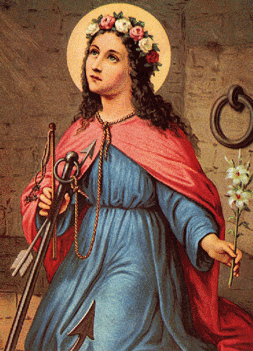
As James Fowler outlines in his book, Stages of Faith*, the search for deeper levels of meaning requires an ability to stand back from our beliefs and evaluate them critically, changing what no longer rings true – even if it requires a break from our past or our clan.  Otherwise, our faith remains childlike.  He identifies Stage 1 faith, for example, in a Catholic woman he interviewed who, interpreting every symbol of her religion literally, staked an almost philomenamonetary worth in telling her beads (points “in the bank”) and worried about pissing off various saints by neglecting to pray to them.  At the other end of the spectrum, Fowler places visionaries like Gandhi or King who staked their lives on a faith in love beyond the norms of their society, valuing good for humanity over good for self.

It’s the difference between obedient adherence to mere form versus courageous application of import. The more we develop toward the latter, Fowler says, the deeper our faith, and the more meaningful our lives.

When I came to AA, my belief system was a mess of contradictions.  Most of what I’d cobbled together to live by had to be straight up chucked in favor of love & respect for people from all walks of life and an ethic of usefulness – values that proved their worth as they lifted me from despair to vitality.  AA sponsors, friends, and sometimes strangers who spoke in meetings – these people taught me how to live.  It’s a process that continues to this day.  Listening, I’m transported outside my own experience into the perspectives of women and men who differ from me in countless ways, yet share my diseased alcoholic mind.  My fellows in AA and Al-Anon have become a sounding board for my tentative thoughts as I navigate the unknowns of today.  Their feedback pushes me beyond what I want to see, pressing me to be ever more honest with myself.Year1AA

Even so, I need to examine AA meetings with some critical distance, as well.  AA is amorphous, because meetings are only as constructive as the alcoholics attending them.  A group of sick people makes a sick meeting.

Dry Drunk** Meetings, for example, have cast aside the Big Book in favor of some kind of open-season group therapy.  Shares focus solely on “checking in,” usually venting frustrations or confessing destructive behavior, all of which is swept aside with the phrase, “but at least I didn’t drink!”  Here plug-in-the-jug abstinence is touted as an asset, even if I’m still an asshole tortured by the fear and self-loathing I once treated with alcohol.  I myself spent the first two years of my sobriety in such meetings, which brought on a debilitating depression.

At the opposite extreme are Competitive Sobriety Meetings, which feature the same schtick over and over: My life sucked, but now I work the 12 Steps constantly, and everything is wonderful!  Yes, dammit, wonderful, because I have 7 sponsees, 5 service positions, 3 home groups, write a 10th step every fucking night and read 86-88 every morning, etc. – so my sobriety is way better than yours!  Here the search for authenticity has been abandoned.  In fear of relapse, I cling to the RIGHT ANSWER.  The second two years of my sobriety were spent developing resentments in such meetings.  The solution was there – yes – a solution that saved my life.  Still, much like Fowler’s Stage 1 woman with her virtual Ken and Barbie saint collection, such meetings tend to make a golden calf of the AA program and its history.

Where is balance to be found?  What rings true?  That’s up to… thine own self, baby!  Today, I have a home group that feels like home.  For me, the most important growth guide is based, not in set rules or standards, but rather in my ways of being, my modes of consciousness – in my awareness of my awareness.  To what degree am I willing to be vulnerable and loving, to admit that I don’t know, but to keep trying regardless? At a dry drunk meeting, can I offer the solution to those who want it, without judging those who don’t?  In competitive sobriety meetings, do I have the courage to speak of my continuing human struggles?

J.K. Rowling may seem a questionable sage, but as I’ve been reading Harry Potter to my son, I’ve noticed how frequently she has Dumbledore preface statements with “I think…”  Unlike Polonius, Dumbledore understands that he is fallible, mourns past mistakes, and acknowledges that he cannot trust himself with power.  His wisdom shows itself as recurring acknowledgement that he may be wrong.c23-horcruxes

In sum, we’re always trying, never done.  Sobriety and spiritual growth are, like life itself, forever touch and go, a muscle that begins to atrophy as soon as we rest it, a puzzle we work on daily even as pieces constantly vanish and reappear.

.

scroll.

* Much of this book deals in depth with developmental psychology, but it’s still an interesting layman’s read.
**For more on Dry Drunk syndrome, see this great article by Liberty Ranch recovery.

Leave a comment

Filed under AA, Alcoholism, Recovery, Sobriety, Spirituality, Twelve Steps

The Codependent Alcoholic’s Quandary

Sometimes I feel pulled in opposite directions by my two programs – AA and Al-Anon – though the confusion actually arises, not from contradiction between them, but from my muddled thinking as a codependent alcoholic.

Bill and Lois

Lois and Bill Wilson, co-founders of Al-Anon and  AA, respectively

AA tells the alcoholic in me that “Our very lives, as ex-problem drinkers, depend on our constant thought of others and how we may help meet their needs” (20).   On the other hand, Al-Anon tells me that “…many of us develop the habit of putting [another] person’s needs first… To recover we have to learn to keep the focus on ourselves” (9).

How can I do both?  How do I constantly think of your needs and keep the focus on me?

When I was new to AA, I resented the idea that selfishness was the “root of [my] troubles” (62).  I was a victim.  Other people hurt me.  It took years of meetings and a fairly forceful sponsor to open my eyes to the ways I victimized myself.  Living in ego, I was “[d]riven by a hundred forms of fear” (62) that there wasn’t enough to go ’round and I wouldn’t get mine.  My sponsor taught me how my egocentric expectations that others do whatever would make me most comfortable laid the foundations for a life of discontent.  (See What a 4th Step is and Ain’t)

In AA, to stop being a black hole of need, we have to literally reverse the direction of our energy flow.  I had to learn to see others, not as appliances, but as fellow children of god to be loved.  Luckily for me, god set me up a bunch of tutorials in this matter.  Here’s one:  In early sobriety, I used to envy a beautiful young woman who secretaried a huge meeting, ever popular and lusted after, dressed to the hilt week after week.  She later relapsed, fled to her friends’ home, and while they were out, chugged a bottle of Drano from under their sink in an effort to die.  Last I spoke with her several years later, she was still missing much of her esophagus and needed a feeding tube to eat.  Her heart itself was scarred.

That’s the pain of alcoholism we share, sans a spiritual solution. Once I could begin to know and internalize that others struggled with the same invisible demons that I did, I could begin to give from the heart.  What the founders of AA knew was that sometimes you have to prime the pump by going through the actions before you feel the spiritheart-chakraThat’s why service work is such a foundational part of our program.  When I feel the outpouring of my own good intentions in making coffee or taking time for a sponsee, I begin to actually want good things for you – to love you.  As my love flows out to you, love from god flows into me, filling my emptiness – and I am healed!

That’s just a spiritual law.

Meanwhile, back at Al-Anon, the core of the program is “Live and Let Live.”  That’s actually two sets of instructions.  The first one, “Live,” means be true to yourself – know yourself, be yourself, love yourself.  Each of these is, for me, a 400-level grad school course that meets 365 days per year.  It’s tough!  When I was new to Al-Anon, I resented my sponsor’s conjecture that I probably didn’t know what I wanted.  How ridiculous!  I’m a very passionate person!  Of course I know I want… I want…

What do you think I should want?  I kinda like ABC – is that okay?  Do you like it?  Really?  So, you must like me!  Yay, I win!

In Al-Anon I realized that I had little to no center, that I’d been a reactor allwhoami my life. I set up relationships of turmoil to keep myself busy so I’d never have to take responsibility for my own happiness.  The greatest distraction from my assigned work of “Live” was harping on how you ought to live.  Really – look at yourself!  You’d be so much better off if you just did X, Y, and Z!  And I can’t do ABC because you hold me back!

Here comes the second half of the Al-Anon slogan: “Let live.”  Okay.  You are sole boss of you.  I haven’t lived your life up until this point, so I can’t know what’s best for you.  That’s between you and your higher power.  I can only tell you how your actions impact me and what I need, and then, based on your response, make choices for my own behavior (which may include parting ways).

But guys, you know what’s still hardest for me?  Weathering disapproval from people who believe they know better than I what I should and shouldn’t do.  You may have your own set of judges, but mine are my siblings; my recovery in AA put us terribly out of step.  Apparently I love, climb, parent, and write wrongly.  For many years I struggled to win their approval, mistaking that effort for “how [I could] help meet their needs.”  But the truth is, no one needs to approve of me!

This is where Al-Anon’s “focus on ourselves” comes in, to help me recognize internal factors – hello! fear of conflict! external locus of self-worth! – that are harming me and helping no one. I can easily detach in other parts of life, but to practice detachment with our first family requires, I’m beginning to think, a black belt in Al-Anon.  I’m still very much a work in progress.

The goal in both AA and Al-Anon is to grow toward my god rather than as dictated by my ego or someone else’s.  God moves me to love and help others, but never toward what I decide they “ought” to be, or in ways that harm my own serenity.  To achieve balance, I have to accept that my doing good for anyone depends on the foundational practice of self-care and self-love, so I can show up with my unique strengths and radiance – complete, confident, and compassionate.

Some day, that’ll be me with my sibs!

.

scroll

Leave a comment

Filed under AA, Al-Anon, Alcoholism, Codependence, Recovery, Sobriety, Spirituality, Twelve Steps

Holiday Parties: 6 Tips for the Recovering Alcoholic

…and why they may be utterly useless

booze-banner-2
.
‘Tis the season when a lot of us get invited to gatherings where the alcohol flows. If we go, we may find ourselves among normies for whom “drinking means conviviality, companionship and colorful imagination,” as well as some pre-bottom drunks.  Because they’re outside recovery, chances are they’ll be a world away from understanding that for us, to drink is to die.

young-people-in-clubdrinking-

drinks we see others taking with impunity…        

Normies view alcohol consumption from the perspective of a normal body and mind, which they assume (come on!) we must  have, too – the kind that can moderate alcohol intake at will. Believing this, they may interpret our abstaining, not as avoiding the poison that can bring down in ruins everything we love, but as a party-poopy failure to “join in the revelry.” Even if we say flat out (as I do), “I’m an alcoholic,” some can’t seem to grasp what that means.  They urge, cajole, and act baffled — or mourn for us.  “What?!  We’re talking a single glass of X, here!” (insert spiked punch, spiked eggnog, spiked cider, or plain old booze).

Standing by our own truth in the face of such reactions can be, for the more codependent among us, socially difficult.  What’s more, watching others take drinks with impunity amid all the sensory experiences of alcohol – hearing the ice clinks, seeing it pour, maybe even smelling it – Whoa! – can rouse our addict from its slumber, enabling it to launch a marketing campaign about the radness of just one drink.

drunk-people-grin

…it’s never enough

Yet the Big Book tells us, “any scheme of combating alcoholism that attempts to shield the sick man from temptation is doomed to failure…. So our rule is not to avoid a place where there is drinking, if we have a legitimate reason for being there.”

Everything hinges on spiritual fitness, which I’ll discuss a little further down. Meanwhile, here are six tips that have helped me feel more comfortable at events where alcohol is served.

  1. Go in the spirit of usefulness, not to “get” social points or further your “little plans and designs.”  My sponsor used to tell me to see “what (I) could pack into the stream of life.” I show up to give. I can give others my attention, my humor, my encouragement, and my caring for them.  If it’s a homemade party, I can ask the hosts what I might do to help. What matters is not how these offerings are received, but the spiritual flow they put me in.
  1. Bring a supply of kick-ass non-alcoholic drinks if possible, that is, if it’s not a fancy catered type thing. As above, bring them not only for yourself, but others. “Hey, I just happened to pick up some Reed’s Ginger Beer, Martinelli’s, and this amazing Trader Joe’s whatever on my way over! Enjoy!”
  1. Have a recovery buddy. Either bring a sober alcoholic with you, or arrange to check in with one before and after.
  1. Pray your ass off. Pray before, pray during (in the bathroom or just your mind), and pray again when it’s time to leave. “God, please help me remember what’s truly important, who I am, and that you’re with me” might be a better prayer than “Help me not drink.”
  1. Know your boundaries before you go. Once we get somewhere, it may feel loserish to leave early, but screw that. Know in advance that as soon as people start slurring and discussing their favored sexual positions, or when a certain hour arrives, you’re gone.
  1. Have something cozy waiting at home. This can be reunion with your beloved pets/people or some treat you decide on in advance: a good movie or book, a slice of cheesecake, blankie & PJs, or all of the above – whatever makes you happy.

Now for the spiritual fitness part: None of these tips will be worth jack if you don’t love your sobriety.

As a newcomer, you may not think you love it, but at some level you do, because it’s your core, your truth, your life. You want to grow and thrive, and while your addiction promises you guzzling will accomplish this, you know better.

I love my sobriety fiercely – as fiercely as if it were my newborn child. It’s only as old as today. Some people might bring their newborn to a whoopee party. I do so when I bring my sobriety, cradling it close. Some might set their newborn down on a table and wander off in search of social adventures, forgetting about it. Others may decide partway through the party that toting this newborn around really inhibits their having a good time, so they’re just gonna chuck it in the garbage tonight and cut loose.

Any time a well-meaning acquaintance urges me to have a drink, they’re holding a garbage can under my newborn. They have no idea what deep fury they’re fucking with. My sobriety is the source of my joy, my awakeness, my love for all the beauties of this life – and no dumbass party can tempt me to drop it. I don’t need to vent this at them; I just need to remember my life is at stake.

Yet, dear readers, the inescapable fact remains that I can’t always remember.  Addiction lives inside my brain – the very same brain needing to remember. It can usurp the helm at any time and disguise a drink as a fine idea.  AA’s ‘spiritual fitness’ refers to my connection to a god that, for reasons unknown, intercedes during these curious mental blank spots to let me pause (provided my steps 1, 2, & 3 stand in earnest) until the truth returns.  To the extent that following these tips reflects my commitment to those steps, they may help me enjoy myself in the midst of boozers.

Yet the bottom line remains: Party or no party, tips or no tips, I’m safe anywhere if my god is with me, and nowhere if it’s not.

.scroll

where it leads

21 year old girl, drunk, killed family of 4 as well as her two passengers.  Will she continue drinking, no matter how much she wants to stop?

4 Comments

Filed under Alcoholism, Recovery, Sobriety, Twelve Steps

Compassion – the best thing you can do for yourself

“Think of others as you would have them think of you.”

.

Self-centered like me?  Love others.  Got problems?  Give it all you got.

It may seem counter-intuitive, but practicing “love and tolerance” (p. 84) for all brings enormous spiritual, mental, and even physical benefits.  What I think about you inevitably colors the attitude I have toward myself, which in turn shapes my experience of life. We can know this based on anything from having lived it to abstract theories of quantum physics telling us the universe is made of energy.  What you dish out is ultimately what you get.

Years ago I recognized myself in a share by my friend, Andrew K..  He told about a time near his bottom when some friends Door peepholestopped by to see him.  From the upper story of the split-level where he lived, he silently crept down the stairs as the friends went on ringing and knocking.  Cautiously he peered out through the peep-hole to see them standing on the front slab exchanging conjectures about him.  What did they want?!  Whatever it was, he couldn’t handle it.  He just didn’t have it in him. Pleased at his evasion, he retreated oh-so silently up the stairs.

Andrew contrasted the story with his experience around Step 7:  “The more I judge you, the more I’m sure you’re judging me, so I actually experience that judging and judge myself.  And on the flipside, I’ve found that the more I let you be you and maybe even love you for it, the more I assume you’re okay with me, and so I’m okay with me.”

Our culture of scarcity encourages us to hoard love, but spiritual axioms teach the opposite.  The doors of the heart need to be oiled daily so that they’ll open even for strangers who “don’t deserve” our love and the very people who irritate us, as well as those in our inner circle.

We do pour out love toward a certain class of strangers all the time.  Yesterday during my ballet class, babyfor instance, we could hardly keep dancing for all the affection we were flooding through the studio’s big storefront windows.  With Halloween a week away, neighborhood retailers were holding a “Safe Trick-or Treat,” so the sidewalk featured a constant stream of bumblebees, superheroes, and characters from all kinds of stories.  Dressed as a dolphin, a woman handing out candy stood with her back to us, so the children would pause facing the glass, where we could see them perfectly.

Our teacher couldn’t help interrupting herself again and again.  “Oh my god, it’s Princess Leah!”  We all looked, and what I saw almost overwhelmed me.  She stood about two and a half feet tall in a flowing tunic, the classic dark buns on either side of her head slightly askew.  Tentatively, knowing what she was supposed to do, she approached the dolphin woman, her eyes staring up with a mix of trust and caution.  People flipped her off.  They called her a fucking bitch.  They judged her as a slut or a failure or beneath their concern — not yet, not yet, mind you.  But in her future.

Tiny Princess Leah was only doing her best, as she will throughout her life, and as will the Incredible Hulk who followed her with his impossibly muscled little green chest.  Already, they’re being taught who to be and how to get stuff.  We find it natural never to judge them (greedy little schmucks!) for what they “ought” to know or do.  To love them freely is ingrained in our culture.

Just for today, what if you practiced seeing the toddler in every person you interact with?  The spirit within that person is exactly the same.  Or what if you tried calling up a “legitimate” feeling of love – a glimpse of your loved one’s inner beauty or a sleepy kitten snuggling against you – and purposefully grew that energy in your chest like an expanding sun until it shone on every sight, sound, and experience?  Commit to loving.  Keep it like an inner homefire that must never go out, not even when fear tries to snuff it or anger tries to blast it from you.  Hold onto it as your homage to goodness, and practice radiating what it generates in all you think and do.

Sun

This under your sternum.

What you’ll get is a world transformed by love.  Today I notice small gestures of love from others that I used to discount as empty manners.  I joke with strangers about the dumbest shit, and to me our shared laughter rings out more beautifully than church bells.  I’ll never be some spiritual giant.  I wrestle daily with a shitload of fear.  But love is god’s power, and I’ve found that channeling it actually lends me power over fear: I sense an active energy of goodness all around me.  The world will feels safer.  If you’re coming from a place of love and encounter darkness in others – cruelty or deceit – you feel it as the anti-matter of goodwill and respond with mourning more than angry contempt.  The difference is huge.

Finally, when you least expect it, awareness will slip in that you, too, are loveable.  It’s hard to grasp, but in this moment, you – despite everything you regret in your past – are as innocent as you were at Princess Leah’s age.  Society sells you its weird customs and you suit up and give it a shot.  You look up toward life’s unknown with the same mix of trust and caution.  You, too, are vulnerable and unique.  It’s okay to see that with love.

Loving the good in others and yourself will swing wide the doors of spirit so you can breathe, and play, and thrive in the freedom of generosity.  It’s either that, or keep peering through the peep-hole.  You can choose.

.

.

Leave a comment

Filed under living sober, Recovery, Sobriety, Spirituality

Step 9: Mending the Past

I’m sorry!  I’m sorry!  Who the heck wants to read about amends?  Nobody!  I don’t even really want to write about them, but I’m going to trust, and ask you to trust, that taking a good look will reveal their beauty.

Angry-WomanSo here’s the quandary.  You may hear people in the rooms kicking around the question: “Who are amends for?  Me or the other person?”  I recall about a dozen years ago hearing a woman announce with contempt, “I’m not making this amends for her!  I’m doing it for me!”  Something sounded wrong in that, but I wasn’t sure what.

Sure, the steps are our pathway to freedom.  But they work because they’re a pathway to change, not self-help.  Didn’t we try every way of helping ourselves when we were drinking, doing whatever our monkey-brains thought would work best?  And what happened?  As I seem to recall, most of us ended up alone and fucking miserable.  The fact is, self-help refers to motivational adjustments to an otherwise successful model of living, such as, “I’m going to exercise more!” or “I’m going to procrastinate less!” not, “I’m going to quit submerging my entire existence in a cesspool of self-disgust caused by senselessly poisoning myself on a daily basis!”

So, no.  We don’t need self help.  CAM00400What we need is a transformation, a psychic change beyond anything we could engineer ourselves that redirects our energy toward maximum usefulness to god and our fellows.  If Step 3 led us to stake the best 4th step inventory we could, if we’ve read it to a sponsor who’s made clear our faulty thinking, then something has shifted in us.  In Steps 6 and 7, we opened to asking god to render us better human beings.  Now we revisit our past in this new light.

When my sponsor asked me to generate compassion toward those I’d resented, it felt like she was asking for some crazy move of spiritual gymnastics.  But really, all I had to do is acknowledge that I’ve fucked up many times myself, out of fear and pitfalls in thinking.  Let’s say I was trying to protect my beloved A when I accidentally nudged B into the boiling oil.  “Doh!”  Or in reaching after that prized X, I forgot I was supposed to hold Y and let it fall into the mile-deep chasm.  “Shit!”  Maybe I heard the enticing, faint calls of  J through the tall grass and, in stepping toward them, crushed underfoot the tiny, delicate K.  “Oh, no! Poor K~!!”

Such botched moves fill at least 75% of my addiction memoir; they’re the stuff of which all our deepest conflicts are made.  That’s why my double backward flip in the pike position comes about as I accept that you, like me, were doing only the best you could.  Now watch this move in slo-mo: I decide to cut you the same slack I wish others might cut me – the slack to be human.  It may take me days or years to get there, but eventually, your wrongs become moot.  The focus closes in on the behavior I exhibited toward you.  Would I want those wrongs carved on my tombstone?  Do I want to carry them until then?

Oops!
Remember, though, that 9 comes after 8, and “became ready” refers to more than just working up nerve.  In early sobriety, I thought I was working Step 9 by writing impulsive letters to my ex’s and telling them way more than they needed to know. By contrast, when I worked Step 8 in earnest, my sponsor wrested my ways of thinking from old to new.  For each person on my list, she crossed out and scribbled notes all over the accounts of harms I thought I’d caused, eliminating 75% of what I’d thought was the issue.  Each time she had me…

1) highlight ONLY those behaviors and attitudes the person was well aware of, to avoid causing further harm

2) boil down the harms via the rubric of selfish, dishonest, thoughtless/inconsiderate

3) come up with one specific example to illustrate each

I was not to apologize.  Rather, I was to articulate the behavior I’d shown and the ways it was wrong, and to ask what I might do to set it right.  She said, “It’s like you left a turd lying somewhere in this person’s life.  You swoop in, say, ‘I believe that’s mine!’, scoop up the turd, and ask if you got it all.”

doveAmends don’t mean you become buddy-roos with the person.  And some may continue to lob fireballs at you, requiring you to maintain a safe distance.  But when I’ve sat down with people from my past and owned, often with my voice shaking, my very human fuck-ups, I’ve witnessed in almost every one of them the blossoming grace of compassion.  Many have spontaneously confessed fuck-ups of their own.  And sometimes, in the pool of truth we shared for those moments, I would behold in them a dignity and beauty to which our old conflict had blinded me.

The 9th step means taking our new way of life out into the world and trusting god in a free fall.  As I once heard it put: “I make amends to restore that person’s faith in basic human decency.  And when I do that, I restore my own.”


peace

1 Comment

Filed under AA, Recovery, Sobriety

Humility and Gratitude

“If you claim to have humility, you don’t have it.”  That saying has some validity.  But there’s a bigger picture here.  Saying you have humility is a bit like saying you inhale.  That is, it’s never a constant state we can hang onto, but part of a fundamental rhythm.  I’m not really sure what the hell I’m saying here, but I’m going to keep writing.

BoxerWe all have egos and self-will built in to help us hold our own in this hazardous world.  It’s when they exceed their useful scope, as they often do for alcoholics, that we run into trouble.  We become selfish and egotistical because those states seem to grant us power, to make us bigger and badder so we can vanquish whatever we fear (i.e. most of life).  Unfortunately, what they really do is shut us off from faith in god – our only true recourse against fear.

Richard Rohr, in his discussion of the Twelve Steps (Breathing Underwater), quotes the bible in relation to Step 7.  Now, don’t run screaming from this blog!  I’m not a Christian and, trust me, not even a monotheist, but that doesn’t mean I can’t recognize wisdom from a Franciscan friar who dares to challenge his church.   Just roll with me a minute.  Anyway, Rohr quotes Luke quoting Jesus: “It is easier for a camel to pass through camelneedlethe eye of a needle than for a rich man to enter the kingdom of God.”  But he moves right along from there.  He says it’s not the possession of stuff per se that blocks us from god, but an attitude of entitlement. “I am the shit!” is a stance that blocks us from spirit, as does its mirror image of self-c0nsumed self-pity, “I am a piece of shit.”  Neither can co-exist with humility and faith.

The points Rohr asserts that I want to highlight are these:  1) That our truth is not in what we claim to believe, but in the way we live.  2) That we pray not in order to “change God” (i.e. kiss ass and win approval) but to “change ourselves.”  3) That prayer opens us to god, and that the gist of all prayer – here I’m paraphrasing – is essentially, I lack.  I need you.  Rohr writes,

So it is important that you ask, seek, and knock to keep yourself in right relationship with Life Itself.  Life is a gift, totally given to you without cost, every day of it, and every part of it.  A daily and chosen “attitude of gratitude” will keep your hands open to… receive life at ever-deeper levels…

What really wakes me up is to substitute the word “sobriety” in place of “life,” above.  Sobriety is indeed a gift, given to me freely every day.  And it started on the day I turned to god and said simply, “I lack.  I can’t do this.  I need you.”  Something shifted then, some channel opened that allowed god to help me do what I’d spent years and thousands of desperate, failed attempts trying to do: Get well.  God, not I, removed my mania for drinking.

Prayer relinquishes the illusion that I can do life, including sobriety, on my own.  As a spiritual being, I am intricately connected to both my Source and my fellows.  Prayer acknowledges this, re-opening the channel.  And it stays open at meetings if I listen knowing I can’t stay sober on my own.  Here’s where that mixed nature of humility comes up.  Truthfully, I go to meetings in a hybrid of mind frames.  Part of me (ego) says, “I’m comin’ up on 20 freakin’ years, dude!  I so know this drill!”  Part of me (compassion) says, “I’m here to help the newcomer and those who are struggling.”  Meeting snowflakeBut a key part of me – the seed of genuine humility – says, “I am here to be taught.  I am here to listen to god speak through my fellow addicts; and whether they drank just this morning, are fresh out of prison, or have thirty years and sponsor a jillion alcoholics does not matter.”

Humility and gratitude are inextricably interwoven, and both are essential to the fabric of sobriety.  Both can be cultivated in mindfulness – living in the simplicity of the present moment, saying to ourselves, “I am a living creature doing this here now,” and seeing, as Rohr says, that all of it is a gift we can love.  Ego lives in the thought-movies that our minds play, in the loveless illusion that we make shit happen, in the Teflon of coolness that causes meaning and responsibility to slide off us until we’re only half alive.  Ego refuses to appreciate that we are everywhere dependent on one another for survival, and on god for sanity (and everything).

One more note, though.  It’s important, too, for me to cultivate humility about my own arrogance.  Here’s my fav quote from Thomas Merton (another Christian, but oh well), part of which kicks off my addiction memoir:

This is the terrible thing about humility: that it is never fully successful… [O]ur humility consists in being proud and knowing all about it… and to be able to do so little about it. *

Pride goes with the turf…and Merton  didn’t even Facebook!

The bottom line is, I’m human and I’m flawed.  I have a big, gaping hole in my guts and an ego determined to fill it with bullshit.  I can either grab at mood altering drugs, attention, food, merchandise, etc. to try to fill the hole ego’s way, or I can acknowledge my incompleteness, my flawed nature, and turn to god for help.  I can do this not only about drinking, but about my unmanageable life in general.  When I open with asking, when I am humble and admit I am wounded, I let god in.  And god lets me flourish.

Love to you, alcoholic!  Love to you, seeking person!

rainbow_heart

*Thomas Merton, Thoughts on Solitude, p. 59

Feel free to share↓

1 Comment

Filed under Alcoholism, Recovery, Sobriety, Twelve Steps

Not-Enoughness

A worthy life is simply one of honesty with oneself and god…

.
I go through phases when I wake up almost every morning with a gut-level anxiety, a feeling of guilt that I’m somehow not doing all I’m supposed to, shame for lacking “success,” and alarm that I’m getting old at a mile a minute.  My whole life, the feeling claims, is a failure.  Before I’ve even sat up in bed, this “not-enoughness” jabs at my mind, perfect lifeprompting vague solutions that pop up like slot machine combos:  “Earn more!”  “Lose weight!”  “Socialize more!”

Whether my not-enoughness, a default setting from childhood, will ever go away I don’t know.  What’s changed is how I respond to it.  Today I understand that it’s just a feeling launched by the part of me that’s still broken.  I return its topspin tennis serve with a quick prayer: “God, please take this away and guide my thinking today.”  While I put on my morning clothes and weigh myself, not-enoughness still chides at me.  I dismiss it automatically and try to focus on the moment: gift of what I am doing, the good fortune of where I am, and the blessings of my reality.  I commit to loving what is instead of lacking what isn’t.

The power for this practice comes from my god, a connection nurtured through many years of working all 12 Steps.  Back when I relied on active drinking and codependency, I believed not only the not-enoughness, but the solutions my mind proposed.  My high school refrain, “Excel more!” gradually morphed into “Be more liked!”  If I could just win your admiration, I’d overcome not-enoughness.  Sans alcohol I was terrified to converse with people, not realizing the main obstacle had to do with the coordinates of my head, which was firmly lodged up my ass.  I could scarcely hear what you were saying, so preoccupied was I with self: what was up with me, what I thought you thought of me, and what I might say to impress you (usually figured out after you left).  Sober socializing was, in short, torture.

Drinking, of course, fixed all that.  It made me smart, funny, beautiful, and worthy.  Glamour drinkSure, I was still biding my time while you talked, but who gave a shit?  I’d get my turn to blab soon enough and, whether you were impressed or not, I, at least, was fine with whatever the fuck I’d just said.  The drunker I got, the wider my range of just fine became.  Maybe you didn’t care to hear about ex-partner’s sexual foibles, but fuck it!  Lissen!  It’s hilarious!

loufinger

Moi, back in the day

The infatuation addiction detailed in my memoir was really just a souped-up version of that same dynamic, with all my need concentrated on a chosen, magical person whose admiration (or even company) worked like cocaine.  Sadly, these worth-seeking projects frequently morphed into real relationships – meaning that the magic one, by committing, lost all magic.  Subsequently, when attacks of not-enoughness struck, I had no “soon things will be different!” to counter it with.  I could only muffle its penalty buzzer with more booze and great ideas.  All I’d end up with was a wreckage of mishaps, huge amounts of money blown, and a hangover like a brain full of puss.

Sobriety has by no means been a picnic.  I spent over two years dry and tortured – fleeing the conversation clusters after meetings with mutters of “fuck ’em!” – before I finally worked the steps and became teachable.  Slowly teachable, that is: I spent nine years in a codependent cocoon focusing all my anxious attention, from the moment I woke, on fixing my partner’s “problems” and ignoring my own.  Really, that morning gong of not-enoughness did not emerge for me as a distinct phenomenon until I found myself waking up alone.  “What is this feeling?” I finally asked.

Self-knowledge may not save us from drinking, but it sure helps with other problems!  The steps have transformed my economics of worth.  The only worth I can feel, I understand now, is self-worth.  I am the only agent who can generate that rebuttal to not-enoughness, no matter what anyone else may think of me.  God has shown me how to cultivate self-esteem by doing estimable works.  It has guided me to grow a loveable life by loving my life.  It has taught me to connect with others more through my heart than my words.

Despite what the zillion ads we’re bombarded with would have us believe, a worthy life is simply one of honesty with oneself and god – whatever that may look like for the individual.  For me, it means I do the best I can with what’s right in front of me Goodmanand trust god that whenever a suitable door approaches, god will not only alert me, but open it.  Why did I start up the small business I run today?  Doors would not open to the 500+ jobs I tried for following my layoff, whereas with just one little ad, the business practically threw itself at me.  Like incremental promotions at a firm called Happiness, Inc., small choices I’ve made have gradually steered my life away from money and prestige toward more time and freedom.  Thrift at home is part of my work.  True, I drive a beater and shop at Goodwill, but I also get to walk my 13-year-old son to school each morning, laughing about this and that.  I get to write instead of wishing to.  I see friends.  I take loads of ballet classes, raise cute hens, and execute my own half-assed home repairs.  Overall, my life today reflects the truth of who I am – a plenitude of what I value and a shortage of what I don’t.  That’s the true test.

In fact, by the time I go to bed each night, I’m overwhelmed with gratitude for my beautiful, rich, love-filled life.  My only prayer is, “Thank you, god, for all of it.  I love you.”

Tomorrow, I know, it all begins again.

imagesShare if you like ~ ↓ ↓

8 Comments

Filed under AA, Alcoholism, Codependence, Drinking, living sober, Recovery, sober, Sobriety, Twelve Steps