
Alcoholism is a master of disguise. That is how it kills. It shows up on the doorstep of your consciousness dressed as an ordinary thought — a good thought, in fact, a good idea that seems to be coming from your own free will. So you welcome it in. It says, essentially, “Hey, a drink is a good idea!”
It’s nicely dressed. It’s friendly. It seems perfectly sensible and justified — justified because, dang it, you do deserve a drink. Chatting with it, you discover you agree on so many points: all this abstinence stuff is an overreaction. Right? Other people make such a big deal over something so simple as a [beer / glass of wine / cocktail]! It’s not their business. Can’t you just do what you want? Of course you can! This is your life and… You know what? A drink is a good idea.
So skilled at disguise is this visitor that the alcoholic never suspects the truth: its aim is death. Your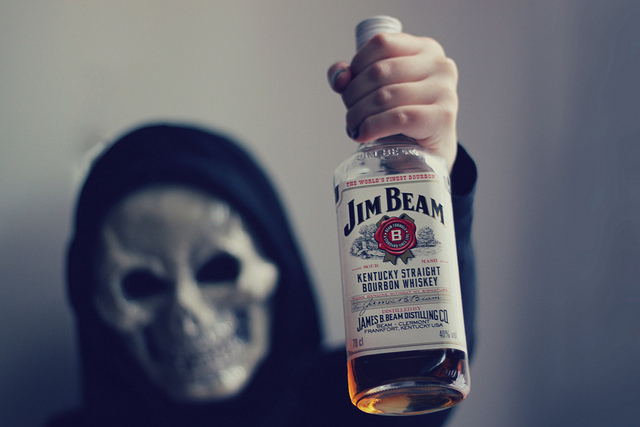 death. It wants you to drink, and keep drinking, to kill yourself while screwing over everything you ever did to STOP drinking, including treatment and step work and soul-searching — all you’ve done to get well. As long as you still have the strength to raise that drink to your lips, Alcoholism has more work to do: “Fuck that,” it chuckles. “C’mon, my friend. A drink is a good idea.”
Impulse — that’s what the visitor relies on. Though we vaguely sense that we’re “being none too smart” [36], we pour whiskey in the milk, decide to have a highball, prescribe for what ails us, rebel, say fuck it, or just mechanically take that drink. We are truly defenseless against the first drink.
So are alcoholic rats.
I recently came across this fascinating medical study of alcoholism conducted on rats: https://www.nature.com/articles/npp2017105.
Because it’s rather dry and scientific, here’s a cheat sheet.
First, the scientists isolated rats like us, that is, “alcohol-preferring rats,” which they call P-rats. An alcohol-preferring rat is one that would rather drink booze than water (sensible, right?) until they are quite hammered and, I assume, pass out. Next, they taught these P-rats to “work for” their booze: when a light went on they had to press an initial lever that would give then access to a second lever which they could press to get booze. All the P-rats learned this.
Now, here’s the kicker: They started giving the rats painful electric shocks some of the time when they pressed the “seeking” lever — the lever that brings them nothing but an opportunity to press a second to score some booze. The breakdown was this:
- 30% of P-Rats greatly decreased use of the “seeking” lever
- 36% of P-Rats moderately decreased use of the “seeking” lever
- 34% of P-Rats, the true alcoholic rats, did not or could not give a shit about the shocks. Increasing the frequency of shocks did not deter them. Ten months’ abstinence with no alcohol available did not untrain them. The instant the booze was back, they were back at it, getting fuck zapped out of their little ratty feet, anything just so they could have a drink.
That’s us, guys! That is us. I think of the first 30% as normies who love to drink. I think of the second 36% as hard drinkers who get told by a doctor to decrease their drinking and are able to do so.
But that last 34% of rats — those the scientists termed “compulsive,” meaning that for them the drive to get alcohol is stronger than any other. And that is alcoholism in a nutshell.
Were the compulsive P-Rats of a lower moral fiber than the other 66% of booze-loving rats?
Might other rats who loved them have convinced them not to press that seeking lever?
Could they maybe have tried more mental control?
No, no, no. They were simply alcoholic rats, and they were screwed.
A higher power is our only hope
Back to that master of disguise, alcoholism. How can we possibly gain the perspective to slam the door in its friendly, affable face? There are these things called “steps.”
- Give up being special. Identify as alcoholic. Know we are no different or “smarter” than anyone else who died of alcoholism.
- Open our minds to something greater than us, a power beyond our thinking.
- Follow that power. Stop believing our thoughts about anything to do with alcohol and ask instead for help. Make a bone-deep commitment to do what is right and good, no longer what we want. Good Orderly Direction. Group Of Drunks. God as we understand it. Opening deeply to any of these will let in the light that heals us.
- Complete the next 9 steps with aid of a good sponsor.
Louisa checking in
I write this today with a heavy heart — crying, actually. All I write here is what I long to say to one person — one who has never listened.
I love this person very much, though I shouldn’t because he’s an ex who done me wrong. He is near to dying from alcoholism. Yesterday he checked in to detox and treatment. Ever since one of his relatives texted me that he was “skeletal and shaking,” I’ve stayed mostly in the background, asking sober friends he’s lost touch with to call. But last night I kept waking and just praying for him to find a higher power.
It’s unlikely. His chances of survival are slim not only because he’s one of us 34% compulsive P-Rats but because his right brain is weak. The left brain is the bullhorn of ego and fixing things; the right takes in a bigger picture. People with right brain strokes, relying on their left brain’s assessments, often deny that anything is wrong with them, that limbs are paralyzed, sometimes even that their paralyzed limbs belong to them. I believe the right brain is also the seat of our spiritual connection, without which we cannot get sober.
Below is a series of photos of George Best, the famous Irish soccer player.
Here he is in 1972 at the height of his fame, enjoying a brewsky.
Here he is in 2003, robust at 57 after a successful liver transplant necessitated by alcoholic cirrhosis.

His liver transplant was so successful and Best felt so great that he welcomed in that friendly visitor, Alcoholism, when it appeared on the doorstep of his mind assuring him a drink was a good idea — “C’mon, George! Just one on a new liver couldn’t hurt!”
Here he is just two years later at 59, a day or two before he died of massive organ failure brought on by alcoholic relapse.

George Best did not mean to commit suicide. His mind was co-opted, and, for whatever reason, he could not reach god to restore him to sanity.
I fear my loved one will follow this same progression. Please pray for him — that he find a way to reach a god of his own understanding that can override the P-Rat compulsion. His name is Gerard.
Thanks, guys. Love is the most powerful force in the universe.

.
Afterword: Gerard did indeed die of alcoholism on July 12, 2023. Drinking enough Indian Pale Ale gave him an unsuspected peptic ulcer which hemorrhaged on what should have been his 60th birthday.
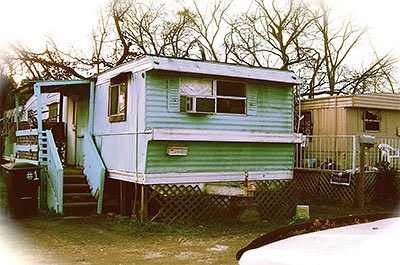

 I was busy. She was hopeless. Just eight minutes and I’d be outta this dump, back to the fresh air and my nice, clean life!

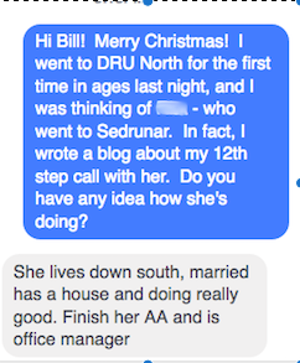


 I can feel my angel urging me toward self-honesty and love, and I don’t need for anyone else to believe that he communicates with me.













 AA itself is built on this oxymoron of confiding anonymously, of being open in a closeted setting. The program needs anonymity not only because every newcomer feels at first the way I did but also to preclude the rise of AA demagogues. Nevertheless, sharing our messiness openly and unsparingly is our lifeblood. The Big Book tells us “that it is only by fully disclosing ourselves and our problems” that we can connect with fellow alcoholics. The 9th step promises that “We will not regret the past nor wish to shut the door on it” as “we will see how our experience can benefit others.” And The Family Afterward reminds us, “in God’s hands, the dark past is the greatest possession you have — the key to life and happiness for others.”






 A Spiritual Evolution