Category Archives: Alcoholism

The Disease We Forget We Have

Late to a Seattle AA meeting 12 years ago, I was just backing into a parallel parking space when another driver zipped forward into the spot. I rolled back to make eye contact with the driver, whose stony stare flung back a challenge: “Are you really gonna make a stink about this? Cause it’ll get you nowhere.”  But then we recognized each other!  He was my friend from meetings! Grinning with contrition, he signaled that I could have the space.  I waved back “no big deal” and drove off – though for years I gave him shit about it.

My friend was still toxic – only about a year sober after three decades of relying on booze, pot, and crack to limp through a dark and confused life. Just beneath his jovial exterior he carried a huge chip on his shoulder, a certainty that everyone and everything had fucked him over so badly he’d never be okay.  That parking space was owed to him despite some rival bitch about to score it.

Over the years that followed, though, my friend underwent what I can only describe as a spiritual transformation.  AA became his home and family as he attended meetings almost daily.  When he finished the steps himself, he began to sponsor new guys, reading the Big Book with them and learning what it felt like to truly want good things for someone else.  His heart grew.  He became a man of great empathy and compassion.

And somehow through that process, he developed empathy for himself, an acceptance of his trying past, including all the suffering that had forced him to change and grow.  The chip on his shoulder melted away.  His shares in meetings emanated that elusive calm that evolves only from gratitude and humility.  When he spoke, people listened.

Finally, as a result of all that he had become in recovery, he quit recovery entirely and became desperate and miserable again.

Wait — what did I just say?  Why would someone do that?  Don’t we all know alcoholism is a lifelong affliction?  Doesn’t the Big Book plainly warn us not to ever let up on our spiritual program?

We are headed for trouble if we do, for alcohol is a subtle foe.  We are not cured of alcoholism. What we really have is a daily reprieve contingent on the maintenance of our spiritual condition.  (p.85)

My friend is far from alone in his abandonment of recovery.  Many of us get a good job, meet a good partner, buy a house, maybe pop out a kid or two, and expect to live happily ever after – without AA.  Some manage to, because they’ve found an alternate spiritual community: a congregation, sangha, even volunteer group.  A few die.  But the majority end up in either a tense, anxious day-to-day hell of frustrated ego, or a full-on relapse that promises relief but takes their job, house, family, dignity, happiness, and mental health instead.

So why do people like my friend, granted a beautiful life in AA, turn their backs on the simple regimen of meetings and service that saved them?

I’ll tell you why: we forget it was god who saved our lame, toxic, beat-to-shit asses.  We decide that, really, we did it!  Seriously – we just made a lot of bad choices back then, so amid the turbulence of all that wreckage, it seemed like the light of sanity came from god.  But now that we’re “winning” at life, we can see the change really came from our own smarty-pants-ness.  That’s right: we wised up, grew up, and climbed up.  And now that life has gotten so full and busy, who has time to waste on meetings and sponsees or prayer & meditation and all that 12-step shit?
That’s exactly what happened to my friend of the stolen parking space, who met me for coffee a few weeks ago.  But an unforeseen blow had upended his prosperity, so now he had this and that problem, but even worse, this other thing was about to happen, and then he’d really be in trouble!  He was physically sick, his face was broken out, and I noticed his hands shaking.

I spoke up: “You need to go to meetings.”  He responded as if I’d just suggested he take up embroidery, but, well aware I was an embroidery fanatic, he’d prepared a strong retort.  He cited reason after reason that AA meetings could do nothing for him, even if he had time to get to them.

“Do you remember,” I interrupted, “when you first came to meetings and you could NOT STOP drinking, and you asked god to help you?”  He held my eyes a few seconds with a distaste remarkably similar to that parking space stare of bitter defiance.  “Vaguely,” he mumbled.

Nothing I could say seemed to get through:  “You can’t find answers through isolation.  God works through people.  We need to be connected.  Answers come when you ask.”  I practically begged him to find a moment alone to offer the simple prayer, God, please help me.  He all but winced at my triteness, promised nothing, and left.

So.  Imagine my joy when a couple days ago that friend blew into my homegroup accompanied by two of his best AA buddies and took a seat at my table.  We cracked jokes til the meeting started.  A ways in, I caught the chair’s eye and signaled, so he called on “the gentleman sitting next to Louisa.”  And do you know what my friend shared?  That for years he’d kept relapsing because he refused to admit he was powerless over drugs and alcohol, and today he was just as stubborn about refusing to admit he was powerless over life. “The truth is, I need to be here,” he said, looking around the room.  “I need you guys.”

For me, god is everywhere — in my home, in the wilderness, in every connection I make with another living creature.  But so is my big fat ego, which wants to Edge God Out.  I need meetings, now and forever, to remind me I’m still an alcoholic who, left to my own devices, will still try to fill that perennial empty spot with the wrong things.  Because you wake me up to the divine unity that heals me, I will always need you guys.

3 Comments

Filed under AA, Alcoholism, God, living sober, Meetings, Recovery, Sobriety, Step 1

Forgiving Shame

Even though I’ve been sober many years, I find my codependent symptoms still crop up like Whack-a-Moles: I get over one and another shows up.  Shame is a particularly pesky mole with big front teeth that keeps popping up no matter how insightfully I whack it.

Brené Brown, a shame researcher, makes this key distinction:

GUILT – says what I did was bad

SHAME – says I, myself, am bad

When I got sober, I carried a lot of guilt – and rightly so!  I’d screwed over just about everyone unlucky enough to have let me into their life.  But over the next year or ten, I learned to stop engaging in harmful behaviors (at least, those I can perceive) and seek a life rooted in the values of honor and kindness.

So when I say I still experience times when shame seems imbued in my very cells, when the conviction flares that I’m secretly wrong, bad, even evil, I’m not crying out for help.  I’m trying to help us both.  Because if you, too, were raised by parents who somehow shamed you or are simply prone to self-criticism, then that same undertone of shame reverberates in your bones as well.

shameMost of the time, we ignore it like some kind of emotional tinnitus, so the feeling doesn’t register.  “What, me? shameful?  That’s absurd!”  But then life happens.  We screw up or feel exposed in some way and ~ BOOM!!  That accumulation of denied self-condemnation drops on us like a Monty Python 16-ton weight.  We’re flattened, aching from a wound that has far less to do with what just happened than scars buried deep in our soul.

For example, years ago I felt so free from shame that I wrote my addiction memoir, trusting that no matter how sick my thoughts and behaviors, even those readers who couldn’t identify would empathize.  When my relatives learned of it, the backlash was intense: they dropped dozens of 16-ton weights – all via email, texts, and online reviews, of course.  I found myself catapulted back deep into shame for who I was and what I believed, as well as for having had the blind audacity to write about it publicly.

vat-of-slimeEver since, I find that whenever some mishap shakes me up, those same shame feelings resurge – even when I’ve done nothing wrong!  I swear, I’d qualify for the Shame Olympics if there were such a thing.  It’s like some huge, soupy vat of shame is just waiting for me to lose my spiritual balance, spin a double pike and topple back in.

Chronic shame cripples our efforts to live authentically.  It hisses that we’re never to question others’ expectations, make waves, or stand out.  It’s the voice of fear, not god.  To be exactly who we’re created to be, to share our gifts unabashedly with the world – that’s what we’re here for.

Significant to sober alcoholics is the idea that getting buzzed will banish shame – along with guilt.  It certainly used to.  That’s why first few times I drank felt like flying.  I was every bit as good as you – hell, even better!  Because that oversized ego I’d stoked to make up for my abysmal self-worth was finally cut free of all those painful, heavy burdens to soar above the world.

Un/fortunately, the highs of addiction gradually diminish until our fix offers no lift at all.  My last drinks  left me as sodden with self-loathing and shame as ever.  Relapse, I know, would bring on not only shame but guilt at having shat on everything sacred to my higher self: integrity, honesty, courage, and faith.

Luckily, shame has several other nemeses.  It thrives on secrecy and silence; the deeper we bury it, the more power it gains. Like botulism, shame cannot survive exposure to open air.  When we talk about our triggers sincerely with trusted others, shame withers.  Meetings and sponsors let that happen.  Voicing our secrets takes courage, but when love lets us embrace our foibles (or even sickness) as merely human, a beautiful humility emerges to eclipse shame.

The audacity to be authentic is one of the tools Brené Brown calls for.  But having recently undergone yet another bout of shame (triggered by a naïve hope disappointed – with the vat waiting), I stumbled on another approach in the teachings of Pema Chödrön.

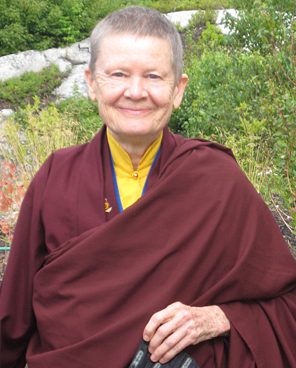
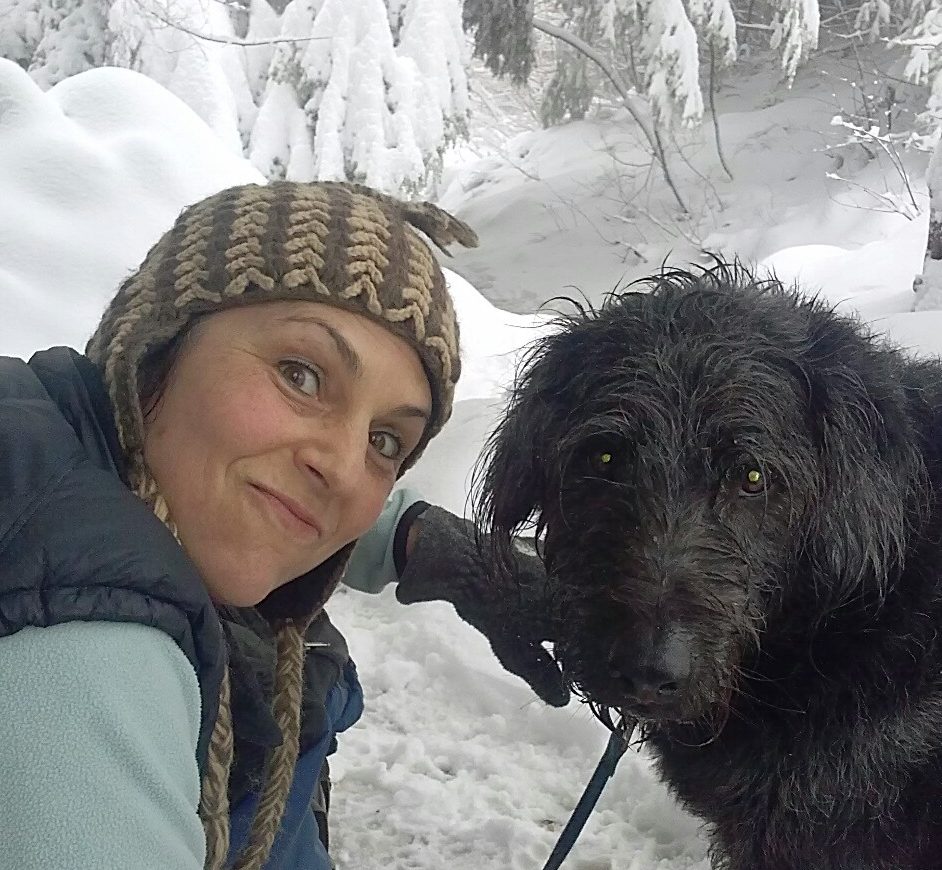
pema-comAbout 13 years ago, a sponsee/friend moving away gifted me a 6-cassette Chödrön lecture series entitled “Awakening Compassion” that I always meant to listen to – even after I ditched my cassette player.  A few months ago, forced to do boring PT exercises nightly before bed, I tossed Tape #1 into an old boom-box; I’ve been listening for about 15 minutes per night ever since.  Pema keeps speaking about “the raw stuff” of life being more important than our mental evaluations of it, and of “the open heart” being like a “sea anemone” that doesn’t retract when disturbed, but rather “softens” to life. Meanwhile, because I’m lying on my yoga mat, my dog Cosmo keeps coming up and dropping his drooly tennis ball on my stomach or maybe my hair, hoping I’ll chuck it across the room for him one more time.  I keep aspiring toward Pema’s lofty wisdom and enlightenment, and then – PLOP!!  Ew!!

The other night I realized – PLOP!!  Ew!! – that Cosmo’s drooly ball and my reaction to it are precisely what Pema means by “the raw stuff” of life. In Cosmo’s place, put any people or conditions that don’t suit me – including unwelcome emotions.  Woven through Pema’s words is encouragement to love this life with an open heart, not retracting into slanted stories and shoulds.

louisa-cosmo-mt-si-2016

Me & Cos on Mt. Si

Whether I snap at Cosmo or whack at shame (“I shouldn’t feel this!”), I am closing my heart to what is, to life.  I don’t have to toss the ball every time, but Cos is almost 12 and before long I’ll lose him.  By the same token, I don’t have to buy into the story shame tells, but I can accept my dance with that emotion over the years as part of my human experience, which is likewise finite and precious.  In other words, much as I’ve learned to accept and forgive shortcomings in other people, so I can begin to practice the same love and tolerance within myself.  Whacking is never our only option.

scroll

.

17 Comments

Filed under AA, Alcoholism, Codependence, Recovery, Sobriety, Spirituality

Vulnerability

The other day I got a call from a woman I don’t know asking about something she’d heard me say in an AA meeting.  She’d tracked me down because she was curious.

“You said the closer you get to God, the more you’re able to love people – you said because you don’t need shit from them.  I’ve been wanting and wanting for years to get closer to that – not wanting or needing people’s approval – but I don’t seem to get anywhere.  How do you do it?”

I offered to meet her for coffee next week. But what the fuck will I say to her?  How can I even hope to frame in one sitting what’s taken me 22 years to learn?  I can’t.  But that’s okay.  Because the truth is, in taking the risk to reach out to me, she’d begun to answer her own question.

Vulnerability is Scary
Neurologically, most of our responses to life involve an almond-sized part of the brain known as the amygdala, the center of fight, flight, or freeze, which scans our sensory data constantly for signs of danger.

Costa Rican girls

Unsafe but unworried Costa Rican kids

In the US, our culture prioritizes shielding ourselves from such danger.  Airbags, seatbelts, baby car seats, and helmets – they’re all mandated by law.  By contrast, when I traveled to Costa Rica, the safety policy appeared to be, “Let’s hope bad shit doesn’t happen.” I saw a couple motorcycling down a pot-holed road with no helmets – not for them or the 1-year-old between them, whom the woman could brace with only one hand because her other dangled groceries near the rear axle.  Another guy ahead of our car perched on the back of his friend’s motorcycle carrying a full-size bicycle across his back – no hands!  Now, I’m sure some bad shit does happen, but among the Costa Ricans I sensed a freedom and happiness – a trust in life and themselves – that Americans can’t even dream of.

If we’re knocking ourselves out to evade physical dangers, it only makes sense that we transfer the same approach to emotional ones.  Research has proven that our brains experience emotional pain and physical pain as virtually identical: the same regions light up when someone turns us a cold shoulder as would if they snapped a mousetrap on our finger.  Rejections hurts.

That’s why we drank!  Then we didn’t have to give a shit who disliked or rejected us, or if we did, it was all delicious maudlin drama.  Yet the day comes when alcohol can no longer anesthetize us, and at the same time the wreckage of our past overwhelms us.  When that happens, we hit bottom.

It’s a pain that cracks us open so deeply, god can touch our hearts.  We admit we don’t know how to live, and we ask for help from god and sober alcoholics.  If we work a program, we learn that ego, unchecked, is the source of our troubles.  Through inventory we name the character defects that ego animates in us and start mustering the willingness to part with them.

So who, then, is this new person?  This human divested of their emotional shield, inflated ego, assorted coping mechanisms – in short of their boozing imperviousness?

It’s a person suddenly exposed and vulnerable as hell.

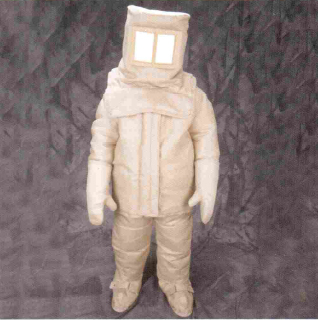
Now, we can be hurt.  We experience pain deeply, sometimes a backlog built up over a lifetime.  If we’re lucky, we have a sponsor who advises us to bring that pain to god.  But sometimes, our amygdalas decide god’s just not concrete enough.  fire-suitWe need safety precautions, emotional helmets and hazmat suits!  So we reduce our vulnerability by learning to edit and hide our true selves.  We develop strategies like people pleasing: whatever we think will smooth our path, whatever others want or would approve, we try to appear.  The goal is to be accepted.  We need it because we so intensely fear rejection’s pain.

The problem is, if we don’t put ourselves out there, exposing our weaknesses and imperfections and hoping to be loved despite them, we also won’t live. We’ll miss the chance to know intimacy, trust, and the warmth of loving other people simply for their humanness.  In short, safe inside our hazmat suits, we’ll miss the richest beauties of life on earth.

So I Guess What I’ll Say to that woman is that since I’ve been sober, life has absolutely beaten the crap out of me, over and over.  Partners have plopped my heart in food processors set on Betrayal – not just once but twice.  My siblings ridiculed and shamed my book – even as I fought cancer.  Besides losing a sister and father, I’ve lost half a dozen dear friends to overdose, accident, and suicide.

Pain.  Pain.  Pain.

But here’s the thing.  Every time, god has been there.  Every time, god has loved me through it.  And the gift from staying sober long enough has been that I begin to fear pain less.  It won’t kill me.  It is, after all, “the touchstone of all spiritual progress” – that which affirms the real deal:  I will love again.  I’ll show up for my siblings.  Cancer won’t haunt me.  And I will never forget my loved ones.

cristins-cookiesI find I have begun to live emotionally in the same spirit the Costa Ricans live physically – with less caution and more freedom.  I can begin to risk pain knowingly.  Today I choose to be vulnerable, extending kindness or heartfelt gifts to those who may reject them, because I don’t need their acceptance.  Sure, I’d like it!  Sure, I hope bad shit doesn’t happen.  But what’s the worst case scenario?  Those “ouch” parts of my brain will light up again, and I’ll cry my guts out again.  And when I turn to god in all my pain and grief, god will say to me again, “Louisa, you are enough, just as you are – I love you in the beauty of your trying.”

Freedom is the difference between hoping for and thinking we need reciprocation.  I am all I have to offer.  This life’s the only time I can do it.  God, I know, has my back.

scroll

.

PS: Happy birthday to me, guys!  Thanks for 22 years on the 29th!  🙂

Post to Facebook

12 Comments

Filed under AA, Addiction, Alcoholism, Codependence, Faith, God, Recovery, Sobriety, Spirituality

The Bedevilments vs. Grace

Here are thousands of [sober] men and women, worldly indeed. They flatly declare that since they have come to believe in a Power greater than themselves… there has been a revolutionary change in their way of living and thinking. In the face of collapse and despair… they found that a new power, peace, happiness, and sense of direction flowed into them.
 
…Is not our age characterized by the ease with which we… throw away the theory or gadget which does not work for something new which does? We had to ask ourselves why we shouldn’t apply to our human problems this same readiness. We were having trouble with personal relationships, we couldn’t control our emotional natures, we were a prey to misery and depression, we couldn’t make a living, we had a feeling of uselessness, we were full of fear, we were unhappy, we couldn’t seem to be of real help to other people— was not a basic solution of these bedevilments more important than whether we should see [an ad for some new gadget]? Of course it was…
 
Our ideas did not work. But the God idea did.
-Alcoholic Anonymous, pp. 50-52
The bedevilments sum up how life sucks for an active alcoholic – or for one dry without a solution.  Anyone familiar with the Big Book knows of them.  They make up yet another passage where the AA founders nailed our experience, so  the hurting alcoholic marvels as s/he reads, “How did they know-?”
.
The bedevilments hurt like hell because they’re symptoms of our dying spirits.  Fear cuts us off from the love that would sustain us, so we languish like plants without sunlight.  Drinking temporarily soothes that pain while ego promises to fix everything by grabbing more admiration from the outside world (via  accomplishments, attractiveness, wealth, etc).  What else could possibly help us besides self-medicating and vanquishing all the assholes in our life?
.
aa-80th-convention

AA’s 80th anniversary: 70,000 sober drunks from 94 nations. D’ya think this thing might work?         (click to enlarge)**

.
The Way Out
This chapter, “We Agnostics,” offers an alternative:  If we replace religious ideas of God with  open-minded spirituality, we can examine the results of faith just as we would any other phenomenon – scientifically.  We see that people who adopt faith in a higher power go from the shit pile to thriving.  We see it over and over.  Linking the two events causally – is that such an illogical jump?  To say, “Hmm… looks like this faith gadget works wayyy  better than the self-reliance gadget I’ve been using” – ?
.
That’s how models function in science.  We observe phenomena and devise a theory, a model that explains what’s going on.  We can’t isolate or observe faith, but we can note its effects.  Faith (and the rigorous stepwork it inspires) arrests the misery of alcoholism.  In drunk after drunk, this shit works.  We don’t have to know why.
.
Still, I remember how I reacted the first time I read “We Agnostics.”  Yes, I suffered all the bedevilments (though I didn’t give a shit about not helping others), but I wasn’t going to buy the idea that what had worked for millions of other people would work for me.  No, because I was smarter.  And I hurt worse.  And the prospect of seeking god felt weirder to me than it had for those guys – obviously.  Just in general, other people were so other-peopleish!  They had nothing to do with me.  They were packed in society like canned beans, whereas I had flowered and grown on the vine of my life, bobbing in breezes and raindrops they’d never experienced.
.
This is the catch-22 of getting sober in AA: we have to trust that we are like others before we can really believe it to be so.  If we trust, we can do what they did and get what they got – but at the start we don’t trust anything!  Even booze, our best buddy ever, has turned on us.  Or has it?  Maybe we should try one more time with the bootstraps and a little less bottle?  Isn’t that more likely to work than something so preposterous?
.
wile-e-coyote-cliffAnd yet we try the unknown thing.  We step out into air.  There’s something in AA meetings, some energy we can’t identify that keeps us coming back.  My brain told me emphatically that AA would never work, yet my hope, my heart, and somehow my car keys carried me to meeting after meeting, where I heard people speaking authentically of ruined relationships, self-loathing, wild emotions, relentless fears, and pain-filled loneliness just like mine – that no longer ruled their lives.  I could see it in their eyes, hear it in their voices: they were free.

.
Grace.  What is it?  It’s defined as “unmerited divine assistance,” a gift from god we receive without earning.  The longer I’m sober, the more I see it’s all grace: every breath I take, every sensation, every emotion, every moment of being alive on this earth.  How could I “earn” any of that?  I was graced with the utter defeat of my wrecked life.  I was graced to meet the person who took me to my first AA meeting.  Graced to find myself out of answers, sick of believing my broken brain over and over, desperate enough to show up despite immense skepticism.  The short version is that I was graced with surrender: “Maybe there is something; maybe I can ask it to help me.”
.
That opened the door enough for those first rays of sunlight to touch me.  duckling-graceThree steps forward, two steps back, I’ve progressed through life’s vicissitudes and cycles of stepwork to reach my own intimate experience with a god that I now love with everything in me.  Today I can see how god – that energy of love powering every element of life – is in you.  I can love you with no self-interest – no more than I have in loving a robin, or a birch tree, or a puffy white cloud shifting across the blue expanse of sky.  Look at you being you!

.
And what a wonder it still is, as I come up on 22 years sober, to watch AA newcomers at the outset of their own  journey.  They come in with bedeviled pain and discontent practically scribbling the space above their chairs. Today, I get to flatly declare to them the peace, happiness, and sense of direction with which I’ve been graced – and watch them find it, too.
.
scroll
.
 **https://rehabreviews.com/went-aas-80th-international-convention-kept-journal-become/#prettyPhoto

6 Comments

Filed under AA, Addiction, Alcoholism, Faith, God, Happiness, Recovery, Sobriety, Spirituality

Compassion’s Spark: a 12th Step Call

On a dark, rainy winter’s evening about ten years ago, I found myself in a run-down urban trailer park trying to find a particular trailer. I don’t remember how I was supposed to identify it, but I do remember a man stepping in front of me whose face I couldn’t see in the dark.  “I got some stuff.  You want some?”  trailer-park“No, thanks,” I replied, moving on. By the light of trailer windows, I saw more shadowy figures moving about in the downpour, and I remember holding my AA Big Book in front of my heart like a shield, asking god to keep me safe.  I was on a full-fledged 12th-step call, one of only a handful in my life.

Twelfth-step calls are less common today because treatment centers tend to be a first stop for addicts wanting help, but the woman whose trailer I was seeking had just been released from the most labor-camp-like detox/treatment center in Seattle – Sedrunar.  A friend had called me about her. “Lena doesn’t have a car to get to meetings.  She’s got two kids, and she’s gonna lose them if she uses again.”

I called Lena, though I was going to insist she take the bus to my house.  But Lena, like any addict, was persuasive.  She didn’t know anyone in the trailer park she could trust to watch her kids – who were seven and two.  Could I please come just this once?

The seven-year-old opened the trailer door.  She stared at me from eyes circled with dark shadows, silent as a spook.  I heard yelled from inside: “Let her in!”  I tried to greet the child cheerily, though to inhale the stinky, steamy air in there felt like an assault. On the floor was an old TV with a beanbag chair in front of it – that and piles of clothes.  Bare walls.  In came Lena, the toddler on her hip naked besides his diaper, food all over his face.  Lena was a bit shorter than me and chunky, about 25. She shook my hand, apologizing for the mess, and handed the boy off to her daughter, pretty much barking at her to go in the bedroom and shut the door so she could talk to this lady – me.

We sat down at the yellow kitchen table.  On the stove, mac & cheese dribbled from a saucepan stovein a way that reminded me of vomit, and smeared noodles dotted the table.  Lena sat across from me and folded her hands expectantly as though I were about to recite poetry.

All I could say was, “Does that window open?” I gestured toward a dark pane at the the table’s end, the glass dripping with condensation.

Lena looked perplexed.  “I’m trying to save heat.”

“I’d really appreciate it.”

Reluctantly she rose and slid the moldy aluminum frame aside about an inch.  While she was up she grabbed a sponge and wiped away most of the noodles at my place, apologizing that she’d just fed her son.

I’d made up my mind that I would stay 30 minutes only.  I began as I always do, by asking Lena to briefly tell me her story.  Clearly practiced from treatment, she launched right into it – how she’d grown up picking crops in Yakima in a Hispanic community; how she’d gotten into meth as a teen.  She was proud that both kids had the same father, but he was a drug dealer.  She’d lost them twice to CPS – once for leaving them in the car outside a bar.

“I’m clean, now, 60 days.  The judge told me this is an extra chance with my kids.  I shouldn’t even have them now.  I gotta stay clean.  I gotta stay sober.”  Here she changed, muscles in her face and throat working hard.  She looked right at me and spoke distinctly: “I can’t… lose… my kids.”

“Well, you’ll need to find a sponsor,” I breezed, “but, unfortunately, I’m full.”  This was somewhat true – I had a few sponsees.  But, of course, I really said it to push away all this squalor.  I wasn’t even sure whether this woman should have her kids.  All I knew was that only 21 minutes stood between me and escape.

I sketched my own story briefly, Lena nodding attentively at every phrase.  I explained that I couldn’t not drink on my own, but by working the 12 steps I’d accessed a higher power that had removed my craving for alcohol and kept me sober eleven years.

“Eleven years!” Lena marveled.  “That’s what I want!  I wanna know how you did that!”

I was starting to explain how I’d worked with a sponsor when we heard a ruckus and the squalling toddler, chased by the spooky girl, burst out of the bedroom.  Hardly taking her eyes from me, Lena scooped her son into her lap and held him close.  She gave the crown of his head tiny kisses and asked him if he wanted a bottle.

Right then – that’s when the voice started.  Not really a voice, but an urging:  Help her.  Sponsor her.  Love her.

No fucking way! my ego countered.  ticking-clockI was busy.  She was hopeless.  Just eight minutes and I’d be outta this dump, back to the fresh air and my nice, clean life!
“He don’t talk,” Lena told me. “They told me he’s disabled, but it ain’t true.  It’s just all he been through.”  Watching the boy’s eyes, the way they moved from Lena to me and back again, I sensed she was right.  Meanwhile the spooky girl joined us with a coloring book, promising to be quiet and asking where her crayons were.  Lena grabbed them from the same box that had held her Big Book.

“It’s not me,” I heard myself telling her. “God has given me a life better than I ever dreamed of.”  Some of the people who’d helped, giving me time and guidance, flashed through my mind.  “I’m not the same person I was.”  Lena nodded intently.  She was not begging.  She was not pleading.  But every cell in her body was straining to hear me.

Just help her.  Just love her.

But I was helping, dammit!  I was steering her toward the program, right?  Just not toward me.  Anyone but me.  But, with just three minutes to go, I made a big mistake.  I looked into Lena’s eyes.  Really looked.  I saw there desperation and terror, but even more, a fierce love for her children.  My own son was five.  How were we any different?

The wall crumbled, compassion washing over me.  “Okay, I’ll sponsor you,” I heard myself saying.  Lena’s face lit up.  “But not here!  You’re gonna have to come meet me at a coffee shop!”

The rest of the story is like a fairy tale.  Lena and I met every Friday tobig-book read the Big Book at a Starbucks while a sober neighbor watched her kids, after which I’d drive us to a meeting.  She had a job riding in a municipal truck, collecting garbage, and within a couple of months she qualified to drive that truck.  She moved into a shitty apartment not far from the trailer park, where I met with her for a while until she found childcare.  She bought a crappy car and started driving herself to meetings.  Whenever I showed up at her homegroup, her kids would ambush me either in the parking lot or when I came in – the little girl now beautiful and clear-eyed, the little boy talking up a storm.  Their laughter still seemed incredible to me – a miracle.

In a little more than a year, we’d progressed to Step 9 when Lena, who was apprenticing as municipal gardener, leased a nice apartment too far north for us to keep meeting.  I drove up and visited her there once.  It was near Christmas.  I remember white carpets, a new sofa, pictures on the walls.  I remember the children bringing me a gift from under the Christmas tree and grinning while I opened it, and my own embarrassment that I had nothing for them.  But I had given them something – and we all knew it.

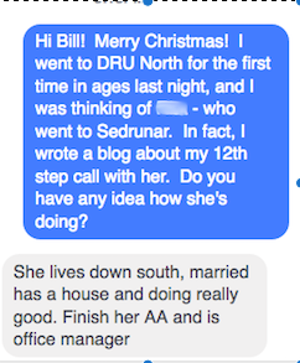
Last night after eight years I went again to that meeting – Lena’s old home group. But she wasn’t there.  Where she’s gone, what she’s doing, I don’t know.  But I’m hopeful.  I sent them prayers.  Today, I’m so grateful that god opened my heart, and that it’s still opening.

scroll

Postscript:  I had to find out…  🙂

screen-shot-2016-12-24-at-5-20-03-pm

8 Comments

Filed under Addiction, Alcoholism, Recovery, Sobriety, Twelve Steps

What’s the Point of “Bill’s Story”?

Pledges inscribed on the flyleaf of Bill and Lois’ family bible:

  • October 20, 1928:  To my beloved wife that has endured so much, let this stand as evidence to you that I have finished with drink forever.
  • November 22, 1928:  My strength is renewed a thousand fold in my love for you. I will never drink again.
  • January, 1929:  To tell you once more that I am finished with it.  I love you.
  • September 3, 1930:  Finally and for a lifetime, thank God for your love.

On Christmas day, 1930, Lois’ mother died. Bill was drunk for days before, too drunk to attend the funeral, and drunk for days after. Lois began work at Macy’s for $19/week to support the two of them.

Anyone familiar with the Big Book of AA knows that in its opening chapter, “Bill’s Story,” co-founder Bill Wilson offers his personal narrative of “what it was like” while he was a prisoner of alcohol, “what happened” when his drinking buddy Ebby visited (miraculously sober), and “what it’s like now” – or was like for him and Lois, flourishing in the early days of AA at the time the book was published.

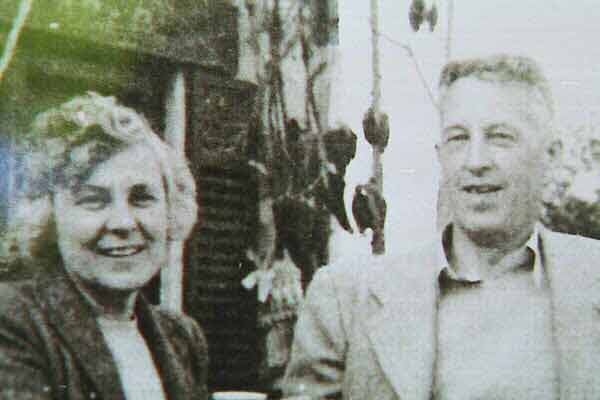
Bill and Lois

Lois and Bill later in life

Standard “homework” for an AA newcomer embarking on the 12 steps is to highlight the passages in “Bill’s Story” to which they relate – at least, that’s how we do it in Seattle (and I expect all over the world).  Sponsees of mine who were sure they’d have zilch in common with some dude of a different race, class, gender, and era writing in terms they consider archaic are surprised to find Bill puts into words experiences, pains, and terrors they’ve suffered but shared with no one.  Identification – that’s how the program works.

It starts from the get-go: “War fever ran high” he opens – each of these four words flashing icons of addiction.  Bill drank when things were awesome: “I was part of life at last, and in the midst of the excitement I discovered liquor.” And he drank when they sucked: “I was very lonely and again turned to alcohol.” By the end of the first paragraph, we can guess Bill drank like we did.  By the end of the first page, we know he turned away from the foreboding doom he felt reading an alcoholic’s tombstone and focused instead on vast faith in his own “talent for leadership” his ability to choose wisely.

 canstockphoto.com

Right there, folks, is the enigma of alcoholism in a nutshell.  Even as we increasingly realize that booze is killing us, we place increasing trust in self-will and self-knowledge, which amount to paper swords in our gladiator’s fight with this powerful, thought-twisting, brain-sabotaging snake.  Why?  Because the curious mental blank spot can override our resolve at any moment.

Though there must have been hundreds of times when Bill rallied all his resolve to quit drinking and found himself shit-faced soon after, his story specifically names five of them.

 1.  Self-will: “Nevertheless, I still thought I could control the situation, and there were periods of sobriety that renewed my wife’s hope.” [Referring to the bible inscriptions]

Blank spot: “Then I went on a prodigious bender, and the chance vanished.”

2.  Self will: “I woke up.  This had to be stopped.  I saw I could not take so much as one drink.  I was through forever.  Before then, I had written lots of sweet promises, but my wife happily observed that this time I meant business.  And so I did.”

Blank spot: “Shortly afterward I came home drunk.  There had been no fight.  Where had been my high resolve?  I simply didn’t know.  It hadn’t even come to mind.”

3.  Self-will: “Renewing my resolve, I tried again.  Some time passed, and confidence began to be replaced by cocksureness.  I could laugh at the gin mills.  Now I had what it takes!”

Blank spot:  “One day I walked into a cafe to telephone.  In no time I was beating on the bar asking myself how it happened.”

4.  Self-will: “It relieved me somewhat to learn [in the hospital] that in alcoholics the will is amazingly weakened when it comes to combating liquor… Understanding myself now, I fared forth in high hope… Surely this was the answer  self knowledge.”

Blank spot: “But it was not, for the frightful day came when I drank once more. The curve of my declining moral and bodily health fell off like a ski-jump.”

5. Self-will: “No words can tell of the loneliness and despair I found in that bitter morass of self-pity.  Quick sand stretched around me in all directions.  I had met my match.  I had been overwhelmed.  Alcohol was my master.  Trembling, I stepped from the hospital a broken man.”

Blank spot: “Fear sobered me for a bit.  Then came the insidious insanity of that first drink, and on Armistice day 1934, I was off again.  Everyone became resigned to the certainty that I would have to be shut up somewhere, or would stumble along to a miserable end.”

But instead of drinking himself to death, Bill receives a visit from his old drinking pal, Ebby, who tells him of the Oxford Group and opens the door to freedom – as the rest of the chapter swiftly summarizes.  Because the focus here, at the book’s beginning, is on defining the problem.

The point of Bill’s story is that we can’t fix ourselves.  No matter how disciplined in other respects, our minds cannot combat our alcoholism, which resides in the mind.  No amount of decision, resolve, moral fiber, determination, or even dedication through the deepest love for a partner can come to our aid at the junctures of the curious mental blank spot, when these thoughts don’t “even come to mind.”

Repulsed by the Oxford Group’s religiosity, Bill did indeed drink himself back into the hospital after Ebby’s first visit, but NOT after Ebby’s hospital visit, because at that time Bill had a white light experience that not only struck him sober for the remaining 36 years of his life, but empowered him to persevere in the difficulties of co-creating a program that would save the lives of millions of fellow alcoholics.

God alone can relieve our addiction, if we ask.  I’m not talking about a god named in any religion,spiritenergy though such gods work fine for some, which is cool.  For me, god is the life force, an energy which flows not only through the matter of our bodies and among all living entities – animal or vegetable – but indeed throughout the order of the universe.  Cut off from this energy flow by ego and hostility, our spirits languish and we find ourselves puppets of addiction.  Yet it’s right there – an energy of immense love and intelligence that we can tap into if we sincerely open to it.  It’s living you right now.  It’s living the planet.  You can write it off as “shit happens” or…

You can start where you are.  Whether you’re hungover as hell right now or sober but in pain, you can ask it for help and guidance.  You might start like this: “I don’t know what you are, but I know that I hurt, and that I need you.  Help me.  Please guide me toward goodness and love and light.  I will look for you in the depths of my heart.”

I guarantee you it will answer.

scroll

Post to Facebook

..             .


13 Comments

Filed under Addiction, Alcoholism, Recovery, Sobriety, Spirituality

Seasons of Sobriety

Sobriety isn’t a task or a diet – it’s a way of life.  And like life, it excited-fanhas its ups and downs, riches and ruins.  The quality of our sobriety varies with our connectedness to god and our fellows, depending on the rigor with which we cultivate both.  Many of us long to be gung-ho about sobriety all the time – and we can be!  It’s just that what gung-ho looks like is going to change over time, which is why I like the analogy of seasons in sobriety.

Among my AA speaker recordings, I particularly love one by Don C., a Native American from Colorado Springs sober since August 10, 1978.  Don describes the horrific beating his alcoholism inflicted, distrust at his first AA meeting, a sponsor who made him read and annotate each Big Book chapter 25 times, and the freedom he accessed (there’s a silence while he fights back tears) by working the 12 steps.  His entire life and outlook changed.  So why, early in his fourth year sober, did he suddenly find himself miserable?

He says:

“I was about three years and two months sober and everything was going to hell. Meetings got stupid; my sponsor was having stupid attacks; the Big Book sucked…  I thought I was going crazy. So I went up to see Johnny Looking Cloud… He was a Native Elder that was in recovery. …He said, ‘You’re thinking this is a white man’s program – and it’s not.  This is the Indian way, also… The steps are 12 gentle ways to bring you back to the original teachings. And when you’re done, you’ll be in harmony… the way it was for your ancestors.’”

Johnny Looking Cloud explains to Don, firstly, that the steps align with the Native teaching of the Four Directions.  Steps 1, 2, and 3 align with the east, direction of the new sun, where we find our relationship with the Creator.  Steps 4, 5, and 6 align with the south, the high sun, where we find our relationship with ourselves.  Steps 7, 8, and 9  align with the west, the setting sun and direction of letting go, where we make amends to heal our relationships with others.  To the north, like the North Star, lie 10, 11, and 12, steps that align with the elders’ teachings to deepen our wisdom.

Secondly, he explains that just as all living things proceed through cycles, so do we in sobriety.  The first year is our spring, when our sap begins to flow and we form buds of potential.  In the summer of our second year, our leaves mature and we bloom – living vigorously in sobriety.  By the autumn of our third year, we’re harvesting sobriety’s fruits – stability, material gain, relationships.  But then along comes that fourth year: winter.  Our leaves wither and drop; the light weakens; sobriety seems barren and empty, as if everything were falling apart – just as Don C. experienced.  But in truth, the slate is only being cleared for a new level of sobriety – a fresh spring.

four-seasons-22

My own seasons haven’t conformed to a four-year pattern, but I’ve definitely experienced that cycle many times in my 21 years’ sobriety.  In my springtimes, I get to see something new, some truth of living or character defect I’d never recognized before, that changes me forever.  My golden summers and autumns extend sometimes for years.

But winter does arrive.  And it sucks.  My sobriety feels ~meh! ~  I can’t recapture my enthusiasm for meetings, stepwork, or service.  Even so, I’ve schlepped through many such winters to reach new springs.  How does that happen… or not happen?

All of us, consciously or not, seek god/goodness/love in our lives.  All of us carry burdens of fear, pain, and loss.  The interrelationship between these two parts, I’ve found, comprises the melody of my life.  The seasons of a heavy and aching soul complement those of lightness and a free spirit.

My feelings really don’t have much to do with god, I don’t think.  Emotions are part of me, rooted in my body and brain – my separateness from god.  Rather, the godly part of me manifests only in my immediate awareness – my ability to see with love in the present instant.

During my summery months, my god-awareness acts like a beam of light, one I can turn on my own emotions – fears and sadness or childish excitement.  I can make friends with whatever nonsensical feelings insist on tagging along with me.  And when I’m good with my own emotions, it’s easy to extend love and compassion to others.

But when sobriety’s winter comes around, the beam wanes so I can’t tell what the hell’s going on.  Emotions victimize me.  I suffer.  I isolate.  I envy.  I doubt life will ever be good again.  gollumIt’s at this point that I’m most vulnerable to the wheedling voice of alcoholism.  It promises me drinking would fix everything.  It points out that other people drink with impunity, claims my life would be more fun if I joined them.  It paints a sweeping mural of a happier me with booze at its center.

For me, thank god (literally), this voice stays puny – I can swat it away like a pesky fly.  But for relapsing friends of mine, it begins to sound credible.  “Take charge of your life!” it urges them.  Humility starts to look like timidity; gratitude like settling; forgiveness like self-debasement.  Before they know it, a grandiose ego has upstaged god and they’re gonna to fix themselves with a drink – and do it right this time!

I wish I could offer a ticket to instant spring.  But there isn’t one.  There’s only acceptance:

doveThis, too, shall pass.  Every alcoholic with long term sobriety has taken refuge in this motto.  When recovery feels like drudgery, we still pursue it as best we can – going to meetings, calling sponsors, being of service.  Maybe we seek out Johnny Looking Cloud, or our own equivalent, and ask for help.  In some ways, those words represent the deepest form of faith.  They capture the willingness to have no idea how things will turn out, yet trust god enough to hang on through the darkness, believing spring will come again.

scroll

.

PS:  Listen to Don C. here.  This isn’t the same talk I have on my 2011 Bellevue CD, but close.

Post to Facebook.

.

.

11 Comments

Filed under AA, Addiction, Alcoholism, Faith, living sober, Recovery, Sobriety

The Bitter End… or Willingness

…[W]e had but two alterna­tives: One was to go on to the bitter end, blotting out the consciousness of our intolerable situation as best we could; and the other, to accept spiritual help.
–“There is a Solution” (p. 25)

Over the years I’ve grown so accustomed to going to meetings, working the steps, and sponsoring people that I tend to forget I’m actually sober through god’s grace alone.  I forget that for most alcoholics, the disease rolls along like a hell-bound runaway train, taking them with it.

The Bitter End:  The other day I had coffee with a longtime friend whose ex-husband bavarian shed– I’ll call him Julius – was once a man vividly alive: handsome, funny, and brilliant. Together they created a beautiful home, the yard landscaped with a Bavarian-style gardenhouse of which I was always a tiny bit jealous. While our children were young, I joined their friends and family at many celebratory gatherings where Julius cheerfully acted as a bartender, mixing everyone’s drinks with a brisk, festive hospitality.

He didn’t seem to like me much, though. His wife had discussed his suspected ‘drinking problem’ with my partner and me, which he seemed to resent.  He was European-born, a year and a half older than I.  Alcohol, he maintained, was a normal part of European life – though Americans abused it.

As the years elapsed, however, my friend experienced the many pains of loving an active alcoholic. Finally she found herself cheated on in conjunction with alcohol, much as I would years later. Because Julius scoffed at AA recovery, she’d had to painfully end the relationship and find her happiness elsewhere.

Still, I continued to see Julius regularly because for some time he and I worked at the same place and exercised at the same gym. I’d witness much important foot traffic bustling to and from his windowed office across the hall from my virtual closet. At the gym, he’d stroll into the big cardio room glancing about as if for an audience — tall, blonde, and well aware of his strapping physique. But meeting his eye was only me, that annoying sober woman!  We’d exchange nods.  Then, about seven years ago, I was laid off and no longer saw him.

So over coffee, I asked my friend, “And how is Julius doing?”

“You didn’t hear?” she started in return. “He died.  It was a few months ago.”

I shook my head, speechless.

“His liver went, and then… Didn’t you see his obituary? I put it on Facebook.”

Maybe you know the feeling I had, when you’ve rivaled someone you actually respect.  It’s as though the two of you were playing an intent game of ping-pong – and they’re suddenly not there.  The ball whizzes off to nowhere,  gone forever; you realize that underneath your resentment was… a slightly bruised form of love.  True, Julius had seemed to scorn my life choices – to flout sobriety by drinking hard and living well.  But he’d also passionately loved his children, the world of intellect, and life itself.  At heart, he was a good man.

My friend proceeded to unfold an old, old story lived out by countless alcoholics, a script starring that unsung hero, the liver. empties We alcoholics poison ourselves, and our liver cures us.  We do it again and again, driven by addiction, and that amazing organ reverses our suicidal onslaughts.  Until one day, it can’t.  It breaks.  But as alcoholics, we can’t stop the onslaught.  Poisons course unchecked through our systems, wreaking havoc on other organs – especially the brain.

Julius could not stop drinking, despite knowing full well alcohol was destroying his life.  He became obese and depressed.  He lost interest in work and took early retirement.  He stopped leaving the house, bathing, shaving, caring about anything.  His children both pitied and resented him, because he lived on the couch in a house that smelled bad.  He peed himself.  He saw no one.  Still, he drank.  And gradually, as ammonia crippled his brain, he stopped making sense.  Visiting to check on him, my friend found him speaking of people not there and tasks imagined.  She called 911.

At the hospital, doctors did all they could, but his body could not recoup.  A bloated wreck of his former self, watched over by the woman whose love he’d betrayed, with the children he would leave fatherless, 12 and 14, clutching his hands on either side, Julius died.

~

alcohol death

~

Willingness:  It’s an odd feeling to hear of someone dying from the same disease you have.  There but for the grace of god go I.  Nothing could be more true.

I was just like Julius.  For so many years, whenever the prospect of my “getting help” was raised by therapists or friends, a bulletproof glass shield came up like an electric car window between me and that idea.  “No.  That will not happen,” I’d think with an iron will.  Like Julius, I planned to slow down and then drink normally.  But I’d sooner join a leppers’ nudist colony than mix with those freaks in AA!

How did that change for me – but not him?  Surely Julius knew a misery just as dark and painful as mine.  But somehow, I was graced with the gift of willingness.

My desire to live jumped tracks.  Its impulse switched from “I must drink” to “I must change.”  Why that happened for me and not for Julius, I cannot tell you.  I did not want to change.  I did not believe AA could help me.  Yet I made that first call, went to that first meeting in spite of my thinking.

That god provides the defense we lack against the first drink – we’re reminded of that miracle often enough.  But even the willingness to BEGIN TO LET GOD HELP US comes from god.  A spark of god glows at our core, our source, and yearns to connect outside us.  For some, the blockage – our will – is temporarily lifted: our spirit reaches out and god answers.  Others languish, locked in self.

Grace is inexplicable!  But we can practice gratitude without understanding: “Thank you, god, for my sobriety.  Thank you for this life – exactly as it is!”

scroll

7 Comments

Filed under AA, Addiction, alcohol damage, Alcoholism, Denial, God, Recovery, Sobriety, Spirituality

What (most) Normal Drinkers Will Never Understand

NOTE:  Hi folks.  At this time of summer, I’m hiking and camping all over the place, so I’m reblogging an oldie but goodie for this week.  I’ll be back in a few with a new post. 🙂

-Louisa


Alcoholism is a physical, mental, and spiritual disease.  That’s what we learn in AA.

Alcoholism is just a lack of self-discipline.  That’s what most of the world thinks.

Alcoholics can exert all the self-discipline in the world and still end up drunk.

That’s absurd.  If they really kept up their self-discipline, if they really stuck to their guns, they could stop or moderate.

Only accessing a power greater than themselves – aka god – can keep an alcoholic sober one day at a time.

That’s just religiosity couched in a cultish slogan. 

Sometimes it’s frustrating to live in a world that doesn’t “get” my disease.  My blood family and normie acquaintances assume the mind works according to certain principles.  The notion of the Curious Mental Blank Spot (p 24) is foreign to them and to almost anyone who hasn’t been utterly stumped and defeated by it.  Thank god I’ve been both, though to get there took about 4,000 attempts of rallying resolve that I would drink with moderation, then finding myself plastered – again.  It took the admission that I’d run my life into the ground despite countless advantages, to the point where I no longer wanted to live.

I’d still have clung to alcohol as my true friend if the stuff hadn’t quit working for me.  When it no longer brought about the magical transformation that had made it a staple of my life – taking away my nervous, self-conscious unworthiness and replacing it with sociability and confidence – only then did I become willing to consider the counter-betrayal of checking out AA.  “Alcoholism made only one mistake,” goes the saying: “It’s the same for all of us.”  Not exactly the same, but close enough that I could learn from other sober drunks the hallmarks of alcoholic thinking, feeling, and experience.

The main hallmark is not drinking.  I’ve had several partners who matched me drink for drink for years on end.  But as soon as they made up their minds to exert their self-disciple, it took.  They could stop.  They had brakes.  Mine might work for a few hours or even days, but then along comes that Curious Mental Blank spot.  My resolve gets greased with coconut oil.  Thoughts of an hour or even a minute ago can find no traction.  They become meaningless.

What’s  the Curious Mental Blank Spot?  We like to think the conscious parts of our brain determine our actions – the frontal lobe of the cerebral cortex, which hosts thoughts and decisions.  But there’s a little lizard living in the basement of our brains – the amygdala – that generates basic survival impulses like fear and anger.   Alcoholism seems to live here.  Like a vine that winds its way front and center, it’s able to circumvent even the most determined resolutions of the frontal lobe, hitching a drink to the basic drives of being alive.  Drinking becomes an impulse, almost like sneezing, that you act on without a rational choice.

addict brainThe experience goes like this.  You’re all set to not drink today.  You’ve made up your mind, and it’s just not an option.  You’re going to drink healthy stuff, maybe exercise, busy yourself with – you should have a drink.  You know what?  A drink is a great idea.  Why not just relax, enjoy just one or two, like a little get-away to Maui that nobody needs to know about?  Eh?  You faintly sense there’s something wrong with this thinking.  Wasn’t a drink what you weren’t going to do.  Yes.  And the reason you weren’t going to do it was… was…

Here something happens similar to flipping through an old fashioned Rolodex and recognizing not a single name:  Let’s see; it was here somewhere: Not good for my body – who’s that?  Always make a fool of myself – do I know him?  Swore to my loved ones – might have met briefly, but…no. None of these ring a bell.  Meanwhile, here’s your amygdala holding out a frosty, aesthetically perfect image of your favorite drink.  It asks, What are ya, a pussy?  You gonna let these cards you don’t even recognize tell you what to do?  Just do what you wanna do – THIS!

It makes so much sense.  The idea of abstaining for any reason seems absurdly far-fetched, while the idea of drinking rings every cerebral bell of recognition for a natural, sensible, sound idea.  So, you decide, “Yes.” All it takes is a millisecond of assent and that genie is out of the bottle again, running your life.

As I once put it in an AA meeting: “My frontal lobe is my amygdala’s BITCH!”

Equally preposterous to the normal drinker (or active alcoholic) is the solution – asking the help of a higher power.  Only once we quit thinking that we, ourselves, have the means to quit drinking, when we give up reliance on self and sincerely ask a higher power for help, something shifts.  Some change happens.  Suddenly, we’re able to weather those Curious Mental Blank Spots with just enough resistance to avoid saying yes.  Do this long enough, and eventually the constant obsession to drink is lifted.

I’m still occasionally struck by the Curious Mental Blank Spot, instances in which I still don’t recognize a single reason not to take a drink, even after decades of sobriety.  “You’re in AA!” -whatever!  “You’d lose all your time!” – Who gives a fuck?  While I’m struggling with these confused thoughts, something steps between me and that image of a flawless, aftermath-free drink my amygdala is advertising:

“How about we just wait five minutes and see if all this is still true?”  It’s not a thought that comes from me.  But within thirty seconds, in my experience, my conscious mind is back at the wheel, and I retract in horror from the idea of drinking.  That is, the window of blindness, when I could have assented and released the genie, lasts only that long.

It may seem unlikely, but that’s pretty much the scenario experienced by millions of alcoholics meeting in 170 nations all over the world.  When we do the things suggested in AA’s program of recovery, that mediating influence – which I call god – restores us to sanity.


scroll

.

2 Comments

Filed under AA, Addiction, Alcoholism, Sobriety

Hurting Out Loud

Nine months ago I published “Prescribed Relapse,” a post on how doctors sabotage our sobriety and threaten our lives as alcoholic addicts by prescribing us vast supplies of opiates.  Telling us to “take them as directed” is about as good as recommending we “stop at the second drink” – as if we had any power to drink or drug “like a gentleman.”  We don’t!  If it cops us a buzz, we default to MORE.

In that post I quoted friend’s Facebook message.  This was Rob, whose doctor turned him on to opioids years ago, hatching a fresh addiction that promptly took over his life:

Yah know, if I’d of known what I would become after a few Vicodin, I’d a shoved them up my doctor’s ass!!  I was never into opiates as a kid. But eight years into sobriety I hurt myself really really bad, and I guess I needed them. But in hindsight, if I had a choice between acute pain and becoming a heroin addict, I would have probably chose the pain. But whatever.  It’s done.  It’s over, right?” 

Last week Rob was coming up on a year clean when he died from accidental overdose.  My friend is gone.  He was 44.  I miss him terribly.  About 20 of us gathered at his sponsor’s house the other day, wrote him a shoe box full of notes, and circled the bonfire where we burned them to share our memories and weep.  I have dialed his voicemail just to hear his voice and bawled my guts out, remembering how I could call any time, how he’d offer me that sweet mix of empathy and “whaddaya gonna do?” acceptance of life’s pains.  He was one I leaned on to help me through my horrific break up, because he’d suffered one, too.

Rob

The more recent break up that triggered this fatal relapse was much less of a big deal.  He missed, not so much his ex-girlfriend as her son – a little boy he’d played dad to for about a year.  Building cushion forts, taking the Big Wheel out for a spin, tickling on the grass – we all saw the happy Facebook photos.

I wish to god he’d told me.  When we talked about missing the boy, he said a lot of “whatever” and “I’m fine.”  Maybe he really thought he was.  Or maybe he was just loath to admit that all his old wounds were re-opened, his heart re-cracked, his loneliness bleeding, a despair darkening his skies, that he’d never have a little family of his own.  Instead, he asked me for help setting up a Tinder dating profile.  That conversation was goofy – lots of “shit -wait a sec, k?” – because we were both on our phones working on phone apps.  It was the last we’d ever have.

Telling others we hurt, and how bad we hurt, is one of the hardest things to do.  We’re afraid of looking weak, looking naive or over-dramatic, or maybe even deserving of the blows dealt us.  For me, with decades of sobriety in AA, the biggest obstacle is pride: I should be more spiritual.  I should see through the dust of my collapsed dreams to recognize my part, take responsibility for my delusions, own my self-centered blindness, and, most of all, have faith that all is as it should be.

But when shit hits the fan, when the bottom falls out of your sky-castle and you’re plummeting, all you feel is WAH!  NO!  I DON’T WANT THIS!  I’m sad!  I’m mad!  I’m hurting!  You want to bawl like a toddler, throw a kicking, floor-pounding fit at god and fucking life and those fuckers who hurt you.  It’s not exactly the most flattering spiritual pose.

But it’s truth.  We have a disease that wants to kill us, and it’s favorite subterfuge is pride.  The most powerful trust we can have is to go to a meeting with our spiritual pants around our ankles for all to see – trusting that we’ll be caught by love.  When I learned my boyfriend had been screwing a girl from work for two and a half years, I went to my homegroup and cried to fifty people: “My boyfriend has been screwing a girl from work for two and a half years!”  How many of them thought, Tch!  How self-deluding that woman must be!   My disease tells me half the room, but god tells me, in the moment of my deepest vulnerability, no one.  Not even that guy in the corner pissed about his DUI.  Every person in that room beamed me human compassion.

My message to you is that, though your fan Shitfanmay whirl so shit-free at the moment that dramatic squalor seems far from hitting you, pain will find you.  And when it does, you’ll need trust in god just to feel it.  Trust in god to forgive yourself for fucking up.  Trust in god to own pain as part of your journey.  But most of all, you’ll need trust in god to reach out and ask for help.  Not just once.  Not just stopping when you think it might be getting old for others.  As alcoholics, what we cover up festers, becomes an emotional abscess fed by our disease, swelling with resentment and self-pity until eventually it bursts as the emotional nihilism of fuck it.  Fuck sobriety.  Fuck trying for a good life.  I tried, and look what it got me: misery.

Sure, it’s self-centered to keep bending people’s ears about your troubles if you’re not also doing the work to heal yourself.  Sure, there are assholes who’ll hear you wrongly, who will twist what you’ve shared against you.  But the deeper truth is this: trust is a form of love, and love is what heals us.

If Rob had loved himself enough, maybe he’d have given himself permission to feel  a degree of pain that, rationally, made no sense to him.  And maybe he’d have tapped into the trust to call somebody, maybe me, maybe another of those loving friends gathered in tears around our pyre of goodbye notes,  and say, “I can’t do this.  I can’t do life.  It hurts too much.”

Maybe he could have given us, instead of heroin, a chance to love him.


scroll


Post to Facebook


8 Comments

Filed under AA, Addiction, Alcoholism, Pain Medication, Recovery, Sobriety, Spirituality