Tag Archives: addiction

The Courage to Surrender

Courage: the ability to do something that you know is right or good, even though it is dangerous, frightening, or very difficult.
—————————————————————————-Macmillan dictionary

.
American popular culture tends to associate courage with kicking ass.  Most of our movie heroes don’t need to overcome fear because they don’t feel any.  All we see from them is the anger and righteousness to smash the bad guys.  This invulnerable version of courage is reflected in Dictionary.com’s definition, as that which “permits one to face Die_hardextreme dangers and difficulties without fear.”

But what if fear is essential to courage?  That is, what if courage involves not just outward action, but the inner struggle to overcome all that holds us back – confusion, doubts… and fear?  In that case, courage means acceptance of our vulnerability, even our weakness, as well as the faith to move beyond it.

What’s this got to do with alcoholism?  People outside the rooms often assume recovery is about the ego’s type of courage: we’re sober because we’ve kicked addiction’s ass.  We conquered that mofo by being strong, disciplined, and – my favorite – taking control!  But there’s a lil’ problem with that.  Where drinking’s concerned, I can pull off none of those things.  I drink myself shitfaced.  That’s just what happens.  No matter how angry or righteous I may feel toward addiction, it’s the only one doing the ass-kickin’.
HOW coinOn the other hand, what I witness and learn in the rooms of AA is another form of courage – the courage to surrender.  Those two words don’t match up in most people’s minds, but for those of us in recovery, they have to.  When we tell ourselves, “I’m gonna beat this thing!” we seem to end up drunk.  But if instead we surrender, something inside us begins to shift, and we develop courage through the three essentials of recovery: Honesty, Open-mindedness, and Willingness.

Honesty
Nobody wants to be an alcoholic.  But even more, nobody who’s known only that way of life can imagine surviving without alcohol – a terrifying prospect.  I don’t know a single person who came to their first AA meeting without half a mind to bolt out the door.  What keeps us there is loyalty to certain moments of clarity – also known as honesty – when we either recognized death on our not-so-distant horizon or, in subtler cases, realized we could no longer endure the mental contortions necessary to sustain denial.  To hang onto that insight despite all the disclaimers our disease flings at us requires courage.

What’s more, every instinct cries out against admitting to a room full of strangers, “I cannot stop drinking and I don’t know how to live.”  Such words may not be voiced at our first meeting, and for some they never are. But alcoholics committed to recovery find the courage to speak these truths, no matter how difficult or painful.  Hearing them still brings tears to my eyes, even after almost 20 years.

Open-mindedness
Alcoholics tend to abhor the idea of groups.  We like to see ourselves as fiercely independent and temperamentally unique, so we’re repulsed by anything that smacks of conformity.  We also can’t stand the prospect of talking to others without a few drinks in us.  The last place we ever thought we’d spill our guts is a goddam cult, meetingwhich is what we’ve been calling AA, between swigs, for years.  Who wants to crawl in and, stone cold sober, ask for help from a group they’ve talked nothing but shit about to anyone who’d listen?  Nobody!  But we do it anyway, strange and frightening as it is.

Neither do I know a single newcomer who read the Twelve Steps on the wall and thought, “Oh, boy! That’ll help!”  The steps seem useless and irrelevant – some ‘hokey-pokey’ dance involving a magic Easter Bunny that has NOTHING to do with our very huge and real problems.  When alcoholics move ahead with these steps despite the certainty that they’ll never work, they’re stepping out on pure faith, reaching for the possibility of other ways to experience life.   The disease continues to offer them “Fuck Everything Free!” cards, but they decline to take one.  To turn away from everything familiar toward something unknown and intangible just because it feels “good or right” takes – you got it! – courage.

Willingness
The road to recovery is lengthy and, in places, steep.  We hear early on, “There’s only one thing you need to change – and that’s everything!”  Not only does that sound creepy, but “change” here is a verb – meaning we have to make it happen.  To find and work with a sponsor, write and read inventory, show up and listen at meetings, make amends, and eventually to sponsor and be of service to others – all these efforts require a willingness we’ve formerly lacked.  Our degree of willingness may wax and wane over the years, but if we steer by what we “know is right or good, even though it is… difficult,” we gradually come to call it by a different name: maybe god’s guidance, or maybe loving-kindness.

scroll.
Whether in terms of the battlefield or bottle, surrender means accepting as reality that which we’ve been fighting to deny.  But while a soldier surrenders only once, for the alcoholic, surrendering to one aspect of reality just moves us to a new perspective where we have to repeat the process.  Once we accept that our lives are unmanageable, we have to look at our relationships, which points us to our selfishness, which alerts us to our fear, which signals us to look at our connection to god and what it truly means to us.  The greatest paradox is that courage gradually leads us to our spiritual source, and yet it was that source (aka god/HP/ loving-kindness), once we opened the channel, that granted us the courage to change.

surrender_flag


Leave a comment

Filed under AA, Alcoholism, Drinking, living sober, Recovery, sober, Sobriety, Twelve Steps

On Alcoholic Denial

The greater our honesty, the more life is worth

Alcohol has never been de-throned in my family. Throughout his life, my father clung persistently to the conviction that alcohol opened a portal to happiness. As the big book says, “For most folks, drinking means conviviality, companionship, and colorful imagination. It means release from care, boredom, and worry. It is joyous intimacy with friends and a feeling that life is good.”

That and much more, for the early alcoholic. Because for us, drinking means release not only from those factors, but from ourselves. We live constantly tormented by the thousand stinging wasps of envy, self-criticism, frustrated desires, and the injustice of being misunderstood even though we know best. Drinking sedates these irritants, and we feel free. The trouble is, they all come back with twice the venom when we sober up. So we need more alcohol to regain peace. We don’t want to examine our consciousness itself and recognize that the bees are all generated by our own sickness.

Like my father, I clung to this pro-booze view as long as I could. The more painful and screwed up my life became, the more convinced I was that I needed alcohol in my corner as my only true friend. When that path led me close enough to meeting death or tragedy – meaning that I regularly drove drunk almost wishing to die and too selfish to consider the threat I posed to others, and that an otherworldly voice actually told me it could no longer help me if I continued to lie to myself – the day came when I finally turned on it.

I’d known for ages that I was alcoholic; I’d resolved a thousand times to drink less. But this time was different. This was a resolve to take action, and it entailed a shift of means that felt almost like murder. I would open the trap door beneath my buddy, alcohol, who unsuspectingly assumed we were still a team.   I would go to AA, that anathema of self-reliance, and I would check out surrender. While I drove to my first meeting, that part of me – my addict – pleaded for me to wake up, say fuck it all, and just down a goddam drink.

Over the nearly 20 years since, as told in my addiction memoir, my sobriety has progressed as slowly as a receding tide that gradually reveals all kinds of submerged skeletons and rusting old junk on a beach. Every corpse, every dysfunctional mechanism has had to be dealt with through awareness, acceptance, and action. It’s a process that continues today through the 12 steps.

What I’m remembering this morning is how astonished I felt each time my father voiced the old belief that alcohol was the goodness of living. One night around Christmas a few years before he died of alcoholic cardiomyopathy, he showed me the strings of Christmas lights in a three-tiered arch over the front door entrance. “Do you know why we have it like that?” he joked. “So our guests will leave thinking they’ve had a good time!”

wineThough I loved my father for joking with me, which he rarely did in his last years, I could barely fathom the mindset involved.  Every doctor he’d seen in 30 years had pronounced him an alcoholic with an enlarged liver and advancing wet brain.  I’m sure he was warned about his thinning heart walls as well.  Mom would confide these medical concerns to me when the mood came over her; more often, she pretended along with Dad that they simply didn’t exist.  Despite the thousands of mornings he’d awoken with killer hangovers, Dad’s thinking around alcohol had changed not an iota since the fabulous cocktail parties thrown in my childhood. My father was a brilliant man. How could something so obvious be walled out from his reality?
He was a star in his career, raised his children lovingly, and remained married to my mom for 59 years.   He was also successful at continuing to drink all his life. Before retirement, he drank only on evenings and weekends. After retirement, he drank all day, pouring wine into his coffee cup an hour or so after breakfast. Did he get DUIs? Never. Did he get in fights or become obnoxious? Not even potentially. This is something many drunks wish they could pull off.

The toll was all on himself.  He endured endless self-loathing, judged his life irritably as having fallen short, and lived in emotional isolation from those closest to him.  There was so much we couldn’t talk about!  Resentments flared at the mere mention of certain names.  Yes, wine dulled these pains somewhat, but less and less as years went on.  He became bitter and snappish.

I am like my father in so many ways besides alcoholism! Sometimes I almost feel I am him as I prune things or cook pancakes or do any of the chores I remember doing with him. When he was dying, I had dreams I would swear were his. As described in my memoir, I’ve had a Near Death Experience, and I often pick up energies/thoughts that are not mine. In these dreams, I was the one dying and looking back on my life.

Approaching death, my father’s consciousness overflowed with anguished regret for having been duped all his life.  He felt he had wasted his chance to meet life head-on with honesty and honor. The old mechanism of self-loathing still had him in its grip, as he felt that by having rejected the Catholic church at a young age, he had angered god.  I woke filled with these feelings at 4:00 AM and drove across town to tell him, before the dawn of his last day, that god loved him, that he had done beautifully, and that there was nothing to regret.  By then he could not speak, but I like to think he could hear.

My own greatest regret is that I couldn’t get my father sober. I couldn’t even speak to him about his alcoholism or AA. Deeply codependent, I felt overpowered by the intensity of denial in our family: admittedly Dad was an alcoholic, but hey, a healthy one! While my family continues that legacy by toasting Dad’s memory and reflecting how much he’d love to be drinking right now, I’ve recently, after a few years in Al-Anon, decided on a shift.  I’ll no longer attend such functions. If my family wants to see me, we can meet for alcohol free events.

There was also no way I could ever speak to my father, even on his deathbed, about the greatest gift he gave me, though I think he knows it now. In a sense, he helped me to find sobriety – a chance to live in the immediacy of life, working to hide nothing from myself and god. In the end, his example of painful denial, of remaining loyal to an illusion, taught me honesty.  The greater our honesty, the more life is worth. I wish I could have shared that with him, but it was not to be.

2 Comments

Filed under Alcoholism, Drinking, Recovery, Sobriety, Twelve Steps

Solo Hiking as an Alcoholic’s Inner Journey

I drank because I was maladjusted to life, and to a certain extent I still am.  So are you.  Life’s not entirely comfy for anyone, no matter how selfish or spiritual, because we constantly bump up against a reality that doesn’t suit our expectations.  Even Kim Jong-un, supreme leader of North Korea who can send any annoying person to prison with a snap of his fingers, probably has a list of reasons to be pissed at the end of each day.  The Dalai Lama, when I heard him speak, told about a fussy toddler on the plane whose mother kept trailing her up and down the aisle until he reflected, “I’m the Dalai Lama, and this woman has more patience than I do!”

One solution is to drink.  Drinking doesn’t change the world, but it dulls our reactions to it, granting us a temporary peace.  But notice that it’s our reactions to life, not life itself, that cause us pain.  And to go even further, what I called “life” by the end of my drinking was a conception thoroughly skewed by my distorted thinking.

I once worked with a sponsee who kept relapsing because she “needed to take the edge off.”  What was this “edge?” I would ask her.  Together we worked out a definition as “tension that mounts incrementally as I am untrue to myself.”  She felt her job forced her to simulate relationships and attitudes she did not really have, but rather than examining her reactions to people and situations, she A) suffered then B) medicated.

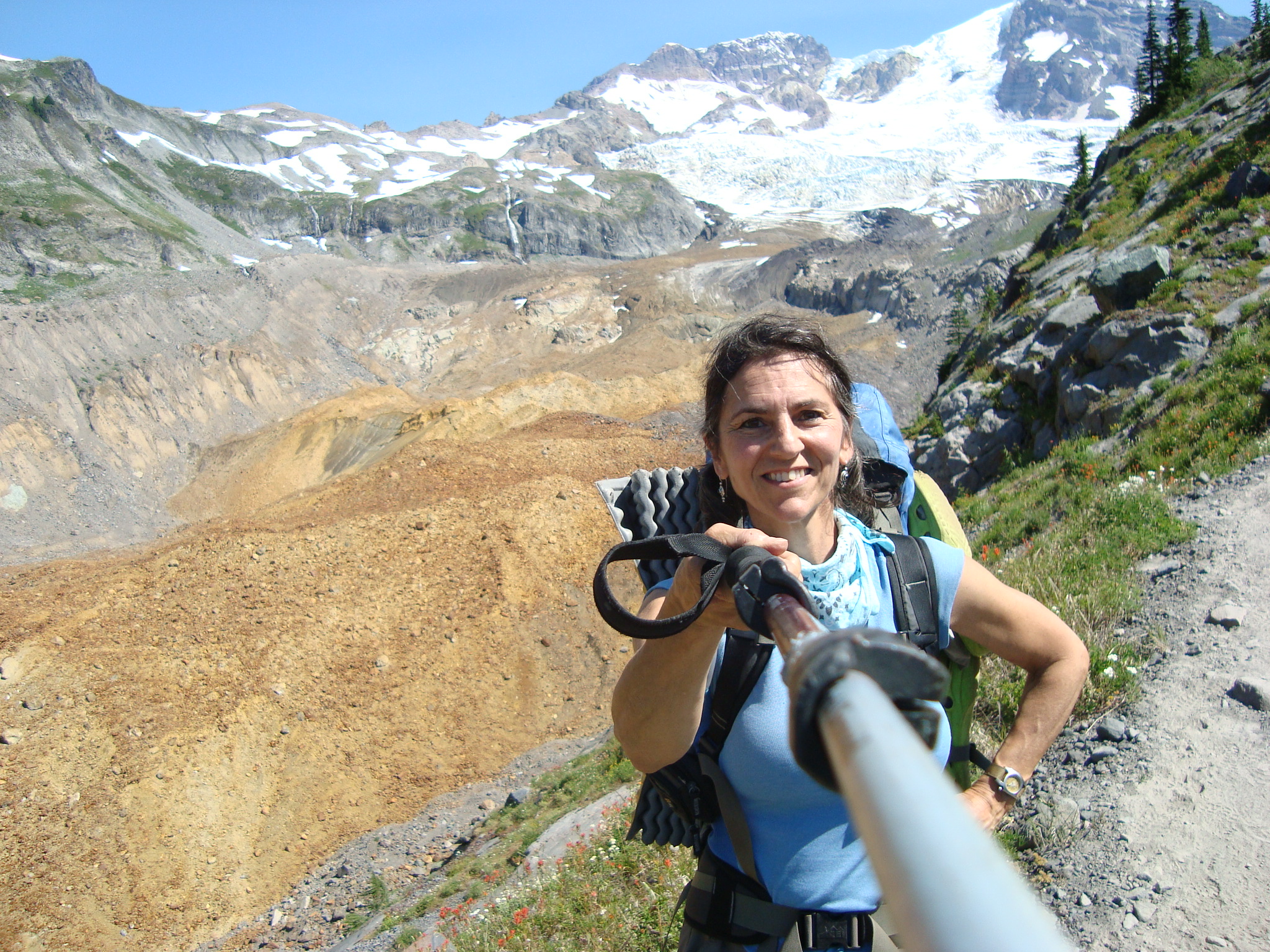
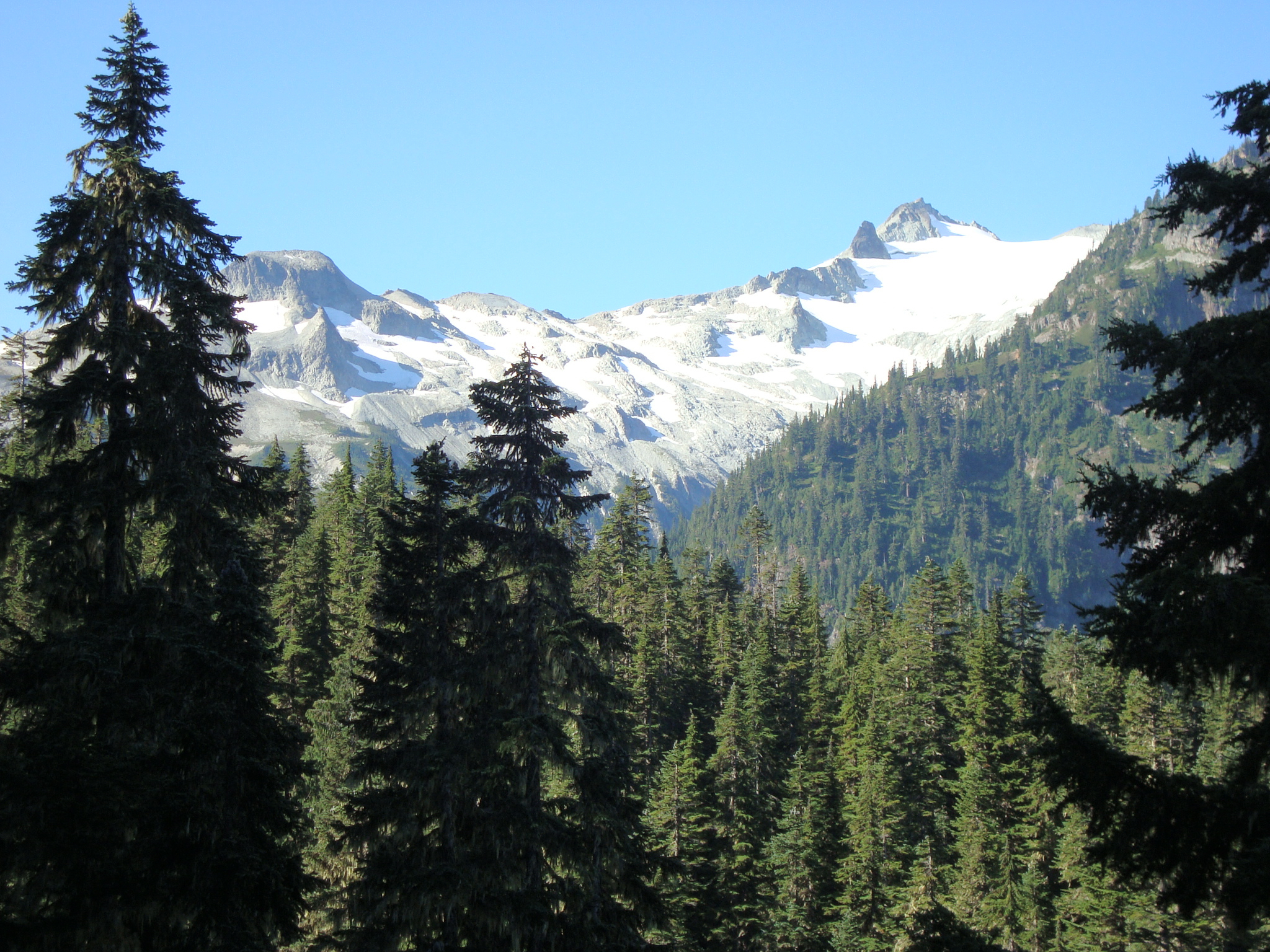
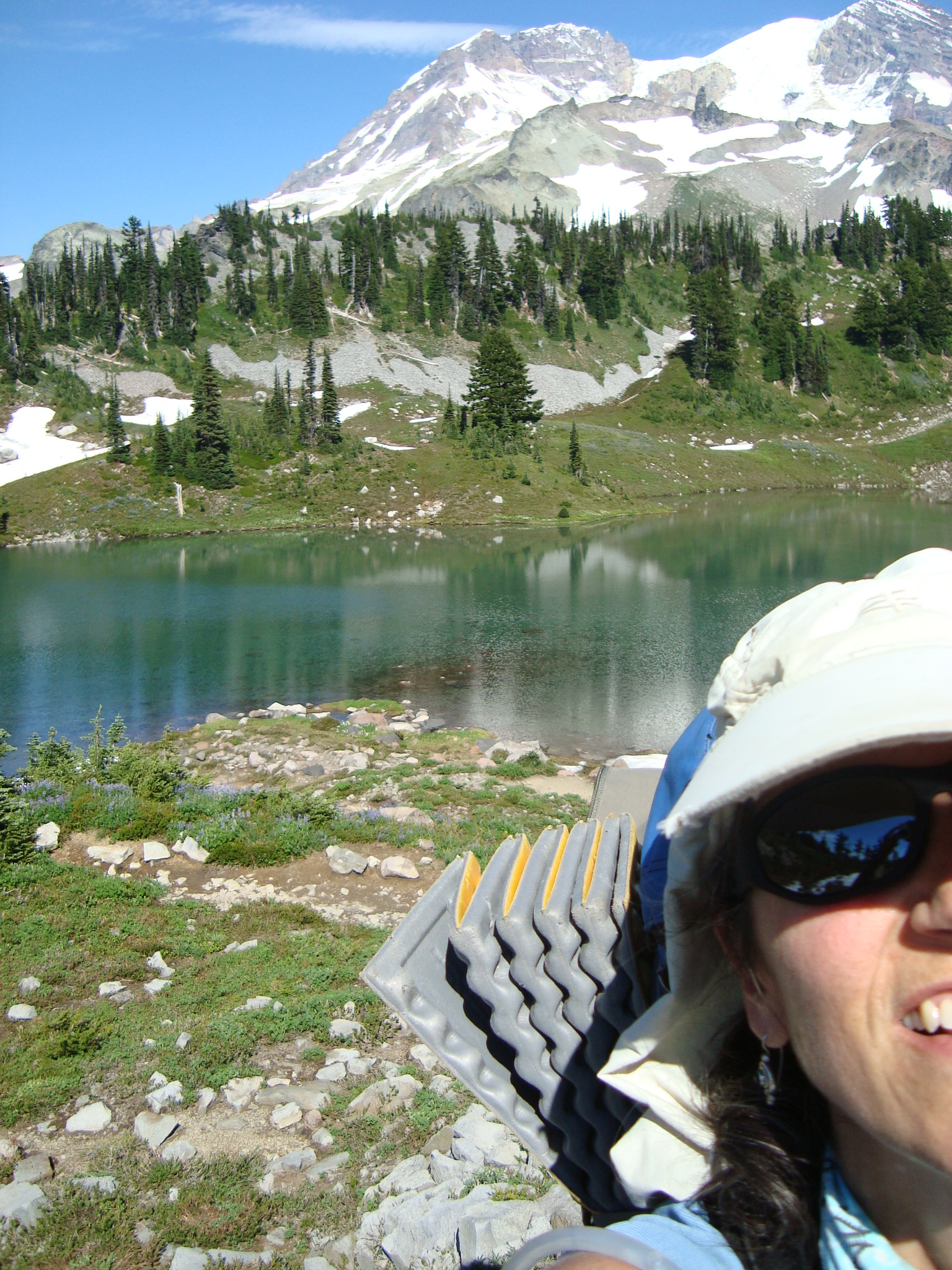
For me to react authentically in life, I have to know who I am and what I’m feeling – a feat easier said than done for a codependent adult child of an alcoholic.  (How do codependents greet each other?  “Hi!  How am I?”)  Hiking alone is, for me, one of the most powerful ways to arrive at this knowledge – especially longer thru-hikes that entail a week or so on the trail.  In 2012 I did the Wonderland Trail, about 100 miles and 22K’ of climbing/descending, and in 2013, still recovering from radiation treatment, I did a section of the Pacific Crest Trail (PCT) covering 75 miles and 16K’ of climbing/descending.  Hiking alone, the only interactions are between you and “nature,” people who’ve made or walked the trail before you, and the present-day hikers you meet.  Many, many hours are spent in your own company.  Incredible beauties are witnessed.  Countless decisions are made.  And each day brings a few hazards that call for courage.

PCT Section J

click to enlarge

Josephine Lake Wonderland


The first days, in my case, are about purging.  On Rainier, I found myself crying for two days.  This was my first major hike after breaking up with my boyfriend, who had taught me nearly every trail skill I knew.  But beyond that, I was coming to terms with the passing of youthful illusions that life stretches on and on.  How did I, Louisa, get to be 52?  Who was this lined, graying woman I’d become?  On the PCT, I expected tears again, but instead met with fear.  I’d begun by traversing Stevens Pass ski resort, and when the trail dropped from there into woods and rounded a hillside to a wholly new vista of indifferent, towering mountains through which I would pass, I got scared.  “What the fuck am I doing?!” I thought.  “What if a bear comes?  Mountain lion?  Rapist?  What if I fall and no one even knows?”  It took me a day or two to realize my deepest fears centered around cancer.  It had struck me, it seemed, out of nowhere, threatening everything I love, forcing me through a prolonged nightmare of treatment from which there was no escape.

In both cases, I had nowhere to run from these feelings.  I had to walk in their company, trudge in their muck until I truly got to know them.  In both cases, I came out on the other side to delight in a freedom so airy and light, I can’t possibly describe it.  The grief for all I’d lost turned to gratitude for the immense wealth I still had – these stunningly gorgeous surroundings plus the strength and know-how to travel though them.  The fear of cancer and all other scariness turned into a reconciliation with god.  Cancer happens, but I could choose to love all the cells on my team striving to protect me from it, and the many generations of medical experts all working to cure people.  I would choose to put my trust in goodness.

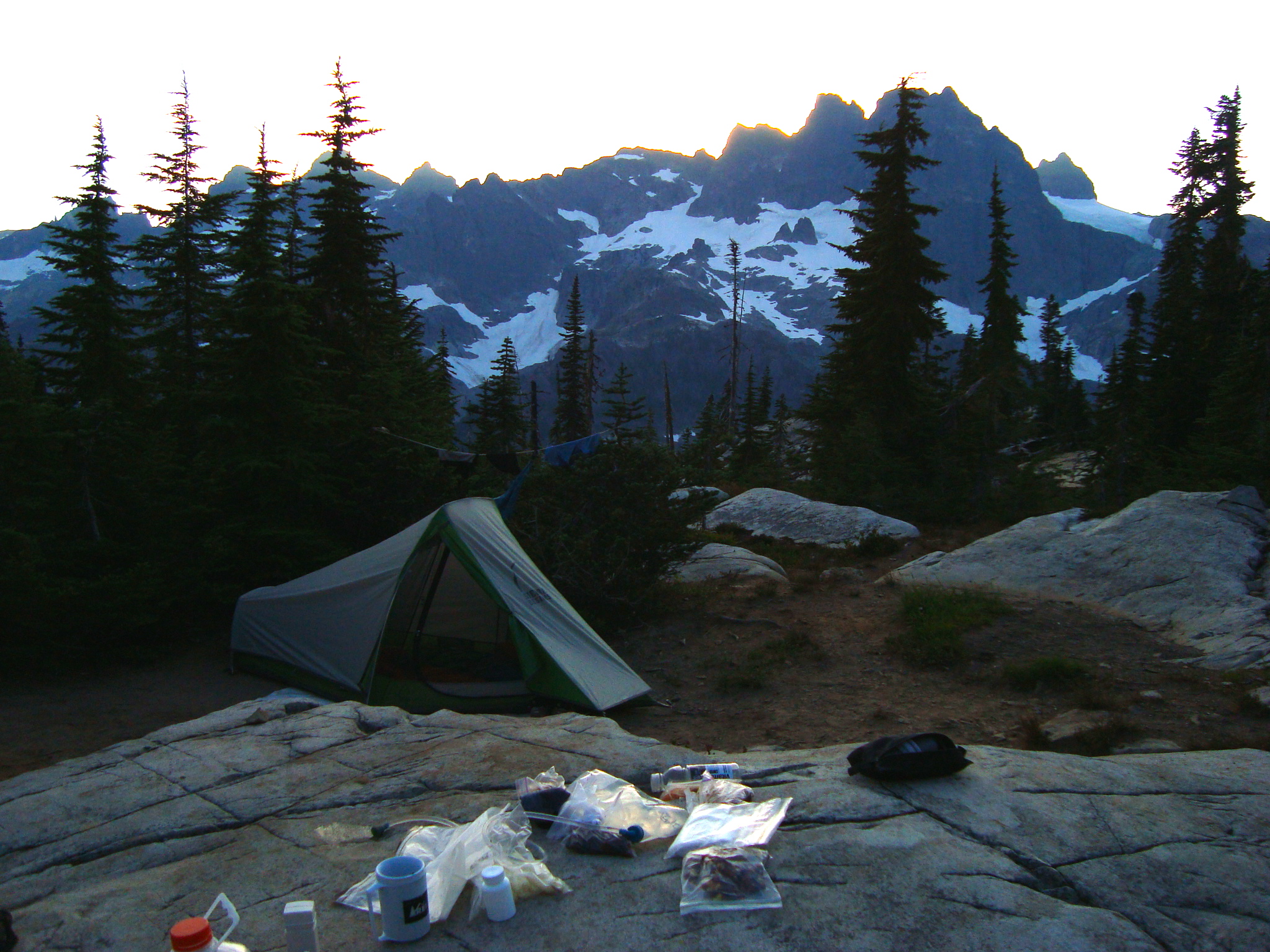
PCT J Camp

Dusk – I’ll tidy up! Clothesline strung behind my tent – wash in a large ziplock, dump away from source.

There’s nothing cozier than your own little camp, bedding down in your own tidy one-bitch tent, when you know what you’re doing.  You look at the map and see what’s coming up tomorrow.  Few moments are more empowering than, after passing warning signs of a high creek or a trail damaged by landslide, you gather your gumption and do what you need to.  Amid the roar of rushing water you choose your stepping rocks with care, plant your trekking pole and orient your balance to push off toward the next stance until, somehow, you’re across.  Or refusing to look down on the now tiny creek that wends far below, you focus on the narrow strip of trail that remains and keep moving.  Once you’ve passed these obstacles, they’re behind you.  Damn right, they are!  You don’t look back and analyze; your attention, buoyed by accomplishment, is all for what’s to come.

Finally, on both trips, I acquired an unexpected companion – both young men who loved the wilderness and had cobbled together from REI displays an idea of what they needed to get through it.  How could my pack be that small?  Why was I not wearing boots?  Why no Mountain House food pouches?  They asked to hike with me a few days and bombarded me with questions.  In each case, I developed love for a total stranger – one a butler to the most glamorous movie star couple alive, the other a Taiwanese Christian Electrical Engineer – sharing a grubby, spontaneous sincerity unimaginable in normal life.

The moral is that if I can practice all these skills on a daily basis – know what’s really going on with me, take each challenge as it comes, and love others by sharing whatever I have to offer – I am in tune with life.  And for as long as that is true, I will not develop an “edge” I need to “take off” by self-medicating.  There are ways to be free within the confines of our own skin.

DSC01967

Emerald Ridge, Wonderland Trail 2012

6 Comments

Filed under Alcoholism, Drinking, living sober, Recovery, Sobriety, Spirituality

Looking Back from almost 20 Years Sober

Then vs. Now

My life is far from perfect.  In a few days, I’ll turn 54, having failed to achieve any of the goals I set in youth.  I’m not a famous writer, and I don’t have much money.  I drive a 1990 Honda that starts with a screwdriver (really), because all my money goes to keep a small house that’s in disrepair.  My boyfriend is out of state most of the time, and I haven’t spoken to my sister or brother in a year and a half.  But… I’m sober.

What does this mean?  It means my life today is a an amazing gift.  As I get closer to hitting the 2o year sober mark, it gets harder to remember who I used to be.  But as a sponsor, in helping other women who suffer as much as I used to, I get to look back and remember.

There was a day when I woke up morning after morning full of toxins and shame.  I’d hide my headaches from my partner, pretending brightness, but more importantly I’d hide reality from myself, pretending I’d just had a bit too much last night because of… whatever.  At least half the time, I’d also be hiding the exhilarating glow of obsessive dreams about whomever I was infatuated with.  I’d go about my day being whoever I thought others expected me to be, looking to you for signs that I was okay, and thinking up ways of impressing you.

And since nothing would work out as I planned, I’d end up filled with sickening envy at your easy life and disappointment at my unfair one.  Most of all, I lived with self-loathing: the conviction that I was a worthless loser.  This conviction could survive any accomplishment I achieved because its taproot ran so deep, all the way to my core: I was hopelessly defective, fundamentally flawed.  And yet, this same worthlessness was the one sure rock I could stand on, the one foundation I could know without doubt.  It set me apart from others, ordinary folk who seemed so naturally filled with well-being.  Honesty, to me in those years, felt like the flat out admission that I sucked.  And the only way to fix that was to have a drink (well…  maybe two.  And then, whoops, a dozen plus) thereby temporarily rendering life simple and myself fabulous.

So what’s the miracle?  What’s the amazing gift?  It’s freedom.  It’s that not only have I woken up clear headed and sober for the past 7,000 mornings or so, but I wake to perceptions much closer to real.  The overwhelmingly loud self-static that used to roar in my thoughts has been tuned down, so my consciousness is a pretty comfy place to live.  I can love being who I am instead of berating myself for all I “should” be, and I can even see that I am a good mom who loves many people and supports herself.

How does that happen?  I got here by working the 12 steps repeatedly, skimming off one layer of denial at a time, one unacknowledged fear at a time – and giving what’s out of my power to god.  (Long version here.)  Today I stay on course by using the serenity prayer as my compass, and as I progress, the landscape keeps changing: things that once seemed those “I cannot change” have jumped sides to things requiring the “courage to change” them, and vice versa.  Gradually, I acquire the wisdom that all I can change is myself – my attitudes and actions – but that doing so transforms my entire world.

My ambition today is not a newer car or even a bestselling novel.  It’s honesty.  I want to go deeper.  There are still untruths I tell myself, deceptions that auto-play in my thoughts.  With god providing the light, I want to root them out and turn them over.  Though they don’t now drive me to drink, I can still feel, as I get ready to meditate, grips on falseness that tighten my world.  “Give up,” I tell myself, “let them go!”  Whether they come from growing up in an alcoholic household or amid a society of warped values and assumptions, unidentified beliefs are incredibly hard to release.  There’s the challenge.

The closer I get to living in truth, the comfier my life becomes – to the point that it’s outrageously luxuriant.  No amount of material luxury can rival that.  Living in a twisted mind, I have traveled Europe, sailed on yachts, eaten at fancy restaurants, or worn sexy new outfits – all the while drowning in dis-ease and self-consciousness, prisoner of an edginess that maybe a few drinks could fix – couldn’t they?  Now, to be where I am, naked under my clothes, simple-minded in my thoughts, flawed in countless ways, and making boo-boos right and left as I use up this obscure lifetime that will vanish under the footprints of future generations – what an amazing party it is!

Plus I can start my car with that screwdriver without even looking faster than 99.999% of the planet’s population.  Ain’t that a heck of an achievement at almost 54?

2014-06-22-goat

Goat Peak, day before yesterday.  What more can I ask?  (Or so I thought… See 5/18/15 post)

2 Comments

Filed under Alcoholism, Drinking, living sober, Recovery, sober, Sobriety

On Cussin’ during Prayer: Separating god from Religion

Step 11

This blog may upset some people, but, oh well.

Over the years I’ve sponsored a lot of women in AA and developed some of my own ways that make me a good fit for some and not others.  For example, many of my newcomer sponsees have a problem with “the god thing” and thus a problem with prayer.  They aren’t sure if they should get down on their knees or clasp their hands, whether to look ceilingward or what to call their god.  It all feels so contrived.

In this case, I suggest they try dropping a few F-bombs while they pray.  That is, if I’ve gotten to know a sponsee a bit and in telling me her story she’s dropped a few, I suggest she do the same with god.  Not in anger, mind you, but as she might with a close friend.  I ask her to try it for a week and check back with me.

Why do I do this?  To help that person separate god from religion.  Religion works fine for some, so if it ain’t broke, don’t fix it.  But for an increasing number of people who desperately need god, religion is not an option.  Fortunately, the 12 Steps give us the freedom to conceptualize god in whatever way works for us.  Chapter 4, “We Agnostics,” urges us: “Do not let any prejudice you may have against spiritual terms deter you from honestly asking yourself what they mean to you” (p. 47).

In my view, many of us assume that our conception of god has to import with it a shitload of trappings from religion.  We carry these prejudices around with us, i.e. ideas based on thinking we have not “honestly” examined.  We may have gotten far enough to let go of the old dude with a white beard image, but many hesitate to go further than that.

Among these imported God-trappings I will, for the purpose of keeping this blog short, limit my discussion to the the assumption that God can get pissed off by a lack of respect.  In this case, to appease Him, we should address God as we would any other authority figure: a police officer, a professor, a judge.  And since God is wa-ay old, we should definitely avoid language that would shock, let’s say, our grandmother.  For that matter, we need to capitalize every friggin’ pronoun referring to the Dude because He, essentially, demands Ass-kissing.

Approach prayer as our regular farting, burping selves?  Heavens, no!  Much of religion involves an effort to partition God off from the vulgarities of real life.  Over the centuries, our urban religious ancestors built temples, mosques, and cathedrals as sanctuaries, in part because there was just too much sheep shit and caterwauling and flies everywhere to let them string two thoughts together in prayer.  Prayer became a solemn supplication devoid of spontaneous personality because religion drilled into us that God wanted it that way.

I am so done with this view of God!  As I explain more fully in my essay, “God Evolved,” this view of God runs counter to my spiritual beliefs in every way.  It’s founded in feudalistic traditions and furthers agendas of classicism, sexism, and species-ism – not to mention personal hypocrisy.  Neither does it match the experience of anyone who has undergone an NDE.  What people experience when they die is an inundation of overwhelming love that exceeds our capacity for description.

There are, however, certain spiritual principles that hold true in life, many of which religion has accurately named.  When you act from unselfish love, you grow.  Any connection between us and god has to be initiated by us.  Anger and fear cut us off from god.  These principles aren’t god’s “judgement.”  They’re just spiritual equivalents of the laws of gravity or thermodynamics.

So, why would I recommend swearing in prayer to my sponsees?  Because… they swear!  And they’re the one who’s seeking god.  What matters when I approach god is that I show up as Louisa, 100%.  Sure, there are times when I feel solemn and ceremonial, but there are others when I’m flippant or pissy or frustrated.  It goes without saying that my god knows and loves all these modes of Louisa.

My sponsees, by contrast, are standing in the shadow of a cold, religious idol that requires thee-and-thou-style grovelling.  Swearing defies that idol, lets it tumble aside, and might just open them to the light of a god they can put their trust in.

As I describe in my addiction memoir (which also contains “God Evolved”),  I was somewhere between atheist and agnostic throughout my first years in the program.  But then from a tattoo artist with a huge afro, I heard these words: “A relationship with god is just like any other relationship: the more you hang out, the tighter you get.”

I hang out with god all the time now – when I’m teaching a class, when I’m peeing, when I’m chopping broccoli.  I talk to it honestly, and I listen.  So far, I’ve been healed of more maladies than you can shake a stick at: active alcoholism, clinical depression/anxiety, sexual obsession addiction, social phobia, (most of my) codependence, and the pessimism that kept me from living the adventures I dreamed of.   Most importantly, god has broken down my walls of isolation and opened me to love freely and try to help others – by posting this, for example, because it may help some reader move a bit closer to grasping their own truth.

1 Comment

Filed under Alcoholism, Near Death Experience, Recovery, Sobriety, Spirituality

Save your Ass, not your Soul

Steps 2, 3, & 12

Taped to my fridge I have an old fortune cookie fortune.  Except it’s an alcoholic fortune.  One of my friends used to order these special alcoholic fortune cookies with program tips and slogans tucked inside on the little strips of paper.  For us, these kind of are fortunes, because our lives go downhill fast if we don’t practice this stuff.  Anyway, it reads:

 “This is a Save Your Ass program not a Save Your Soul program.  We are concerned with the here & now, not the hear after.” Fridge

You might notice that he misspelled hereafter as “hear after,” and apparently no one at the fortune cookie factory noticed.  As it happens, this friend of mine, Dave F., has since gone to the hereafter.  His liver quit on him suddenly at age 47, many years into a healthy sobriety, and he did not survive the transplant.  But for me, because of how Dave lived, and because I still think about things he shared in meetings, he has indeed gone to the “hear after.”

“Religion is for people who’re afraid of going to hell. Spirituality is for those who’ve already been there.”

That saying, attributed to various people, runs along the same lines as the Save Your Ass slogan.  Those who accuse AA of religiosity, as I once did, completely miss the point.  Drunks don’t want to be holy.  We don’t hope to get into some God-ass-kissers’ heaven.  And we sure don’t go through the 12 Steps to become shining examples of goody-two-shoes bullshit.  No.  We want to live.  We’re motivated by pain and the threat of self-destruction, and we’ve known both too well for longer than we could stand.  To get sober, we need the help of a higher power to remove our compulsion to drink.  But to stay sober, we need that god to relieve us of the compulsion to think in alcoholically self-centered, fear-driven ways that twist us up inside until we either tip the bottle or otherwise wreck our lives.

Mind you, I can wreck mine purely from the inside.  If I’m off the beam spiritually, even the most outwardly beautiful Hallmark moment can be shot through with  x_(insert anxiety, insecurity, self-loathing, jealousy, ire, not enough etc.) to the point where, idyllic as it looks, I’m in hell.  The choice is mine to wallow in those feelings addictively or to forcefully wrench away from them and ask god for help.  I say “forcefully” because the pull of those emotional reflexes can be every bit as tempting as the reflex to drink.

Dave was prone to all these aspects of our disease, but he kept turning away from his defects, reaching for what god could offer instead of what his disease could.  Not just once in a blue moon, but consistently.  One summer night at an AA meeting we hold around a campfire on the beach (Golden Gardens, Tues night), I heard him tell a story that has stayed with me in the “hear after.”

That same day he’d tried to summit Mount Olympus alone.  Sounds epic, but it’s also a lo-ong drive, an even longer overnight hike in, and a very dangerous ascent.  In any case, almost as soon as he’d reached the glacier, one of his crampons broke (spiky foot gear for climbing ice).  He’d tried to rig it: fail.  He’d tried to climb without it: fail.  Finally, he’d had no choice but to turn around in defeat.  Having driven straight from the mountains to the beach, he was boiling water on his camp stove for his freeze-dried dinner as he spoke. Here’s the story I remember him telling.

“I got down into the trees, and I was so damn pissed.  I broke for lunch at this creek and I was just pissed as hell.  All this time, all this preparation – fuckin’ crampon breaks!  I was denied!  It felt so unfair, and just like my whole life has gone that way – you know?  But then I see something pop out of the water, and it’s this little bird.  There’s serious fast-moving water in this creek, rapids, pools.  And I see where he lands, and he’s got this tiny fish.  Swallows it.  And he’s lookin’ at the water.  Flits somewhere else, looks at the water.  Boom!  He shoots in!  He’s like a rocket.  Few seconds later, pops out.  This time, no fish.”

Dave told about the change that came over him, watching.  Sometimes the bird hit pay dirt and sometimes, for all its daring, getting churned around in that washing machine of roaring ice water, it got nothing.  Gradually, he remembered to notice what a spectacularly beautiful place he was in.  Gradually, he accepted what had happened.

“Maybe that’s what I was supposed to see today,” he reflected.  “Not the view from the top, but that bird trying, and going for it, and working with whatever god gives it – fish or no fish.  Maybe I just wasn’t supposed to summit today,  or I could’ve fallen cause the crampon broke at a bad time.”  He shrugged wistfully, stirring the package.  “This was supposed to be my victory dinner.  But maybe it is, just being here with you guys, sober.  Tonight I’m grateful.”  Waves broke on the sand.  We could all see the sun setting behind the Olympic mountains across the water, and now Dave turned his head to look at them.  “I’ll tag Olympus another day.”

And tag it he did, solo, a year later – his last.  On that day, he nabbed a truly precious fish.

I didn’t get a chance to see Dave F. in the hospital, but I heard that all the nurses, doctors, and orderlies fell in love with him because of his humor and kindness.  I know over a hundred people who love, remember, and miss Dave today because of his selfless generosity.  That guy used to carry the makings and equipment for entire pancake breakfasts 3,000 feet up Tiger Mountain, cook during our mountaintop meeting, and hand out steaming plates to anybody.  He reached out to newly sober drunks who didn’t know jack about climbing and brought groups of them up mountains, passing on his knowledge.  He even planned group climbs on holidays for those without family, spreading the word about our sober climbing group at AA meetings everywhere. In the summer of 2o12 I joined him on a climb of Mailbox Peak, laughing and joking about I don’t remember what.  The other guys looked up to him.  He had confidence and charisma.

Contrast this with 2006, the first hike I ever took with Dave F., when he spent most of our descent of Mount Si complaining to me about his job, luck with women, lack of education, and life in general – letting out his sense that he never got a break.  Or compare it to our first ascent of Rainier that same year, when he kept to himself at base camp and spoke little to anyone except our leader.  He struck me as wounded – lonely but too shy to socialize, trapped inside himself. He was like a bird waiting for a fish to jump out of the whitewater into his beak.

Here’s the crux, okay?  Dave underwent a psychic change, that spiritual awakening named in Step 12 that happens as a result of sincerely working 1 through 11.  If he hadn’t, up there on Olympus, he wouldn’t even have noticed that friggin’ bird.  Or if he had, he wouldn’t have given a shit because seething about how he’d been robbed would demand all his attention.  But with the psychic change, Dave sensed that such a path, the way of resentment and self-pity, was dangerous, because resentment spreads in an alcoholic like a cancer until, before you know it, you’re too smart to go anymore to those stupid meetings where all those bozos are so full of shit.  Recovery like Dave’s takes courage.  It takes work.

Turning to god is how we save our asses.  When we’re open, when we’re in the habit of looking, god speaks to us through the tiniest, most unlikely messengers.  If we want that message more than our version of the story, we pay attention, we see metaphor, and let god give us exactly what we need to be whole and free in the here and now.

Mount Olympus, Washington.  How’s the view from there now, sweet Dave?  We miss you!

Mount Olympus, Washington. How’s the view from there now, sweet Dave? We miss you!

.

.

PS: To my surprise, while hiking this August, I camped at the same wilderness site from which the above photo was taken.  Here’s my (ex)boyfriend’s version, not quite as good, but still:

2014-08-05 15.33.37

Leave a comment

Filed under Alcoholism, Recovery, Sobriety

Those Pesky Character Defects

My Experience with Steps 6 & 7

When I first got sober, I couldn’t recognize any character defects in myself for the first few months.  See, I was such a nice lying, cheating, manipulative, self-pitying, ass-kissing, two-faced gossip, how could you hold it against me?  Selfish?  Me?  No more than the next guy!

I was raised in an alcoholic home and had carried a secret compulsive disorder for most of my life.  If denial were an Olympic event, I think my whole family would make the US team.  I can see us in snazzy team unitards with EVERYTHING’S FINE! emblazoned across the chest.  Always, when I was drinking, it seemed to me I did what I had to do to survive; I believed my own story.  Or at least, my public relations stand with myself was that my own story was to be believed.  But deeper down, even years before I got sober, I hid the heavy, dark acknowledgment that I was full of shit.

The first defects to go were lying, cheating, and stealing.  From the beginning of my young adult years, I’d lived off the high of infatuation, which I found ways to manufacture.  Since I’d learned from my family that I was not enough, the star of approval that would cure my insecurity lay always outside me, carried by certain designated hotties.  First, I’d notice you had it.  For weeks I’d stalk you, thrilling each time I caught a glimpse.  Eventually we’d become friends and drink together.  This is when I could really let it rip, confiding in you how my current partner didn’t understand me, held me back like some kind of jailor.  You’d empathize, unaware that I was frickin’ FLYIN’ ON DOPAMINE in your presence.  Your attention made me pretty, charming, and deep.  It was heaven!  The more I reeled you in, the closer I got to clinching that gold star.  But once I had you, once you’d given me both your heart and the star, the fucker turned to tinfoil.  You farted.  You told the same story twice.  You were, in short, human.  So before you knew it, you became the jailor, and I was off looking for someone new to commiserate with about you.  I repeated this cycle every five years.  Three times.

With my first partner in sobriety, I quit that game.  I never looked at other women – or men.  I was done with that.  I also gave up flirting.  Why?  Because flirting sends a message that I’m interested and available, and if I’m neither, I need to knock it the fuck off.  I also quit stealing.  Mine had been wimpy theft – padding the tip jar, pocketing office supplies – taking what I told myself I deserved.  But now, I walked back into stores if I found something in my cart I’d not been charged for.  When a cash dispenser gave me an extra $20, I turned it in.  And when my employer put an extra paycheck in my account, I called and reported it.  Twice:  Not.  My.  Money.

Next to go were those defects listed by my sponsor during my first 5th step, about 2.5 years into sobriety.  She wrote:

WoodsCoverFinal

  • Playing god: casting, directing, scripting (I believed you ought to do whatever worked best for me)
  • People pleasing (to get you on my side, cause I might need you later)
  • Dominant (cooler than you) / dependent (you’re cooler than me) dichotomy
  • Self pity

I was not allowed, she said, to rate people higher or lower on a coolness scale anymore.  We were all just stars in the night sky, some grouped as constellations, some not.  How do you quit doing something like that, stop thinking in a way that’s been reflex since kindergarten?  Step 7, in her version, went like this: God can’t remove a character defect if you’re still using it.  That means you have to try like hell not to do it, and god will eventually lift it.

Letting go of those defects took a lo-ong time.  It took making 9th step amends with people I had judged as less cool and seeing the grace with which they’d made peace with my wrongdoing.  It took hearing 5th steps from women of all shapes and sizes, gradually seeing that we all worry about the same shit.  We all fear not being loved, not being seen, not having dignity.  Whenever I ask a sponsee what the person resented ought to have done, the answer’s the same: what would have worked best for me.  Understanding this helped me let go.

Eventually, I came to “victimless crimes,” or behaviors that only hurt me. I’d already seen that smoking was a form of lying.  Whenever I compartmentalize an inconvenient truth (smoking kills) for the sake of what I want to do (I like it), I’m denying truth.  Yep.  Lying!  So I quit.  I saw that saying I loved animals (I value their feelings!) and eating meat (so suffer your life in a sunless hell and die in terror with no caring soul anywhere to rescue you) made me a hypocrite.  Today I’m a vegetarian, and my eggs come from my own happy backyard chickens.  (Of course, I still drive a car and enjoy white American privilege – not sure what to do there.)

In recent years, having been beat up sufficiently by life, having lost serenity and myself enough times, as well as many loved ones who’ve died, I quit judging struggling alcoholics who act out, and I quit gossiping.  I guess I’ve just known craziness enough times to appreciate that the person in question would manage better if they could.  I separate the behavior (which is unfortunate) from the person (who is likewise unfortunate).  Women in all kinds of dicey dilemmas call me, some sober, some not.  I listen, empathize, and give them my best shot.  Then I tell no one.  To not gossip at all is no easy feat!   I needed training wheels at first: my best friend, a trustworthy man, served as my overflow outlet.  If I absolutely had to tell someone, I’d tell him, and him only.  The buck stopped there.

Really, all these defects are interrelated.  Whenever I look to people instead of god for worth and validation, they become a means of meeting my needs.  But god does heal us.   It’s still a miracle to me that I’ve gone almost ten years without infatuation, eight loving the same boyfriend.  Never, never, I thought, would god free me from that.

I ain’t perfect.  Trust me, I still have a kitchen junk drawer full of defects – impatience, envy, vanity, anger, Facebook-induced ADD/procrastination, and 27 forms of fear.  I honestly think many of these are essential to the human experience – the trick is to recognize them and laugh at yourself.

So at 19.5 years sober, here’s what’s left: I judge myself.  I feel I’m not enough, that I’m somehow a failure.  I feel guilt and shame for something I can’t name.  I fear financial ruin.  I fear growing old without the humility to accept it.  And most of all, I fear that I’m wasting my life, because being right here doing this seems not as good as what I ought to be doing, off in the Andes or on Oprah or whatever.  I lack.  I am wrong, faulty, unacceptable.  These beliefs are the inheritance of having grown up around alcoholism, wounds of the child I hid so long with my own addictions and dysfunctional behavior.  Now that I’ve quit all those false covers, what’s left is, they fuckin’ hurt.

Therapy. Check!  EMDR. Check!  Sometimes I’ll feel good for months and think I’ve finally reached the sunlight.  But other times they creep back.  Self-blame, guilt, I-suckness.  I’ve asked god a zillion times to take them, sometimes on my knees and crying.

But god does not do drama.  That I’ve learned.  Instead god had me call an old friend after 32 years who suggested I buy the ACA (Adult Children of Alcoholics) big book.  And, holy shit!  There I was, described in its opening pages!  So last week I went to my first two ACA meetings, where people understood my experience to a T – people who were healing.

Here’s the bottom line:  If you’re on a spiritual path, there’s always more footwork to be done.  There’s always trying like hell when you don’t really know what the fuck you’re doing.  But that’s where faith comes in.  However blindly you stagger, head toward goodness.  Head toward Love.  Keep putting one uncertain foot in front of the other, and trust that god will guide you.

1 Comment

Filed under Alcoholism, Codependence, Recovery, Sobriety, Spirituality