What a 4th Step Is and Ain’t

Recently I’ve encountered a few people at odds with the 12 steps who see the 4th step as negative and punishing. To their minds, it’s an exercise in self-judgment that drags down people’s self esteem and flagging spirits.

I disagree.  Of course, I’m just another drunk – one who’s stayed sober a while and writes too much.  Still, my own belief is that, as with all the tools of the steps, the 4th step’s effectiveness depends on how closely one adheres to the instructionsScreen Shot 2014-09-02 at 11.28.37 AM and spirit of the Big Book.  To me, all the steps step are founded in the power of love with the goal of achieving a freer flow of that love – for myself, for my fellows, and for life/god.

The Short Version

I came to AA because I was beyond miserable. My every intention, good and bad, backfired because people didn’t react as they were supposed to, and my self-loathing took deep, savoring tokes on those fumes of failure.  Yet I kept trying to work those intentions over and over, always hoping for a different result, the same way I’d kept trying to drink normally. Before I could stop grabbing for those faulty tools, I had to see them.

But what part of me does the seeing?  Whether a 4th step is shaming or freeing depends on whether I view it from the standpoint of my ego, who compares, competes, and complains, or a deeper layer consciousness, my true self that opens to god.  Who’s at the wheel depends in turn on the thoroughness of my 1st, 2nd, and 3rd steps.  Am I truly done trying to fix everything?  Done running around being crazy?  If so, who can restore me to sanity?  A judgmental god?  A god who says, “Louisa, you really fucked up, and it’s your own selfish fault, so eat it!”

Nope.  It’s a god who loves, who is love, who hurts with me when I’m in pain.  When I allow that god into my vision, I can start to see how in my recurring complaint that “people didn’t react as they were supposed to,” the true problem lies not in the people or their reactions but in those words, “supposed to.”  Supposed to, that is, by my agenda, based on Louisa’s efforts to arrange things for her own maximum comfort and benefit (also known as “selfishness – self-centeredness!”)  A loving god guides me toward the wisdom of understanding what is and is not mine to change:  I can’t change you.  I can only change me.  When I rely on god – not you – to provide all I need to build a good life, when I’m more interested in giving than receiving, I find it possible to live and let live.

The Long Version, for those interested…

My331289200303_1 1st step sucked for two years.  Because I wasn’t open to any sort of god, I surrendered only enough to admit I needed meetings. Or not even!  Most of the time I went only because I’d been willingly 13th stepped* into the program.  I say willingly because my ego was still very much in charge, and what it knew best was codependence. Dry, I focused on molding my partner as a way of navigating life, using my same old tools. But then god chucked some major stuff in my path, obstacles these tools couldn’t surmount: first the death of my sister, then a resultant clinical depression. I believed the wrong sister had died – the worthless one was still dragging on in her useless life. When the pain got bad enough, when despite twice doubling the Zoloft, I found getting out of bed to be an exhausting exercise in futility, I sought out a new sponsor.  To her I said, and meant, help me!

My ego’s belief was that I needed to trick people into loving me by hosting the Louisa show.  That’s the reason no god would love me, because it would see right through all the hoopla of my trying to be pretty, savvy, complex, and blah blah fartsworth to know me in all my pathetic unworthiness. Who could love that?  God already did, my sponsor promised. She gave me permission to entertain the possibility that the infinite love I’d experienced in my Near Death Experience was how god embraced me all the time – except that I shut it out. I couldn’t feel god’s love because of something  from me that repelled it.

Hmm, what could that be…? How about fear and resentment, those Bobbsey Twins of darkness?

“Driven by a hundred forms of fear [‘that we would lose something we already possessed or would fail to get something we demanded’]… we step on the toes of our fellows” in our efforts “to arrange” them in our own way “and they retaliate.”† In other words,

A) I’m afraid my needs won’t be met, so

B) I try to manipulate other people to meet them. ButAnger

C) they have a different agenda: meeting their needs. So

D) it doesn’t work my way, and

E) I get pissed.  And maybe

F) they get pissed, too.

A 4th step is first a way of tracing backwards from the pissedness (E) to identify the fear at stake (A).  Column 3 lists the needs I was trying to recruit others to meet. They’re very real needs: for self-esteem (self-worth), security (being ok), ambitions (growing), personal relations (fitting in), and sex relations (sexual identity). The problem is, I can go for minutes or years just positive that if I only coach someone rightly, urging and expecting, they’ll step up to fill my need and I’ll be all set!  Except the bastards don’t cooperate.  Instead they do shit that hurts me, wrecks my plans.

At some point, I invented for my sponsees a column 3½: “Name the Diss.” That is, I have the sponsee write out what insult the uncooperative candidate seemed, by their actions, to be saying. For example, if someone I trusted lies to or cheats me, I feel like they’re saying, “You’re a gullible chump!” If a woman I’d like to pale in comparison to me sexually attracts all the guys I know like iron filings to a magnet, I feel like she’s saying, “You’re not sexy!” If a friend shafts me for other company, s/he says, “You’re not worth my attention!” These stingers can embed themselves in our spiritual skin for decades – these perceived disses. If we fear they may be true, we foment anger to defend ourselves from their outrageous slander, even though it’s really WE who keep rehashing the imagined diss long after the other person has forgotten.  That’s the re in resentment.

How can a 4th step free us from all this?

First off, the actual problem lies not in the person resented, but in my recruitment process and assumptions. Sometimes I try to recruit an incapable or unwilling candidate, and sometimes my need is actually something that can be filled only by me or god.  To grasp this, I have to recognize that what EVERY SINGLE person on my 4th step did wrong was FAIL to make Louisa comfortable.  Whether they didn’t return my smile or cheated on me in bed, my resentment is rooted, not in moral conviction per se, as I might like to think, but in the presumption that they A) exist to meet my needs and B) have the means to do so.

That presumption is…. wait for it…. you know it….. selfish!  You say, But, but-!  I say listen.  To let go of point A, I need to recognize that this person’s primary mission is always to meet their own needs – not mine. For point B, I need to borrow from Byron Katie a bit and ask, “Did that person have the means to do what was, in my view, the right thing?”  Apparently not.  If they weren’t honest with me, apparently they did not have the internal means to be so.  I don’t go to the hardware store to buy bread, and I can’t ask this person to draw upon inner strengths or character assets they simply do not possess. They are not a vending machine into which I can deposit in my coins of kindness, good faith, whatever, and expect to get a pop can of the behavior I want.

It’s in my expectation that others show up as I prefer, not as who they are, that I set myself up for hurt.  And sure, hurt is inevitable.  My ex-partner’s infidelity was devastating to me.  But when I’m totally honest with myself, I see that in some way, I ignored what was inconvenient.  I might also see that in some way at some point, I’ve done the very thing I resent.  And lastly, I see what hurt most was actually the implied diss I told myself: “I’m not loveable.”

The 4th step teaches compassion, forgiveness, and acceptance of the fact that all human beings – you, me, and everyone we encounter – are flawed.  Being flawed is nothing to be ashamed of; it’s essential to our humanity.  I fuck up.  God loves 670px-Shade-a-Flower-Rose-when-Drawing-With-a-Graphite-Pencil-Step-1me.  I try again and fuck up.  God still loves me.  I can respond in the same way toward you with your fuck ups, or I can decide that your flaws cause me too much pain and steer clear of you (eventually without rancor).  But gradually I learn where the exploding mines of human interaction are lodged, and I begin not to step there.

I do believe there’s one exception to this pattern. Parents are sole custodians of a child, who rightly depends on them to meet all their needs.  When parents fail to, when their actions cause injury, the child has no “part” to identify in Column 4.   That said, however, once the child becomes an adult, they do become responsible for their own lives, including the care of those injuries. If they’re trying to draw healing out of another person, it’s not going to work – particularly if that person, their parent, is still flawed.

Forgiveness is a gift we grant ourselves.  When compassion won’t come, we can think back on the times we most knew we should not drink, and drank anyway.  When we should not have flirted, and flirted anyway.  Should have told the truth and didn’t.  Some part of us longed to make better choices, but the needed power wasn’t there.  We lacked impetus.  So it goes with every misdeed of people on our 4th step: the clarity and strength to choose wisely simply weren’t there.  To resent a seed for not sprouting or a rabbit for not being a paycheck makes no sense.  So it goes with the people in my life – for not being programmable.  And thank god they’re not, or I’d never learn jack!

.

.
* “13th stepping” refers to dating/taking a partner among newcomers in the program.
† See p. 62 in the Big Book and  p. 76   in the 12 & 12

9 Comments

Filed under AA, Alcoholism, Recovery, Sobriety, Twelve Steps

A Lil’ Note on Fear

What’s that saying we hear around the rooms – “Be careful what you pray for – you just might get it” – ? In the last few weeks I’ve learned that when you do get what you thought you wanted, it turns out not to be what you thought.

A week ago Wednesday a client of mine canceled, so I thought I’d grab the time to write a post.  I’d skipped the previous week because of a long hike, so I pushed myself to just crank something out.  News of Robin Williams’ suicide had shaken me.  My own years of battling depression were but a drop in the bucket to his, I knew, but after Google brought me his choice words on the inner experience of alcoholism, I’d felt a powerful upwelling of compassion.  Could I remember and describe that feeling?

An hour and a half later, it was online.  That entire day, the post got one (1, uno) view.  I considered deleting it, seeing as it didn’t “fit” with most of my blog.  Except that I liked it.  It said what I’d felt.  So, after adding the opening disclaimer, I posted a link to Facebook and left for work.

When I got home that evening, there were 187 views.  Since my previous all-time high had been 80, I thought something must’ve gone haywire with my WordPress stats.  Two friends had shared the link – that’s it. trending-sign But just for shits and giggles, I posted it on an open AA Facebook page as well.  In the next 24 hours there were 1,600 views, a number doubled or tripled daily.   As of right now, the total number of views has reached almost 75,000 from over 100 nations.

Two weeks ago, I’d have told you my only reaction would be elation.  Every writer wants to be read, right?  But the inflow of comments gave me a feeling more like when you’ve put too much lighter fluid on the briquettes and light them too soon.  The flames leap higher and higher until – aack! – what have you done?!

Exposure was a scary feeling I’d not anticipated.  The blog had traveled to readers critical of AA and recovery, a few of whom accused me of discounting depression, glorifying myself, or forcing AA on others – nonetrend of which I’d intended.  In these voices I felt aggression, like flaming arrows entering my home.  They seemed certain I thought I knew shit, that I was saying, “Here’s the real deal on Robin Williams.”  But there is no high horse to knock me down from.  I never claimed to know anything.  I’d written my feelings – what I’d wondered, and how that felt.

I’ve never seen this in AA literature, but it seems to me that, just as there plain hamburgers and cheeseburgers, so are there two basic types of alcoholics: plain and codependent.  Plain alcoholics fear god won’t care for them, and codependent alcoholics fear they’re not worth caring for, period.  That is, unless others say they are.  Codependents try all kinds of ways to win the approval that, this time, might just fill that painful hole in their soul.  It’s a double disease that divides the adult self, who of course knows better, from the inner child who still pleads, “Like me! Like me!”

In my case, apparently, that means everybody.  My emotional balance often seems as precarious as if I were riding a unicycle, so that any disturbance makes me wobble and flail absurdly all over the place.  Because this fear was absurd!  Even with tens of thousands of folks quietly re-posting, and kind comments outnumbering critical ones by 10 to 1, every damn time I went to checked email, my body anticipated criticism with huge shots of adrenaline – that flush in your stomach that fills you with dread.

During the two days of highest blog traffic, my constant state of fear obliterated mindful presence.  I got a parking ticket (too many thoughts to feed the meter), a speeding ticket (too many to notice speedometer), and went without sleep.  When I described my critic-angst to sober friends, their advice was either “Fuck ’em!” (by far most common) or “It’s self-centered to expect others to see what we see.”  But neither helped.  I’d originally started this blog to publicize my addiction memoir, which I secretly hoped might some day take off the way the blog has, but now I had doubts about even wanting that. Maybe I was just too easily bruised, I thought, to be putting myself out there that way.

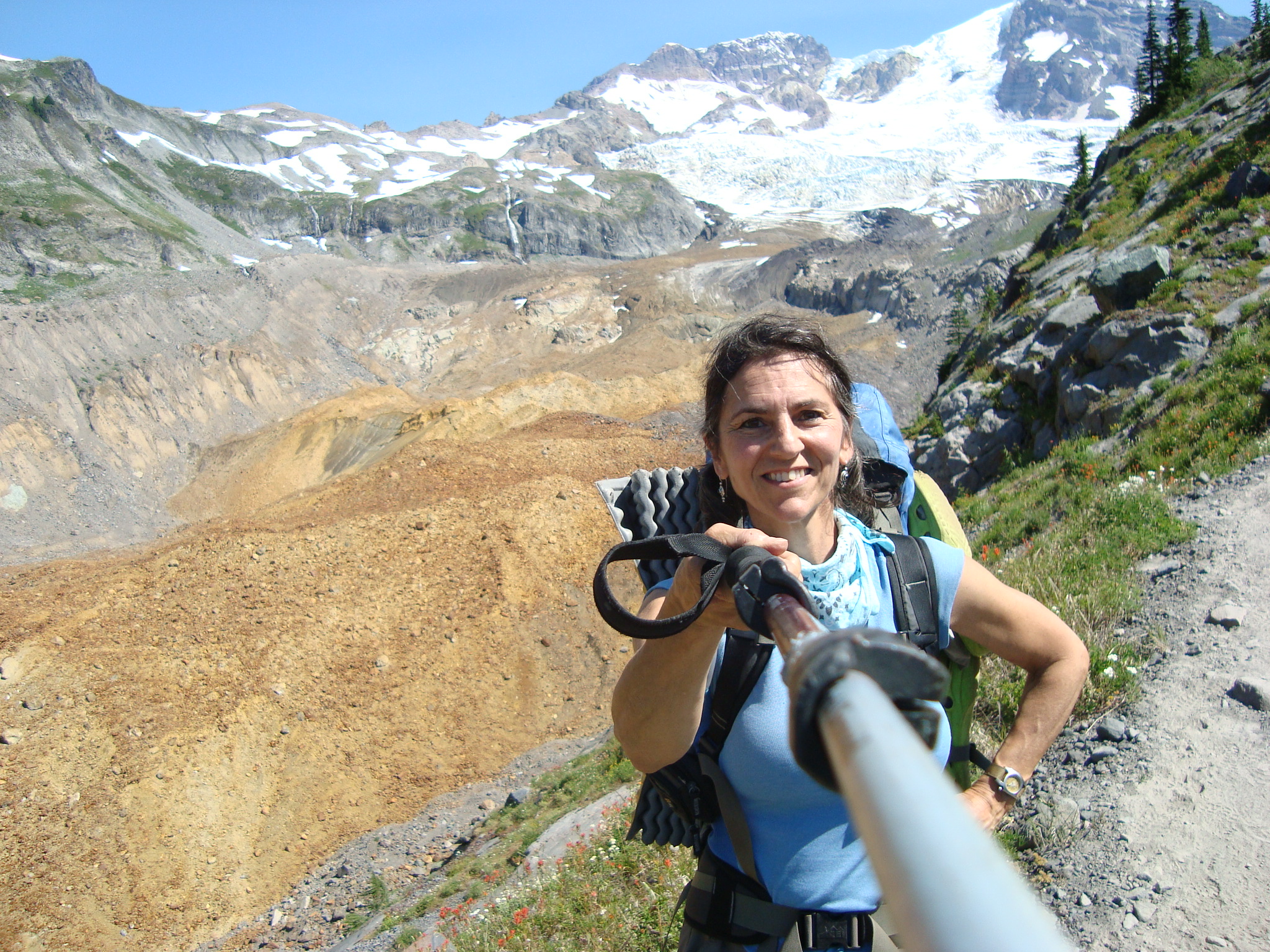
The irony is, I don’t fear the world.  This past weekend, I loaded up the car with my son, dog, and two backpacks, drove 138 miles into the North Cascades, hiked a mile in, rented a canoe, and paddled 4 miles on a glacier-melt lake to find a small inlet where our sober friends were camping – no roads, no cars.  Sunday morning, along a trail where for the past two years we’ve encountered bears, I went for a run carrying a collapsed, pointed trekking pole just in case.  Sure enough, major bear poop showed up on the trail about a mile in – dark with lots of berries – but since it didn’t look fresh, I kept on, just keeping my eyes open and blowing out a trumpet-style farty noise every so often as a bear-bell.  That kind of courage I don’t lack.

Codependence makes me over-reactive to others’ responses, because I think I need approval to outweigh my deepest fear – that dark secret that I do suck and am going to be exposed as a fake and a fraud.  It’s the fear that others will discover how flawed and therefore vile I am and react with disgust.  On this camping trip, surrounded by loving, flawed alcoholics and the beauty of mountains, I saw my fear as something I need to make peace with until god takes it.  When fear of judgement comes on, I can only accept it as I would a sneezing fit, involuntary and inevitable.  Whoops!  Adrenaline rush!  I’m a fake and a fraud who’s unworthy and everybody’s gonna find out!  …Gesundheit!

One of the greatest gifts I’ve received in sobriety is the distance allowing me to not believe my own thoughts.  I have faith in something far greater than my own mind, something that shapes my life with wild turns of events that I could never, ever see coming.  For now I can tell fear, “Thanks for sharing.”  I can hold up the “Please wrap it up” card.  But I can also trust that god is teaching me in ways I can’t yet fathom, and that fear, like pain, is a voice for what still needs healing.

.

DSC02999

Boy and dog on Ross Lake: what does matter.

4 Comments

Filed under AA, Alcoholism, Codependence, living sober, Recovery, Sobriety, Twelve Steps

Robin W., Alcoholic

Note: This is the first time I’ve written about something outside my own personal experience, but it’s been on my mind enough that I felt moved to.

.

When Amy Winehouse’s body was found with a blood alcohol content of .4% (five times the DUI level), lying among scattered vodka bottles like so many smoking guns, most of the media and public understood that her death was caused by alcoholism.

Not so with the loss of Robin Williams – also caused by alcoholism, but in a much subtler sense.  The press does note that he had checked into rehab a few weeks prior, but his prolonged suspension of active drinking causes them to dismiss his addiction as conquered.  It seems to me only my fellow alcoholics are able to intuit the close relationship between his alcoholism, depression, and the unbearableness of being that led him to take his life.

Williams was very open about his 2003 relapse after 20 years’ sobriety.  He told Parade:Screen Shot 2014-08-13 at 3.06.06 PM

“One day I walked into a store and saw a little bottle of Jack Daniel’s. And then that voice — I call it the ‘lower power’ — goes, ‘Hey. Just a taste. Just one.’ I drank it, and there was that brief moment of ‘Oh, I’m okay!’ But it escalated so quickly. Within a week I was buying so many bottles I sounded like a wind chime walking down the street. I knew it was really bad one Thanksgiving when I was so drunk they had to take me upstairs.”

A Guardian reporter asked if friend Christopher Reeves’ death was what triggered his relapse.

“No,” he says quietly, “it’s more selfish than that. It’s just literally being afraid. And you think, oh, this will ease the fear. And it doesn’t.” What was he afraid of? “Everything. It’s just a general all-round arggghhh. It’s fearfulness and anxiety.”

He added, about the demise of his second marriage in 2008, years after he’d managed to get sober again:

“You know, I was shameful, and you do stuff that causes disgust, and that’s hard to recover from. You can say, ‘I forgive you’ and all that stuff, but it’s not the same as recovering from it. It’s not coming back.”

If you’re an alcoholic, you don’t just read these words; you identify with them because you’ve lived them.  You know that wheedling voice of the “lower power,” that all-pervading fear of existence, and the burden of shame Williams describes.  And if you’re like me, you feel tremendous empathy for this man, who had recognized his depression as a spiritual malady linked to his alcoholic disease and had tried his best to combat it by strengthening his spiritual connection in treatment.

According to the press, over the previous year Williams had been shooting movies and shows back to back, maintaining a “manic pace.”  To me, this frenzy of activity seems a way of trying desperately to live, to stay engaged in life.  My friend Dave McC  fought depression in a similar way in the year before his suicide, hiking the Cascade Mountains at a furious pace.  But the disease catches up.  It gets to us when we’re alone, worming into that inmost chamber of self where no one can reach us – except god.  What most pains me and frightens me about Williams’ death is that he knew the solution.  He had a program.  He was trying to help himself.  And yet for reasons we’ll never know, he could not access that “Power which pulls [us] back from the gates of death.”

So often, I want to think of sobriety as a set equation rather than a blessing.  That is, I want to believe that if you take certain actions, working the three sides of the triangle by going to meetings, working with a sponsor, and doing service work, then you’re guaranteed a certain result: lasting sobriety.  Williams’ death reminds me that’s anything but the case.  In fact, it’s all grace.  We’re guaranteed nothing.  We’re never home free – not even with twenty years’ sobriety and all the talent, intelligence, and accomplishment a person could ask for.

Rather, the fact that I – an alcoholic child of alcoholic children going back many, many diseased generations – write this with 19 years and 7 months’ sobriety is nothing short of miraculous.  The fact that you’re reading it with however many days or years you have sober – you, who are also hardwired to drink – is likewise a miracle.  Every day that we live in the light of sanity and sobriety is a gift.  It’s another day we can be grateful not to find ourselves in that tortuous nightmare of spiritually starving depression that led Williams – knowing alcohol and drugs would not help him – to choose the one-way exit of suicide.

From a broader perspective as an Near Death Experience survivor, I do believe Williams found not only relief but bliss in leaving his body.  For whatever reason, though, we are born into these earthly lives with a sense of mission to carry them out, and a love for the material world that anchors us here for their duration.  I’d like to live out mine, certainly.  But my sobriety, my faith in a higher power, directions to love and honor others through kindness and service, and the happiness I’ve been granted by pursuing this path all unite to remind me I am never in charge.  Certainly, I’m not in charge of my sobriety.  I can take the steps I know to nurture it, but the results are out of my hands.

In the end, the loss of this talented, accomplished man who could no longer stand his life reminds me to be grateful for today.  I don’t have a lot of  the stuff our culture equates with success.  But no gifts are more precious than sanity, sobriety, peace of mind, and the strength they grant me to love others freely.


scroll

.

312 Comments

Filed under AA, Alcoholism, Recovery, sober, Sobriety, Spirituality

On Alcoholic Denial

The greater our honesty, the more life is worth

Alcohol has never been de-throned in my family. Throughout his life, my father clung persistently to the conviction that alcohol opened a portal to happiness. As the big book says, “For most folks, drinking means conviviality, companionship, and colorful imagination. It means release from care, boredom, and worry. It is joyous intimacy with friends and a feeling that life is good.”

That and much more, for the early alcoholic. Because for us, drinking means release not only from those factors, but from ourselves. We live constantly tormented by the thousand stinging wasps of envy, self-criticism, frustrated desires, and the injustice of being misunderstood even though we know best. Drinking sedates these irritants, and we feel free. The trouble is, they all come back with twice the venom when we sober up. So we need more alcohol to regain peace. We don’t want to examine our consciousness itself and recognize that the bees are all generated by our own sickness.

Like my father, I clung to this pro-booze view as long as I could. The more painful and screwed up my life became, the more convinced I was that I needed alcohol in my corner as my only true friend. When that path led me close enough to meeting death or tragedy – meaning that I regularly drove drunk almost wishing to die and too selfish to consider the threat I posed to others, and that an otherworldly voice actually told me it could no longer help me if I continued to lie to myself – the day came when I finally turned on it.

I’d known for ages that I was alcoholic; I’d resolved a thousand times to drink less. But this time was different. This was a resolve to take action, and it entailed a shift of means that felt almost like murder. I would open the trap door beneath my buddy, alcohol, who unsuspectingly assumed we were still a team.   I would go to AA, that anathema of self-reliance, and I would check out surrender. While I drove to my first meeting, that part of me – my addict – pleaded for me to wake up, say fuck it all, and just down a goddam drink.

Over the nearly 20 years since, as told in my addiction memoir, my sobriety has progressed as slowly as a receding tide that gradually reveals all kinds of submerged skeletons and rusting old junk on a beach. Every corpse, every dysfunctional mechanism has had to be dealt with through awareness, acceptance, and action. It’s a process that continues today through the 12 steps.

What I’m remembering this morning is how astonished I felt each time my father voiced the old belief that alcohol was the goodness of living. One night around Christmas a few years before he died of alcoholic cardiomyopathy, he showed me the strings of Christmas lights in a three-tiered arch over the front door entrance. “Do you know why we have it like that?” he joked. “So our guests will leave thinking they’ve had a good time!”

wineThough I loved my father for joking with me, which he rarely did in his last years, I could barely fathom the mindset involved.  Every doctor he’d seen in 30 years had pronounced him an alcoholic with an enlarged liver and advancing wet brain.  I’m sure he was warned about his thinning heart walls as well.  Mom would confide these medical concerns to me when the mood came over her; more often, she pretended along with Dad that they simply didn’t exist.  Despite the thousands of mornings he’d awoken with killer hangovers, Dad’s thinking around alcohol had changed not an iota since the fabulous cocktail parties thrown in my childhood. My father was a brilliant man. How could something so obvious be walled out from his reality?

He was a star in his career, raised his children lovingly, and remained married to my mom for 59 years.   He was also successful at continuing to drink all his life. Before retirement, he drank only on evenings and weekends. After retirement, he drank all day, pouring wine into his coffee cup an hour or so after breakfast. Did he get DUIs? Never. Did he get in fights or become obnoxious? Not even potentially. This is something many drunks wish they could pull off.

The toll was all on himself.  He endured endless self-loathing, judged his life irritably as having fallen short, and lived in emotional isolation from those closest to him.  There was so much we couldn’t talk about!  Resentments flared at the mere mention of certain names.  Yes, wine dulled these pains somewhat, but less and less as years went on.  He became bitter and snappish.

I am like my father in so many ways besides alcoholism! Sometimes I almost feel I am him as I prune things or cook pancakes or do any of the chores I remember doing with him. When he was dying, I had dreams I would swear were his. As described in my memoir, I’ve had a Near Death Experience, and I often pick up energies/thoughts that are not mine. In these dreams, I was the one dying and looking back on my life.

Approaching death, my father’s consciousness overflowed with anguished regret for having been duped all his life.  He felt he had wasted his chance to meet life head-on with honesty and honor. The old mechanism of self-loathing still had him in its grip, as he felt that by having rejected the Catholic church at a young age, he had angered god.  I woke filled with these feelings at 4:00 AM and drove across town to tell him, before the dawn of his last day, that god loved him, that he had done beautifully, and that there was nothing to regret.  By then he could not speak, but I like to think he could hear.

My own greatest regret is that I couldn’t get my father sober. I couldn’t even speak to him about his alcoholism or AA. Deeply codependent, I felt overpowered by the intensity of denial in our family: admittedly Dad was an alcoholic, but hey, a healthy one! While my family continues that legacy by toasting Dad’s memory and reflecting how much he’d love to be drinking right now, I’ve recently, after a few years in Al-Anon, decided on a shift.  I’ll no longer attend such functions. If my family wants to see me, we can meet for alcohol free events.

There was also no way I could ever speak to my father, even on his deathbed, about the greatest gift he gave me, though I think he knows it now. In a sense, he helped me to find sobriety – a chance to live in the immediacy of life, working to hide nothing from myself and god. In the end, his example of painful denial, of remaining loyal to an illusion, taught me honesty.  The greater our honesty, the more life is worth. I wish I could have shared that with him, but it was not to be.

2 Comments

Filed under Alcoholism, Drinking, Recovery, Sobriety, Twelve Steps

Living Sober/Awake: True Self vs. Ego

Sobriety is about pursuing the truth of ourselves…

I remember when I was about three weeks sober, a short time after I’d realized the call of the ideal party was a pied piper of vanity that would lead me to my death, I came home snubbed and pissed at someone, opened a near-beer, swigged it, and slammed the bottle down on my kitchen counter, muttering curses as I squinted to light up a smoke.  At that moment, either I or something within me realized: I was drinking.  Or at least, as good as drinking – and would be soon if I didn’t wake up to it.  Some part of me was able to step back and see my posturing: I was cool, he was a bastard, so I would puff up and strut in my own company to feel vindicated.  I could see how incredibly dumb the whole deal was.

And yet I felt lost without it.  How could I navigate reality without my old scripts?

Just a few nights ago I went to my old homegroup for the first time in almost two years and witnessed something of the same thing.  The crowd there is young and hip, and many of the shares anticipate a too-cool mindset: “If you’re sittin’ there thinkin’ I’m a pussy for believing this shit, then maybe you should go drink, dude.  When it kicks your ass, maybe you’ll wanna listen.”  Now, this is a fine message straight out of the big book (p. 31-32).  But my reaction to the meeting told me something had changed in me.  I’d woken up to recognize as affectation what used to seem natural and neutral.  Recovery was present at that meeting, yes, but in the same way balletic grace and agility are present in pro football: you have to look past all the the thuggish aggression to see them.

What is AA’s “vital spiritual experience” that lets us recover from drinking?  Connection to a higher power.  And what part of us connects to that higher power?  Is it our social self, the part of us that negotiates a constant interchange of signals with others?  Is it our thinking self, the part that figures out where we stand relative to the ideas of the world?  Is it our will, the part that tries to manipulate circumstances to achieve whatever we’ve labelled optimal?  No, no, no! – clearly none of the above.  Then what is it?

We touch god with the inmost kernel of our being: spirit, soul, our true self.  When I first got sober andheart-chakra tried to seek god, it seemed there was practically nothing there to reach for.  “Flimsy reed” described it perfectly – as if I were trying to grasp something too insubstantial to even feel.  What I understand today is that god wasn’t the thing under-developed; it was my barely-there true self trying to connect with it!  I had no familiarity with my own soul.  I’d lived 99% of my life in the realm of ego, constructing myself around comparisons of what I thought you thought of me versus what I thought of you.  Was there anything genuine in me, besides fear?  I couldn’t find it.  But as it turns out, pursuing sobriety is about pursuing the truth of ourselves that is inextricably connected to god.

How do you recognize true self?  Here are some handy hallmarks.  Only the true self feels unmitigated compassion.  It loves without neediness or score-keeping.  My true self senses the sacred in every tree, bird, and human being it encounters, feeling connected to the goodness not only of living things but even in the inanimate world of matter.  My ego’s world, by contrast, runs a gamut of competitors, threats, means, and so what?  It’s a barren perspective of need.

I had an experience of a quick turn-around with from ego to true self the other day.  I was browsing on friggin’ Facebook, feeling inferior, convinced everyone was having a more rollicking summer than I was – all of them constantly water skiing, laughing, and carpe-dieming away.  In other words, I was caged in ego.  I came across a friend’s page and was busy envying his social life without even knowing it when I gathered from friends’ posts that he was in prison.  He’d relapsed.  He’d been caught doing something bad and sentenced to four years.

Half of me died and another half came awake.  If you want to say I had an emotion of feeling sorry for my friend, you’ll be missing the entire point, which is that I remembered love – an almost as physical sensation pouring from my heart.  My friend’s voice came to me, his energy, and his sweet shyness at my “18 years sober/get to keep my boob” party soon after my cancer diagnosis, where he was wet-behind-the-ears sober again.  He’d told me my example of constant kindness helped him, and he vied with others to drive me to my surgery.  I knew his goodness, and no one who has not lived as a puppet of addiction, doing things against your higher self, can understand the compassion I felt learning of his fuck up.  The tears his past photos brought to my eyes weren’t just for him – they were for all of us grappling with this disease.  Suddenly, all the brag posts on Facebook transformed.  Now they struck me as courageous: I understood we would all live, suffer, grow old and die alone, and that our show-offy flourishes on Facebook were no different from the exclamations of toddlers: “Look at me!”  “I did it!”  We’re all just doing our best.  We’re all trying to shine, do well, risk falling to grab the gold ring.

In that moment, my authentic self could see as god does – through the eyes of love.

What the Catholics refer to as “Holy Spirit” and Quakers as the “still small voice” does guide us more as we learn, over years of working our programs, to cut the crap and access our spiritual core.  Some of my NDE friends have encountered this voice on the other side as as their guardian angel, a loving spirit to whom ego makes us deaf.  Or maybe it’s the candle of god-energy in us.  Whatever you want to call it, this is the power that nudges us toward goodness, and it seems to me it’s what keeps us sober.  Only something beyond our own brains can guard us from the “curious mental blank spot,” but to connect with it, we have to sometimes let go our thoughts, emotions, and posturing and become, to the extent we can, simply our own aliveness, the bit of god inside.  More and more, I think living from that place is the sole path not only to sobriety, but to a meaningful life.

8 Comments

Filed under AA, Alcoholism, Recovery, Sobriety, Spirituality, Twelve Steps

Solo Hiking as an Alcoholic’s Inner Journey

I drank because I was maladjusted to life, and to a certain extent I still am.  So are you.  Life’s not entirely comfy for anyone, no matter how selfish or spiritual, because we constantly bump up against a reality that doesn’t suit our expectations.  Even Kim Jong-un, supreme leader of North Korea who can send any annoying person to prison with a snap of his fingers, probably has a list of reasons to be pissed at the end of each day.  The Dalai Lama, when I heard him speak, told about a fussy toddler on the plane whose mother kept trailing her up and down the aisle until he reflected, “I’m the Dalai Lama, and this woman has more patience than I do!”

One solution is to drink.  Drinking doesn’t change the world, but it dulls our reactions to it, granting us a temporary peace.  But notice that it’s our reactions to life, not life itself, that cause us pain.  And to go even further, what I called “life” by the end of my drinking was a conception thoroughly skewed by my distorted thinking.

I once worked with a sponsee who kept relapsing because she “needed to take the edge off.”  What was this “edge?” I would ask her.  Together we worked out a definition as “tension that mounts incrementally as I am untrue to myself.”  She felt her job forced her to simulate relationships and attitudes she did not really have, but rather than examining her reactions to people and situations, she A) suffered then B) medicated.

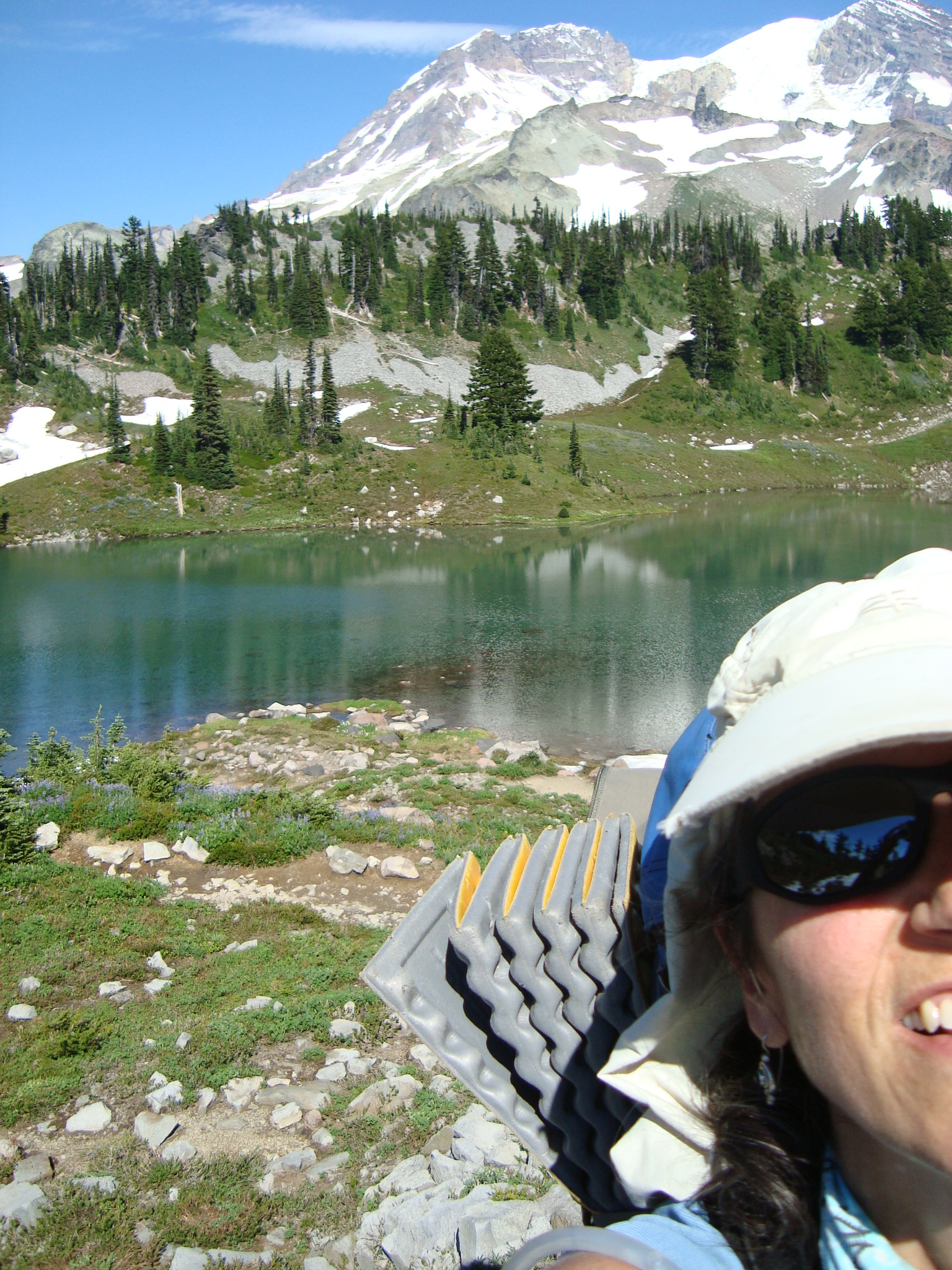
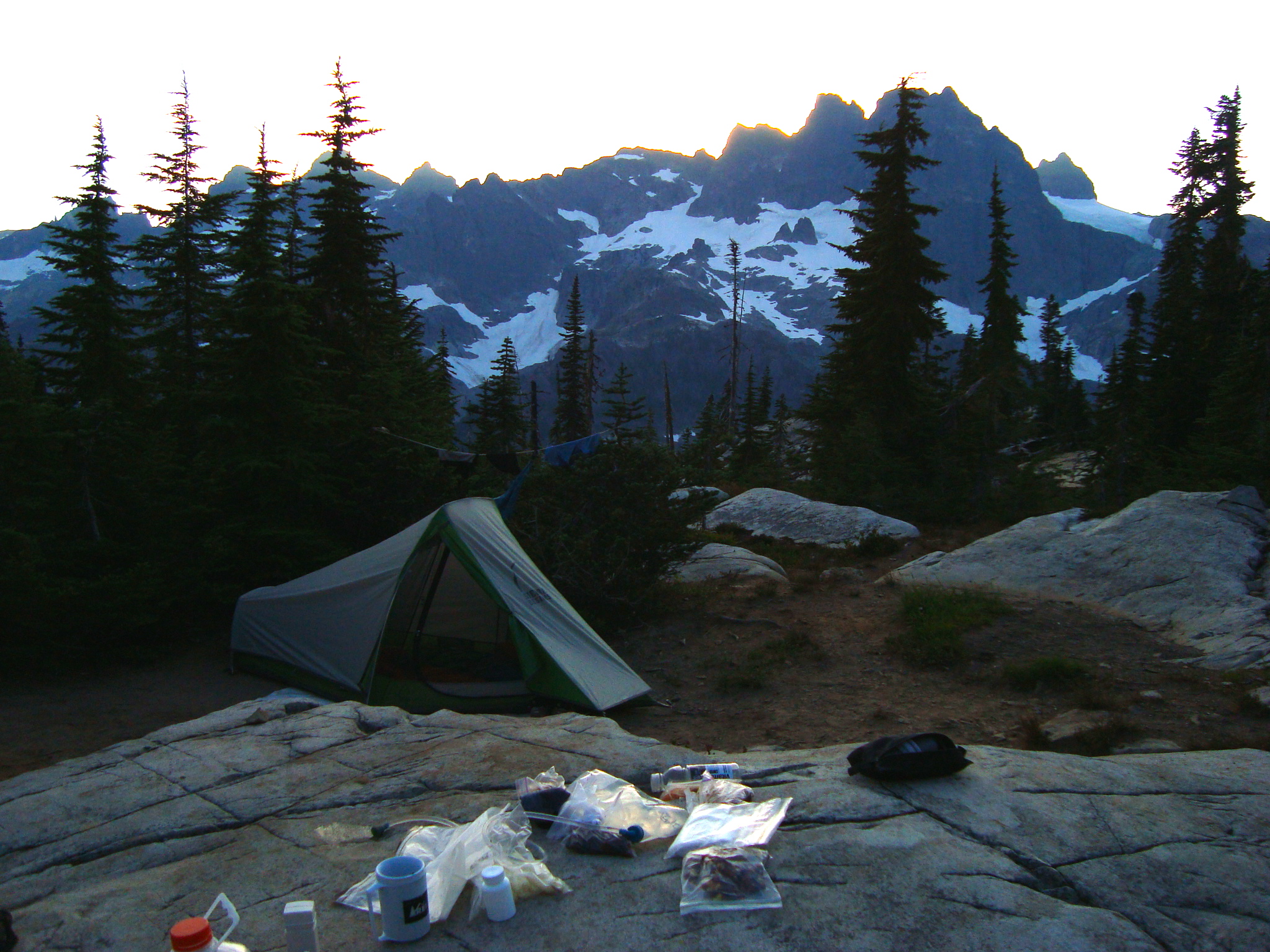
For me to react authentically in life, I have to know who I am and what I’m feeling – a feat easier said than done for a codependent adult child of an alcoholic.  (How do codependents greet each other?  “Hi!  How am I?”)  Hiking alone is, for me, one of the most powerful ways to arrive at this knowledge – especially longer thru-hikes that entail a week or so on the trail.  In 2012 I did the Wonderland Trail, about 100 miles and 22K’ of climbing/descending, and in 2013, still recovering from radiation treatment, I did a section of the Pacific Crest Trail (PCT) covering 75 miles and 16K’ of climbing/descending.  Hiking alone, the only interactions are between you and “nature,” people who’ve made or walked the trail before you, and the present-day hikers you meet.  Many, many hours are spent in your own company.  Incredible beauties are witnessed.  Countless decisions are made.  And each day brings a few hazards that call for courage.

PCT Section J

click to enlarge

Josephine Lake Wonderland


The first days, in my case, are about purging.  On Rainier, I found myself crying for two days.  This was my first major hike after breaking up with my boyfriend, who had taught me nearly every trail skill I knew.  But beyond that, I was coming to terms with the passing of youthful illusions that life stretches on and on.  How did I, Louisa, get to be 52?  Who was this lined, graying woman I’d become?  On the PCT, I expected tears again, but instead met with fear.  I’d begun by traversing Stevens Pass ski resort, and when the trail dropped from there into woods and rounded a hillside to a wholly new vista of indifferent, towering mountains through which I would pass, I got scared.  “What the fuck am I doing?!” I thought.  “What if a bear comes?  Mountain lion?  Rapist?  What if I fall and no one even knows?”  It took me a day or two to realize my deepest fears centered around cancer.  It had struck me, it seemed, out of nowhere, threatening everything I love, forcing me through a prolonged nightmare of treatment from which there was no escape.

In both cases, I had nowhere to run from these feelings.  I had to walk in their company, trudge in their muck until I truly got to know them.  In both cases, I came out on the other side to delight in a freedom so airy and light, I can’t possibly describe it.  The grief for all I’d lost turned to gratitude for the immense wealth I still had – these stunningly gorgeous surroundings plus the strength and know-how to travel though them.  The fear of cancer and all other scariness turned into a reconciliation with god.  Cancer happens, but I could choose to love all the cells on my team striving to protect me from it, and the many generations of medical experts all working to cure people.  I would choose to put my trust in goodness.

PCT J Camp

Dusk – I’ll tidy up! Clothesline strung behind my tent – wash in a large ziplock, dump away from source.

There’s nothing cozier than your own little camp, bedding down in your own tidy one-bitch tent, when you know what you’re doing.  You look at the map and see what’s coming up tomorrow.  Few moments are more empowering than, after passing warning signs of a high creek or a trail damaged by landslide, you gather your gumption and do what you need to.  Amid the roar of rushing water you choose your stepping rocks with care, plant your trekking pole and orient your balance to push off toward the next stance until, somehow, you’re across.  Or refusing to look down on the now tiny creek that wends far below, you focus on the narrow strip of trail that remains and keep moving.  Once you’ve passed these obstacles, they’re behind you.  Damn right, they are!  You don’t look back and analyze; your attention, buoyed by accomplishment, is all for what’s to come.

Finally, on both trips, I acquired an unexpected companion – both young men who loved the wilderness and had cobbled together from REI displays an idea of what they needed to get through it.  How could my pack be that small?  Why was I not wearing boots?  Why no Mountain House food pouches?  They asked to hike with me a few days and bombarded me with questions.  In each case, I developed love for a total stranger – one a butler to the most glamorous movie star couple alive, the other a Taiwanese Christian Electrical Engineer – sharing a grubby, spontaneous sincerity unimaginable in normal life.

The moral is that if I can practice all these skills on a daily basis – know what’s really going on with me, take each challenge as it comes, and love others by sharing whatever I have to offer – I am in tune with life.  And for as long as that is true, I will not develop an “edge” I need to “take off” by self-medicating.  There are ways to be free within the confines of our own skin.

DSC01967

Emerald Ridge, Wonderland Trail 2012

6 Comments

Filed under Alcoholism, Drinking, living sober, Recovery, Sobriety, Spirituality

Sober versus Dry: A Big Difference

Over the course of a life of recovery, the ego dies a slow and painful death.

Alcoholism is a disease of body, mind, and spirit, so for newcomers, the first order of business is definitely to withdraw from physical addiction by simply not taking a drink.  Doing this, however, doesn’t treat the mental and spiritual aspects of our disease.  Few of us drank ourselves nearly to death in the midst of an otherwise hunky-dory grasp of life.

AA doesn’t claim to have “a monopoly” on treating this three-fold disease – only a way that works.  That is, if you’ve tried other ways and they’ve failed you, you can find your answer in the Big Book’s pages.  But a lot of people in AA don’t do this.  Instead, they rely on a combo of “plug in the jug” dryness and regular “dumping” at meetings to relieve their pent-up discomfort.

By contrast, I know several people outside of AA who are progressing in spiritual development.  What characterizes such people is a constant seeking for spiritual insight, a day by day dedication to becoming a better person – with “better” referring not necessarily to “more successful” but to more spiritually healthy.  That would mean more grateful, kind, loving, and unselfish.  The kickback for all this work is inner peace.  And these non-AA sober alcoholics often have it, despite the fact that they don’t go to meetings.

The thing is, I need meetings as a setting where compassion pulls my head out of my ass.  Left to my own devices, my ego begins to regroup and convince me that everything is all about me.  Because of the way my life is set up – by my spiritual values rather than my ego’s agenda – my ego finds it highly unsatisfactory: I should be richer and thinner and get more attention.  I should be “in control.”  When I go to meetings, the pain of newcomers reminds me where chasing these lures will lead me, and the wisdom of oldtimers reminds me of all the ego wants me to forget – the humility, gratefulness, and service to others that fills life with a gentle happiness.

And yet, there’s a layer further you can go – or toward which you can be drawn against your own will.  Spiritual quests of even the most sincere seekers are at heart selfish.  We want that damn chit of inner peace!  I want to be happy!  I want my life to be filled with meaning, so I can feel good about it.  Even in my efforts to diminish ego, it appears to have the last laugh – or would, if it weren’t for another agent involved in this process.

That agent is god.  When we work a spiritual program, however tainted by the interests of “self-improvement” it may be, the act of reaching, seeking, and opening ourselves to something greater than self sabotages all our well laid plans by giving god an opening, a chink in our “control” armor.  God beams in and moves the furniture around in ways we never intended, so that in tripping, in stubbing our toes and falling on our faces, we’re forced low enough to see what it is we truly stand upon.

This happened to me when I wrote my addiction memoir, which I intended to help others.  But god got in and messed everything up.  It moved the coffee table to the middle of my house traffic: my siblings reacted to the book with untempered rage and insult, and then I got breast cancer.  I held onto god through that turmoil, and for a while I could see nothing.  But when clarity returned, I found myself in a wholly different place – a place where I have less sense of control but am more comfortable with it.  Where the phrase, “Oh, well!” seems to contain far more wisdom, whether it’s said before taking a courageous plunge or an evasive nap.  And place more differentiated from my siblings.  This was nothing I thought of or intended.  It resulted from neither program nor self-improvement.  But if I had not been working at both, the shift could not have occurred.

I’ve watched friends in the program not only climb to sweet joys but also suffer collapses similar to mine. I catch glimpses through their shares as they walk through this same Dark Night of the Soul.  Yes, joy is the fruit of spiritual growth, but pain, unfortunately, remains the “touchstone” of that growth.  The alternative is to turn away from god and tighten our grip on the illusions of control, of knowing best, of being right – and wronged.  It is to choose the rigidity of fear over the gentleness of faith.

Over the course of a life of recovery, the ego dies a slow and painful death.  (Of course, it never dies completely until we do.)  For those of us who once embraced it as our only savior, its demotion from the driver’s seat takes not months or years, but decades.  Like anything toxic, it retreats to reveal what appears at first a barren wasteland, a void where what I think is not important; I’m not powerful or authoritative, so life is not fun in a potentially dazzling way.  But the seeds of truer meaning are already germinating beneath that dull surface and will one day sprout: My being alive is precious; I’m both loveable and free, so my life gathers beauty in a quiet way.  This happens not just once, but with every inch of ground the ego surrenders.

2 Comments

Filed under AA, Alcoholism, Recovery, sober, Sobriety, Spirituality

Lessons from Chickens: Emotional Sobriety

Thoughtlessness, Jealousy, Resentment

About three years ago, we acquired chickens.  It’s a growing trend in our PC neighborhood, but I doubt I’d have taken the plunge if the mom of my son’s playmate hadn’t offered me two of her hens, saying six was just too many.  After I’d spent my weekend building a coop, she reneged without the least regret.  “Actually, one of them died, and I’m keeping the rest,” she told me over the phone.  When I noted that it might have been nice to learn this sooner, she offered only a brisk apology:  “I just decided this morning.  Sorry!  You can get yours someplace else.”

Ironically enough, this normie mom’s attitude captures perfectly the mindset of chickens I envy most.  Maybe I’m just too much of a people-pleaser, but never in this world could I could retract an offer that way.  I’d probably give you the promised hens on principle, stuffing how much I wanted not to, or at least apologize to a slobbering degree if I kept them – “I’m so sorry!  God, I’m so terrible, but I just can’t!”

The thing about chickens is, like feathered Cartmans, they do what they want.  Roaming about our yard, if they think of something, they do it.  The minute a gate’s left open, they’re through it and psyched.  If I take too long to feed them, they jump the back porch barrier and peck at the glass door:  “Ape!  Where’s our goddamn oatmeal?!”

My chickens never doubt their own self-worth.  God made them to be chickens, and, damn right, they’re gonna do it!  They know how to scratch and forage for bugs, how to preen and sunbathe and find shelter during rain.  They know where to lay their eggs and when to retreat to the coop toward dusk.  These are the bulleted items of their Chicken Job Requirements, and they carry them out with flawless, almost scornful confidence. Chickens have no morals, no conscience.  They don’t Facebook.  Chickens do, however, have plenty of drama.

Two of the three hens we ended up getting “someplace else” turned out to be peri-menopausal.  That is, the farm woman offloading them on us felt so guilty that at the last minute she literally chased after us with an Ameraucana pullet. “Wait!” she puffed. “Chickens are happier in threes!”  We thought she was just being nice, but after one season, the first two quit laying.

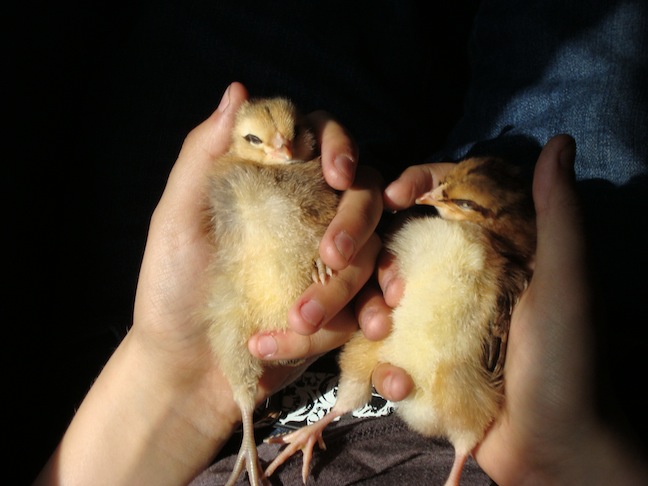
So on my son’s 12th birthday I brought home, peeping and scrabbling inside a paper lunch sack, a day old chick – helpless, scared, and weighing slightly more than a walnut.  Because she was slate black, like our dog and hamster, coincidentally, my son named her Pepper.

Now, whether chickens are happier in threes I don’t know, but a baby chick is definitely miserable alone.  Pepper’s needy cheeping filled our living room any time we tried to leave her in her cage.  I happened to be going through radiation for breast cancer at the time, and found my constant anxiety soothed by little Pepper’s gentle rustlings, soft peeps, and toying with my earrings or hair as she nestled on my shoulder – enough that I could meditate. ( I wrote this blog about it.) An adolescent Pepper once perched on my shoulder through the entire six block walk to my son’s school, with passersby asking, “Um… is that a… chicken?”  I’d nod, eyeing their chickenless shoulders with slight condescension.2013-04-14 18.48.47

Pepper grew up to be an absolutely tremendous Barred Rock hen who lays eggs daily and loves me fiercely.  Yes, chickens can love!  How else would you explain the fact that any time I sit down in the back yard, she jumps into my lap, makes happy chicken noises galore and, after holding my gaze steadily with her bright eye, settles down for a nice meditation nap?

Tragically for Pepper, however, after the two menopausal hens expired, my son and I brought home another lunch sack, this time holding two new chicks – Claire and Henrietta.  Having a pair, we found, made a world of difference: they were content to snuggle with each other but still bonded with us.

2014-03-24 13.46.43

Even before we transferred Claire and Henrietta outside, we knew Pepper was going to be jealous, but we had no idea how jealous.  She hates those little fuckers!  It’s not just a matter of pecking order.  The Ameraucana, though still at the top of the chain, shows no interest in these two outside the occasional feigned peck over food.  But for Pepper, it’s deeply personal.  It’s about rights to Mom’s attention, to being loved as cute and little.

When I come outside, she tries to drive those brats away from me by chasing them all over the yard, or jumps on me as if to claim me if she can.  I have to put down food in multiple places because Pepper hustles frantically from one pile to the next, pecking at the chicks and trying to gobble down everything before they get any.  Of course we can’t enclose them all in the same pen or she corners them and pecks them bloody.

In short, Pepper is the embodiment of jealous, possessive self-centeredness, played out in chicken caricature.  She does what she wants, yes.  And she wants those damn chicks gone! While Pepper sleeps in my lap, I often admire the perfection of her feathers, each one barred with a band of black, white, and rainbow iridescence.  I notice the perfect way they’re arranged to merge toward her tail, or the parallel precision of her white wing quills.  There is such great artistry in a single chicken!  But I also contemplate the design of Pepper’s feelings and instincts, her ruthless jealousy.  That demand for emotional security is built into both of us almost as powerfully as the needs of basic survival.

What does any of this have to do with alcoholism?  I guess that depends on how long you’ve been sober, and whether you work a program.  But the next time I hear a 4th Step, or find in my own 10th step the hostility of claiming what’s “mine” – that person, recognition, attention, security, or love I can’t let anyone else “steal” from me – I’ll think of Pepper as I recognize that these natural, god-given instincts are forgivable.

But I’ll also realize that, with a greater brain comes greater responsibility.   We need to check ourselves – particularly if we’re alcoholic.  Sure, that playdate mom can indulge now and then in “I do what I want!” mentality without consequences.  For her, the line between self-care and self-centeredness is not a crucial distinction.  But for me, giving free rein to even the simplest, chicken-brained instincts – selfish jealousy, resentment, and aggression – can sabotage my entire recovery.  “For when harboring such feeling we shut ourselves off from the sunlight of the Spirit. The insanity of alcohol returns and we drink again. And with us, to drink is to die.”

It may sound dramatic, but in my AA community, we hear of another alcoholic/addict’s death every month or two – the culmination of a landslide that began with a few petty grains of sand.

Pepper parrot         

Pepper where she still loves to be.

Leave a comment

Filed under Alcoholism, living sober, Recovery, Sobriety, Urban chickens

Looking Back from almost 20 Years Sober

Then vs. Now

My life is far from perfect.  In a few days, I’ll turn 54, having failed to achieve any of the goals I set in youth.  I’m not a famous writer, and I don’t have much money.  I drive a 1990 Honda that starts with a screwdriver (really), because all my money goes to keep a small house that’s in disrepair.  My boyfriend is out of state most of the time, and I haven’t spoken to my sister or brother in a year and a half.  But… I’m sober.

What does this mean?  It means my life today is a an amazing gift.  As I get closer to hitting the 2o year sober mark, it gets harder to remember who I used to be.  But as a sponsor, in helping other women who suffer as much as I used to, I get to look back and remember.

There was a day when I woke up morning after morning full of toxins and shame.  I’d hide my headaches from my partner, pretending brightness, but more importantly I’d hide reality from myself, pretending I’d just had a bit too much last night because of… whatever.  At least half the time, I’d also be hiding the exhilarating glow of obsessive dreams about whomever I was infatuated with.  I’d go about my day being whoever I thought others expected me to be, looking to you for signs that I was okay, and thinking up ways of impressing you.

And since nothing would work out as I planned, I’d end up filled with sickening envy at your easy life and disappointment at my unfair one.  Most of all, I lived with self-loathing: the conviction that I was a worthless loser.  This conviction could survive any accomplishment I achieved because its taproot ran so deep, all the way to my core: I was hopelessly defective, fundamentally flawed.  And yet, this same worthlessness was the one sure rock I could stand on, the one foundation I could know without doubt.  It set me apart from others, ordinary folk who seemed so naturally filled with well-being.  Honesty, to me in those years, felt like the flat out admission that I sucked.  And the only way to fix that was to have a drink (well…  maybe two.  And then, whoops, a dozen plus) thereby temporarily rendering life simple and myself fabulous.

So what’s the miracle?  What’s the amazing gift?  It’s freedom.  It’s that not only have I woken up clear headed and sober for the past 7,000 mornings or so, but I wake to perceptions much closer to real.  The overwhelmingly loud self-static that used to roar in my thoughts has been tuned down, so my consciousness is a pretty comfy place to live.  I can love being who I am instead of berating myself for all I “should” be, and I can even see that I am a good mom who loves many people and supports herself.

How does that happen?  I got here by working the 12 steps repeatedly, skimming off one layer of denial at a time, one unacknowledged fear at a time – and giving what’s out of my power to god.  (Long version here.)  Today I stay on course by using the serenity prayer as my compass, and as I progress, the landscape keeps changing: things that once seemed those “I cannot change” have jumped sides to things requiring the “courage to change” them, and vice versa.  Gradually, I acquire the wisdom that all I can change is myself – my attitudes and actions – but that doing so transforms my entire world.

My ambition today is not a newer car or even a bestselling novel.  It’s honesty.  I want to go deeper.  There are still untruths I tell myself, deceptions that auto-play in my thoughts.  With god providing the light, I want to root them out and turn them over.  Though they don’t now drive me to drink, I can still feel, as I get ready to meditate, grips on falseness that tighten my world.  “Give up,” I tell myself, “let them go!”  Whether they come from growing up in an alcoholic household or amid a society of warped values and assumptions, unidentified beliefs are incredibly hard to release.  There’s the challenge.

The closer I get to living in truth, the comfier my life becomes – to the point that it’s outrageously luxuriant.  No amount of material luxury can rival that.  Living in a twisted mind, I have traveled Europe, sailed on yachts, eaten at fancy restaurants, or worn sexy new outfits – all the while drowning in dis-ease and self-consciousness, prisoner of an edginess that maybe a few drinks could fix – couldn’t they?  Now, to be where I am, naked under my clothes, simple-minded in my thoughts, flawed in countless ways, and making boo-boos right and left as I use up this obscure lifetime that will vanish under the footprints of future generations – what an amazing party it is!

Plus I can start my car with that screwdriver without even looking faster than 99.999% of the planet’s population.  Ain’t that a heck of an achievement at almost 54?

2014-06-22-goat

Goat Peak, day before yesterday.  What more can I ask?  (Or so I thought… See 5/18/15 post)

2 Comments

Filed under Alcoholism, Drinking, living sober, Recovery, sober, Sobriety

On Cussin’ during Prayer: Separating god from Religion

Step 11

This blog may upset some people, but, oh well.

Over the years I’ve sponsored a lot of women in AA and developed some of my own ways that make me a good fit for some and not others.  For example, many of my newcomer sponsees have a problem with “the god thing” and thus a problem with prayer.  They aren’t sure if they should get down on their knees or clasp their hands, whether to look ceilingward or what to call their god.  It all feels so contrived.

In this case, I suggest they try dropping a few F-bombs while they pray.  That is, if I’ve gotten to know a sponsee a bit and in telling me her story she’s dropped a few, I suggest she do the same with god.  Not in anger, mind you, but as she might with a close friend.  I ask her to try it for a week and check back with me.

Why do I do this?  To help that person separate god from religion.  Religion works fine for some, so if it ain’t broke, don’t fix it.  But for an increasing number of people who desperately need god, religion is not an option.  Fortunately, the 12 Steps give us the freedom to conceptualize god in whatever way works for us.  Chapter 4, “We Agnostics,” urges us: “Do not let any prejudice you may have against spiritual terms deter you from honestly asking yourself what they mean to you” (p. 47).

In my view, many of us assume that our conception of god has to import with it a shitload of trappings from religion.  We carry these prejudices around with us, i.e. ideas based on thinking we have not “honestly” examined.  We may have gotten far enough to let go of the old dude with a white beard image, but many hesitate to go further than that.

Among these imported God-trappings I will, for the purpose of keeping this blog short, limit my discussion to the the assumption that God can get pissed off by a lack of respect.  In this case, to appease Him, we should address God as we would any other authority figure: a police officer, a professor, a judge.  And since God is wa-ay old, we should definitely avoid language that would shock, let’s say, our grandmother.  For that matter, we need to capitalize every friggin’ pronoun referring to the Dude because He, essentially, demands Ass-kissing.

Approach prayer as our regular farting, burping selves?  Heavens, no!  Much of religion involves an effort to partition God off from the vulgarities of real life.  Over the centuries, our urban religious ancestors built temples, mosques, and cathedrals as sanctuaries, in part because there was just too much sheep shit and caterwauling and flies everywhere to let them string two thoughts together in prayer.  Prayer became a solemn supplication devoid of spontaneous personality because religion drilled into us that God wanted it that way.

I am so done with this view of God!  As I explain more fully in my essay, “God Evolved,” this view of God runs counter to my spiritual beliefs in every way.  It’s founded in feudalistic traditions and furthers agendas of classicism, sexism, and species-ism – not to mention personal hypocrisy.  Neither does it match the experience of anyone who has undergone an NDE.  What people experience when they die is an inundation of overwhelming love that exceeds our capacity for description.

There are, however, certain spiritual principles that hold true in life, many of which religion has accurately named.  When you act from unselfish love, you grow.  Any connection between us and god has to be initiated by us.  Anger and fear cut us off from god.  These principles aren’t god’s “judgement.”  They’re just spiritual equivalents of the laws of gravity or thermodynamics.

So, why would I recommend swearing in prayer to my sponsees?  Because… they swear!  And they’re the one who’s seeking god.  What matters when I approach god is that I show up as Louisa, 100%.  Sure, there are times when I feel solemn and ceremonial, but there are others when I’m flippant or pissy or frustrated.  It goes without saying that my god knows and loves all these modes of Louisa.

My sponsees, by contrast, are standing in the shadow of a cold, religious idol that requires thee-and-thou-style grovelling.  Swearing defies that idol, lets it tumble aside, and might just open them to the light of a god they can put their trust in.

As I describe in my addiction memoir (which also contains “God Evolved”),  I was somewhere between atheist and agnostic throughout my first years in the program.  But then from a tattoo artist with a huge afro, I heard these words: “A relationship with god is just like any other relationship: the more you hang out, the tighter you get.”

I hang out with god all the time now – when I’m teaching a class, when I’m peeing, when I’m chopping broccoli.  I talk to it honestly, and I listen.  So far, I’ve been healed of more maladies than you can shake a stick at: active alcoholism, clinical depression/anxiety, sexual obsession addiction, social phobia, (most of my) codependence, and the pessimism that kept me from living the adventures I dreamed of.   Most importantly, god has broken down my walls of isolation and opened me to love freely and try to help others – by posting this, for example, because it may help some reader move a bit closer to grasping their own truth.

1 Comment

Filed under Alcoholism, Near Death Experience, Recovery, Sobriety, Spirituality