Category Archives: Step 3

Broken Brain vs. Inspiration: Which do I rely on?

Going to AA meetings and working the 12 steps with a sponsor can transform our lives. But in my experience, having taken the 3rd step involves conceding the fallacies of my own “reflex” thoughts on a daily basis. My mind is still set to certain defaults established in childhood or whenever, and those patterns are frequently, though not always, the first inclinations that come to mind.

Yeah, yeah, as I come up on  30 years’ sobriety (on 1/29), the 11th Step promises have mostly come true. That is, “we find that our thinking will, as time passes, be more and more on the plane of inspiration. We come to rely upon it.” But keep in mind that such reliance is possible only because we’ve made a habit of “ask[ing] God for inspiration, an intuitive thought or decision” (86-7).

In Step 3, I acknowledged that my own brain, when detached from god, is busted. Let’s remember where my own best thinking and determination to seek happiness and thrive on my own terms led me again and again: incomprehensible demoralization, deep despair, and suicidal ideation. Drinking was only one of many great ideas my thinking espoused for how to best navigate life. And it’s STILL busted, my brain. What I’ve “come to rely upon” is guidance from a higher power, not my ego-tainted perspective.

So here I am on my beautiful 5 acres in rural Oregon. Everything my angel foretold has come to pass. Somehow, my city house sold in three weeks – for less than I’d wanted, but within 24 hours of the deadline set in my contingency offer. Naïve about closing costs, I found myself many thousands short of the new house price, but my mother’s estate, which had been hung up in probate for over a year, came through 6 hours before I’d have lost the new house.  These are little miracles. In other words, I’m pretty sure I’m where I’m supposed to be, but by none of my own doing — other than moving ahead in faith.

Those of you who’ve moved after age 50 know this shock of not knowing where you are. My mental map of Seattle was incredibly detailed; here, I knew the way from my home to the store, beach, and a few trails.

But that’s where Step 3 comes in. For vague reasons, I felt hesitant to show up at any new AA meetings. I would look them up online, even put them on my calendar with great resolve, but once it got pitch dark out – and I do mean pitch dark – I’d be scared to leave my cozy little house. So I didn’t go to meetings for a month. Not even Zoom ones.




ISOLATING. That’s what I was doing, with my 2 cute dogs, a fireplace, deer outside the window, and coyotes and raccoons I’d sent packing, while I threw myself into UN-packing, putting off AA always just one more week. By grace, I knew this was my alcoholic brain’s will for me, not god’s direction for growth. Meanwhile, my addiction was rubbing its evil hands together in anticipation of a relapse.

So I did what I could: I called a friend from my old home group and confessed all the above. She made me promise I’d go to an AA meeting the next day, so I promised. Then I broke that promise… because yada, yada. But after she texted me, DID YOU GO?? and I had to sheepishly reply NO, my ego, I suppose, got prodded from the other side. I’m supposed to be all wise and shit, but here I was acting like a backassward chickenshit. So the next week, I set out in utter darkness and sheets of rain, relying solely on my high-beams and GPS to get me somewhere. Eight miles later, I walked into a cozy room with a fireplace, Christmas tree, and cushy chairs filled by six fellow alcoholics.

I was home. I was safe. And before I even spoke a word, I was loved.

I thought, “Of course! Of course! How could I have been so timid, so stupid, so gullible as to isolate for over a month?!” But I also knew: fear had taken me offline. Fear had slid me backward into my own reflexes. Louisa’s broken brain had been telling me that staying home alone was playing it safe.  It was wrong — as always.

Well, those alcoholics had me download an AA app very that night and recommended three more meetings nearby. I started going, meeting more alcoholics, making new friends, being of service, even going out for coffee! My routine now is three AA and one Al-Anon meeting per week, all in person. For my 30th sobriety birthday, a woman I’d never laid eyes on in November is bringing a homemade carrot cake for the celebration, and everyone’s excited for me.

What’s more, these people possess a mosaic of experiences that mirror everything I’m struggling through. They remember being new here, wanting to isolate, feeling baffled by power outages, wells, and septic systems, and many feel shocked to find themselves at various thresholds of old age. Not only have they told me about gym facilities, parks, trails, garden clubs, community email, and less expensive stores, but at every meeting I hear profound insights that allay my fears and enrich my experience of living.


Pick one.

Whenever I don’t WANT a new sponsee, don’t WANT to drive someone to a meeting, or chair one, or stay after to break down the room, etc., god’s inspiration reminds me how I didn’t WANT to go to AA in the first place, didn’t WANT to get a sponsor, REALLY didn’t WANT to throughly work steps 4 through 9, or to change “everything” about my approach to living. But going against my own thinking has brought me a joyous life I could never have built myself. Day by day, I can either screw it all up by trusting my defaults, or reach beyond them to continue on this amazing spiritual path toward new adventures.


PS: Just for fun…  Deer and coyote from inside my house.


4 Comments

Filed under AA, AA fellowship, Alcoholic relapse, Alcoholics Anonymous, Happiness, Meetings, Recovery, Step 3

Third Step: Next Right Thing

The first three steps of Alcoholics Anonymous are pure logic:

  • Step 1: “I can’t” (drink in moderation, manage my life, etc.)
  • Step 2: “A higher power can” (restore me to sanity)

Therefore

  • Step 3: “I choose to let it” (by turning my will over to HP)

In Step 2 alone there’s plenty to ruffle our prideful alcoholic feathers, right? Not just the higher power thing, but this insinuation that we’re currently not sane. Hmmph!  For years, maybe decades, we’ve defended our passionate reliance on alcohol by assuring everyone, including ourselves, “I’ve got this!” I can remember thinking, “And even if I don’t quite have it, I’m saner than most people.”

Of course I had no clue how insane I was: I wasn’t SANE enough to! Today, however, I can affirm with perfect certainty that I was bat-shit crazy and had been for years. Confusing self-poisoning with self-care on a daily basis was only the tip of the iceberg.

But then there’s that whole “God” thing. Many newcomers choke on the word, so they never really nail down this crucial foundation of Steps 1-3. Religion’s claimed monopoly on spiritual life is largely to blame. It has bamboozled so many into thinking a higher power must involve religion.

freedom-of-religion-gettyimages-517212696 copyQuite the opposite, in my opinion. As Carl Jung observed, “One of the main functions of organized religion is to protect people against a direct experience of God” (emphasis mine).  Religion miscasts god/HP as an external authority figure, when in fact god is “living” us 24-7, living the trees and grass and little rolly-poly bugs and bunny wabbits. God loves us all sooooo powerfully that we’re animated by it. That wondrously complex arrangement of hydrogen, oxygen, carbon, and trace elements you see in a cold corpse is inexplicably enervated with god’s love to become… YOU!

God speaks within us, not through any text or religious authority. Disagree if you want, but I guarantee you, no religious authority can keep an alcoholic sober! Only we, waking up to god’s guidance through Step 3, can manage that one day at a time. In fact, the more religion has been forced on someone as a child, the more difficult finding god within can be.

duckling-grace2

God at work!

My ex-boyfriend recently drank himself to death with beer — Indian Pale Ale, to be exact. He’d gone through detox and treatment to emerge gung-ho sober, but multiple handicaps blocked him from tapping into a power greater than himself.  A) He’d been raised Catholic; B) he was left-brained to an extreme, having impaired his brain interconnections with binge drinking as a teen; C) he felt extremely awkward and uncomfortable in socializing, also due to B.

A made him keep reverting to seeing HP as an authority figure; B kept him from feeling his connection (8:00) to everything else, and C kept him from hearing or seeing god through his fellow alcoholics.

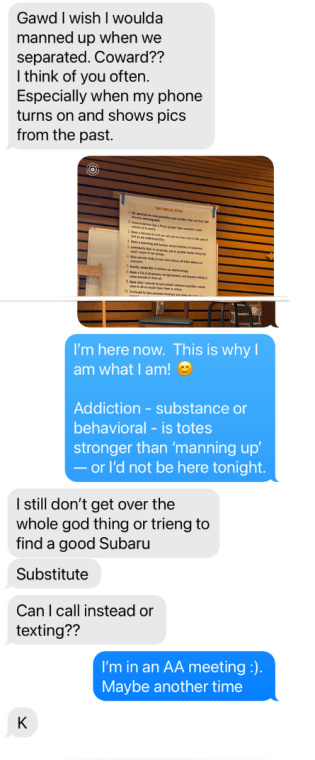
Below are his last texts to me. Before you laugh at the ‘Subaru’ thing, recall that while sober this man could carry in his mind the full schematics for a Boeing 787. These texts are crippled with drunkenness because… he was less than a week from dying.

Gerard combined texts

You can imagine how often I weep that I didn’t agree to that last call, as I might’ve if I’d not been sitting right next to my Al-Anon sponsor. But in truth, I didn’t want to witness him in that state, slurring his words, awash in vague emotions, making little sense. It was too painful. Besides, I couldn’t have helped him find his HP any more than you could. A week later, on his 60th birthday, he died of a gastric hemorrhage.

“Do the next right thing” was one of those resonant 3rd Step sayings Screen Shot 2024-03-05 at 11.38.13 AMI heard early on in AA. Strangely, “right” did not equate to “most desired.” It steered me away from what I thought would feel good, make me look good, or bring temporary relief, and toward a deeper sense of right and wrong. **


We all carry that sense within. It’s a feeling in our gut. We often have to quiet the chatter of our thoughts before we can make contact with it, but it’s there. Initially, I grasped only few “next right things” like so many flimsy reeds: go to a meeting; stay out of bars; don’t meander toward the store’s booze section or hang out with users.

Today, though, I have a huge, rich bouquet of next right things to choose from every day: practice gratitude; call a friend (instead of texting); exercise/ hike/ do yoga/ walk the doggies someplace new; do service work or donate; tidy or fix something; meditate; notice beauty; be kind, be kind, be kind.

Princess and GoblinOn my favorite sleep podcast, in a book entitled, The Princess and the Goblin, I recently listened to a description of how a child princess, who has discovered her own magical great, great grandmother in a remote tower of the castle, is led by the grandmother’s wisdom even in her absence. When afraid, she’s supposed to put a ring the grandmother gave her under her pillow and feel with her index finger for a gossamer thin thread connecting the two of them. It’s a perfect metaphor for always being connected to our higher power.

But here’s the cool part. The thread at her fingertip doesn’t just lead to the safety of her grandmother. It leads her deep into the goblin mines, into terrifying pitch darkness, across underground streams and through narrow passageways where she’s filled with doubt and urgent desire to turn back but can’t because the thread leads only forward. To her amazement, it leads her to her friend, a courageous boy the goblins have all but buried in a cavern, shows her the way to free him, and guides them both back to daylight and safety. In fear for herself, she’s led to rescue someone else. While boy insists her idea of “grandmother’s thread” is nonsense (right up til the end when he finds it himself), she trusts it beyond her own thinking.

So, I find, goes life after one makes a solid 3rd Step. We are led forward, often scared, but guided to greater outcomes.

I alone can sense where my “god-consciousness” leads. Many don’t understand why I’m about to move away from this city where I was born 63 years ago — to I don’t even know where. I’ll find out soon enough. I trust my thread. It’s just the next right thing.

.

scroll

.

.

** As I describe in my Die-Hard book –> the first two communications I heard from my post-NDE guardian angel, having just driven home horrifically drunk, were: “This is the last time I can help you; you DO know right from wrong!”  Hearing him opened space for what has unfolded as 29 years sober.

4 Comments

Filed under AA, Alcoholism, living sober, Recovery, Step 3

Unexpected Teachers

About two months before I got sober, a voice spoke to me — one I now know as my angel’s (I call him Egnacio).  I’d just driven to my log cabin completely hammered, tearing along winding, woodedNarrow Bridge roads as fast as 80 mph with the radio blaring, seeing quadruple as I bombed through the narrow railroad overpass where I should have died. Instead I reached home, but as I clung to my car door for steadiness and glanced up at the stars, congratulating myself on my badass driving skills, the voice shot through me like a thunderbolt from Zeus, except it was a bolt of telepathy, of knowing, extremely urgent and somehow stern: “This is the last time I can help you.  And you DO know right from wrong!”

In the nearly 28 years since that night, sober all but those first two months, I’ve come to realize that Egnacio’s two brief communications actually contained a template for living, a standard on which to base all future choices and judgments. 

Screen Shot 2022-08-21 at 9.37.50 AMThe first, “This is the last time I can help you,” meant essentially, “If you really want to bash your brains out on a telephone pole or scar your life with paralysis or the guilt of having killed another driver, have at it.”  What he was conveying was this: I (Louisa) am responsible for my own life — for my choices, my outcomes, and the caliber of my character.  The same is true for everyone, and there comes a point when even a guardian angel has to quit trying to help.

The second, “You DO know right from wrong!” was essentially a call for the 3rd step.  At the time, I was letting all my addictions, whether substance or emotional, run rampant. Egnacio asserted that I knew better, that I had the capacity to search within for god’s take on my every thought, communication, and intended action. I can consult Good Orderly Direction on whether what I’m doing is good and right, based in love and truth.  I can also sense if other people’s behavior strikes me as good and right, based in love and truth. But if I think back to communication #1, I must accept that their ways are THEIR responsibility, not mine.

We all encounter teachers in our lives. The teachers we EXPECT are those we look up to: sponsors, mentors in life or work, wise friends, maybe even (if we’re very lucky) parents or grandparents. We look to these people to demonstrate for us how to navigate life with grace and insight. For example, I love and admire my AA/Al-anon sponsor because she’s constantly telling on herself, sharing in AA meetings and recovery conversations all the petty jealousies, insecurities, habits, and worries that fill her thoughts throughout the day.

In fact, she finds herself hilarious! Why? Because she doesn’t identify with the ego that’s constantly churning out these thoughts and reactions. She doesn’t buy into her own thinking. In light of Communication #2 above, she has access to a gauge of reality beyond her own flux of thoughts — her god.  

Similarly, she has fun describing her flaws because her self-worth comes NOT from how she looks to other people, NOT from whether she’s seen as an AA guru (as she comes up on 38 years’ sobriety), NOT from what I or her coworkers or husband or anyone else thinks about her. She knows god loves her, and that’s all she needs. On good days, I can follow her example.

Then then are the unexpected teachers.  All of us have been betrayed by those we thoroughly trusted. Supposed friends, admired mentors, sponsors, family members, lovers — each of us will have the experience of being hurt by such people, and the stronger our trust in them was, the more profound the pain. 

Screen Shot 2022-08-21 at 9.45.16 AM

Among the most important learnings of sobriety is that these people, likewise, are our teachers.  They showcase how to cause pain with our words, judgements, assumptions, indifference, and carelessness. They demonstrate for us the harm these attitudes and resulting actions inflict, and as we smart from their deeds, we learn firsthand how devastatingly they hurt.

In short, UNEXPECTED teachers model for us how NOT to live. Once we understand that, we can view them as assets. We don’t have to analyze exactly what made them choose to do X.  Many of us waste a tremendous amount of time trying, but such thinking has a name: Resentment. We must instead remember that, in light of Communication #1, they alone are responsible for figuring out the machinations of their egos. All we need to take to heart is their EFFECT.  

Step 3 is a core decision, a choice to always run our thinking past our higher power and seek to do right, not wrong.  Via steps 4-9, we gain insights that can increase the honesty with which we perceive our own motives. We can learn to see the ways we are just like our UNEXPECTED teachers, how easily we  inflict the same harms, maybe more subtly. And we’re resolved to continuously strive to do better.  

On the surface that means damage control in not causing harm impulsively — not saying what anger burns to say, not sending the righteous text, calling someone out, acting on the whims of antagonistic emotions. At a deeper level, it means showing up with honor to do whatever we’ve said we’ll do. But at the deepest level, it means trusting, as my sponsor trusts, that we will in time be able to distinguish “right from wrong.”  We pause, if possible, long enough to differentiate our ideals and responsibilities from simply meddling with others.

Egnacio made such a call when he let me go after saving me one last time: “Live blindly, chasing ego’s chimeras, if that’s what you choose!” That’s what I myself sigh inwardly almost every week to the main unexpected teacher in my life.  I’m so grateful to have found another way to live!

Detach with love

8 Comments

Filed under Codependence, living sober, Recovery, Spirituality, Step 3

Agnostic? Think: Good Orderly Direction

My addiction memoir tells how I went from a bright, healthy teen (okay, with a teeny hypersexual disorder) to a lonely, depressed, obsessive, codependent, underachieving, and increasingly reckless drunk who disdained Alcoholics Anonymous as a doom just short of suicide. Why so reluctant?  The God thing.  The book’s second half describes my ungraceful but dogged ascent from that pit of misery toward the healthy, friend-filled sober life I get to live today.

Much as I’ve love for everyone to read the book, I can give you a major spoiler here: I didn’t do it.

The words that opened the door to faith in something that might help me were shared by a woman in large pastel stretch pants sitting against the wall at my third or so AA meeting: “If you can’t deal with the word ‘God,’ that’s fine!  Just think ‘Good Orderly Direction.'”

I perked up. Certainly I could not deal with the word, “God.” That religion-based concept seemed to me a preposterous character created by humans to explain what rudimentary science couldn’t. Such a deity was not going to advise me on whether I should stuff the tip jar at work if a customer paid cash or continue stalking the guy I was obsessed with.

But Good Orderly Direction — that was something to be sensed in my inmost heart. That I could look for, because I remembered going against it when I was busy screwing up my life. For me, Step 3 was essentially a resolution to start listening for it and going with it. Who knew the source of G.O.D. would turn out to be my higher power? And who knew that following its guidance would migrate me from the self-generated heartless world that had defeated me toward the sweet experience that’s now my normal?

Goodness as True North
As an active alcoholic, the only compass I ever consulted was ego. I was a popularity materialist — never enough! — as are many in our “individualistic” culture (thanks to marketing).  I longed to be seen as cool (see also Coolness) and liked by designated cool people. I was convinced that the more I could make that happen, the better I’d feel about myself. And even though this model had failed to bring me anything but discontent for 34 years, I kept thinking the problem lay in my performance, not the model itself.

Good Orderly Direction, however, does not hinge on what others think. It’s a compass deep within, with Goodness as its true north.  The first half is sensing it — what is the good and right thing to do here?  The second is acting on it without hesitation.

I remember a conversation I had a few years back with my relapsed alcoholic boyfriend. As a rationale for getting drunk, he asked me, “Don’tcha sometimes just wanna say ‘fuck it’?” As it turned out, he had indeed been saying “fuck it” for some while, carrying on a second relationship behind my back. Sober, he’d been a man with integrity and compassion.

By contrast, my father drank alcoholically while retaining integrity and compassion — toward everyone but himself. Alcoholism wheedled him into deferring day after day the ultimate reckoning: “Why do I drink so much every night?” He resisted looking inward to all the clamors he muted with booze, saying, in his own academic way, “fuck it.”

But Good Orderly Direction is more than the antithesis of fuck it; it’s the antithesis of ego. It is a form of caring, of knowing that your choices matter and seeking those that will feel right in the long run. You may have trouble at first distinguishing Goodness from ego’s “best for me”; you may also mistake it for what other people tell you to do, whether they’re in your family or your AA group. But gradually, as you become more attuned to seeking, the voice gets louder, so you gain a clearer sense of whether you’re tuned into it.

As the choices people make based on the north star of Good Orderly Direction begin to alter the course of their lives, as even cynical or bottomed-out addicts begin to heal and build self-esteem by doing esteemable acts, a lot of us begin to realize — “Hey, this isn’t coming from me!”

God Ain’t Religion
As people who follow this blog know, I got to cheat. The spirit world operates all around us all the time, but we’re as deaf to it as the barriers we maintain against love are thick. For me, having had a Near Death Experience followed by paranormal after-effects even as I fought to maintain my atheism, the presence that had spoken to me on the other side began interceding in my thoughts as soon as I started seeking Good, until I had no choice but to fold and acknowledge, not religion’s God, but my god.

Religion is a bit like agriculture, while the spirit world is nature itself. Religion quantifies something omnipresent yet inexplicable — the power of the life force — by reducing it to the equivalent of rows and crops and acreage.  To be atheist because we reject religion is like saying because there is no Great Farmer, nothing grows — all the while discounting the fact that we and all living things around us are exquisite expression of nature, of the life force.

No one can give you god-awareness. You have to develop your own, based on your own experiences both inner and external. The most direct route to get there is by seeking Good Orderly Direction. Eventually, seeking will become part of you, as it has for me: No one at Fred Meyer saw me miss self-checking a bag of avocados yesterday, but when I discovered them in my reusable shopping bag, I handed them to the attendant on my way out simply because I had not paid for them — end of story. I know not only that Karma is a real phenomenon, but that guilt is a real feeling, even when we pretend not to feel it. Both carry a price tag that far exceeds four avocados.

Ask for guidance.  Look deeper.  Listen harder.  Within you, something magnificent will sprout.


10 Comments

Filed under Alcoholics Anonymous, Faith, God, living sober, Near Death Experience, Recovery, Spirituality, Step 3