Category Archives: Sobriety

Looking Back from almost 20 Years Sober

Then vs. Now

My life is far from perfect.  In a few days, I’ll turn 54, having failed to achieve any of the goals I set in youth.  I’m not a famous writer, and I don’t have much money.  I drive a 1990 Honda that starts with a screwdriver (really), because all my money goes to keep a small house that’s in disrepair.  My boyfriend is out of state most of the time, and I haven’t spoken to my sister or brother in a year and a half.  But… I’m sober.

What does this mean?  It means my life today is a an amazing gift.  As I get closer to hitting the 2o year sober mark, it gets harder to remember who I used to be.  But as a sponsor, in helping other women who suffer as much as I used to, I get to look back and remember.

There was a day when I woke up morning after morning full of toxins and shame.  I’d hide my headaches from my partner, pretending brightness, but more importantly I’d hide reality from myself, pretending I’d just had a bit too much last night because of… whatever.  At least half the time, I’d also be hiding the exhilarating glow of obsessive dreams about whomever I was infatuated with.  I’d go about my day being whoever I thought others expected me to be, looking to you for signs that I was okay, and thinking up ways of impressing you.

And since nothing would work out as I planned, I’d end up filled with sickening envy at your easy life and disappointment at my unfair one.  Most of all, I lived with self-loathing: the conviction that I was a worthless loser.  This conviction could survive any accomplishment I achieved because its taproot ran so deep, all the way to my core: I was hopelessly defective, fundamentally flawed.  And yet, this same worthlessness was the one sure rock I could stand on, the one foundation I could know without doubt.  It set me apart from others, ordinary folk who seemed so naturally filled with well-being.  Honesty, to me in those years, felt like the flat out admission that I sucked.  And the only way to fix that was to have a drink (well…  maybe two.  And then, whoops, a dozen plus) thereby temporarily rendering life simple and myself fabulous.

So what’s the miracle?  What’s the amazing gift?  It’s freedom.  It’s that not only have I woken up clear headed and sober for the past 7,000 mornings or so, but I wake to perceptions much closer to real.  The overwhelmingly loud self-static that used to roar in my thoughts has been tuned down, so my consciousness is a pretty comfy place to live.  I can love being who I am instead of berating myself for all I “should” be, and I can even see that I am a good mom who loves many people and supports herself.

How does that happen?  I got here by working the 12 steps repeatedly, skimming off one layer of denial at a time, one unacknowledged fear at a time – and giving what’s out of my power to god.  (Long version here.)  Today I stay on course by using the serenity prayer as my compass, and as I progress, the landscape keeps changing: things that once seemed those “I cannot change” have jumped sides to things requiring the “courage to change” them, and vice versa.  Gradually, I acquire the wisdom that all I can change is myself – my attitudes and actions – but that doing so transforms my entire world.

My ambition today is not a newer car or even a bestselling novel.  It’s honesty.  I want to go deeper.  There are still untruths I tell myself, deceptions that auto-play in my thoughts.  With god providing the light, I want to root them out and turn them over.  Though they don’t now drive me to drink, I can still feel, as I get ready to meditate, grips on falseness that tighten my world.  “Give up,” I tell myself, “let them go!”  Whether they come from growing up in an alcoholic household or amid a society of warped values and assumptions, unidentified beliefs are incredibly hard to release.  There’s the challenge.

The closer I get to living in truth, the comfier my life becomes – to the point that it’s outrageously luxuriant.  No amount of material luxury can rival that.  Living in a twisted mind, I have traveled Europe, sailed on yachts, eaten at fancy restaurants, or worn sexy new outfits – all the while drowning in dis-ease and self-consciousness, prisoner of an edginess that maybe a few drinks could fix – couldn’t they?  Now, to be where I am, naked under my clothes, simple-minded in my thoughts, flawed in countless ways, and making boo-boos right and left as I use up this obscure lifetime that will vanish under the footprints of future generations – what an amazing party it is!

Plus I can start my car with that screwdriver without even looking faster than 99.999% of the planet’s population.  Ain’t that a heck of an achievement at almost 54?
2014-06-22-goat

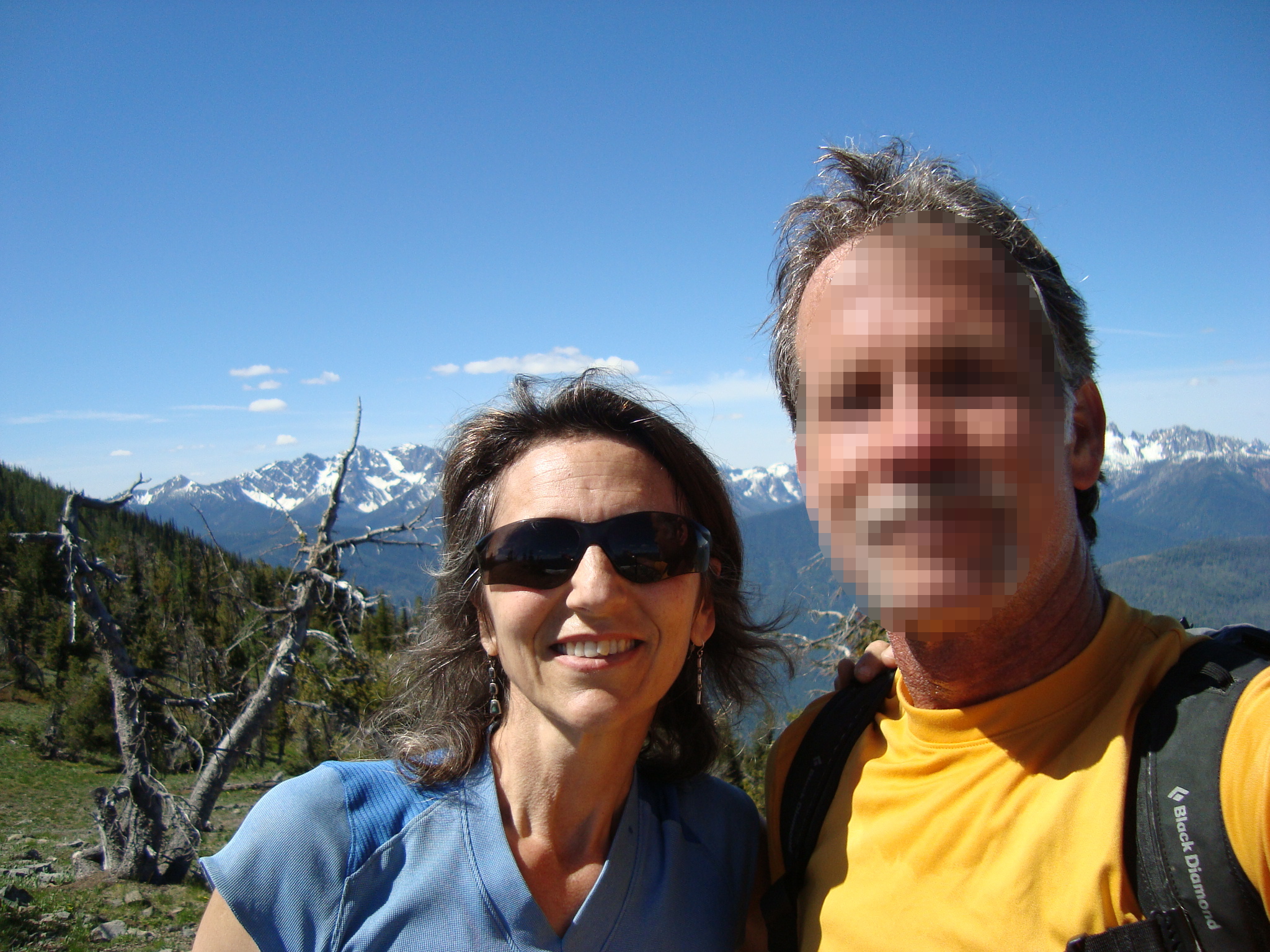
Goat Peak, day before yesterday.  What more can I ask?  (Or so I thought… See 5/18/15 post)

2 Comments

Filed under Alcoholism, Drinking, living sober, Recovery, sober, Sobriety

On Cussin’ during Prayer: Separating god from Religion

Step 11

This blog may upset some people, but, oh well.

Over the years I’ve sponsored a lot of women in AA and developed some of my own ways that make me a good fit for some and not others.  For example, many of my newcomer sponsees have a problem with “the god thing” and thus a problem with prayer.  They aren’t sure if they should get down on their knees or clasp their hands, whether to look ceilingward or what to call their god.  It all feels so contrived.

In this case, I suggest they try dropping a few F-bombs while they pray.  That is, if I’ve gotten to know a sponsee a bit and in telling me her story she’s dropped a few, I suggest she do the same with god.  Not in anger, mind you, but as she might with a close friend.  I ask her to try it for a week and check back with me.

Why do I do this?  To help that person separate god from religion.  Religion works fine for some, so if it ain’t broke, don’t fix it.  But for an increasing number of people who desperately need god, religion is not an option.  Fortunately, the 12 Steps give us the freedom to conceptualize god in whatever way works for us.  Chapter 4, “We Agnostics,” urges us: “Do not let any prejudice you may have against spiritual terms deter you from honestly asking yourself what they mean to you” (p. 47).

In my view, many of us assume that our conception of god has to import with it a shitload of trappings from religion.  We carry these prejudices around with us, i.e. ideas based on thinking we have not “honestly” examined.  We may have gotten far enough to let go of the old dude with a white beard image, but many hesitate to go further than that.

Among these imported God-trappings I will, for the purpose of keeping this blog short, limit my discussion to the the assumption that God can get pissed off by a lack of respect.  In this case, to appease Him, we should address God as we would any other authority figure: a police officer, a professor, a judge.  And since God is wa-ay old, we should definitely avoid language that would shock, let’s say, our grandmother.  For that matter, we need to capitalize every friggin’ pronoun referring to the Dude because He, essentially, demands Ass-kissing.

Approach prayer as our regular farting, burping selves?  Heavens, no!  Much of religion involves an effort to partition God off from the vulgarities of real life.  Over the centuries, our urban religious ancestors built temples, mosques, and cathedrals as sanctuaries, in part because there was just too much sheep shit and caterwauling and flies everywhere to let them string two thoughts together in prayer.  Prayer became a solemn supplication devoid of spontaneous personality because religion drilled into us that God wanted it that way.

I am so done with this view of God!  As I explain more fully in my essay, “God Evolved,” this view of God runs counter to my spiritual beliefs in every way.  It’s founded in feudalistic traditions and furthers agendas of classicism, sexism, and species-ism – not to mention personal hypocrisy.  Neither does it match the experience of anyone who has undergone an NDE.  What people experience when they die is an inundation of overwhelming love that exceeds our capacity for description.

There are, however, certain spiritual principles that hold true in life, many of which religion has accurately named.  When you act from unselfish love, you grow.  Any connection between us and god has to be initiated by us.  Anger and fear cut us off from god.  These principles aren’t god’s “judgement.”  They’re just spiritual equivalents of the laws of gravity or thermodynamics.

So, why would I recommend swearing in prayer to my sponsees?  Because… they swear!  And they’re the one who’s seeking god.  What matters when I approach god is that I show up as Louisa, 100%.  Sure, there are times when I feel solemn and ceremonial, but there are others when I’m flippant or pissy or frustrated.  It goes without saying that my god knows and loves all these modes of Louisa.

My sponsees, by contrast, are standing in the shadow of a cold, religious idol that requires thee-and-thou-style grovelling.  Swearing defies that idol, lets it tumble aside, and might just open them to the light of a god they can put their trust in.

As I describe in my addiction memoir (which also contains “God Evolved”),  I was somewhere between atheist and agnostic throughout my first years in the program.  But then from a tattoo artist with a huge afro, I heard these words: “A relationship with god is just like any other relationship: the more you hang out, the tighter you get.”

I hang out with god all the time now – when I’m teaching a class, when I’m peeing, when I’m chopping broccoli.  I talk to it honestly, and I listen.  So far, I’ve been healed of more maladies than you can shake a stick at: active alcoholism, clinical depression/anxiety, sexual obsession addiction, social phobia, (most of my) codependence, and the pessimism that kept me from living the adventures I dreamed of.   Most importantly, god has broken down my walls of isolation and opened me to love freely and try to help others – by posting this, for example, because it may help some reader move a bit closer to grasping their own truth.

1 Comment

Filed under Alcoholism, Near Death Experience, Recovery, Sobriety, Spirituality

Save your Ass, not your Soul

Steps 2, 3, & 12

Taped to my fridge I have an old fortune cookie fortune.  Except it’s an alcoholic fortune.  One of my friends used to order these special alcoholic fortune cookies with program tips and slogans tucked inside on the little strips of paper.  For us, these kind of are fortunes, because our lives go downhill fast if we don’t practice this stuff.  Anyway, it reads:

 “This is a Save Your Ass program not a Save Your Soul program.  We are concerned with the here & now, not the hear after.” Fridge

You might notice that he misspelled hereafter as “hear after,” and apparently no one at the fortune cookie factory noticed.  As it happens, this friend of mine, Dave F., has since gone to the hereafter.  His liver quit on him suddenly at age 47, many years into a healthy sobriety, and he did not survive the transplant.  But for me, because of how Dave lived, and because I still think about things he shared in meetings, he has indeed gone to the “hear after.”

“Religion is for people who’re afraid of going to hell. Spirituality is for those who’ve already been there.”

That saying, attributed to various people, runs along the same lines as the Save Your Ass slogan.  Those who accuse AA of religiosity, as I once did, completely miss the point.  Drunks don’t want to be holy.  We don’t hope to get into some God-ass-kissers’ heaven.  And we sure don’t go through the 12 Steps to become shining examples of goody-two-shoes bullshit.  No.  We want to live.  We’re motivated by pain and the threat of self-destruction, and we’ve known both too well for longer than we could stand.  To get sober, we need the help of a higher power to remove our compulsion to drink.  But to stay sober, we need that god to relieve us of the compulsion to think in alcoholically self-centered, fear-driven ways that twist us up inside until we either tip the bottle or otherwise wreck our lives.

Mind you, I can wreck mine purely from the inside.  If I’m off the beam spiritually, even the most outwardly beautiful Hallmark moment can be shot through with  x_(insert anxiety, insecurity, self-loathing, jealousy, ire, not enough etc.) to the point where, idyllic as it looks, I’m in hell.  The choice is mine to wallow in those feelings addictively or to forcefully wrench away from them and ask god for help.  I say “forcefully” because the pull of those emotional reflexes can be every bit as tempting as the reflex to drink.

Dave was prone to all these aspects of our disease, but he kept turning away from his defects, reaching for what god could offer instead of what his disease could.  Not just once in a blue moon, but consistently.  One summer night at an AA meeting we hold around a campfire on the beach (Golden Gardens, Tues night), I heard him tell a story that has stayed with me in the “hear after.”

That same day he’d tried to summit Mount Olympus alone.  Sounds epic, but it’s also a lo-ong drive, an even longer overnight hike in, and a very dangerous ascent.  In any case, almost as soon as he’d reached the glacier, one of his crampons broke (spiky foot gear for climbing ice).  He’d tried to rig it: fail.  He’d tried to climb without it: fail.  Finally, he’d had no choice but to turn around in defeat.  Having driven straight from the mountains to the beach, he was boiling water on his camp stove for his freeze-dried dinner as he spoke. Here’s the story I remember him telling.

“I got down into the trees, and I was so damn pissed.  I broke for lunch at this creek and I was just pissed as hell.  All this time, all this preparation – fuckin’ crampon breaks!  I was denied!  It felt so unfair, and just like my whole life has gone that way – you know?  But then I see something pop out of the water, and it’s this little bird.  There’s serious fast-moving water in this creek, rapids, pools.  And I see where he lands, and he’s got this tiny fish.  Swallows it.  And he’s lookin’ at the water.  Flits somewhere else, looks at the water.  Boom!  He shoots in!  He’s like a rocket.  Few seconds later, pops out.  This time, no fish.”

Dave told about the change that came over him, watching.  Sometimes the bird hit pay dirt and sometimes, for all its daring, getting churned around in that washing machine of roaring ice water, it got nothing.  Gradually, he remembered to notice what a spectacularly beautiful place he was in.  Gradually, he accepted what had happened.

“Maybe that’s what I was supposed to see today,” he reflected.  “Not the view from the top, but that bird trying, and going for it, and working with whatever god gives it – fish or no fish.  Maybe I just wasn’t supposed to summit today,  or I could’ve fallen cause the crampon broke at a bad time.”  He shrugged wistfully, stirring the package.  “This was supposed to be my victory dinner.  But maybe it is, just being here with you guys, sober.  Tonight I’m grateful.”  Waves broke on the sand.  We could all see the sun setting behind the Olympic mountains across the water, and now Dave turned his head to look at them.  “I’ll tag Olympus another day.”

And tag it he did, solo, a year later – his last.  On that day, he nabbed a truly precious fish.

I didn’t get a chance to see Dave F. in the hospital, but I heard that all the nurses, doctors, and orderlies fell in love with him because of his humor and kindness.  I know over a hundred people who love, remember, and miss Dave today because of his selfless generosity.  That guy used to carry the makings and equipment for entire pancake breakfasts 3,000 feet up Tiger Mountain, cook during our mountaintop meeting, and hand out steaming plates to anybody.  He reached out to newly sober drunks who didn’t know jack about climbing and brought groups of them up mountains, passing on his knowledge.  He even planned group climbs on holidays for those without family, spreading the word about our sober climbing group at AA meetings everywhere. In the summer of 2o12 I joined him on a climb of Mailbox Peak, laughing and joking about I don’t remember what.  The other guys looked up to him.  He had confidence and charisma.

Contrast this with 2006, the first hike I ever took with Dave F., when he spent most of our descent of Mount Si complaining to me about his job, luck with women, lack of education, and life in general – letting out his sense that he never got a break.  Or compare it to our first ascent of Rainier that same year, when he kept to himself at base camp and spoke little to anyone except our leader.  He struck me as wounded – lonely but too shy to socialize, trapped inside himself. He was like a bird waiting for a fish to jump out of the whitewater into his beak.

Here’s the crux, okay?  Dave underwent a psychic change, that spiritual awakening named in Step 12 that happens as a result of sincerely working 1 through 11.  If he hadn’t, up there on Olympus, he wouldn’t even have noticed that friggin’ bird.  Or if he had, he wouldn’t have given a shit because seething about how he’d been robbed would demand all his attention.  But with the psychic change, Dave sensed that such a path, the way of resentment and self-pity, was dangerous, because resentment spreads in an alcoholic like a cancer until, before you know it, you’re too smart to go anymore to those stupid meetings where all those bozos are so full of shit.  Recovery like Dave’s takes courage.  It takes work.

Turning to god is how we save our asses.  When we’re open, when we’re in the habit of looking, god speaks to us through the tiniest, most unlikely messengers.  If we want that message more than our version of the story, we pay attention, we see metaphor, and let god give us exactly what we need to be whole and free in the here and now.

Mount Olympus, Washington.  How’s the view from there now, sweet Dave?  We miss you!

Mount Olympus, Washington. How’s the view from there now, sweet Dave? We miss you!

.

.

PS: To my surprise, while hiking this August, I camped at the same wilderness site from which the above photo was taken.  Here’s my (ex)boyfriend’s version, not quite as good, but still:

2014-08-05 15.33.37

Leave a comment

Filed under Alcoholism, Recovery, Sobriety

The “F*ck it” Prayer

Steps 2 and 3

Drinking was to me what spinach is to Popeye, except that Popeye doesn’t particularly seem to loathe himself without spinach.  But, as I’ve said in previous blogs, the stuff eventually quit working.  Then I loathed myself with or without alcohol.  Essentially, by the end I could drink enough to walk into walls and still feel chained to the dumbest scumbag on the planet.

So I went to AA.

When I first got sober, the world came at me with all its razor sharp edges, angry intensity, and impatient people who seemed to always know what the hell they were doing.  Meanwhile I was constantly frantic, bumbling on stage without a script and faking everything at a furious pace.  I knew no way to slow down.  I had to BE all the damn time.  Aack!  I developed panic attacks and a fear-driven hyperactivity that eventually landed me in a clinical depression – my body’s way of forcing me to stop trying to control EVERYTHING.

Fortunately, over the 19.5 years since then, I’ve gradually learned that I can grant myself a lot of the freedom that alcohol once gave me to flow with life and even ride its rapids with relative serenity.  All I need is two things.  One of those is a very special prayer I offer in times of stress.  Yep.  Fold your hands and say it with me now: “F*ck it.”

But wait a minute!  There are f*ck its and then there are f*ck its.  Without a higher power, when I said “f*ck it,” I meant: “F*ck all you assholes!  It’s no fair!  You’re full of shit anyway!”  It was a cry of anger, attack, and self-pity.

Nowadays, with a higher power, the f*ck it prayer means something more like this: “F*ck my mind’s pointless efforts to control this shit.  I quit.  It’s all yours, god, cause I can’t f*ckin’ deal.  I’m gonna trust that all will be well one way or another.”  (The prayer, as you can see, is way quicker!)  In all sincerity, this is a 3rd Step prayer of humility and acceptance.  It signals the admission that we’re powerless to control the outcomes of situations around us, and willingness to let go and let god.

Here are a few opportune situations where you might try out the “f*ck it” prayer.

PEOPLE #1: SMALL TALK: Social awkwardness.  Wanting not to be left standing dumbassedly alone in a group setting.  Wanting people to like me.  Maybe even to let them know I like them.  So… what is there to say?  Aack!  Around me acquaintances seem to produce bon mots of witty exchange as easily as a gumball machine produces gumballs.  I, meanwhile, can talk about my… um… couch!  It has a lot of dog hair.  Except that would be so boring. I’d be shunned, cupping my social worth like a small dog turd as I wandered away…

Time for the prayer! F*ck it.  “You know, I’ve got so much dog hair on my couch, it’s kinda woven in.”  There, I said it!  Maybe it’ll fly somewhere, or maybe crash and burn.  But if I’ve prayed my “f*ck it” prayer in the right spirit, I don’t care.  Why?  Because “I’m going to trust that all will be well one way or another.”  My world won’t end if this conversation fizzles.

PEOPLE #2: DROPPING INHIBITIONS: Something we rarely stop to think about is that social fun involves trusting others.  It means being spontaneous – saying or doing the silly thing that comes to mind as we dance or Slip n’ Slide or stuff our faces with marshmallows.  Whatever it is, you have to just do it.

EXCEPT… we have inhibitions.  As communal primates, we’re genetically programmed to suppress behavior that might get us ostracized.  That’s why we don’t go to school without pants on or sing really loudly on the bus.  Inhibitions are like little uniformed censors in a brain booth who stamp “denied” on any idea that might make us look like an idiot.  Unless you’re drunk.  Whenever I got shitfaced, so did my censor.  He got a sense of humor, cranked some tunes in his booth, and really didn’t give a rat’s ass anymore what anyone thought about us.

Once we get sober, though, that damn censor is always awake and wary that people might judge.  “Don’t risk it,” he says.  “We can’t pull it off.”  Goofy idea DENIED!

What sober people have to learn to do is manually relieve the censor of his duty.  Like this:

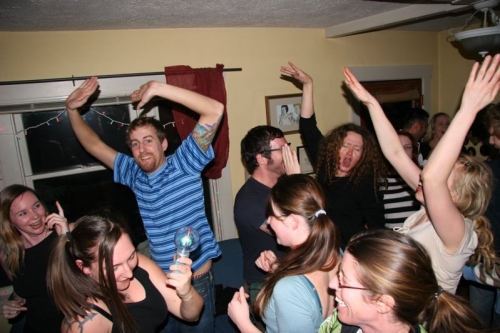
“F*ck it.  The friends around me love me enough to see me and not judge.  Besides, everyone is way too busy thinking about themselves!  I’m gonna tell the joke.  I’m gonna make the face, do the voice.”  Here’s a picture from an AA birthday party at my house years ago.  All these friends are stone cold sober.  We’ve sent the censor packing and leapt from seaside cliffs.  We’re freed not by mood altering drugs, but by our love and trust.

dance2

PEOPLE #3: CONFLICT:  Conflicts come up with family and coworkers, and sometimes even in our programs.   The other person sees things differently because of loads of stuff predating this clash. F*ck it.  I can’t change their childhood or prevailing brain patterns or set ways of responding to whatever.  I can only change myself.

(For advanced studies of the “f*ck it” prayer in this context, go to Al-Anon.)

LIFE’S PIDDLEDY-SHIT, e.g. traffic, messy house, long lines, deadlines, stuff I gotta do:  To me, when this kind of stuff is happening, it’s always a huge deal.  If my son is late for school on a Tuesday, if I’m late to meet a client, if the line I’m in is long, it means ruin and utter devastation will ensue.  That’s why I need to pray…

F*ck it.  I am so not in control, here.  God, it’s all yours!  I’m just here doing my best and leaving the results up to you.

The trouble with life’s piddledy-shit is that it really is life – or the majority of it.  The challenge is to love it as life.  For me, big risks survived have helped take the stress out of piddledy-shit, but the effect is temporary.  Each time I climbed Mount Rainier and made it back, I thought I’d never sweat the small stuff again.  Having gone through breast cancer had something of the same effect.  But I forget!

FINANCIAL FEAR: Every month it seems there’s no way I’m going to make the mortgage.  I often delay until the last day possible, but somehow it gets paid, and while my bank balance reads, say, $7.36 for a while, we just eat whatever’s in the cupboards.  But do I learn that things work out?  No.  I seem to prefer envisioning a future where my son and I reside in our car.

The thing about financial fear is, it’s ALWAYS about the future.  If we stay in the now, we’re okay and needs are met.  Even sober friends of mine who’ve lived through homelessness have come out okay on the other side, so long as they didn’t drink.

God – not people, places, and things (including dollars) – is ultimately what cares for us.

At the beginning of this blog, I said there were two things I need to live with the same freedom alcohol once gave me.  One of them is the “f*ck it” prayer, which I’ve just told you about.  But what about the other?

It’s love.  Love for you.  Love for god.   Love for every detail of life’s experiences.  But I’ll save that for another blog.  Can’t write everything!  F*ck it!

3 Comments

June 2, 2014 · 9:52 am

Those Pesky Character Defects

My Experience with Steps 6 & 7

When I first got sober, I couldn’t recognize any character defects in myself for the first few months.  See, I was such a nice lying, cheating, manipulative, self-pitying, ass-kissing, two-faced gossip, how could you hold it against me?  Selfish?  Me?  No more than the next guy!

I was raised in an alcoholic home and had carried a secret compulsive disorder for most of my life.  If denial were an Olympic event, I think my whole family would make the US team.  I can see us in snazzy team unitards with EVERYTHING’S FINE! emblazoned across the chest.  Always, when I was drinking, it seemed to me I did what I had to do to survive; I believed my own story.  Or at least, my public relations stand with myself was that my own story was to be believed.  But deeper down, even years before I got sober, I hid the heavy, dark acknowledgment that I was full of shit.

The first defects to go were lying, cheating, and stealing.  From the beginning of my young adult years, I’d lived off the high of infatuation, which I found ways to manufacture.  Since I’d learned from my family that I was not enough, the star of approval that would cure my insecurity lay always outside me, carried by certain designated hotties.  First, I’d notice you had it.  For weeks I’d stalk you, thrilling each time I caught a glimpse.  Eventually we’d become friends and drink together.  This is when I could really let it rip, confiding in you how my current partner didn’t understand me, held me back like some kind of jailor.  You’d empathize, unaware that I was frickin’ FLYIN’ ON DOPAMINE in your presence.  Your attention made me pretty, charming, and deep.  It was heaven!  The more I reeled you in, the closer I got to clinching that gold star.  But once I had you, once you’d given me both your heart and the star, the fucker turned to tinfoil.  You farted.  You told the same story twice.  You were, in short, human.  So before you knew it, you became the jailor, and I was off looking for someone new to commiserate with about you.  I repeated this cycle every five years.  Three times.

With my first partner in sobriety, I quit that game.  I never looked at other women – or men.  I was done with that.  I also gave up flirting.  Why?  Because flirting sends a message that I’m interested and available, and if I’m neither, I need to knock it the fuck off.  I also quit stealing.  Mine had been wimpy theft – padding the tip jar, pocketing office supplies – taking what I told myself I deserved.  But now, I walked back into stores if I found something in my cart I’d not been charged for.  When a cash dispenser gave me an extra $20, I turned it in.  And when my employer put an extra paycheck in my account, I called and reported it.  Twice:  Not.  My.  Money.

Next to go were those defects listed by my sponsor during my first 5th step, about 2.5 years into sobriety.  She wrote:

WoodsCoverFinal

  • Playing god: casting, directing, scripting (I believed you ought to do whatever worked best for me)
  • People pleasing (to get you on my side, cause I might need you later)
  • Dominant (cooler than you) / dependent (you’re cooler than me) dichotomy
  • Self pity

I was not allowed, she said, to rate people higher or lower on a coolness scale anymore.  We were all just stars in the night sky, some grouped as constellations, some not.  How do you quit doing something like that, stop thinking in a way that’s been reflex since kindergarten?  Step 7, in her version, went like this: God can’t remove a character defect if you’re still using it.  That means you have to try like hell not to do it, and god will eventually lift it.

Letting go of those defects took a lo-ong time.  It took making 9th step amends with people I had judged as less cool and seeing the grace with which they’d made peace with my wrongdoing.  It took hearing 5th steps from women of all shapes and sizes, gradually seeing that we all worry about the same shit.  We all fear not being loved, not being seen, not having dignity.  Whenever I ask a sponsee what the person resented ought to have done, the answer’s the same: what would have worked best for me.  Understanding this helped me let go.

Eventually, I came to “victimless crimes,” or behaviors that only hurt me. I’d already seen that smoking was a form of lying.  Whenever I compartmentalize an inconvenient truth (smoking kills) for the sake of what I want to do (I like it), I’m denying truth.  Yep.  Lying!  So I quit.  I saw that saying I loved animals (I value their feelings!) and eating meat (so suffer your life in a sunless hell and die in terror with no caring soul anywhere to rescue you) made me a hypocrite.  Today I’m a vegetarian, and my eggs come from my own happy backyard chickens.  (Of course, I still drive a car and enjoy white American privilege – not sure what to do there.)

In recent years, having been beat up sufficiently by life, having lost serenity and myself enough times, as well as many loved ones who’ve died, I quit judging struggling alcoholics who act out, and I quit gossiping.  I guess I’ve just known craziness enough times to appreciate that the person in question would manage better if they could.  I separate the behavior (which is unfortunate) from the person (who is likewise unfortunate).  Women in all kinds of dicey dilemmas call me, some sober, some not.  I listen, empathize, and give them my best shot.  Then I tell no one.  To not gossip at all is no easy feat!   I needed training wheels at first: my best friend, a trustworthy man, served as my overflow outlet.  If I absolutely had to tell someone, I’d tell him, and him only.  The buck stopped there.

Really, all these defects are interrelated.  Whenever I look to people instead of god for worth and validation, they become a means of meeting my needs.  But god does heal us.   It’s still a miracle to me that I’ve gone almost ten years without infatuation, eight loving the same boyfriend.  Never, never, I thought, would god free me from that.

I ain’t perfect.  Trust me, I still have a kitchen junk drawer full of defects – impatience, envy, vanity, anger, Facebook-induced ADD/procrastination, and 27 forms of fear.  I honestly think many of these are essential to the human experience – the trick is to recognize them and laugh at yourself.

So at 19.5 years sober, here’s what’s left: I judge myself.  I feel I’m not enough, that I’m somehow a failure.  I feel guilt and shame for something I can’t name.  I fear financial ruin.  I fear growing old without the humility to accept it.  And most of all, I fear that I’m wasting my life, because being right here doing this seems not as good as what I ought to be doing, off in the Andes or on Oprah or whatever.  I lack.  I am wrong, faulty, unacceptable.  These beliefs are the inheritance of having grown up around alcoholism, wounds of the child I hid so long with my own addictions and dysfunctional behavior.  Now that I’ve quit all those false covers, what’s left is, they fuckin’ hurt.

Therapy. Check!  EMDR. Check!  Sometimes I’ll feel good for months and think I’ve finally reached the sunlight.  But other times they creep back.  Self-blame, guilt, I-suckness.  I’ve asked god a zillion times to take them, sometimes on my knees and crying.

But god does not do drama.  That I’ve learned.  Instead god had me call an old friend after 32 years who suggested I buy the ACA (Adult Children of Alcoholics) big book.  And, holy shit!  There I was, described in its opening pages!  So last week I went to my first two ACA meetings, where people understood my experience to a T – people who were healing.

Here’s the bottom line:  If you’re on a spiritual path, there’s always more footwork to be done.  There’s always trying like hell when you don’t really know what the fuck you’re doing.  But that’s where faith comes in.  However blindly you stagger, head toward goodness.  Head toward Love.  Keep putting one uncertain foot in front of the other, and trust that god will guide you.

1 Comment

Filed under Alcoholism, Codependence, Recovery, Sobriety, Spirituality

What (most) Normal Drinkers Will Never Understand

The Curious Mental Blank SpotWoodsCoverFinal

Alcoholism is a physical, mental, and spiritual disease.  That’s what we learn in AA.

Alcoholism is just a lack of self-discipline.  That’s what most of the world thinks.

Alcoholics can exert all the self-discipline in the world and still end up drunk.

No, says the rest of the world.  If they really kept up their self-discipline, if they really stuck to their guns, they could stop or moderate.

Only accessing a power greater than themselves – aka god – can keep an alcoholic sober one day at a time.

That’s just religiosity, says the rest of the world, in a cultish slogan. 

Sometimes it’s frustrating to live in a world that doesn’t “get” my disease.  My blood family and casual acquaintances assume the mind works according to certain principles.  The notion of the Curious Mental Blank Spot (see Ch 2, p 24) is foreign to them and to almost anyone who hasn’t been utterly stumped and defeated by it.  Thank god I’ve been both, though to get there took about 4,000 attempts of rallying resolve with every fiber of my being that I was not going to drink (or would drink with moderation) and then finding myself plastered – again.  It took the admission that I’d run my life into the ground despite countless advantages, to the point where I no longer wanted to live.

But I still would have clung to alcohol as my only friend, determined to manage my drinking, if the stuff hadn’t quit working for me.  When it no longer brought about the magical transformation that had made it a staple of my life, taking away my nervous, self-conscious unworthiness and replacing it with sociability and confidence, only then was I willing to consider the counter-betrayal of checking out AA.  “Alcoholism only made one mistake,” goes the saying: “It’s the same for all of us.”  Not exactly the same, but close enough that I could learn from other people the hallmarks of alcoholic thinking, feeling, and experience.

The main hallmark is not drinking a lot.  I’ve had several partners who matched me drink for drink for years on end.  But as soon as they made up their minds to exert their self-disciple, it took.  They could stop.  They had brakes.  Mine might work for a few hours or even days, during which I was able to act on my resolve.  But then along comes that Curious Mental Blank spot.  My resolve is greased with coconut oil.  Thoughts of an hour or even a minute ago create no traction.  None.  They become meaningless.

In terms of a rough, cartoon image of the brain, what happens is this.  We like to think the conscious parts of our brain determine our actions – the frontal lobe of the cerebral cortex, which hosts thoughts and decisions.  But there’s a little lizard living in the basement of our brains – the amygdala – that generates basic survival impulses like fear and anger.   Alcoholism seems to live here.  Like a vine that winds its way front and center, it’s able to circumvent even the most determined, powerful resolves of the frontal lobe, connecting a drink to the basic conditions of being alive.  Drinking becomes an impulse, almost like breathing, that you act on without a rational choice.

The subjective experience goes like this.  You’re all set to not drink today.  You’ve made up your mind, and it’s just not an option.  You’re going to drink healthy stuff, maybe exercise, busy yourself with – you should have a drink.  A drink is a great idea.  Why not just relax, enjoy just one or two, like a little get-away to Maui that nobody needs to know about?  Eh?  You know there’s something wrong with this thinking.  A drink is what you weren’t going to do.  Yes.  And the reason you weren’t going to do it was… was…

Here something happens similar to flipping through an old fashioned Rolodex rolodexand recognizing not a single name:  Let’s see it was here somewhere: “Not good for my body” – who’s that?  “Always make a fool of myself” – do I know him?  “Swore to my loved one” – might have met briefly.  No, no… none of these ring a bell.  Meanwhile, here’s your amygdala holding out a frosty, aesthetically perfect image of your favorite drink.  It asks, What are you, a pussy?  You gonna let these cards you don’t even recognize tell you what to do?  Just do what you wanna do – THIS!

It makes so much sense.  It makes perfect sense.  The idea of abstaining for any reason seems absurdly far-fetched, while the idea of drinking rings every bell of recognition for a natural, sensible, sound idea.  So, you decide, “Yes.” All it takes is a millisecond of assent and that genie is out of the bottle again, running your life.

As I once put it in an AA meeting: “My frontal lobe is my amygdala’s BITCH!”

Equally preposterous to the normal drinker or active alcoholic is the solution – asking the help of a higher power.  When you quit thinking that you, yourself, have the means to quit drinking, when you give up using your resolve and sincerely ask a higher power for help, something shifts.  Some change happens.  Suddenly, you’re able to weather those Curious Mental Blank Spots with just enough resistance to avoid saying yes.  Do this long enough, and eventually the constant obsession to drink is lifted.

In my case, after 19.5 years’ sobriety, I am still occasionally struck by the Curious Mental Blank Spot, instances in which I still don’t recognize a single reason not to take a drink.  “You’re in AA!” seems so stupid.  “You’d lose all your time!” – Really?! Who gives a fuck?  But in my case, something steps between me and whatever image of a flawless, aftermath-free drink my amygdala is advertising.  A cloudy thought wades to the front of my mind: “How about we just wait five minutes and see if all this is still true?  The drink won’t vanish in five minutes, will it?”

Within thirty seconds, in my experience, my conscious mind is back at the wheel.  That is, the window of blindness, when I could have assented “yes” and released the genie, lasts only that long.

It may seem unlikely, but that’s pretty much the scenario experienced by millions of alcoholics meeting in 170 nations all over the world.  When we do the things suggested in AA’s program of recovery, that mediating influence restores us to sanity.

There are people in my AA meetings who claim to be atheist.  That’s fine, but ideas of what constitutes god are amorphous.  I don’t believe, either, in what they think of as God – an omnipotent humanesque boss figure.  I certainly don’t believe in religion (though teachings of some figures, including Buddha and Jesus, contain tremendous wisdom).  I believe in the very same thing most of these alleged atheists believe in: the power of love; the power of goodwill.  If they didn’t believe in connection to other human beings (which is love & goodwill), they wouldn’t come to meetings.  If they’re sharing, they’re seeking even more connection, to be heard by others, to participate.  And in that feeling, they’re seeking the help of a higher power, whether they call it that or not.

I believe without a doubt that I was graced in all the life events that forced me to AA.  I still am graced by events that lead me along the path of spiritual growth – as described in my addiction memoir.  The lessons I hear in AA meetings match seamlessly with those I hear in IANDS* meetings, brought back from the other side by those who’ve had out of body experiences.  Nothing is more important than loving kindness.  Even casual slights hurt people, malevolence is poison, and each resentment you hold against others sticks to your spirit – a filth like diarrhea all over your skin, as one IANDS speaker experienced it in her NDE.  And by contrast, the goodness of helping others glows through us like the Light.

We’re here to love, which cures all our afflictions – including alcoholism.


scroll

.

*IANDS: International Association of Near Death Studies.  Local chapter: Seattle IANDS.

Feel free to share! 

4 Comments

Filed under Alcoholism, Recovery, Sobriety