Category Archives: Drinking

Psychic Change

Toward Alcohol

When we hit bottom in our drinking careers, we’re pretty much forced to change.  We’re truly sick and tired of being sick and tired; we recognize, however faultily, that our way is not working.  We become teachable.  That is, we’re desperate enough to try out AA’s approach even though it feels foreign, artificial, and disorienting.

For me this meant giving up the belief that I knew everything.  I’d always felt sure I could perceive the lay of the land in a snap and choose the best course, which I then acted on with chutzpah and a dash of fukitol.  Drinks made me feel better, so I frickin’ took ’em.  Certain designated figures, also known as cool people, carried what I craved, so I chased ’em.  Responsibility and integrity felt cumbersome, so I shrugged ’em off – free to follow my whims wherever they might lead!

And where was that?  Loneliness so lethal I wanted to scream for eternity and futility so rampant I wanted to break and trash and burn every fucking thing that ever touched my life – that’s where my knowing everything took me.

12 stepsAA – the supposed solution – seemed as silly as a cake walk.  The 12 Steps, anyone could see, held no more wisdom than a hopscotch grid, and yet all these AA dolts claimed that if you sincerely played hopscotch, if you landed in each arbitrarily chalked off square, you’d bust through to frickin’ Narnia or something – whatever they meant by this “4th dimension of existence.”

But since a U-turn could lead me only back to the hell, I went ahead.  I gave up control, followed directions, did the dance.  And I commenced to change – to heal and grow and behold countless unexplored and rich possibilities hitherto invisible to me.

From somewhere inside me, I began to sense a direction besides my thoughts.  They – my thoughts – were still as dumb and which-way as ever, but this new chord, this voice within – it began to lead me instead of them.  Guidance I heard and talked about in AA aligned with this voice, but did not constitute it.  Rather, I had “tapped an unsuspected inner resource” previously drown out by all the fears, demands, and clutter spewed by my ego.

I’d experienced a psychic change.  I’d begun to develop a spiritual life that edged out my craving for booze.

Toward Life Itself

“Our liquor was but a symptom,” says the Big Book, of our messed up approach to life.  If we merely take away the faulty solution of drinking, life hits us full force and feels unbearable. The lasting solution is to live on a spiritual basis which flows in tune with reality rather than fighting it.

Spiritual evolution is not a matter of content.  That is, it’s never a matter of learning X, Y, and Z, passing the quiz, and graduating.  Rather, it’s a habit of cultivating open-mindedness and reaching for growth.  In other words, the conditions for continuous growth are the same as those that freed us from compulsive drinking: I elect not to buy into my thoughts, not to obey my ego, not to fall for the idea that my way is right.  Only by turning away from these easy-to grab reflexes can I open myself to another voice – the more fundamental guidance of a higher power.

second-handDay by day, growth happens at the juncture between what I’m exposed to and how I react to it.  In that immediate crucible, I make more tiny choices than can possibly be noted, but collectively, they coalesce into a “gear” for my outlook.  I plop into good-ole self-pity or reach for seemingly impossible gratitude – though I may end up somewhere between.  What matters is whether I ask my higher power to guide those tiny choices, and whether I commit the incremental shards of my awareness to pursuing that guidance.

Growth can’t happen when ego takes over.  The world becomes scary, because if what I’ve decided is supposed to happen doesn’t, I’m gonna be screwed. There’s never enough, so I lock into my plans.  I get tunnel vision – which means I’m sealed off from potential good outside my will.  I consign myself to stagnation.

The openness of faith reminds me life is always a collaborative effort – mine and god’s.  Sure, I still plan and take action, but with built-in acceptance of whatever plays out.  Even if things fuck up and fall apart, I’ll still be okay.  My “enough” originates not from stuff or status, but from the power of god’s love flowing through me, the strength to generate and nurture and delight.

Jess and Chip

Jesse & Chip (by permission) 1 month post-flood: “The joy of living [they] really have, even under pressure and difficulty.”

Consider some dear friends of mine who moved to Wimberley, TX, last year only to lose everything they owned in a recent river flood.  One day things were dandy, and next their home was was missing two walls and contained only mud and somebody else’s overturned couch.  They had no renters’ insurance.  Can you imagine that?  I mean, can you really imagine losing everything?  Yet these are two happy and thriving, not only because they’re sober, but because they live on a spiritual basis.  They don’t lament.  They have their precious lives, their energy, their love – a flow that’s providing all they need to rebuild what was lost, even as they pitch in to help neighbors… or support a faraway friend (me) processing a painful break-up.

The psychic change to living on a spiritual basis means we accept life’s uncertainty, taking our best shot and leaving the results to god.  Failure’s fine.  It happens.  Floods happen.  Betrayals happen.  We can only keep listening for the voice within and trying to follow it toward good actions and good people, but with no guarantees.  Because, while it’s true we each reap what we sow, it’s also true we’re  scattering seeds from an unmarked, mixed bag. What will take root and flourish depends, we know, as much on the rain and sun as our work. Yet we do it anyway – and cheerfully.

Millet- sower

The Sower, J. F. Millet, 1850


 scroll

1 Comment

Filed under AA, Alcoholism, Drinking, Faith, God, Happiness, Recovery, Sobriety, Spirituality, Twelve Steps

People, Places, and Pain

Recently, someone I trusted betrayed my confidence deeply.  Or rather, I just found out about it last week.  Before then, I’d have said such a thing could never happen – and I’d have staked my life on it.  In a way, I did.  Maybe some day I’ll write about the specifics, but right now I’m too shocked to have any perspective.  I haven’t slept more than a few hours at a time all week; my heart pounds so I feel each beat; I have no appetite.  Sure, it’s great to drop five pounds in a week, but not with shaking hands you have to hide from clients or sinking guts that weigh down every breath.

I’ve often heard in the rooms that placing one’s faith in people, places, and things is a recipe for pain.  But how can we avoid doing just that?  Part of my loving – or feeling I love – inevitably involves dependence.  I trust that a friend or loved one honors me as I do them, and pretty soon I’ve hung my well-being on their actions without even realizing it.  In the same way, I rely on the places and things I love to provide me security.  I get attached to my body’s health.  These elements should all stay put just as I’ve arranged them.  I want to know my happiness is safe, that I can depend on the world to take care of me.

Natori, Japan

But it isn’t, and I can’t.

When illusions get ripped away, we realize that everywhere we make a home for ourselves in the world, we simultaneously become exposed.  We begin to think that home is part of us, of our being – our identity – and that we can shed our skin there in perfect safety.  But people are flawed.  They fuck up.  They decide, at times, that it’s a grand idea to be immensely selfish, throwing us under a bus.  Other “homes” are just as impermanent.  Diagnoses drop bombs on our health.  Jobs end and take financial security with them.  Sweet kids become addicts.  People move away.  Houses burn.  Earthquakes happen.  Nothing stays put.

When I am most in pain, I turn to god.  And god, I have found, is  there for me most when pain has torn open my heart.  I can feel it.  It doesn’t exactly empathize, because pain is not part of its realm.  But it loves.  Even when everything has gone to shit, god loves as always – the way the sun rises each morning, the way the ocean waves curl over and thunder up the beach, the way the spring grass sprouts through winter’s dead mat of straw year after year after year.  “I’m here.  I love you.”  That’s what it says.  But if I listen closer than I want to, it’s also saying, “All is well, if you’ll only let it be so.”  It’s talking about acceptance.  About humility.  God is in what is.  So when I fight what is, I’m fighting god.

Do I think about taking a drink?  Wouldn’t that fixDrinker silhouette everything?  Wouldn’t it calm my heart from slapping against the inside of my sternum?  Just cop a decent buzz and I could quit giving a shit.  Then I could vent my hurt as outrage and lash out about what a worthless piece of shit the person who hurt me was.  That anger – wouldn’t it  jack up my sense of power, raise me on towering flames of righteousness so I could smite?  Then maybe I wouldn’t have to feel this intense vulnerability, this loss, this pain… pain… pain….

Sure, that might happen temporarily.  But when the drunkenness retreated, I’d have nothing.  I’d have lost not only the person I trusted, but myself.

I hadn’t gone to one of my Near Death Experience (NDE) meetings in months, but when I asked last week on Facebook if someone would go with me, a Tennessee friend who’s had an NDE as well responded: “I’m in town; let’s go!”  At that meeting, the makers of a TV show came down front and announced they were interviewing NDEers.  So, as one of them passed my aisle seat, I handed him my card.  I didn’t think much of it.

NDEYesterday I was sitting with my pain, my journal open in my lap, staring into space.  The phone rang and one of those TV researchers asked if I would tell her my NDE story.  It takes a while, because I’ve had 14 paranormal after-effects as well, but she assured me she had all the time in the world.  So I told it again for the for the first time in years.  The story’s scattered through my addiction memoir and I’ve presented it to Seattle IANDS* and at the Seattle Theosophical Society, but there’s no call to tell it in daily living.

When I got to the part about my huge 9th Weird Thing, I explained:

“That’s the moment when I got it.  I mean, before then I’d believed god was real whenever I was feeling spiritual or something, but otherwise I’d set that aside and  believe in my own mind.  But this thing was so inexplicable – it was all the proof a person could ask for.  I knew then god is with us in every tiny thing that happens.  And something changed in me.  I was sobbing and I prayed, ‘Okay – I know you’re real!  I’ll never you doubt again!'”

“That’s so cool!” exclaimed the woman.  She was busy taking notes.  And in the little stretch of silence that followed, something nudged me: Hear yourself.  Sitting there, I remembered that the 9th Weird Thing really did happen.  I remembered all my weird things – that they had actually happened to me, that I really lived them, and that no material view of the world could explain them.

What I’d prayed fervently a few nights before was this: “Let me know you’re with me.”  So it came about that I spoke the very words I needed to hear.  Plus there was a deeper message wrapped up in that “hear yourself,” saying also, “heal yourself.”   It went something like this:

There’s a home at your core that’s always safe, because you and I inhabit it together.  Make that home your true one.  Spend time there, spruce it up, make it strong.  Because there, sweet child, even as the world falls down around you, my love will carry you, and you’ll be okay. 

Today, I know that’s true.

scroll

*Seattle IANDS = Seattle branch of the International Association for Near Death Studies

Leave a comment

Filed under Alcoholism, Drinking, living sober, Near Death Experience, Recovery, Sobriety, Spirituality

Enlightened but Dead: Why Alcoholics Need God

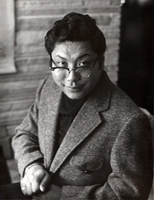
Pema Chödrön’s teacher, the venerable Chögyam Trungpa, drank a lot.  Drinking was a staple of his sanga, where he threw big parties among his students, and he was known to carry vodka in a water bottle.  Trungpa explained in one of his spiritual books why his drinking differed from that of an ordinary alcoholic:

“Whether alcohol is to be a poison or a medicine depends on one’s awareness while drinking. Conscious drinking—remaining aware of one’s state of mind—transmutes the effect of alcohol. Here awareness involves a tightening up on one’s system as an intelligent defense mechanism…

“For the yogi, alcohol is fuel for relating with his students and with the world in general, as gasoline allows a motorcar to relate with the road. But naturally the ordinary drinker who tries to compete with or imitate this transcendental style of drinking will turn his alcohol into poison…”*

Sadly, it appears that Trungpa’s liver failed to read the book and appreciate his “transcendental style” of yogi drinking.  Despite diagnoses of cirrhosis and doctors’ warnings that more drinking would kill him, Trungpa continued to drink heavily until it did indeed kill him in April of 1986, when he was just 48 years old.

Trungpa~

Philosopher Alan Watts was considered a sage throughout the ’60s after he rose to prominence with the 1951 publication of The Wisdom of Insecurity – a pivotal text  introducing Eastern concepts to Western society.  The book considers the ego’s dis-ease with the unstable nature of reality and its efforts to create security via constructs of memory and projection coalescing in a story of “I,” which Watts dismisses as unreal: only awareness divorced from self can access reality.  Watts, like Trungpa, was well aware of the futility of escapist drinking:

“One of the worst vicious circles is the problem of the alcoholic.  In very many cases he knows quite clearly that he is destroying himself, that, for him, liquor is poison, that he actually hates being drunk… And yet he drinks.  For, dislike it as he may, the experience of not drinking is worse… for he stands face to face with the unveiled, basic insecurity of the world.”

Unfortunately, identifying this vicious circle did not grant Watts the power to exit it.  Like Trungpa, he often gave lectures while sloppy drunk. He, too, developed end-stage alcoholism that deeply concerned his ex-wife and friends, and died of alcoholic cardiomyopathy – e.g. heart failure – at 58.

Watts~

Both of these men were masters of self-knowledge and the meditative disciplines that yield inner peace.  Both could speak brilliantly on the ills of ego and treasures of honesty.  Yet neither could stop drinking.  And they’re just two examples out of jillions.  Why did they fail?  Why would people so insightful not quit what was clearly killing them?  The Big Book explains:

“If a mere code of morals or a better philosophy of life were sufficient to overcome alcoholism, many of us would have recovered long ago.  But we found that such codes and philosophies did not save us, no matter how hard we tried.  We… could will these things with all our might, but the needed power wasn’t there. Our human resources, as marshalled by the will, …failed utterly.” (p. 44)

In Shambala: The Sacred Path of the Warrior, Trungpa makes very clear that no god enters into his vision.  “Over the past seven years, I have been a presenting series of ‘Shambala Teachings’ [on]… secular enlightenment, that is, the possibility of uplifting our personal existence and that of others without the help of any religious outlook.”

Good for him!  I agree wholeheartedly that self-knowledge is great stuff.  But it will not cure alcoholism.

In a 1968 talk, Bill Wilson, one of AA’s founders, described the initial amazement of the psychiatric community at the unprecedented breakthroughs of AA.  Many alcoholism specialists attended meetings and saw their own alcoholic patients, with whom years of psychiatric work had failed, achieve abstinence and mental health in a matter of weeks.  One suggested that Bill assemble a group of such psychiatrists to testify before the Academy of Medicine about AA’s success. So Bill asked them.

“And not a one would do it! …In effect, each said, ‘Look, Bill. You folks have added up in one column more of the resources which have been separately applied to alcoholics than anyone else… [But] the sum of them won’t add up to the speed of these transformations in these very grim cases… So for us, there is an unknown factor at work in AA.  [B]eing scientists, we… call it the X factor.  We believe you people call it the grace of God. And who shall go to the Academy and explain the grace of God?  No one can.'”

questionSorry, folks!  But the X factor, and that alone, is what saves an alcoholic: Connection with a higher power, to god as we understand it.  We ask god to help us, and we’re relieved of a compulsion that no amount of self-knowledge can touch.

Humility is the key ingredient to receiving grace.  We have to ask for it, accepting that we’ve been defeated.  By contrast, Trungpa, for all his wisdom, exhibited a strong tendency toward hubris.  The true warrior, he explains in Shambala, is both Outrageous and Inscrutable.  “…[H]aving overcome hope and fear, the warrior… fathoms the whole of space.  You go beyond any possibilities of holding back at all…. Your wakefulness and intelligence make you self-contained and confident with a confidence that needs no reaffirmation through feedback.” In other words, I got this!  Screw what anyone else thinks!

Watts, meanwhile, purported to embrace God, but his abstractions reduced it to a mere abandonment of I, which enabled connection with the eternal now and rendered us one with God.  For Watts, there could be no “Hey, god (you) please help (me)!” because the you / I division negated the fact that we are god: “[W]e cannot lay ourselves open to grace, for all such split-mindedness is the denial… of our freedom.”

Reluctance to seek god’s help almost killed AA co-founder Bill Wilson, too.  Relatively unknown in AA culture is the fact that Bill was so deeply repulsed by the God element in his friend Ebby’s solution that he went on drinking for three weeks after Ebby’s visit and landed yet again in a sanitarium.  There, after Ebby had visited him again to recap the spiritual solution, he had this experience:

“And again the despair deepened until the last of this prideful obstinacy was momentarily crushed out. And then, like a child crying out in the dark, I said, ‘If there is a God, will he show himself?’ And the place lit up in a great glare, a wondrous white light. Then I began to have images, in the mind’s eye, so to speak, and one came in which I seemed to see myself standing on a mountain and a great clean wind was blowing, and this blowing at first went around and then it seemed to go through me. And then the ecstasy redoubled and I found myself exclaiming, ‘I am a free man! So THIS is the God of the preachers!'”

Light
In my Near-Death Experiences group, I’ve heard several people describe similar experiences, when the “white light” of love brilliantly illuminated the room around them; but, naturally, many of Bill’s contemporaries considered him daft for insisting it had happened.  In his talk, he attributes this phenomenon not to his own specialness, but to the role it enabled him to play in AA, explaining that the powerful faith most AAs develop over months or years was for him simply crammed into a few minutes: “It did give me an instant conviction of the presence of God which has never left me… And I feel that that extra dividend may have made the difference in whether I would have persisted with AA in the early years or not.”

In other words, Bill was given what he needed not only to overcome a lifetime of harrowing addiction, but to co-create AA and persist in carrying its message into the dark world of his fellow alcoholics.  Why?  Because he asked… and frickin’ meant it.

.

scroll

.

PS: I have tremendous respect for both these sages as well as for Buddhism.  By no means am I critical of their legacy or beliefs.  Reading both authors did contribute to my self-knowledge, for which I am grateful, because such insight aids in a lifetime quest for serenity.  My point is merely that self-knowledge, no matter how deep or how keen, cannot arrest this disease, as these two tragically premature deaths testify.  See comments below. 

– Louisa

  • (Heart of the Buddha, p. 153)

31 Comments

Filed under AA, Alcoholism, Drinking, Faith, God, Recovery, Sobriety, Spirituality, Twelve Steps

The Wisdom of Ordinary Schmucks

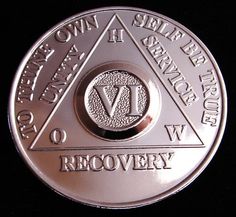
Today, Thursday the 29th, I have 20 years clean and sober. Woot!

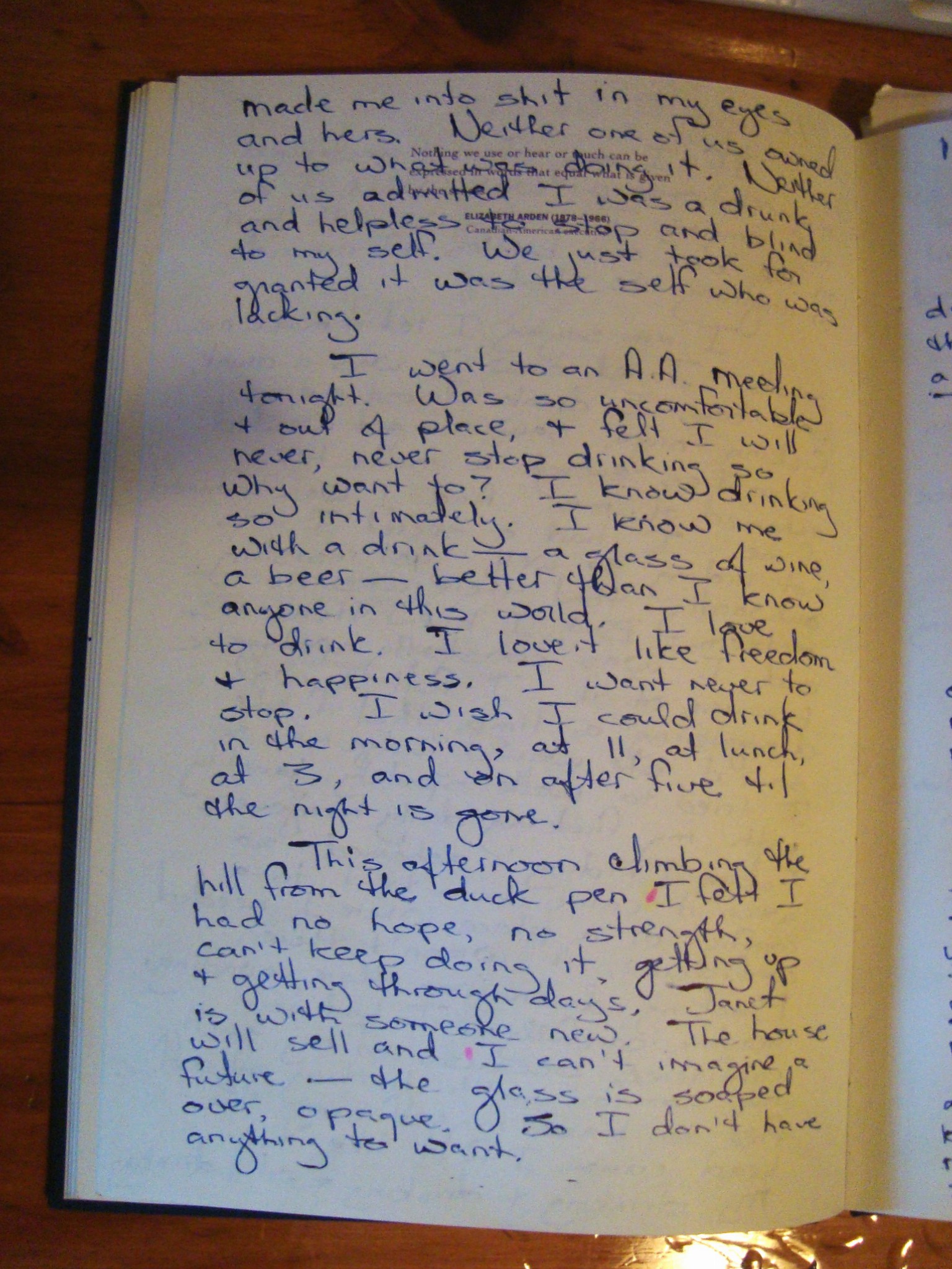
Here’s a journal entry I wrote 20 years ago after my first AA meeting:

1/29/1995:  “I went to an AA meeting tonight. Was so uncomfortable and out of place, and felt I will never, never stop drinking so why want to? I know drinking so intimately. I know me with a drink – a glass of wine, a beer – better than I know anyone in this world. I love to drink. I love it like freedom and happiness. I want never to stop. I wish I could drink in the morning, at eleven, at lunch, at three, and on after five ‘til the night is gone.”

2015-01-29 08.01.00

journal page

Writing that was a scared, deeply confused and unhappy semi-suicidal woman who thought her mind ought to be able to get her out of any jam. The last thing she suspected was that those people among whom she felt “so uncomfortable and out of place” would not only save her from slow death, they would teach her to transform living into something beautiful and joy-filled. I remember judging every person in that room by the standards my family had ingrained in me. Anyone lacking at least a BA, anyone with a working class job who wasn’t slumming ironically for the sake of some art form, was ignorant. As for the 12 Steps, it took me about 40 seconds to read them off the wall. How could such vague ideas accomplish anything?  Sure, these ordinary schmucks believed in them, but I was way smarter and more special.

Wisdom, however, is neither academic nor cultural. It’s about living – how we respond to the passions of being human, like our desires for love, fulfillment, and specialness.  It concerns how we deal with fear, anger, and the impulse to defend what we love.  And it’s far more a matter of what we let go as false than what we cling to as true.  The ordinary schmucks in AA taught me how to cast off the hoary crust of fear that had blocked me from the truths of god and my fellows, freeing me to be myself and to love you intrinsically because you are, at heart, just like me.

The first things the schmucks taught me were wisdom bytes passed down in AA, which made such an impression that I remember to this day where I sat relative to the person speaking.  “I can’t fix my broken brain with my broken brain,” said a guy at the next table with unruly hair sticking out from under his baseball cap. “That’s why I need the help of something greater than me.”  Whoa! I thought, no wonder I can’t get better!  Too bad I reject everything to do with God!  But then a few days later an overweight woman in polyester pants sitting to my left against the wall said, “If you can’t think God, if that’s objectionable to you, just think Good Orderly Direction.  You can seek that – something deeper than your own thinking.”

There light_bulbare countless other key moments when light bulbs went on for me. “My ego tells me I’m the shit, and my self-loathing insists I’m a piece of shit.  But God grants me the humility to be right-sized – to be a worker among workers, a driver among drivers, a sober drunk among sober drunks.”
But even more important, what the schmucks have shared with me is their experience of living life. The first story I ever identified with was told by a guy (sitting near the door to my right) who ordered Chinese take-out that arrived without chopsticks.  He knew he had a pair in the house, some nice bamboo ones, but couldn’t find them. He went bananas searching for them.  He kept looking in the silverware drawer again and again, lifting out the tray and shoving stuff around. Furious, he checked all kinds of illogical places – the junk drawer, his desk, the broken dishwasher – while his take-out got cold. It seemed to be about a principle.

This was in maybe my second week sober, but I still hear that guy’s words every time I go bonkers trying to find something.  “It’s just my ego refusing to accept what is” echoes in my mind.  “It’s just me being human and flawed.”  I’ve since heard countless stories of ways to be human and flawed, issues I once thought were mine alone.  Incrementally, they push me toward acceptance of things I cannot change.  But what about that courage to change the things I can?

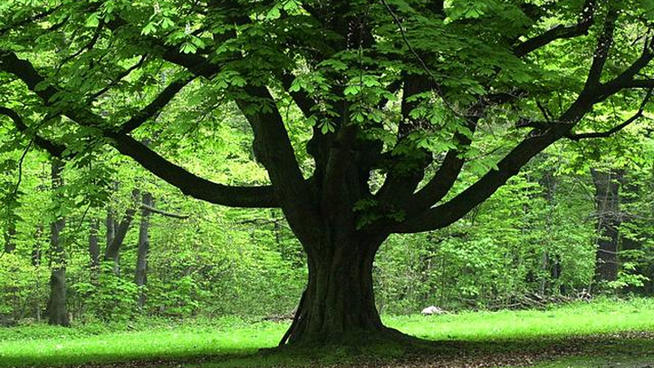
The 12 steps grew from empty suggestions to a revolution in life perspective once I worked them with a hard-ass sponsor who pushed me to see beyond my story.  They changed me, dredging up insights from the depths of my inner knowledge and compelling me to face them.  When I didn’t like what I saw, I was willing to ask my god for help, much as I’d asked in theoak-tree beginning to be relieved of the compulsion to drink.  I was willing to work with god to become what it (i.e. love/Good Orderly Direction) would have me be.  I write this now when I have almost no time in my week because of my commitment to follow through on that direction.

Telling the truth – the human truth. That’s what I heard the schmucks doing over and over once I’d awoken through the steps.  They taught me with their shares that there’s almost always a deeper, more honest revelation underneath whatever story we’ve cooked up about ourselves and others.  Pretty much any problem boils down to “I’m afraid” of not getting what I think I need or losing what I have.  And any happiness boils down to “I love.”

I’m no longer the woman who wrote of clinging to her glass, to her liquid freedom and happiness that had, unfortunately, quit working.  Some wisdom comes simply with age.  We begin to see the old in the young and vice versa, see the broke in the rich, and to have compassion for people living though pains we have known.  Whether one is in AA or not, pain can be the greatest teacher if it moves us to replace our defunct illusions with love and tolerance rather than tout them with righteous judgement.  Gradually, we come to see the trajectory of birth to death resembles a meteor’s streak through the night sky: the small and insignificant burn bright, casting light where there was none, and then go out.  We can’t begrudge anyone the color or angle of their flare.  We are all miraculous and unique ordinary schmucks.

Thanks for 20 years, guys!

20 year coin

2 Comments

Filed under AA, Alcoholism, Drinking, living sober, Recovery, Twelve Steps

Not-Enoughness

A worthy life is simply one of honesty with oneself and god…

.
I go through phases when I wake up almost every morning with a gut-level anxiety, a feeling of guilt that I’m somehow not doing all I’m supposed to, shame for lacking “success,” and alarm that I’m getting old at a mile a minute.  My whole life, the feeling claims, is a failure.  Before I’ve even sat up in bed, this “not-enoughness” jabs at my mind, perfect lifeprompting vague solutions that pop up like slot machine combos:  “Earn more!”  “Lose weight!”  “Socialize more!”

Whether my not-enoughness, a default setting from childhood, will ever go away I don’t know.  What’s changed is how I respond to it.  Today I understand that it’s just a feeling launched by the part of me that’s still broken.  I return its topspin tennis serve with a quick prayer: “God, please take this away and guide my thinking today.”  While I put on my morning clothes and weigh myself, not-enoughness still chides at me.  I dismiss it automatically and try to focus on the moment: gift of what I am doing, the good fortune of where I am, and the blessings of my reality.  I commit to loving what is instead of lacking what isn’t.

The power for this practice comes from my god, a connection nurtured through many years of working all 12 Steps.  Back when I relied on active drinking and codependency, I believed not only the not-enoughness, but the solutions my mind proposed.  My high school refrain, “Excel more!” gradually morphed into “Be more liked!”  If I could just win your admiration, I’d overcome not-enoughness.  Sans alcohol I was terrified to converse with people, not realizing the main obstacle had to do with the coordinates of my head, which was firmly lodged up my ass.  I could scarcely hear what you were saying, so preoccupied was I with self: what was up with me, what I thought you thought of me, and what I might say to impress you (usually figured out after you left).  Sober socializing was, in short, torture.

Drinking, of course, fixed all that.  It made me smart, funny, beautiful, and worthy.  Glamour drinkSure, I was still biding my time while you talked, but who gave a shit?  I’d get my turn to blab soon enough and, whether you were impressed or not, I, at least, was fine with whatever the fuck I’d just said.  The drunker I got, the wider my range of just fine became.  Maybe you didn’t care to hear about ex-partner’s sexual foibles, but fuck it!  Lissen!  It’s hilarious!

loufinger

Moi, back in the day

The infatuation addiction detailed in my memoir was really just a souped-up version of that same dynamic, with all my need concentrated on a chosen, magical person whose admiration (or even company) worked like cocaine.  Sadly, these worth-seeking projects frequently morphed into real relationships – meaning that the magic one, by committing, lost all magic.  Subsequently, when attacks of not-enoughness struck, I had no “soon things will be different!” to counter it with.  I could only muffle its penalty buzzer with more booze and great ideas.  All I’d end up with was a wreckage of mishaps, huge amounts of money blown, and a hangover like a brain full of puss.

Sobriety has by no means been a picnic.  I spent over two years dry and tortured – fleeing the conversation clusters after meetings with mutters of “fuck ’em!” – before I finally worked the steps and became teachable.  Slowly teachable, that is: I spent nine years in a codependent cocoon focusing all my anxious attention, from the moment I woke, on fixing my partner’s “problems” and ignoring my own.  Really, that morning gong of not-enoughness did not emerge for me as a distinct phenomenon until I found myself waking up alone.  “What is this feeling?” I finally asked.

Self-knowledge may not save us from drinking, but it sure helps with other problems!  The steps have transformed my economics of worth.  The only worth I can feel, I understand now, is self-worth.  I am the only agent who can generate that rebuttal to not-enoughness, no matter what anyone else may think of me.  God has shown me how to cultivate self-esteem by doing estimable works.  It has guided me to grow a loveable life by loving my life.  It has taught me to connect with others more through my heart than my words.

Despite what the zillion ads we’re bombarded with would have us believe, a worthy life is simply one of honesty with oneself and god – whatever that may look like for the individual.  For me, it means I do the best I can with what’s right in front of me Goodmanand trust god that whenever a suitable door approaches, god will not only alert me, but open it.  Why did I start up the small business I run today?  Doors would not open to the 500+ jobs I tried for following my layoff, whereas with just one little ad, the business practically threw itself at me.  Like incremental promotions at a firm called Happiness, Inc., small choices I’ve made have gradually steered my life away from money and prestige toward more time and freedom.  Thrift at home is part of my work.  True, I drive a beater and shop at Goodwill, but I also get to walk my 13-year-old son to school each morning, laughing about this and that.  I get to write instead of wishing to.  I see friends.  I take loads of ballet classes, raise cute hens, and execute my own half-assed home repairs.  Overall, my life today reflects the truth of who I am – a plenitude of what I value and a shortage of what I don’t.  That’s the true test.

In fact, by the time I go to bed each night, I’m overwhelmed with gratitude for my beautiful, rich, love-filled life.  My only prayer is, “Thank you, god, for all of it.  I love you.”

Tomorrow, I know, it all begins again.

imagesShare if you like ~ ↓ ↓

8 Comments

Filed under AA, Alcoholism, Codependence, Drinking, living sober, Recovery, sober, Sobriety, Twelve Steps

The Courage to Surrender

Courage: the ability to do something that you know is right or good, even though it is dangerous, frightening, or very difficult.
—————————————————————————-Macmillan dictionary

.
American popular culture tends to associate courage with kicking ass.  Most of our movie heroes don’t need to overcome fear because they don’t feel any.  All we see from them is the anger and righteousness to smash the bad guys.  This invulnerable version of courage is reflected in Dictionary.com’s definition, as that which “permits one to face Die_hardextreme dangers and difficulties without fear.”

But what if fear is essential to courage?  That is, what if courage involves not just outward action, but the inner struggle to overcome all that holds us back – confusion, doubts… and fear?  In that case, courage means acceptance of our vulnerability, even our weakness, as well as the faith to move beyond it.

What’s this got to do with alcoholism?  People outside the rooms often assume recovery is about the ego’s type of courage: we’re sober because we’ve kicked addiction’s ass.  We conquered that mofo by being strong, disciplined, and – my favorite – taking control!  But there’s a lil’ problem with that.  Where drinking’s concerned, I can pull off none of those things.  I drink myself shitfaced.  That’s just what happens.  No matter how angry or righteous I may feel toward addiction, it’s the only one doing the ass-kickin’.

HOW coinOn the other hand, what I witness and learn in the rooms of AA is another form of courage – the courage to surrender.  Those two words don’t match up in most people’s minds, but for those of us in recovery, they have to.  When we tell ourselves, “I’m gonna beat this thing!” we seem to end up drunk.  But if instead we surrender, something inside us begins to shift, and we develop courage through the three essentials of recovery: Honesty, Open-mindedness, and Willingness.

Honesty
Nobody wants to be an alcoholic.  But even more, nobody who’s known only that way of life can imagine surviving without alcohol – a terrifying prospect.  I don’t know a single person who came to their first AA meeting without half a mind to bolt out the door.  What keeps us there is loyalty to certain moments of clarity – also known as honesty – when we either recognized death on our not-so-distant horizon or, in subtler cases, realized we could no longer endure the mental contortions necessary to sustain denial.  To hang onto that insight despite all the disclaimers our disease flings at us requires courage.

What’s more, every instinct cries out against admitting to a room full of strangers, “I cannot stop drinking and I don’t know how to live.”  Such words may not be voiced at our first meeting, and for some they never are. But alcoholics committed to recovery find the courage to speak these truths, no matter how difficult or painful.  Hearing them still brings tears to my eyes, even after almost 20 years.

Open-mindedness
Alcoholics tend to abhor the idea of groups.  We like to see ourselves as fiercely independent and temperamentally unique, so we’re repulsed by anything that smacks of conformity.  We also can’t stand the prospect of talking to others without a few drinks in us.  The last place we ever thought we’d spill our guts is a goddam cult, meetingwhich is what we’ve been calling AA, between swigs, for years.  Who wants to crawl in and, stone cold sober, ask for help from a group they’ve talked nothing but shit about to anyone who’d listen?  Nobody!  But we do it anyway, strange and frightening as it is.

Neither do I know a single newcomer who read the Twelve Steps on the wall and thought, “Oh, boy! That’ll help!”  The steps seem useless and irrelevant – some ‘hokey-pokey’ dance involving a magic Easter Bunny that has NOTHING to do with our very huge and real problems.  When alcoholics move ahead with these steps despite the certainty that they’ll never work, they’re stepping out on pure faith, reaching for the possibility of other ways to experience life.   The disease continues to offer them “Fuck Everything Free!” cards, but they decline to take one.  To turn away from everything familiar toward something unknown and intangible just because it feels “good or right” takes – you got it! – courage.

Willingness
The road to recovery is lengthy and, in places, steep.  We hear early on, “There’s only one thing you need to change – and that’s everything!”  Not only does that sound creepy, but “change” here is a verb – meaning we have to make it happen.  To find and work with a sponsor, write and read inventory, show up and listen at meetings, make amends, and eventually to sponsor and be of service to others – all these efforts require a willingness we’ve formerly lacked.  Our degree of willingness may wax and wane over the years, but if we steer by what we “know is right or good, even though it is… difficult,” we gradually come to call it by a different name: maybe god’s guidance, or maybe loving-kindness.

scroll.
Whether in terms of the battlefield or bottle, surrender means accepting as reality that which we’ve been fighting to deny.  But while a soldier surrenders only once, for the alcoholic, surrendering to one aspect of reality just moves us to a new perspective where we have to repeat the process.  Once we accept that our lives are unmanageable, we have to look at our relationships, which points us to our selfishness, which alerts us to our fear, which signals us to look at our connection to god and what it truly means to us.  The greatest paradox is that courage gradually leads us to our spiritual source, and yet it was that source (aka god/HP/ loving-kindness), once we opened the channel, that granted us the courage to change.

surrender_flag


Leave a comment

Filed under AA, Alcoholism, Drinking, living sober, Recovery, sober, Sobriety, Twelve Steps

On Alcoholic Denial

The greater our honesty, the more life is worth

Alcohol has never been de-throned in my family. Throughout his life, my father clung persistently to the conviction that alcohol opened a portal to happiness. As the big book says, “For most folks, drinking means conviviality, companionship, and colorful imagination. It means release from care, boredom, and worry. It is joyous intimacy with friends and a feeling that life is good.”

That and much more, for the early alcoholic. Because for us, drinking means release not only from those factors, but from ourselves. We live constantly tormented by the thousand stinging wasps of envy, self-criticism, frustrated desires, and the injustice of being misunderstood even though we know best. Drinking sedates these irritants, and we feel free. The trouble is, they all come back with twice the venom when we sober up. So we need more alcohol to regain peace. We don’t want to examine our consciousness itself and recognize that the bees are all generated by our own sickness.

Like my father, I clung to this pro-booze view as long as I could. The more painful and screwed up my life became, the more convinced I was that I needed alcohol in my corner as my only true friend. When that path led me close enough to meeting death or tragedy – meaning that I regularly drove drunk almost wishing to die and too selfish to consider the threat I posed to others, and that an otherworldly voice actually told me it could no longer help me if I continued to lie to myself – the day came when I finally turned on it.

I’d known for ages that I was alcoholic; I’d resolved a thousand times to drink less. But this time was different. This was a resolve to take action, and it entailed a shift of means that felt almost like murder. I would open the trap door beneath my buddy, alcohol, who unsuspectingly assumed we were still a team.   I would go to AA, that anathema of self-reliance, and I would check out surrender. While I drove to my first meeting, that part of me – my addict – pleaded for me to wake up, say fuck it all, and just down a goddam drink.

Over the nearly 20 years since, as told in my addiction memoir, my sobriety has progressed as slowly as a receding tide that gradually reveals all kinds of submerged skeletons and rusting old junk on a beach. Every corpse, every dysfunctional mechanism has had to be dealt with through awareness, acceptance, and action. It’s a process that continues today through the 12 steps.

What I’m remembering this morning is how astonished I felt each time my father voiced the old belief that alcohol was the goodness of living. One night around Christmas a few years before he died of alcoholic cardiomyopathy, he showed me the strings of Christmas lights in a three-tiered arch over the front door entrance. “Do you know why we have it like that?” he joked. “So our guests will leave thinking they’ve had a good time!”

wineThough I loved my father for joking with me, which he rarely did in his last years, I could barely fathom the mindset involved.  Every doctor he’d seen in 30 years had pronounced him an alcoholic with an enlarged liver and advancing wet brain.  I’m sure he was warned about his thinning heart walls as well.  Mom would confide these medical concerns to me when the mood came over her; more often, she pretended along with Dad that they simply didn’t exist.  Despite the thousands of mornings he’d awoken with killer hangovers, Dad’s thinking around alcohol had changed not an iota since the fabulous cocktail parties thrown in my childhood. My father was a brilliant man. How could something so obvious be walled out from his reality?

He was a star in his career, raised his children lovingly, and remained married to my mom for 59 years.   He was also successful at continuing to drink all his life. Before retirement, he drank only on evenings and weekends. After retirement, he drank all day, pouring wine into his coffee cup an hour or so after breakfast. Did he get DUIs? Never. Did he get in fights or become obnoxious? Not even potentially. This is something many drunks wish they could pull off.

The toll was all on himself.  He endured endless self-loathing, judged his life irritably as having fallen short, and lived in emotional isolation from those closest to him.  There was so much we couldn’t talk about!  Resentments flared at the mere mention of certain names.  Yes, wine dulled these pains somewhat, but less and less as years went on.  He became bitter and snappish.

I am like my father in so many ways besides alcoholism! Sometimes I almost feel I am him as I prune things or cook pancakes or do any of the chores I remember doing with him. When he was dying, I had dreams I would swear were his. As described in my memoir, I’ve had a Near Death Experience, and I often pick up energies/thoughts that are not mine. In these dreams, I was the one dying and looking back on my life.

Approaching death, my father’s consciousness overflowed with anguished regret for having been duped all his life.  He felt he had wasted his chance to meet life head-on with honesty and honor. The old mechanism of self-loathing still had him in its grip, as he felt that by having rejected the Catholic church at a young age, he had angered god.  I woke filled with these feelings at 4:00 AM and drove across town to tell him, before the dawn of his last day, that god loved him, that he had done beautifully, and that there was nothing to regret.  By then he could not speak, but I like to think he could hear.

My own greatest regret is that I couldn’t get my father sober. I couldn’t even speak to him about his alcoholism or AA. Deeply codependent, I felt overpowered by the intensity of denial in our family: admittedly Dad was an alcoholic, but hey, a healthy one! While my family continues that legacy by toasting Dad’s memory and reflecting how much he’d love to be drinking right now, I’ve recently, after a few years in Al-Anon, decided on a shift.  I’ll no longer attend such functions. If my family wants to see me, we can meet for alcohol free events.

There was also no way I could ever speak to my father, even on his deathbed, about the greatest gift he gave me, though I think he knows it now. In a sense, he helped me to find sobriety – a chance to live in the immediacy of life, working to hide nothing from myself and god. In the end, his example of painful denial, of remaining loyal to an illusion, taught me honesty.  The greater our honesty, the more life is worth. I wish I could have shared that with him, but it was not to be.

2 Comments

Filed under Alcoholism, Drinking, Recovery, Sobriety, Twelve Steps

Solo Hiking as an Alcoholic’s Inner Journey

I drank because I was maladjusted to life, and to a certain extent I still am.  So are you.  Life’s not entirely comfy for anyone, no matter how selfish or spiritual, because we constantly bump up against a reality that doesn’t suit our expectations.  Even Kim Jong-un, supreme leader of North Korea who can send any annoying person to prison with a snap of his fingers, probably has a list of reasons to be pissed at the end of each day.  The Dalai Lama, when I heard him speak, told about a fussy toddler on the plane whose mother kept trailing her up and down the aisle until he reflected, “I’m the Dalai Lama, and this woman has more patience than I do!”

One solution is to drink.  Drinking doesn’t change the world, but it dulls our reactions to it, granting us a temporary peace.  But notice that it’s our reactions to life, not life itself, that cause us pain.  And to go even further, what I called “life” by the end of my drinking was a conception thoroughly skewed by my distorted thinking.

I once worked with a sponsee who kept relapsing because she “needed to take the edge off.”  What was this “edge?” I would ask her.  Together we worked out a definition as “tension that mounts incrementally as I am untrue to myself.”  She felt her job forced her to simulate relationships and attitudes she did not really have, but rather than examining her reactions to people and situations, she A) suffered then B) medicated.

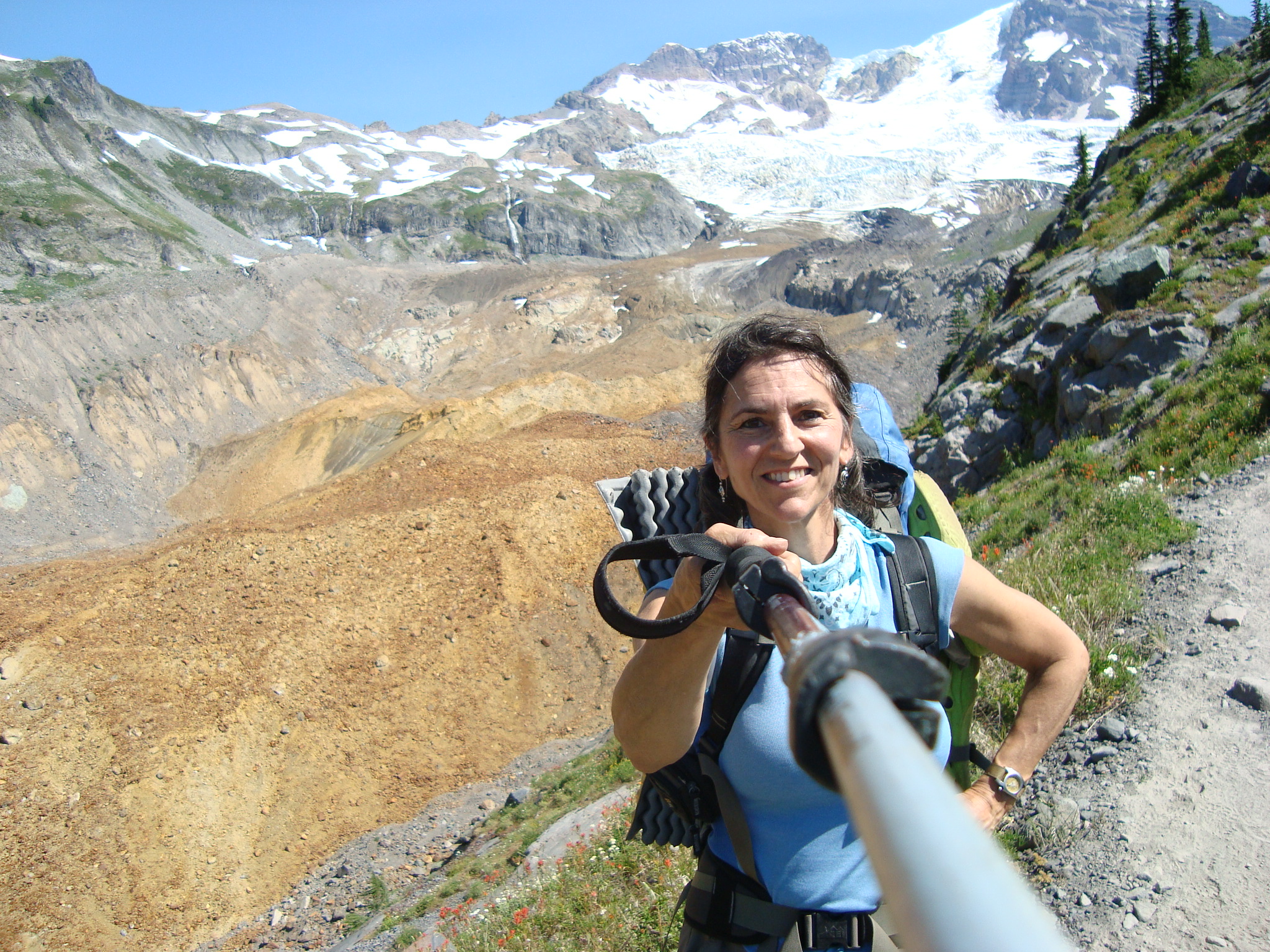
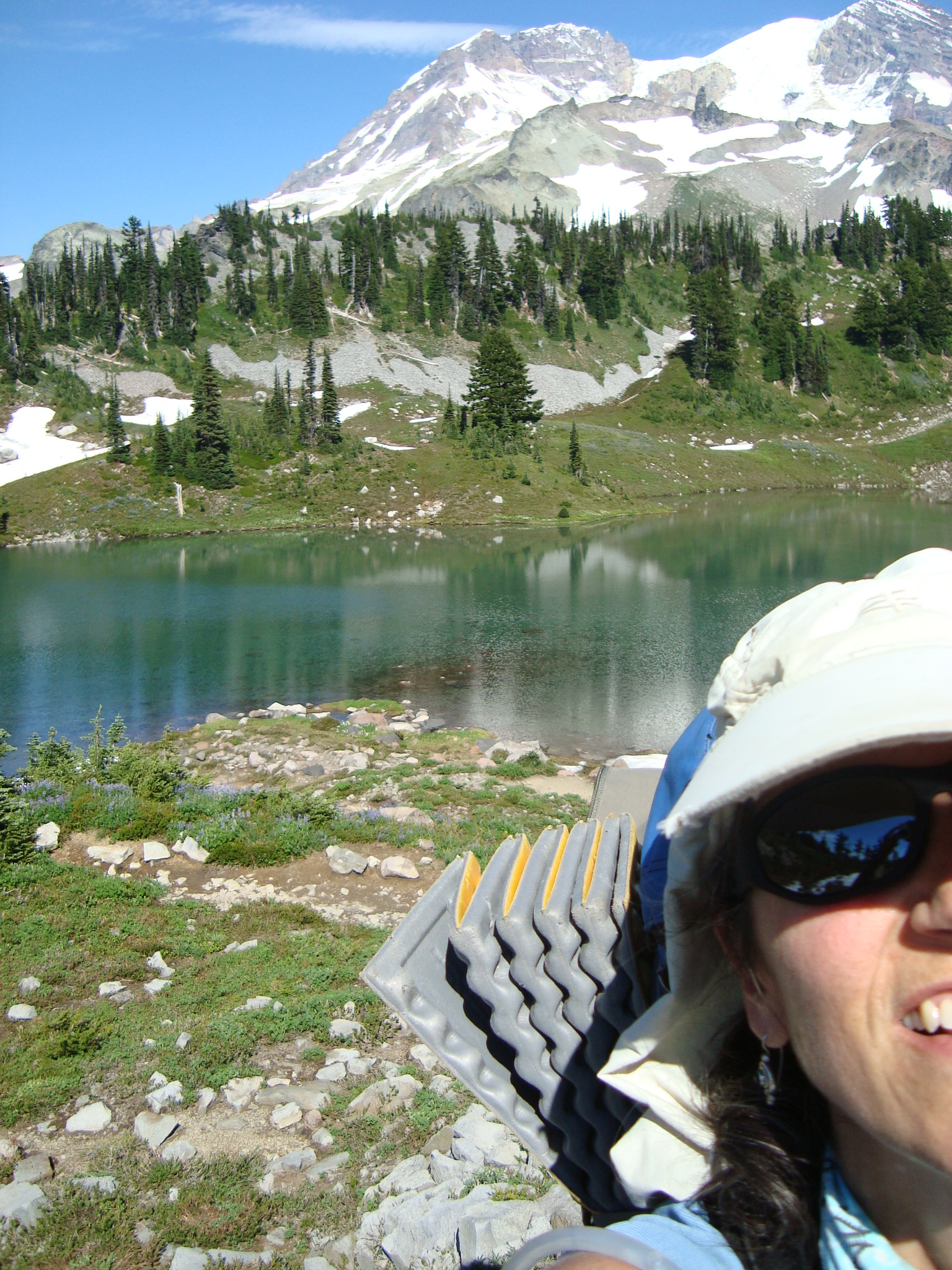
For me to react authentically in life, I have to know who I am and what I’m feeling – a feat easier said than done for a codependent adult child of an alcoholic.  (How do codependents greet each other?  “Hi!  How am I?”)  Hiking alone is, for me, one of the most powerful ways to arrive at this knowledge – especially longer thru-hikes that entail a week or so on the trail.  In 2012 I did the Wonderland Trail, about 100 miles and 22K’ of climbing/descending, and in 2013, still recovering from radiation treatment, I did a section of the Pacific Crest Trail (PCT) covering 75 miles and 16K’ of climbing/descending.  Hiking alone, the only interactions are between you and “nature,” people who’ve made or walked the trail before you, and the present-day hikers you meet.  Many, many hours are spent in your own company.  Incredible beauties are witnessed.  Countless decisions are made.  And each day brings a few hazards that call for courage.

PCT Section J

click to enlarge

Josephine Lake Wonderland


The first days, in my case, are about purging.  On Rainier, I found myself crying for two days.  This was my first major hike after breaking up with my boyfriend, who had taught me nearly every trail skill I knew.  But beyond that, I was coming to terms with the passing of youthful illusions that life stretches on and on.  How did I, Louisa, get to be 52?  Who was this lined, graying woman I’d become?  On the PCT, I expected tears again, but instead met with fear.  I’d begun by traversing Stevens Pass ski resort, and when the trail dropped from there into woods and rounded a hillside to a wholly new vista of indifferent, towering mountains through which I would pass, I got scared.  “What the fuck am I doing?!” I thought.  “What if a bear comes?  Mountain lion?  Rapist?  What if I fall and no one even knows?”  It took me a day or two to realize my deepest fears centered around cancer.  It had struck me, it seemed, out of nowhere, threatening everything I love, forcing me through a prolonged nightmare of treatment from which there was no escape.

In both cases, I had nowhere to run from these feelings.  I had to walk in their company, trudge in their muck until I truly got to know them.  In both cases, I came out on the other side to delight in a freedom so airy and light, I can’t possibly describe it.  The grief for all I’d lost turned to gratitude for the immense wealth I still had – these stunningly gorgeous surroundings plus the strength and know-how to travel though them.  The fear of cancer and all other scariness turned into a reconciliation with god.  Cancer happens, but I could choose to love all the cells on my team striving to protect me from it, and the many generations of medical experts all working to cure people.  I would choose to put my trust in goodness.

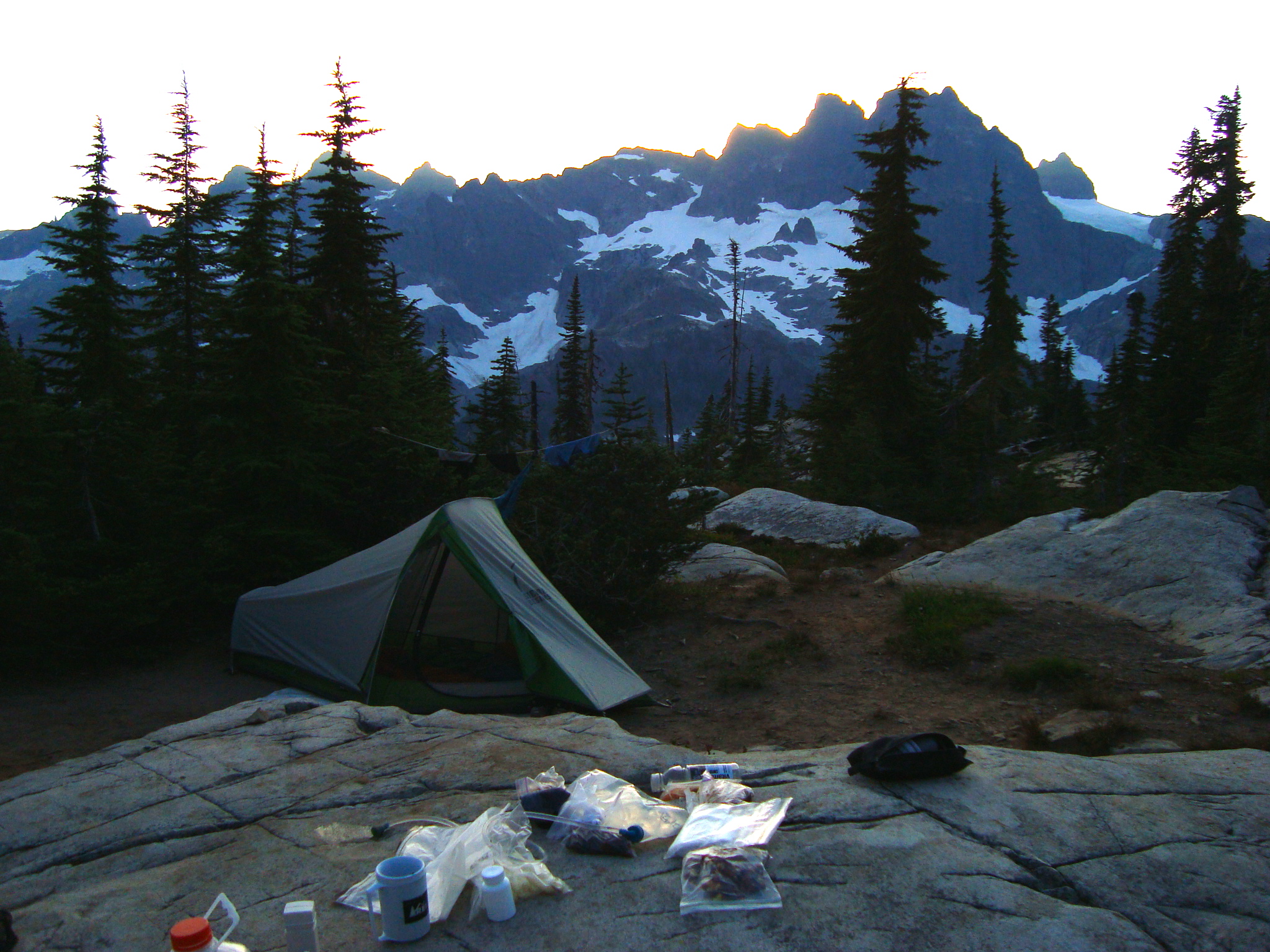
PCT J Camp

Dusk – I’ll tidy up! Clothesline strung behind my tent – wash in a large ziplock, dump away from source.

There’s nothing cozier than your own little camp, bedding down in your own tidy one-bitch tent, when you know what you’re doing.  You look at the map and see what’s coming up tomorrow.  Few moments are more empowering than, after passing warning signs of a high creek or a trail damaged by landslide, you gather your gumption and do what you need to.  Amid the roar of rushing water you choose your stepping rocks with care, plant your trekking pole and orient your balance to push off toward the next stance until, somehow, you’re across.  Or refusing to look down on the now tiny creek that wends far below, you focus on the narrow strip of trail that remains and keep moving.  Once you’ve passed these obstacles, they’re behind you.  Damn right, they are!  You don’t look back and analyze; your attention, buoyed by accomplishment, is all for what’s to come.

Finally, on both trips, I acquired an unexpected companion – both young men who loved the wilderness and had cobbled together from REI displays an idea of what they needed to get through it.  How could my pack be that small?  Why was I not wearing boots?  Why no Mountain House food pouches?  They asked to hike with me a few days and bombarded me with questions.  In each case, I developed love for a total stranger – one a butler to the most glamorous movie star couple alive, the other a Taiwanese Christian Electrical Engineer – sharing a grubby, spontaneous sincerity unimaginable in normal life.

The moral is that if I can practice all these skills on a daily basis – know what’s really going on with me, take each challenge as it comes, and love others by sharing whatever I have to offer – I am in tune with life.  And for as long as that is true, I will not develop an “edge” I need to “take off” by self-medicating.  There are ways to be free within the confines of our own skin.

DSC01967

Emerald Ridge, Wonderland Trail 2012

6 Comments

Filed under Alcoholism, Drinking, living sober, Recovery, Sobriety, Spirituality

Looking Back from almost 20 Years Sober

Then vs. Now

My life is far from perfect.  In a few days, I’ll turn 54, having failed to achieve any of the goals I set in youth.  I’m not a famous writer, and I don’t have much money.  I drive a 1990 Honda that starts with a screwdriver (really), because all my money goes to keep a small house that’s in disrepair.  My boyfriend is out of state most of the time, and I haven’t spoken to my sister or brother in a year and a half.  But… I’m sober.

What does this mean?  It means my life today is a an amazing gift.  As I get closer to hitting the 2o year sober mark, it gets harder to remember who I used to be.  But as a sponsor, in helping other women who suffer as much as I used to, I get to look back and remember.

There was a day when I woke up morning after morning full of toxins and shame.  I’d hide my headaches from my partner, pretending brightness, but more importantly I’d hide reality from myself, pretending I’d just had a bit too much last night because of… whatever.  At least half the time, I’d also be hiding the exhilarating glow of obsessive dreams about whomever I was infatuated with.  I’d go about my day being whoever I thought others expected me to be, looking to you for signs that I was okay, and thinking up ways of impressing you.

And since nothing would work out as I planned, I’d end up filled with sickening envy at your easy life and disappointment at my unfair one.  Most of all, I lived with self-loathing: the conviction that I was a worthless loser.  This conviction could survive any accomplishment I achieved because its taproot ran so deep, all the way to my core: I was hopelessly defective, fundamentally flawed.  And yet, this same worthlessness was the one sure rock I could stand on, the one foundation I could know without doubt.  It set me apart from others, ordinary folk who seemed so naturally filled with well-being.  Honesty, to me in those years, felt like the flat out admission that I sucked.  And the only way to fix that was to have a drink (well…  maybe two.  And then, whoops, a dozen plus) thereby temporarily rendering life simple and myself fabulous.

So what’s the miracle?  What’s the amazing gift?  It’s freedom.  It’s that not only have I woken up clear headed and sober for the past 7,000 mornings or so, but I wake to perceptions much closer to real.  The overwhelmingly loud self-static that used to roar in my thoughts has been tuned down, so my consciousness is a pretty comfy place to live.  I can love being who I am instead of berating myself for all I “should” be, and I can even see that I am a good mom who loves many people and supports herself.

How does that happen?  I got here by working the 12 steps repeatedly, skimming off one layer of denial at a time, one unacknowledged fear at a time – and giving what’s out of my power to god.  (Long version here.)  Today I stay on course by using the serenity prayer as my compass, and as I progress, the landscape keeps changing: things that once seemed those “I cannot change” have jumped sides to things requiring the “courage to change” them, and vice versa.  Gradually, I acquire the wisdom that all I can change is myself – my attitudes and actions – but that doing so transforms my entire world.

My ambition today is not a newer car or even a bestselling novel.  It’s honesty.  I want to go deeper.  There are still untruths I tell myself, deceptions that auto-play in my thoughts.  With god providing the light, I want to root them out and turn them over.  Though they don’t now drive me to drink, I can still feel, as I get ready to meditate, grips on falseness that tighten my world.  “Give up,” I tell myself, “let them go!”  Whether they come from growing up in an alcoholic household or amid a society of warped values and assumptions, unidentified beliefs are incredibly hard to release.  There’s the challenge.

The closer I get to living in truth, the comfier my life becomes – to the point that it’s outrageously luxuriant.  No amount of material luxury can rival that.  Living in a twisted mind, I have traveled Europe, sailed on yachts, eaten at fancy restaurants, or worn sexy new outfits – all the while drowning in dis-ease and self-consciousness, prisoner of an edginess that maybe a few drinks could fix – couldn’t they?  Now, to be where I am, naked under my clothes, simple-minded in my thoughts, flawed in countless ways, and making boo-boos right and left as I use up this obscure lifetime that will vanish under the footprints of future generations – what an amazing party it is!

Plus I can start my car with that screwdriver without even looking faster than 99.999% of the planet’s population.  Ain’t that a heck of an achievement at almost 54?

2014-06-22-goat

Goat Peak, day before yesterday.  What more can I ask?  (Or so I thought… See 5/18/15 post)

2 Comments

Filed under Alcoholism, Drinking, living sober, Recovery, sober, Sobriety