Pledges inscribed on the flyleaf of Bill and Lois’ family bible:
- October 20, 1928: To my beloved wife that has endured so much, let this stand as evidence to you that I have finished with drink forever.
- November 22, 1928: My strength is renewed a thousand fold in my love for you. I will never drink again.
- January, 1929: To tell you once more that I am finished with it. I love you.
- September 3, 1930: Finally and for a lifetime, thank God for your love.
On Christmas day, 1930, Lois’ mother died. Bill was drunk for days before, too drunk to attend the funeral, and drunk for days after. Lois began work at Macy’s for $19/week to support the two of them.
Anyone familiar with the Big Book of AA knows that in its opening chapter, “Bill’s Story,” co-founder Bill Wilson offers his personal narrative of “what it was like” while he was a prisoner of alcohol, “what happened” when his drinking buddy Ebby visited (miraculously sober), and “what it’s like now” – or was like for him and Lois, flourishing in the early days of AA at the time the book was published.
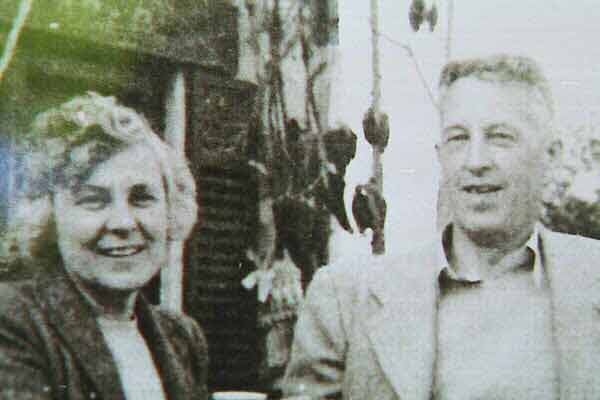
Lois and Bill later in life
Standard “homework” for an AA newcomer embarking on the 12 steps is to highlight the passages in “Bill’s Story” to which they relate – at least, that’s how we do it in Seattle (and I expect all over the world). Sponsees of mine who were sure they’d have zilch in common with some dude of a different race, class, gender, and era writing in terms they consider archaic are surprised to find Bill puts into words experiences, pains, and terrors they’ve suffered but shared with no one. Identification – that’s how the program works.
It starts from the get-go: “War fever ran high” he opens – each of these four words flashing icons of addiction. Bill drank when things were awesome: “I was part of life at last, and in the midst of the excitement I discovered liquor.” And he drank when they sucked: “I was very lonely and again turned to alcohol.” By the end of the first paragraph, we can guess Bill drank like we did. By the end of the first page, we know he turned away from the foreboding doom he felt reading an alcoholic’s tombstone and focused instead on vast faith in his own “talent for leadership” — his ability to choose wisely.

Right there, folks, is the enigma of alcoholism in a nutshell. Even as we increasingly realize that booze is killing us, we place increasing trust in self-will and self-knowledge, which amount to paper swords in our gladiator’s fight with this powerful, thought-twisting, brain-sabotaging snake. Why? Because the curious mental blank spot can override our resolve at any moment.
Though there must have been hundreds of times when Bill rallied all his resolve to quit drinking and found himself shit-faced soon after, his story specifically names five of them.
1. Self-will: “Nevertheless, I still thought I could control the situation, and there were periods of sobriety that renewed my wife’s hope.” [Referring to the bible inscriptions]
Blank spot: “Then I went on a prodigious bender, and the chance vanished.”
2. Self will: “I woke up. This had to be stopped. I saw I could not take so much as one drink. I was through forever. Before then, I had written lots of sweet promises, but my wife happily observed that this time I meant business. And so I did.”
Blank spot: “Shortly afterward I came home drunk. There had been no fight. Where had been my high resolve? I simply didn’t know. It hadn’t even come to mind.”
3. Self-will: “Renewing my resolve, I tried again. Some time passed, and confidence began to be replaced by cocksureness. I could laugh at the gin mills. Now I had what it takes!”
Blank spot: “One day I walked into a cafe to telephone. In no time I was beating on the bar asking myself how it happened.”
4. Self-will: “It relieved me somewhat to learn [in the hospital] that in alcoholics the will is amazingly weakened when it comes to combating liquor… Understanding myself now, I fared forth in high hope… Surely this was the answer — self knowledge.”
Blank spot: “But it was not, for the frightful day came when I drank once more. The curve of my declining moral and bodily health fell off like a ski-jump.”
5. Self-will: “No words can tell of the loneliness and despair I found in that bitter morass of self-pity. Quick sand stretched around me in all directions. I had met my match. I had been overwhelmed. Alcohol was my master. Trembling, I stepped from the hospital a broken man.”
Blank spot: “Fear sobered me for a bit. Then came the insidious insanity of that first drink, and on Armistice day 1934, I was off again. Everyone became resigned to the certainty that I would have to be shut up somewhere, or would stumble along to a miserable end.”
But instead of drinking himself to death, Bill receives a visit from his old drinking pal, Ebby, who tells him of the Oxford Group and opens the door to freedom – as the rest of the chapter swiftly summarizes. Because the focus here, at the book’s beginning, is on defining the problem.
The point of Bill’s story is that we can’t fix ourselves. No matter how disciplined in other respects, our minds cannot combat our alcoholism, which resides in the mind. No amount of decision, resolve, moral fiber, determination, or even dedication through the deepest love for a partner can come to our aid at the junctures of the curious mental blank spot, when these thoughts don’t “even come to mind.”
Repulsed by the Oxford Group’s religiosity, Bill did indeed drink himself back into the hospital after Ebby’s first visit, but NOT after Ebby’s hospital visit, because at that time Bill had a white light experience that not only struck him sober for the remaining 36 years of his life, but empowered him to persevere in the difficulties of co-creating a program that would save the lives of millions of fellow alcoholics.
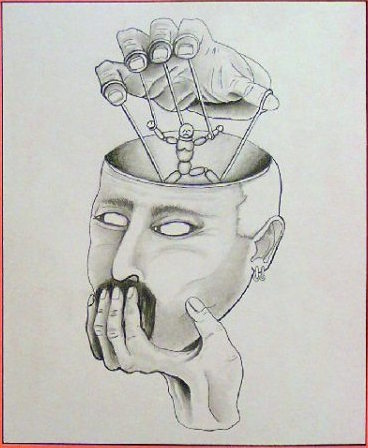
God alone can relieve our addiction, if we ask. I’m not talking about a god named in any religion, though such gods work fine for some, which is cool. For me, god is the life force, an energy which flows not only through the matter of our bodies and among all living entities – animal or vegetable – but indeed throughout the order of the universe. Cut off from this energy flow by ego and hostility, our spirits languish and we find ourselves puppets of addiction. Yet it’s right there – an energy of immense love and intelligence that we can tap into if we sincerely open to it. It’s living you right now. It’s living the planet. You can write it off as “shit happens” or…
You can start where you are. Whether you’re hungover as hell right now or sober but in pain, you can ask it for help and guidance. You might start like this: “I don’t know what you are, but I know that I hurt, and that I need you. Help me. Please guide me toward goodness and love and light. I will look for you in the depths of my heart.”
I guarantee you it will answer.


.. .



 has its ups and downs, riches and ruins. The quality of our sobriety varies with our connectedness to god and our fellows, depending on the rigor with which we cultivate both. Many of us long to be gung-ho about sobriety all the time – and we can be! It’s just that what gung-ho looks like is going to change over time, which is why I like the analogy of seasons in sobriety.




 Stay out of his life. Pray that he receive all the love and happiness you couldn’t give him.” When I objected, trying to explain step 9, he reared up powerfully: “This amends would be more for you than for him! He has a new wife! Let him be!”









 sky-castle and you’re plummeting, all you feel is WAH! NO! I DON’T WANT THIS! I’m sad! I’m mad! I’m hurting! You want to bawl like a toddler, throw a kicking, floor-pounding fit at god and fucking life and those fuckers who hurt you. It’s not exactly the most flattering spiritual pose.
 may whirl so shit-free at the moment that dramatic squalor seems far from hitting you, pain will find you. And when it does, you’ll need trust in god just to feel it. Trust in god to forgive yourself for fucking up. Trust in god to own pain as part of your journey. But most of all, you’ll need trust in god to reach out and ask for help. Not just once. Not just stopping when you think it might be getting old for others. As alcoholics, what we cover up festers, becomes an emotional abscess fed by our disease, swelling with resentment and self-pity until eventually it bursts as the emotional nihilism of fuck it. Fuck sobriety. Fuck trying for a good life. I tried, and look what it got me: misery.


 my in-laws lacked a sense of humor! Though, okay – I might have had a bit much. But the bride gets to make a mistake, right?


 Recently, however, my sponsor gently informed me the time had come for me finish that thing and read her my 5th step. She set a date one week out. BAM! So, reluctantly, I dug into the work, listing everyone’s “offenses” and why they hurt me, but then tracing out how I, myself, helped to bring about each one. I met my sponsor’s deadline for the same reason I still go to meetings: what I don’t want to do, I know deep down, is what I really need to grow in sobriety.


 A Spiritual Evolution