Tag Archives: spirituality

The Bitter End… or Willingness

…[W]e had but two alterna­tives: One was to go on to the bitter end, blotting out the consciousness of our intolerable situation as best we could; and the other, to accept spiritual help.
–“There is a Solution” (p. 25)

Over the years I’ve grown so accustomed to going to meetings, working the steps, and sponsoring people that I tend to forget I’m actually sober through god’s grace alone.  I forget that for most alcoholics, the disease rolls along like a hell-bound runaway train, taking them with it.

The Bitter End:  The other day I had coffee with a longtime friend whose ex-husband bavarian shed– I’ll call him Julius – was once a man vividly alive: handsome, funny, and brilliant. Together they created a beautiful home, the yard landscaped with a Bavarian-style gardenhouse of which I was always a tiny bit jealous. While our children were young, I joined their friends and family at many celebratory gatherings where Julius cheerfully acted as a bartender, mixing everyone’s drinks with a brisk, festive hospitality.

He didn’t seem to like me much, though. His wife had discussed his suspected ‘drinking problem’ with my partner and me, which he seemed to resent.  He was European-born, a year and a half older than I.  Alcohol, he maintained, was a normal part of European life – though Americans abused it.

As the years elapsed, however, my friend experienced the many pains of loving an active alcoholic. Finally she found herself cheated on in conjunction with alcohol, much as I would years later. Because Julius scoffed at AA recovery, she’d had to painfully end the relationship and find her happiness elsewhere.

Still, I continued to see Julius regularly because for some time he and I worked at the same place and exercised at the same gym. I’d witness much important foot traffic bustling to and from his windowed office across the hall from my virtual closet. At the gym, he’d stroll into the big cardio room glancing about as if for an audience — tall, blonde, and well aware of his strapping physique. But meeting his eye was only me, that annoying sober woman!  We’d exchange nods.  Then, about seven years ago, I was laid off and no longer saw him.

So over coffee, I asked my friend, “And how is Julius doing?”

“You didn’t hear?” she started in return. “He died.  It was a few months ago.”

I shook my head, speechless.

“His liver went, and then… Didn’t you see his obituary? I put it on Facebook.”

Maybe you know the feeling I had, when you’ve rivaled someone you actually respect.  It’s as though the two of you were playing an intent game of ping-pong – and they’re suddenly not there.  The ball whizzes off to nowhere,  gone forever; you realize that underneath your resentment was… a slightly bruised form of love.  True, Julius had seemed to scorn my life choices – to flout sobriety by drinking hard and living well.  But he’d also passionately loved his children, the world of intellect, and life itself.  At heart, he was a good man.

My friend proceeded to unfold an old, old story lived out by countless alcoholics, a script starring that unsung hero, the liver. empties We alcoholics poison ourselves, and our liver cures us.  We do it again and again, driven by addiction, and that amazing organ reverses our suicidal onslaughts.  Until one day, it can’t.  It breaks.  But as alcoholics, we can’t stop the onslaught.  Poisons course unchecked through our systems, wreaking havoc on other organs – especially the brain.

Julius could not stop drinking, despite knowing full well alcohol was destroying his life.  He became obese and depressed.  He lost interest in work and took early retirement.  He stopped leaving the house, bathing, shaving, caring about anything.  His children both pitied and resented him, because he lived on the couch in a house that smelled bad.  He peed himself.  He saw no one.  Still, he drank.  And gradually, as ammonia crippled his brain, he stopped making sense.  Visiting to check on him, my friend found him speaking of people not there and tasks imagined.  She called 911.

At the hospital, doctors did all they could, but his body could not recoup.  A bloated wreck of his former self, watched over by the woman whose love he’d betrayed, with the children he would leave fatherless, 12 and 14, clutching his hands on either side, Julius died.

~
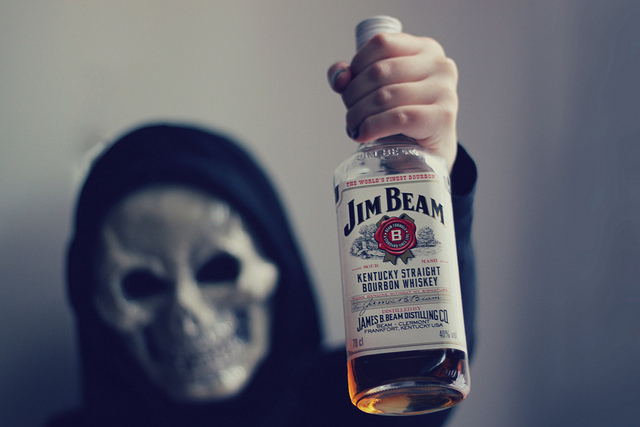
alcohol death

~

Willingness:  It’s an odd feeling to hear of someone dying from the same disease you have.  There but for the grace of god go I.  Nothing could be more true.

I was just like Julius.  For so many years, whenever the prospect of my “getting help” was raised by therapists or friends, a bulletproof glass shield came up like an electric car window between me and that idea.  “No.  That will not happen,” I’d think with an iron will.  Like Julius, I planned to slow down and then drink normally.  But I’d sooner join a leppers’ nudist colony than mix with those freaks in AA!

How did that change for me – but not him?  Surely Julius knew a misery just as dark and painful as mine.  But somehow, I was graced with the gift of willingness.

My desire to live jumped tracks.  Its impulse switched from “I must drink” to “I must change.”  Why that happened for me and not for Julius, I cannot tell you.  I did not want to change.  I did not believe AA could help me.  Yet I made that first call, went to that first meeting in spite of my thinking.

That god provides the defense we lack against the first drink – we’re reminded of that miracle often enough.  But even the willingness to BEGIN TO LET GOD HELP US comes from god.  A spark of god glows at our core, our source, and yearns to connect outside us.  For some, the blockage – our will – is temporarily lifted: our spirit reaches out and god answers.  Others languish, locked in self.

Grace is inexplicable!  But we can practice gratitude without understanding: “Thank you, god, for my sobriety.  Thank you for this life – exactly as it is!”

scroll

7 Comments

Filed under AA, Addiction, alcohol damage, Alcoholism, Denial, God, Recovery, Sobriety, Spirituality

Happy, Joyous, and Free

Throughout my 20s and early 30s I drank almost daily and blacked out at least weekly because alcohol made all my lies come true.  Not my dreams – my lies: I wanted to be right in everything that I got, and wronged in everything that I didn’t.  Alcohol made that possible.

loufinger

Me, 1990

Until it didn’t.  I was loath to admit the light was growing dimmer, that more and more shit was seeping in through the seams, but  the day(s) came when life felt unbearable – with or without alcohol.  Suicide and AA being a toss-up, I tried them out in the only order possible.  I went to an AA meeting January 29, 1995, and I’ve not had a drink since.

But when I heard you guys quoting the line from the Big Book, “we are sure God wants us to be happy, joyous, and free,” it sounded like a crock.  Me – happy?

First off, by “God” you had to mean some kind of authority figure, some “He,” some tyrant of righteousness – which I mentally flipped off.

Secondly, only stupid people were happy.  You guys lacked the guts to acknowledge life’s futility, the grim jest of being born into this harsh world only to suffer endless loneliness and disappointment.  You preferred buying into Barney-the-Dinosaur style clichés and niceties.

Anyway, you AA people were never going to brainwash me with your spiritual drivel.

But you did.  Turns out I needed brainwashing pretty badly – given that my every thought was thoroughly toxic.

Hiking 100 miles of the Pacific Crest Trail is how I spent last week – Section i of Washington, southbound.  I went with a sober friend 22 years my junior, and we had the time of our lives.  After making only 8 miles the first day, given our 40-lb packs laden with a week of food, we stepped up our pace to climb and descend 15- 17 wilderness miles daily, passing perhaps 4 to 6 fellow hikers per day.  Almost every night at camp, we held a two-person AA meeting.  The first nights we futzed around with reciting “How it Works,”  but we soon said screw it and just used the Serenity Prayer.

We shared formally, no one else around for miles:

ME: “I’m Louisa and I’m and alcoholic.”

KACIE: “Hi, Louisa!”

Our shares let us remind each other that all the happiness, joy, and freedom we were reveling in were contingent on our sobriety, and thus on god.  I cried more than once: the emotions of loving the beauty of this world and awareness of mortality were so strong I could hardly stand them.  For instance, I met a highly enlightened spiritual guide on the trail.

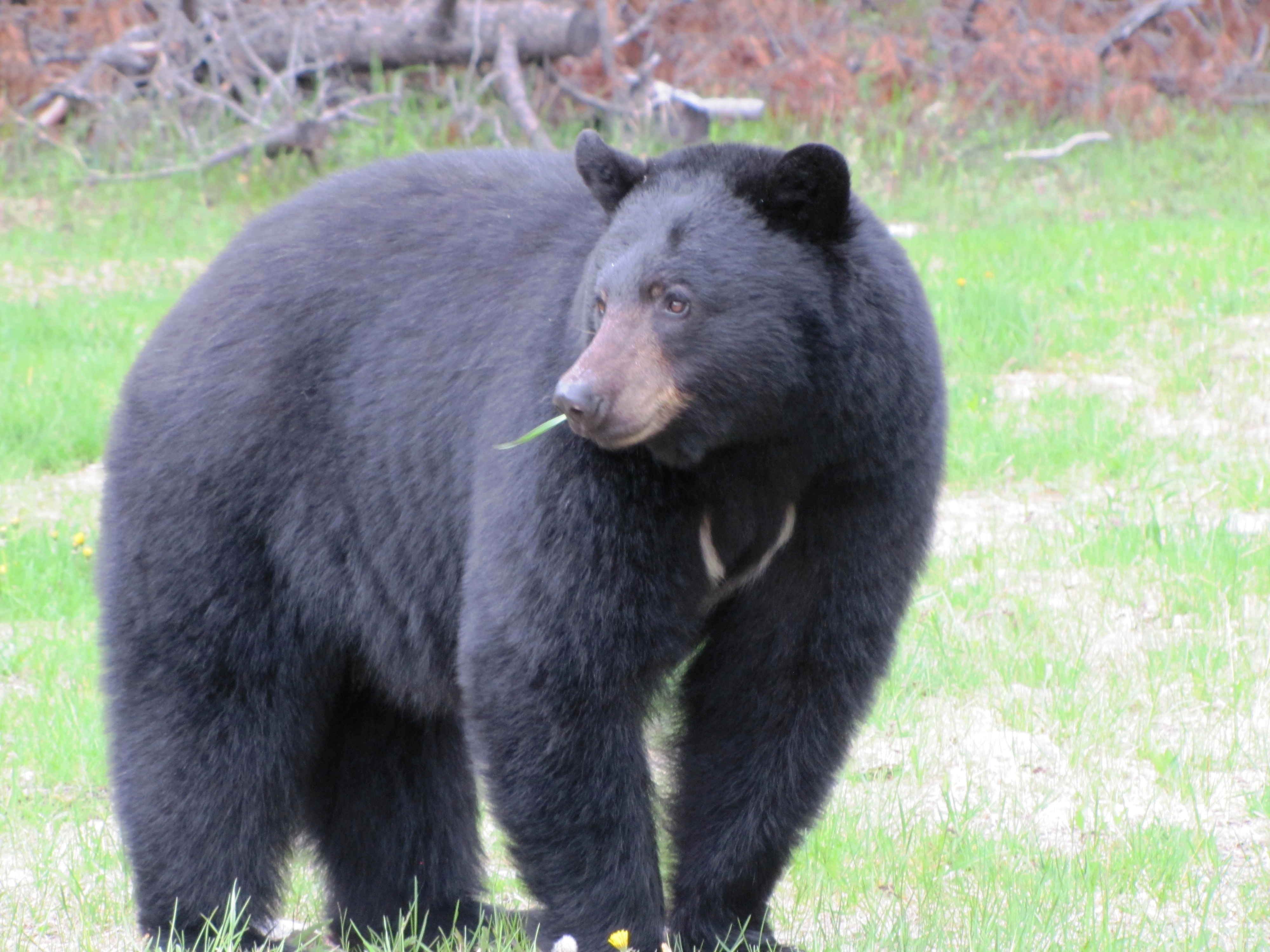
What happened was that, high on a ridge in strong wind, I rounded a rock outcropping to see a huge black bear beside the trail.  The size of a dark refrigerator, he was sitting on his rump in an alpine meadow of wildflowers about 30 feet distant, contentedly chewing some vegetation with the wind at his back.  Thoughtfully he lifted his great head as if to say, “What a wonderful day to be a bear!”  I felt no fear – only a strong sense that my choices were important.  I turned to Kacie: “There’s a bear.”  We walked behind the rock where we held a bellowed conversation about our hopes the bear would move.  When we came back around the rock two minutes later, he had vanished.

Bear

NOT my photo!  A camera is not what comes to mind…

As a self-conscious human, I’ll never be as at ease in the world as that wild creature.  But letting god into my life has brought me a tiny bit closer every day.  I want to know that I am meant to live, as that bear knew: that I belong to the earth, to nature.  I want to know I’ll be provided  all I need.  I want to understand that, even when I have the power to trump others – in the bear’s case to kill effortlessly – choosing peace and simplicity is almost always the wiser course.  The faith and confidence to be fully and unapologetically Louisa while harming no one – that’s the goal of my sober life.

If I could go back and tell that AA-scoffing Louisa of 1995 what I understand today, I might say this:

  • “You think “God” means someone outside you, some entity confronting you.  You’re wrong.  The very ember inside you that wants to live, that loves life and goodness and others – your “you-ness” itself is god!!  You are a drop of god transforming matter to life in every cell of your body.  To know god is to delve deeper in your life-force and discover it’s the same power that interconnects all life.  To trust god is to understand that all who’ve lived and died are nano-parts of a tremendous, intricate unfurling.

Anonymous friend

Along the way, Kacie got slowed down by a terrible blister, so at a spur trail to a water source she sat down on a log to change to sandals while I went off to filter.  By the time I returned she was chatting with a through-hiker who’d started off in Mexico.  He’d already said goodbye and was 20 feet down the trail when something moved me to call out: “Can we give you some food?”  He halted in his tracks.  We filled a Ziplock with all kinds of yummy stuff that thrilled him.  THAT’s when we learned he, too, was an alcoholic.  Kacie had even visited his homegroup thousands of miles away in Key West!  Blown away by that “coincidence,” he shared with us how he’d relapsed at the last outpost of civilization and was nervous about the next.  We listened.  We said we’d pray for him.  And we did.

I would tell 1995 Louisa:

  • You think happiness comes from getting what you want, impressing people, winning stuff.  But true joy comes from giving, from reaching out and helping others.  It’s only selfish fear that blocks you from channeling god to others.  The more you trust, the more god frees you from the mire of self-centeredness, so loneliness can  be replaced by an endless flow of love – for the world.

Life is so damn good today, you guys!

How do I find the courage to step out on a wilderness trail, armed with only a stack of printed maps, and head for someplace I’ve never even seen 100 miles away?  Easy.  All I have to do is take one step.  Then another.  Same as staying sober.  And whether I meet up with a bear or a fellow drunk, I’ll ask god to guide my course.

scroll


VIDEO VERSION OF OUR HIKE: https://youtu.be/5vio7oDjhsQ


6 Comments

Filed under Addiction, Faith, God, Recovery, Sobriety, Spirituality

What (most) Normal Drinkers Will Never Understand

NOTE:  Hi folks.  At this time of summer, I’m hiking and camping all over the place, so I’m reblogging an oldie but goodie for this week.  I’ll be back in a few with a new post. 🙂

-Louisa


Alcoholism is a physical, mental, and spiritual disease.  That’s what we learn in AA.

Alcoholism is just a lack of self-discipline.  That’s what most of the world thinks.

Alcoholics can exert all the self-discipline in the world and still end up drunk.

That’s absurd.  If they really kept up their self-discipline, if they really stuck to their guns, they could stop or moderate.

Only accessing a power greater than themselves – aka god – can keep an alcoholic sober one day at a time.

That’s just religiosity couched in a cultish slogan. 

Sometimes it’s frustrating to live in a world that doesn’t “get” my disease.  My blood family and normie acquaintances assume the mind works according to certain principles.  The notion of the Curious Mental Blank Spot (p 24) is foreign to them and to almost anyone who hasn’t been utterly stumped and defeated by it.  Thank god I’ve been both, though to get there took about 4,000 attempts of rallying resolve that I would drink with moderation, then finding myself plastered – again.  It took the admission that I’d run my life into the ground despite countless advantages, to the point where I no longer wanted to live.

I’d still have clung to alcohol as my true friend if the stuff hadn’t quit working for me.  When it no longer brought about the magical transformation that had made it a staple of my life – taking away my nervous, self-conscious unworthiness and replacing it with sociability and confidence – only then did I become willing to consider the counter-betrayal of checking out AA.  “Alcoholism made only one mistake,” goes the saying: “It’s the same for all of us.”  Not exactly the same, but close enough that I could learn from other sober drunks the hallmarks of alcoholic thinking, feeling, and experience.

The main hallmark is not drinking.  I’ve had several partners who matched me drink for drink for years on end.  But as soon as they made up their minds to exert their self-disciple, it took.  They could stop.  They had brakes.  Mine might work for a few hours or even days, but then along comes that Curious Mental Blank spot.  My resolve gets greased with coconut oil.  Thoughts of an hour or even a minute ago can find no traction.  They become meaningless.

What’s  the Curious Mental Blank Spot?  We like to think the conscious parts of our brain determine our actions – the frontal lobe of the cerebral cortex, which hosts thoughts and decisions.  But there’s a little lizard living in the basement of our brains – the amygdala – that generates basic survival impulses like fear and anger.   Alcoholism seems to live here.  Like a vine that winds its way front and center, it’s able to circumvent even the most determined resolutions of the frontal lobe, hitching a drink to the basic drives of being alive.  Drinking becomes an impulse, almost like sneezing, that you act on without a rational choice.

addict brainThe experience goes like this.  You’re all set to not drink today.  You’ve made up your mind, and it’s just not an option.  You’re going to drink healthy stuff, maybe exercise, busy yourself with – you should have a drink.  You know what?  A drink is a great idea.  Why not just relax, enjoy just one or two, like a little get-away to Maui that nobody needs to know about?  Eh?  You faintly sense there’s something wrong with this thinking.  Wasn’t a drink what you weren’t going to do.  Yes.  And the reason you weren’t going to do it was… was…

Here something happens similar to flipping through an old fashioned Rolodex and recognizing not a single name:  Let’s see; it was here somewhere: Not good for my body – who’s that?  Always make a fool of myself – do I know him?  Swore to my loved ones – might have met briefly, but…no. None of these ring a bell.  Meanwhile, here’s your amygdala holding out a frosty, aesthetically perfect image of your favorite drink.  It asks, What are ya, a pussy?  You gonna let these cards you don’t even recognize tell you what to do?  Just do what you wanna do – THIS!

It makes so much sense.  The idea of abstaining for any reason seems absurdly far-fetched, while the idea of drinking rings every cerebral bell of recognition for a natural, sensible, sound idea.  So, you decide, “Yes.” All it takes is a millisecond of assent and that genie is out of the bottle again, running your life.

As I once put it in an AA meeting: “My frontal lobe is my amygdala’s BITCH!”

Equally preposterous to the normal drinker (or active alcoholic) is the solution – asking the help of a higher power.  Only once we quit thinking that we, ourselves, have the means to quit drinking, when we give up reliance on self and sincerely ask a higher power for help, something shifts.  Some change happens.  Suddenly, we’re able to weather those Curious Mental Blank Spots with just enough resistance to avoid saying yes.  Do this long enough, and eventually the constant obsession to drink is lifted.

I’m still occasionally struck by the Curious Mental Blank Spot, instances in which I still don’t recognize a single reason not to take a drink, even after decades of sobriety.  “You’re in AA!” -whatever!  “You’d lose all your time!” – Who gives a fuck?  While I’m struggling with these confused thoughts, something steps between me and that image of a flawless, aftermath-free drink my amygdala is advertising:

“How about we just wait five minutes and see if all this is still true?”  It’s not a thought that comes from me.  But within thirty seconds, in my experience, my conscious mind is back at the wheel, and I retract in horror from the idea of drinking.  That is, the window of blindness, when I could have assented and released the genie, lasts only that long.

It may seem unlikely, but that’s pretty much the scenario experienced by millions of alcoholics meeting in 170 nations all over the world.  When we do the things suggested in AA’s program of recovery, that mediating influence – which I call god – restores us to sanity.


scroll

.

2 Comments

Filed under AA, Addiction, Alcoholism, Sobriety

Hurting Out Loud

Nine months ago I published “Prescribed Relapse,” a post on how doctors sabotage our sobriety and threaten our lives as alcoholic addicts by prescribing us vast supplies of opiates.  Telling us to “take them as directed” is about as good as recommending we “stop at the second drink” – as if we had any power to drink or drug “like a gentleman.”  We don’t!  If it cops us a buzz, we default to MORE.

In that post I quoted friend’s Facebook message.  This was Rob, whose doctor turned him on to opioids years ago, hatching a fresh addiction that promptly took over his life:

Yah know, if I’d of known what I would become after a few Vicodin, I’d a shoved them up my doctor’s ass!!  I was never into opiates as a kid. But eight years into sobriety I hurt myself really really bad, and I guess I needed them. But in hindsight, if I had a choice between acute pain and becoming a heroin addict, I would have probably chose the pain. But whatever.  It’s done.  It’s over, right?” 

Last week Rob was coming up on a year clean when he died from accidental overdose.  My friend is gone.  He was 44.  I miss him terribly.  About 20 of us gathered at his sponsor’s house the other day, wrote him a shoe box full of notes, and circled the bonfire where we burned them to share our memories and weep.  I have dialed his voicemail just to hear his voice and bawled my guts out, remembering how I could call any time, how he’d offer me that sweet mix of empathy and “whaddaya gonna do?” acceptance of life’s pains.  He was one I leaned on to help me through my horrific break up, because he’d suffered one, too.

Rob

The more recent break up that triggered this fatal relapse was much less of a big deal.  He missed, not so much his ex-girlfriend as her son – a little boy he’d played dad to for about a year.  Building cushion forts, taking the Big Wheel out for a spin, tickling on the grass – we all saw the happy Facebook photos.

I wish to god he’d told me.  When we talked about missing the boy, he said a lot of “whatever” and “I’m fine.”  Maybe he really thought he was.  Or maybe he was just loath to admit that all his old wounds were re-opened, his heart re-cracked, his loneliness bleeding, a despair darkening his skies, that he’d never have a little family of his own.  Instead, he asked me for help setting up a Tinder dating profile.  That conversation was goofy – lots of “shit -wait a sec, k?” – because we were both on our phones working on phone apps.  It was the last we’d ever have.

Telling others we hurt, and how bad we hurt, is one of the hardest things to do.  We’re afraid of looking weak, looking naive or over-dramatic, or maybe even deserving of the blows dealt us.  For me, with decades of sobriety in AA, the biggest obstacle is pride: I should be more spiritual.  I should see through the dust of my collapsed dreams to recognize my part, take responsibility for my delusions, own my self-centered blindness, and, most of all, have faith that all is as it should be.

But when shit hits the fan, when the bottom falls out of your sky-castle and you’re plummeting, all you feel is WAH!  NO!  I DON’T WANT THIS!  I’m sad!  I’m mad!  I’m hurting!  You want to bawl like a toddler, throw a kicking, floor-pounding fit at god and fucking life and those fuckers who hurt you.  It’s not exactly the most flattering spiritual pose.

But it’s truth.  We have a disease that wants to kill us, and it’s favorite subterfuge is pride.  The most powerful trust we can have is to go to a meeting with our spiritual pants around our ankles for all to see – trusting that we’ll be caught by love.  When I learned my boyfriend had been screwing a girl from work for two and a half years, I went to my homegroup and cried to fifty people: “My boyfriend has been screwing a girl from work for two and a half years!”  How many of them thought, Tch!  How self-deluding that woman must be!   My disease tells me half the room, but god tells me, in the moment of my deepest vulnerability, no one.  Not even that guy in the corner pissed about his DUI.  Every person in that room beamed me human compassion.

My message to you is that, though your fan Shitfanmay whirl so shit-free at the moment that dramatic squalor seems far from hitting you, pain will find you.  And when it does, you’ll need trust in god just to feel it.  Trust in god to forgive yourself for fucking up.  Trust in god to own pain as part of your journey.  But most of all, you’ll need trust in god to reach out and ask for help.  Not just once.  Not just stopping when you think it might be getting old for others.  As alcoholics, what we cover up festers, becomes an emotional abscess fed by our disease, swelling with resentment and self-pity until eventually it bursts as the emotional nihilism of fuck it.  Fuck sobriety.  Fuck trying for a good life.  I tried, and look what it got me: misery.

Sure, it’s self-centered to keep bending people’s ears about your troubles if you’re not also doing the work to heal yourself.  Sure, there are assholes who’ll hear you wrongly, who will twist what you’ve shared against you.  But the deeper truth is this: trust is a form of love, and love is what heals us.

If Rob had loved himself enough, maybe he’d have given himself permission to feel  a degree of pain that, rationally, made no sense to him.  And maybe he’d have tapped into the trust to call somebody, maybe me, maybe another of those loving friends gathered in tears around our pyre of goodbye notes,  and say, “I can’t do this.  I can’t do life.  It hurts too much.”

Maybe he could have given us, instead of heroin, a chance to love him.


scroll


Post to Facebook


8 Comments

Filed under AA, Addiction, Alcoholism, Pain Medication, Recovery, Sobriety, Spirituality

Doing What We Don’t Want

Almost none of us liked the self-searching, the leveling of our pride, the confession of shortcomings which the process requires for its successful consummation.”  (p. 25)

“To be doomed to an alcoholic death or to live on a spiritual basis are not always easy alternatives to face.”  (p. 44)

Nobody wants to come to AA, but our pain and lack of alternatives shunt us there.Nobody reads over those 12 steps on the wall and thinks, “Oh, I see!  That’ll fix me!”  But they will.

At my first AA meeting, thoughts of irony, disbelief, criticism, and a simple desire to bolt filled my brain.  I saw nothing of value in those simplistic, god-mentioning steps.

Reluctant PeeWeeHerman

Why do we need to live on a spiritual basis?  First, because we’re inherently spiritual beings.  More specifically, because the alternative is to live by self-propulsion, which may work fine for normies but for alcoholics invariably leads to a “choice” to drink, because a disease has commandeered our decision-making process.

What’s so great about the steps?  When we first come in, we’re in a state of spiritual starvation because we’ve shrouded ourselves in a world of lies.  We don’t think so, of course.  But the fact is, we’ve made up stories – about who did what, why, and how – that simply do not square with reality.  The steps have two main purposes: to remove the layers of delusional resentment blocking us from god and to encourage us to grow in connection with that god (who, by the way, removes the drink problem).

Totally unrelated to AA is Seattle IANDS, which features speakers who, like me, have temporarily died and/or left their bodies and brought back memories from the other side.  One speaker I heard a few years ago encountered god as Jesus – as do most Christians (we see what we think of as god).  At that time she was a teen speeding through East LA in bad company.  In the split second before an impending car accident, time stopped.  After she refused a demon at her feet who urged her to come with him and get even with everyone who’d ever wronged her, she left her body.  A guardian angel all but pulled her skyward, where she encountered a swarthy, bearded figure in a robe “of rough cloth somebody had sewn by hand” – whom she knew to be Jesus.

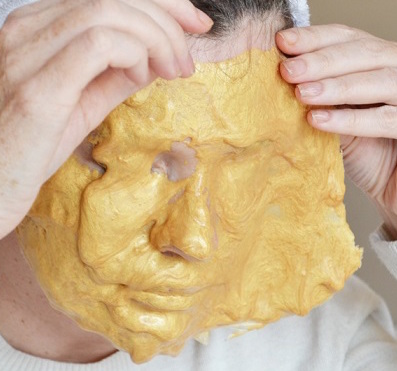
Peel off maskHere’s the best part: Jesus went to embrace her, but just before the embrace made a face of subdued revulsion and turned away.  It was at that point she realized she was coated from head to toe in some utterly disgusting filth, something “like diarrhea.”  Jesus telepathically told her these were her accumulated resentments.  The next parts of her NDE involved ways of shedding them, of learning love as her purpose on earth.

In all the NDE stories I’ve heard, complex spiritual truths are condensed into vivid, resounding images that capture complexities at a glance.  This girl, angry and on the brink of joining gang life, was coated in shit.  Her resentments repelled god’s love.  Yes, her NDE permanently altered the trajectory of her life (today she’s a nurse), but we alcoholics  can learn the same lesson without dying – it’s right there in our Big Book:

“…[T]his business of resentment is infinitely grave. We found that it is fatal. For when harboring such feelings we shut ourselves off from the sunlight of the Spirit. The insanity of alcohol returns and we drink again. And with us, to drink is to die” (p.66).

In my own NDE, which I experienced as an atheist, I plunged into the sun as the source of all life – i.e. the closest thing I knew to god’s embrace – and was surrounded by the Light, a love and bliss more potent than words can convey.  Lately, in going through difficult times, I’ve often found myself praying to feel just a little bit of that Light again.  Please.  Just a little. 

What I was not doing was working my steps.  I didn’t feel like it.  For about six months I’d been not writing a 4th step started on my ex-boyfriend, and more recently on former tenants.  If I was carrying any resentments at all, there was certainly no ire behind them, so why dwell on them with a full inventory?  Why waste the time?  I tend not to see what the steps have to do with the Light, heaven, etc.

Recently, however, my sponsor gently informed me the time had come for me finish that thing and read her my 5th step.  She set a date one week out.  BAM!  So, reluctantly, I dug into the work, listing everyone’s “offenses” and why they hurt me, but then tracing out how I, myself, helped to bring about each one.  I met my sponsor’s deadline for the same reason I still go to meetings: what I don’t want to do, I know deep down, is what I really need to grow in sobriety.


I read her my fifth step.  A wise woman, she pointed out my current character defects:

  • not seeing the truth because I fear loss and prefer my concocted stories
  • not speaking my truth out of fear of conflict or loss
  • not honoring Louisa – failure to act on my own boundaries

These were lesser forms of my same old defects of dishonesty, selfish manipulation, and victimhood from 5th steps past.  Lesser – but they’re still diarrhea!  Since then I’ve prayed, not to feel the Light, but for help releasing my defects and completely forgiving those I’d felt wronged me.  For two weeks, I’ve been repeating out loud, “I completely forgive you, [name], for anything I thought you did.”

Guess what’s happened?

Thinking of my mom the other day (who was not on the inventory), I suddenly appreciated her in a whole new light: I loved her more ever.  Same with my friends, my dog and chickens, and even my messy home.  It’s everywhere, this stuff to love!  Trees!  Chihuahuas!  Passersby!  Loving stuff, I sometimes feel swept into the frothy fringe of something… amazing.  It’s a glow, a tantalizing giddiness at getting to be here: a tiny taste of the Light.

I’ve shed one more layer of shit.  It works only if we do it, this 202 word pathway to a beautiful life!

“We have found much of heaven and we have been rocketed into a fourth dimension of existence of which we had not even dreamed.” (p.25)

scroll

Post to Facebook

1 Comment

Filed under AA, Addiction, Afterlife, Faith, Recovery, Sobriety, Spirituality, Twelve Steps

The Ultimate False God: Coolness

What is “coolness”?

Words are tricky.  This philosopher guy, Derrida, once pointed out that words and ideas are all attached to one another like a big web or network, but the web itself is attached to nothing.  The word/idea “rock” has nothing do with an actual lump of minerals, except in our collective memory.  The whole mass of meaning floats.  There’s no anchor.

So when I say “coolness,” we’ll have to at least take a second to figure out what I might mean.

No culture worships this quality more ardently than ours in the US.  The vast majority of our cultural icons embody it – figures emblematic of wild West lore, gangster lore, entertainment industry lore, and so on.  John Wayne.  Al Capone.  Drake?  We foist coolness on famous figures who eschewed it in real life, like Einstein or Lincoln, and even on certain animals like panthers or falcons.

Coolness is an aura of infallibility that rebuffs any weakness – including fu insecurity, confusion, or dependence that makes one vulnerable.  Coolness implies the individual is a source, a sun of personal charisma.  Even alienated characters, if they’re cool, attract the audience who “gets” them, just as each peer group defines its own style of cool.  Across the board, though, cool figures exude confidence – an immunity to bungling, embarrassment, and indecision that elevates them in the eyes of others.

But because words float around, we sometimes conflate coolness with positivity.  In conversation, we use “cool!” as a synonym for laudable, so we might potentially mix it up with goodness.  However, there’s a world of difference.  Take Mother Teresa for instance: what she did in Calcutta was “really cool,” but did she embody any of the “coolness” described above?  Would Kanye West rap about her?  Not exactly.

Alcoholics often drink to feel cool.  At least, as a practicing alcoholic, I did.  And you know what?  I succeeded with flying colors – again, and again, and again – in my own mind.  Of the thousands of drinks I took, the only one that failed to cool-ify me… was my last.

snoopy_joecoolToday, when I try to go back mentally and recreate that sense of “coolness,” what I arrive at is a sense of a force field, a glow of indifference highlighting me as subtly superior.  Louisa with a few drinks in her was undaunted by whatever (imagined) disapproval mainstream dolts cast her way.  Fuck ’em!  Some part of me watched myself and approved, finding ways to make you think I didn’t care what you thought.
Shitfaced, I was even cooler.  I became a rugged individual, a Rambo against social decorum, yet slinky and wily, sorta like Catwoman.  Your cool may differ.  Yet whether boisterous or aloof, we all seek the same sense of impervious, indifferent badassery – a condescending dismissal of the humanity around us.  We’re keen.  We’re cocky.  We know shit.

But all we’ve done, in reality, is swallow some liquid.

Sobriety, on the other hand, demands rigorous honesty.  People who cannot recover are “constitutionally incapable of being honest with themselves.”  In my eyes, coolness comes down to a form of inner dishonesty which, for us, can be lethal.  The friends I see struggling most in AA – the ones who keep relapsing, almost dying, or who eventually do die – are the ones I sense still worshipping this false god.

As hard as it may seem, rigorous honesty means giving up the illusion of coolness.  It means ceasing to worship at that altar, unmasking that ideal as empty and pointless.  It means grasping and accepting that everyone – not just us, but everyone – is fallible, vulnerable, incomplete, and often scared.  Sure, some people with emotional defenses close their minds to these flaws, but they still suffer them, and to the degree that they deny them, they will never find peace.

To be human is to not know what the fuck you’re doing at least half the time.  It’s struggling with worry and insecurity, wanting to be liked even when you don’t want to.  It’s meaning well, but having stuff not work out, and looking stupid.  We’re vulnerable, fragile, and frequently lost.  Coolness pretends to banish all this – but it lies.

To be human, fundamentally, is to be incomplete.  We are each of us a tiny bubble of life, little princebroken off from a greater source that is living-ness, the whole of god.  Being isolated is painful.  It’s hard to be sealed off in our yardage of skin, encapsulated in our lonely skulls – because our true essence is we.  God is we – the manifold of all beings.  For this reason, what fuels us most is connection to others – compassion, collaboration, love – not in our glory, but in our humbleness – our simplest human state.

Those who can’t stay sober – many are trying to worship both gods: the god of love and the god of “fuck off, bitches.”   Some are addicted to imagined admiration, but most are simply grasping for a life-ring.  A few still glorify partying as a form of rebellion: “Fuck, yeah, we gonna rip it up tonight!” (meaning they’re going to ingest things).  Others retreat into the cool of morose isolation, of just not giving a shit.

The antithesis of coolness is caring deeply.  That means we do give a shit about what matters, including others’ welfare.  We’re forever working toward something constructive, remaining true even when the going gets tough.  For me, the source that loans me the power to care passionately is god.  I have enough; I can take a risk and reach toward you.  Ironically, the more we renounce coolness, the greater our capacity to generate acts of goodness that could be deemed “cool.”

Only when I acknowledge that I’m not an island, when I admit to god all the weaknesses and wounds my ego denies, do I open myself to a loving power that completes me, rather than the drink that only  seems to.  Love – that energy we can pass on in a thousand forms, not of coolness, but of warmth – is ultimately the power that keeps us sober.

scroll

Post to Facebook

9 Comments

Filed under Addiction, Alcoholism, Faith, God, Recovery, Sobriety, Spirituality

Self-Loathing: it’s a thing

Whatever I write here, it’s going to  fail epically because my words can’t capture the feeling of self-loathing.  I’ll just end up looking like some pompous dork who thinks she knows shit, so she posts, “Hey, everybody!! I know ALL ABOUT self-loathing!  Yeah, um, it’s like, when you hate yourself!” All you guys reading are going to wince in response, saying, “Whoa–” and hurry to click your way outta here.  OMG – I’m so embarrassed.  Cause here it is, me again, tainting everything with that gross, defective me-ness and fucking it all up. Why? Because there’s just something fundamentally wrong with me! Cause I just plain SUCK!

Okay, that was a simulation.  Really I’m okay.  🙂  But if you didn’t recognize that mental path as familiar turf, you should probably skip this post. Chances are, if you’re an alcoholic, you know it well. Self-loathing is that voice that volunteers ruthlessly condemning “insight” when you’re tired or sick or PMSing  – or sometimes even when things are fine.

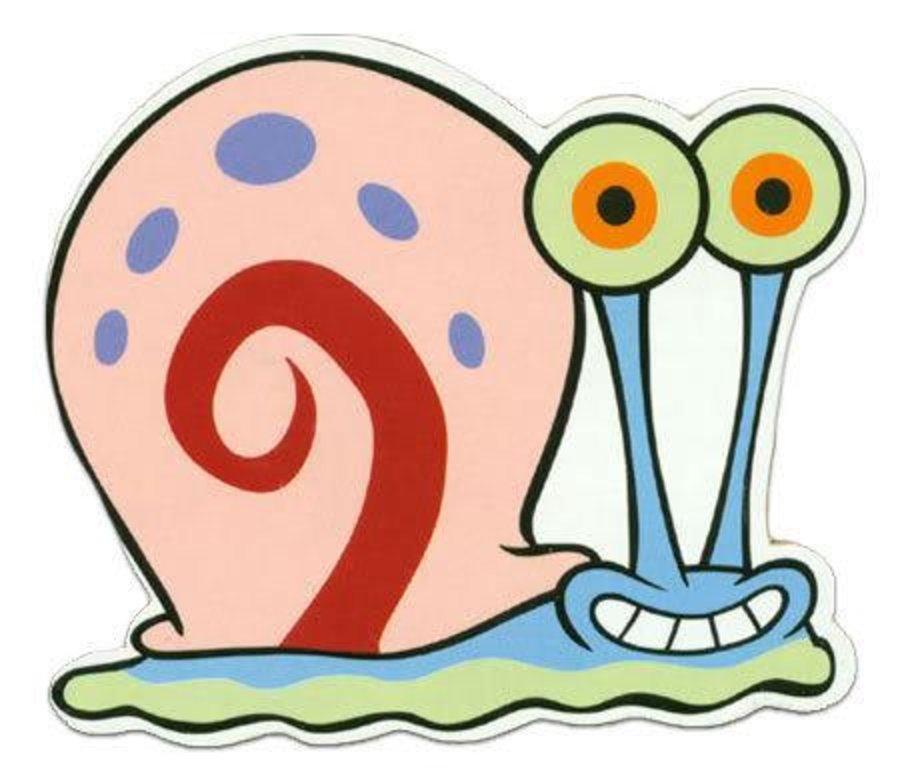
Gary-snail-spongebobSelf-loathing is particularly pronounced in alcoholics/addicts as the flipside of self-aggrandizement. We develop an oversized ego that attempts to compensate for our weak sense of self-worth. You can envision it as a big, technicolor-shelled snail waving antennae of “I’m so totally awesome!” that, when you flip it over, reveals the oozy slime of “I so totally suck!”  Scientifically speaking, relief derives from becoming a humble, right-sized little snail like Spongebob’s.  That’s why we need the 12 Steps.

Before I came to AA, I believed the voice of self-loathing was unique to me. As described in my addiction memoir, I first experienced it in preschool, a feeling that other kids could all consult a script I lacked.  In my teen years through recovery at 34, I thought of that voice as “brutal honesty” or “facing facts.” When it was on, any sense of my own basic okayness struck me as self-satisfied idiocy. It seemed to declare truths I’d always known deep down.

The only person I’d ever heard speak self-loathing was my alcoholic father. “As soon as I wake up,” he’d confess, “I say to myself, P—,” (our last name) “get your lazy butt out of bed! You’re gonna louse something up today, you no-good schlemiel!”  Sadly, Dad never got sober, and gradually his self-loathing developed an immunity to the alcohol that had once curbed it.

By contrast, when my sweet son was only 6, he cried to me one night before bed: “I just feel sorry for anyone who has to be around me, because I’m such a horrible person!  I don’t feel sorry for me, I feel sorry for them. I just wish I could be anybody else!  I hate me!”

Hugging him didn’t help.  Telling him he was wonderful didn’t help. What helped was explaining to him what I’m about to tell you.

Self-loathing is a thing.  It’s a voice, an entity unto itself, a part of our mind that tells us the same stuff over and over.  My sponsor taught me to call it “the worm.” My son and I named it “the mean voice.”

Having a name for self-loathing, recognizing its voice self_hating_by_lithraelwhen it speaks, takes away half of its power. In meetings, when I first heard others describe their self-loathing, I was floored. How could John possibly experience self-loathing? He’s such a wonderful guy!  Karen is so funny and smart – how could she possibly think she’s shit?

In my experience, most non-recovered alcoholics (and some Al-Anons) vacillate between thinking they’re the shit, and thinking they’re a piece of shit.  Normies must experience this phenomenon too, but A) I doubt their swings are as extreme, and B) people outside the program rarely admit to things that make no sense, even to themselves.  We in recovery, however, admit to everything and thus discover we’re not alone, which opens the way to healing.

Getting rid of self-loathing entirely is not, at least in my experience, possible.  What we can do through the steps is label its voice and take away its megaphone to render it fairly harmless.

DaisySteps 4 and 5 showed me my fundamental human foibles. Steps 6 and 7 narrowed them to flaws I could, with god’s help, stop practicing – self-pity, self- importance, and harsh judgement of others – all platforms on which self-loathing stands.  Steps 8 and 9 allowed me to set straight past wrongs to arrive at a clean, guilt-free slate.  Today steps 10, 11, and 12 keep me current, connected, and useful.

How does this weaken our sidekick, self-loathing?  Working those steps and many years of living a spiritually-based life have drawn from my core a certainty that god loves me. Despite many human shortcomings, I am fundamentally good – because god guides me toward goodness.  Ultimately, that’s the sunlight the vampire of self-loathing can’t endure.

And yet – even after 21 years of sobriety – self-loathing still won’t die.  It hurls insults at random intervals.  “You’re alone cause you’re boring and no one wants to be with you!” “You’re wrong and shameful!”  “You’re full of inherent, bumbling dumbness!”

Coprolalia

It helps to make friends with that voice.  Like someone suffering coprolalia – the Tourrette’s symptom of uttering profanity – it just can’t keep quiet!  It’s trying to beat the world to the punch, blurt out the worst so no one else can surprise us with it.  Stripped of its accusations, self-loathing amounts to nothing but another guise of fear.

The quickest strategy I’ve ever heard for dealing with self-loathing is my friend Brenda’s. She named her self-loathing voice Carl.  Why Carl?  No particular reason.  Now, whenever it crops up and tells her she’s a failure, no one likes her, etc., she just rolls her eyes and says simply, “Shut up, Carl.”

It works!

Did John F. Kennedy ever think incredibly dumb things or occasionally fart with a quizzical inflection?  Of course he did!  But he alone knew it.  Because we know ourselves more intimately than does anyone else alive, we must love ourselves – screw-ups and all – with equal fervor and humility.

Take that, self-loathing!

scroll

Post to Facebook

9 Comments

Filed under AA, Addiction, Alcoholism, Codependency, Recovery, Sobriety, Spirituality, Twelve Steps

Insides to Outsides: Envy vs. Compassion

I get envious.  I hate to admit it.  Envy’s such a low-down, ego-driven emotion, but sometimes the best I can do is admit I’m feeling it and maybe ask god to help me stop.  Lately, god’s been doing just that – showing me how little I know.

Envy can happen only when we compare our insides to other people’s outsides. And what a beautiful (AA) phrase that is, too!  We get lonely, assuming others are capering about with friends.  We scroll bored and depressed through Facecrack, convinced everyone else is reveling in a kick-ass life.  Always, we imagine other people have it easier.

In my drunken 20s and 30s, even after my Near Death Experience showed me otherwise, I clung to an objectivist, mechanical view of the universe that kept things pretty straightforward. But as the years brought on a series of paranormal experiences – knowing stuff I shouldn’t know, seeing stuff I shouldn’t see – I had to expand my realm of possibility.  Quantum physics increasingly shows researchers what an elusive, pliable, witness-influenced phenomenon “reality” can be.  And the spirit world is constantly showing me the same.

Angels & Demons

For me, it’s no longer beyond the bounds of possibility that when I pray for help with a specific character defect, god will provide the grist for just that – if I’m willing to perceive it.

So, anyway – I asked god to remove my envy.  It had been plaguing me particularly since I brought home my alcoholic ex-boyfriend’s cell phone and discovered his extreme, prolonged deception around his sex addiction.  I felt like an idiot for having banked all my love in a rotten vessel.  And all around me, it seemed, were couples savoring romantic bliss.

Left outFor reasons I can’t explain, my comparisons swarmed around a particular friend.  She and I had known each other only faintly from ballet class on the day when, less than a month after my horrific break up, I sat in the Department of Motor Vehicles, skinny from insomnia/inability to eat and still subtly shaking, waiting to renew my driver’s license.  In walked gorgeous Jane with her two beautiful children, so I waved her over.  Ten minutes later I knew that Jane, just like me, was a sober alcoholic who’d had her kids late in life.  She’d been married 10 years to a wonderful non-alcoholic man.

I trusted her.  By the time I left with my license, I’d confided the entire gruesome betrayal story, exposing all my wounds down to details I’d told no one else.  For some of the lewder texts and fetishes I’d seen on my boyfriend’s phone, I even spelled out words while her wholesome preschoolers played nearby.  Jane’s stricken face showed genuine empathy.  Even so, I berated myself afterwards for sharing TMI: “Why did you do that?!  You’re such a freak!”

Days, weeks, and months later, Jane’s husband would stop by our class lovers runningto pick up their kids, the two of them exchanging a brief kiss.  Mind you, I have plenty of friends in happy relationships, but for some reason that image, or even the thought of it, would spur me to beat myself up mercilessly:  I’d fucked up my whole life by choosing the wrong man.  If only I’d chosen more wisely, held out for a normie, found a good, church-going father like that, I’d have the happy intimacy Jane enjoyed!  Instead, I had nothing.

~

We never have a clue what’s coming.  Last week as I arrived at class, Jane rushed up to me in tears. “Thank god you’re here!” she said.  “My husband’s been cheating on me for years and years!  He’s a sex addict!”

I hugged her.  My heart flared with empathy as I understood this bomb had blasted not only her heart, as in my case, but her entire hearth, home, and family beyond anything I could imagine.  Still, the knife of betrayal – that I did know.  I looked into her eyes and spoke the words that had saved my sanity: “His sickness has nothing to do with you.”  We went to a coffee shop where I sat and listened while ‘crazy’ words spilled from her mouth — words of rage and agony and violence!  I nodded with recognition at even the harshest threats of retaliation.  I remembered that white rage.  Because when everything falls apart, there are no rules – except to stay sober.

To help Jane do that, I made up my mind to offer everything I could.

Love is the ultimate risk.  There’s no protecting yourself.  You open your heart and let someone live in there.  The more you love them, the deeper into your core their roots grasp.  So if a day comes that those roots are suddenly torn out, chunks of your soul get ripped out with them.  You die a little bit.  This is true for all of us.

backside embroideryWhat I’ve learned in AA is that nothing I’ve felt, thought, or done is unique to me.  Nothing!  In meetings we reveal our knotty, crisscrossed under-stitching instead of the smooth embroidery we show the outside world.  That’s how we learn to trust each other.  God reminds me over and over: in spite of whatever differing externals ego and envy harp on, our pains and our joys are the same. Helping one another through them, whether in ways big or small, is indeed the ultimate purpose of being alive.  Nothing matters more.

Jane is a strong woman.  She’ll walk through this hell, and she’ll do it without a drink.  And I’ll walk with her as much as I can.  I remember all the little kindnesses friends offered that helped me through my darkest days – frequent texts, maybe a positive CD, a bouquet, and most of all, listening.  Today, those are things I can do for Jane.

Why did I decide on that particular day, that particular hour, to head for that particular DMV to renew my license?  Why did Jane?  Was it merely by chance we shared the hour that bonded us?   You can think what you like, but I believe god sows at our feet the seeds of all we need to heal each other.

Everything is in divine order.


scroll

Post to Facebook

6 Comments

Filed under AA, Al-Anon, Faith, God, Recovery, Sobriety, Spirituality

What Alcohol Did; What god Does

Pain happens, starting when we’re young. In our efforts to evade it, we suppress a whole array of feelings, turning away and denying them. But like an ignored roommate sharing the small apartment of our psyches, the pain lives on. It doesn’t grow up. It stays the age we were when the trauma happened. Countless negative beliefs systems sprout to position it – that we’re not good enough, that others will reject our true selves, so we need to strategize to please them.  We try.  Again we miss the mark and endure more pain, the rabble of negativity within us creating a ceaseless inner shitstorm.

It sucks – the shitstorm does.  Our psyches can become a hellhole.  In AA, we speak of the shitty committee.

Shitty Committee

click to enlarge

What Alcohol Did for Me
The first time I got wasted, alcohol shrank that entire tornado of pain and fear so small it could fit inside a harmless little bubble and float off somewhere in my mind’s periphery – totally irrelevant.  Hey!  I was fine, you were fine, and if someone didn’t like us, fuck ‘em. My psyche’s protective walls fell away so the world opened up as a land of plenty, beautiful and safe. Life was so damn easy!  Cocaine tripled that effect*, adding an intense interest and delight in all things.

I wanted that feeling again.  And again.  Addiction promises a shortcut, an escape from ourselves. It’s that hope, that sweet anticipation of GOOD STUFF that lures us every time to jump on it again. Something as simple as a red notification number on Facebook can trigger a spurt of anticipatory endorphins in our minds – this is gonna be good! This cheesecake, this big sale, this cocaine porn winning horse remodel facelift romance booze is gonna lift me right out of the bad stuff, set me on top, make being me so smooth!  Dopamine levels surge, causing us to “forget” all the pain in our lives.

“Thus addiction… arises in a brain system that governs the most powerful emotional dynamic in human existence: the attachment instinct.  Love.”  Gabor Maté is writing here of opiates, but the same principle applies to all drugs that impact our dopamine levels – including alcohol.

sunshine1That first perfect, blissful high is, in my opinion, reminiscent of heaven.  Literally.  Hear the story of anyone who’s had a Near Death Experience (NDE) in which they went to the Light, and they’ll tell you they were permeated by an ovewhelming Love, a brilliance so powerful it left no room for anything bad. The Light is the unfiltered energy of Love that is not incarnate, not trapped in a limiting body; it is whence we originate, what powers us here, and what we’ll return to. And it’s a memory of bliss for which we hunger desperately as we trudge through the difficulties of being human.

So what am I saying?  That consciousness from a brain artificially flooded with dopamine resembles consciousness in heaven?  Yep.  ‘Fraid so.  That’s why many addicts sacrifice their lives in pursuit of it.  Un/fortunately, our brains respond to such bombardment by curtailing both production of and receptors for dopamine, so life without using more becomes increasingly hellish – and that change persists for years.

What god Does for Me
…is not as fast or dramatic, but it works: god gives me the self-compassion to heal my own wounds.  The message of the Big Book is love.  In the rooms we’re surrounded with it as we dare to take that First Step, to admit openly, “You guys, I don’t know what the fuck I’m doing!!”  From that humility, we tap an “an inner resource” – god as we understand it – which begins to edge out ego as our guide for living.  The more love we accept from god, the more we have to offer others, and vice versa.  For the first time, we can love imperfect people from the standpoint of our own imperfection.  In other words, as working the steps gradually teaches us compassion for others, we also develop it for ourselves.  We become conduits of the Light.

“You have to feel it to heal it,” my cousin and I like to say.  In scaredgirlmeditation I go in looking for that little 9-year-old Louisa who was so blighted by shame, and I ask her to tell me where it still hurts.  I feel it, too; I grieve with her; I comfort her.  You don’t have to do anything, I tell her. You can just be you, and I’ll love you.  I can promise her this because my god has promised it to me. At the core of Al-Anon, ACA, and SLAA, named either directly or indirectly, is the healing power of self-parenting. That’s the nexus of change.  We can play both roles, loving and healing our past selves.

Today my inner little girl is pretty happy.  She got banged up rather badly in my recent break-up, but she’s convalescing well.  We share an open world infused with goodness – because I perceive god in all I encounter.  At times I do experience bliss – basking in the beauty of the mountains, laughing myself loopy with sober friends, or witnessing the miracle of my sweet son. It’s not a cheap bliss, either: it’s the real McCoy, earned through hard spiritual work – that freedom I once faked temporarily with alcohol and drugs.  And like heaven, it’s all about love.

~

Watch This:
Here’s a simple animation that depicts volumes about addiction in a brief 4.5 minutes.  Strangely, watching it makes me cry.

I’m guessing Andreas Hykade, the film’s German creator, knew addiction well. It’s not by coincidence that our protagonist is a kiwi, a flightless bird.  We all feel like that – denied the soaring others pull off.  Neither is the grating step-by-step sound effect accidental. Real life is one step at a time and arduously incremental compared to the smooth bliss of intoxication. Even the images’ barren simplicity reflects the stark focus of addiction. An animation teacher at Harvard, Hykade chose a simple line drawing over every state-of-the-art visual effect at his disposal.

NUGGETS

Kiwi addict

.

So many of us never escape that final darkness.  If you have, take a moment for gratitude.

.

scroll

* Gabor Maté, In the Realm of Hungry Ghosts, p.153

Post to Facebook

4 Comments

Filed under Addiction, Afterlife, Al-Anon, Alcoholism, Denial, God, Near Death Experience, Recovery, Sobriety, Spirituality

10 Principles for Living Sober

FoodinBagA few weeks ago, I asked a clerk and bagger if they’d watch the sack of groceries I’d just bought while I ran back for another item.  When I returned, my groceries were gone and they felt terrible – so terrible that the bagger walked the aisles with me trying to help me remember what I’d bought.  But without the receipt we couldn’t recall much.  I’d picked up a number of things on impulse.

“You know,” she said after we’d covered the store with little success, “this deal is on us.  Really, you can just fill a bag with–.”

“Corn flakes!” I remembered.

But I soon drew another blank, so she urged a little harder. “It ends up as a theft write off, so you can just go for it.  Anything you want is fine with us!”

True, I’m a single mom and always short of money, so almost everything I looked at, I wanted.  Fancy jams and teas – mmm.  Maple syrup.  Organic soaps.  Mega-vitamins.

I left with a half-filled bag containing only what I distinctly remembered buying.

Question:  Why?  Am I going for sainthood?  Do I get a bang out of feeling superior?  Do I think god keeps score?

Answer: None of the above.  The fact is, I’m a doomed alcoholic who’s graced with sobriety one day at a time.  I’m not mindlessly drinking myself to death right now due solely to the power and guidance of my new employer – god as I understand god.  In each situation, I have just one prime directive: Do the most good I can for all concerned. 

The store was concerned; having my stuff stolen did not mean I could steal from it.

During active alcoholism, I lived by a slightly different prime directive: Do the most good I can for Louisa.  In every situation, I considered what would most benefit me.  What would make me feel good?  What might pay off later by making me feel even better?  If there were negative consequences, what eventual rewards might outweigh them? Certain people’s esteem was worth more than others’ pain or anger.  Gradually, navigating by my own best interest, I ruined my life.

Ruby slippersSo I quit that game.  What I seek now is clarity.  How I find it is by living in alignment with my HP’s prime directive, which I will here attempt to unravel as my own 10 principles for living sober gleaned from the Big Book, my fellows, and my own stepwork. Here they are, in no particular order:

1. Be where you say you’ll be and do what you say you’ll do.  (Choose Integrity)

2. Think of others as you’d have them think of you.  (Choose compassion)

3. Be honest with yourself always, and with others short of reckless harm. (Choose reality)

4. Give as much kindness as you possibly can to every being you encounter. (Choose love) 

5. Avoid gossip – and envy, which fuels internal gossip. (Choose respect)

6. Do not flirt either as or with a committed person. (Choose honor)

7. Let others be in charge of what’s best for them. (Choose detachment)

8. Pay attention to all you do and how it squares with your values. (Choose awareness)

9. Be grateful for everything – everything – everything. (Choose humility)

10.  Know that god loves you the same way you love small, helpless creatures, only a billion times more – whether you’re in your body or out of it – so try loving yourself that way, and love god for loving the world.  (Choose faith)

~

Now that I’ve written them all out, it looks like an awful lot of rules!  But I don’t think of them distinctly – more as Miguel Ruiz’s Fourth Agreement, “Always do your best.”

My agreement with god – my way of acknowledging  sobriety as a gift I’m graced with – is simply to try my best in each situation to do the most good I can for all concerned,  which means applying the above 10 principles.  For example, #3 and #8 mean I don’t eat meat by denying the horrors of factory ‘farms,’ or even shop at Walmart; #4 means being of service.  Sometimes the rules conflict and I have to work out what “most good” means.  For instance, to follow #5 – don’t gossip – I may reply “I don’t know” when I pretty much do.  Or to fulfill #6 – don’t flirt – I may pretend to be indifferent when I’m not.  But those bits of dishonesty fall under the “short of reckless harm” proviso in #3.

Then there’s the Al-Anon piece.  Up until a few years ago, I thought #4 – giving kindness and love – was to be practiced unconditionally.  You could treat me like shit and I’d just keep showing up with love, giving you the benefit of the doubt and killin’ you with kindness.  Al-Anon’s “Don’t be a doormat” applied, I assumed, only to codependent wives and mothers slaving selflessly for those who used them.

It took blatant abuse from those closest to me to drive home the fact that I need to recognize and respond to toxicity in others. People’s behavior tells me what they’re made of.  If I overlook continuous patterns, I’m lying to both myself and them.

Detachment (#7), I’ve learned, applies to letting other people think of me as they choose: I can’t make them understand me.  I can’t make them return goodwill no matter how much I beam their way.  At a certain point, loving myself as god loves me (#10) means I have to set boundaries.  Tortoises carry shells and roses sprout thorns for good reason: we often need protection to hold our own.

tortoise-roseOf course there are plenty of times I screw up – times I choose fear, choose anger, choose self.  Sometimes I wallow in loneliness and self-pity.  Plus I once ordered a cheap tent from Walmart.  But I never give up and say “fuck doing what’s right.”  As soon as clarity returns, I own my mistakes and do my best to clean things up.  It’s actually the easier, softer way, because I get to live in a beautiful, love-bright world with like-minded people.

scroll

Post to Facebook

4 Comments

Filed under Al-Anon, Alcoholism, Faith, living sober, Recovery, Sobriety, Spirituality