Tag Archives: recovery

We Are NEVER Too Well for AA Meetings

I recently had a chance to tell none other than Bill Gates, who went to my high school and was at my 40th reunion, that I had 23 years sober. “Impressive!” he remarked.  He’d just told me that a mutual friend of ours, a venture capitalist and hilarious jokester on the school bus back in the day, had died — overdosed on fentanyl-laced heroin after many years clean.

Yet when I told him I still go to weekly AA meetings, Gates looked baffled: “Really?!” he said, drawing back sharply.  Even as I explained that exactly what had happened to our friend Keith could happen to me at any time with booze, he still looked incredulous.

Here’s one of the deadliest afflictions known to humans, killing 6% of the global population every year (WHO), and this man, who, through the Gates Foundation, has done more to battle diseases worldwide than anyone else on the planet, had no inkling of alcoholism’s lifelong grip.

Sometimes I think ours is the most misunderstood illness in the world, and AA the most misunderstood cure.

Getting Too Well?
Of course, there’s a part of every sober alcoholic that agrees with Gates. A part of me agrees daily, claiming, “Louisa, clearly you’ve got this thing beat!  Look at how accomplished and sensible your life is now!  Waking up in somebody else’s bed with Cheetos orange around your mouth and a hangover from hell–? That is just sooo not gonna happen anymore!”

The result of this voice is that, as I type this, I’ve not been to an AA meeting for nigh on three weeks.  A week ago, I was supposed to chair one and forgot.  And I’ve not posted a new blog here for almost two months.

Why?  Partly for good reasons.  When I got sober in 1995, I couldn’t imagine what I was going to DO now that I couldn’t drink alone while scrawling boy-obsessive drivel in my journal, or drink in bars while bending indifferent ears, playing darts, pool, or pinball.  Take all that away, and what else was there to life?

As sobriety gradually revealed, within me were talents and loves neglected like withered, leafless plants.  Before alcohol took over, I’d danced, hiked, and written.  AA reopened the flow of love my heart was dying for, slowly at first via people in meetings, and then, as I worked the steps, through my own dilating portal to god. The elixir of life — godlove — watered my spirit so those dried up, nearly dead talents sprouted fresh leaves and blossomed again.

Sobriety, as a result, has been anything but dull.  Today, these loves fill up much of my life.

About two weeks ago, I was dancing onstage in a ballet recital — at a week shy of age 58.  Godlove let me bond with my troupe, mainly teenage girls and twenty-something women.  There was a moment in the dressing room when all nine of us gathered around my phone, which was playing the one disjointed moment of our dance.  “We lunge there,” I said, “on the low note.”  I’ll never forget the solemn way their eyes met mine, not because I’m old and bossy, but because we needed unity and they trusted my cue.

We aced it.
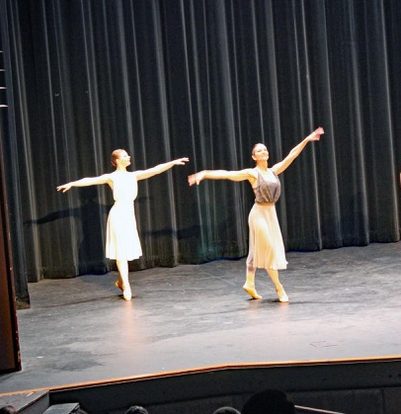
Performing (on right)

Warming up before dressed rehearsal (on right)

The weekend before, three sober women friends and had I attempted Mount Adams — a 12K’ volcano four hours’ drive from home.  Thunderstorms forced us to camp at the trailhead rather than base camp and shoot for the summit the next day, when high winds and whiteout above 9K’ turned us back.  Still, we had a blast getting rained on, climbing, and taking turns “losing enthusiasm” as we tried to find shelter from the icy winds.  Here are three of us at 9K’ pulling our “bikini bitches” stunt of pretending it’s not frickin’ FREEZING just long enough for photos.

Suck in tummy award to me, center 😉

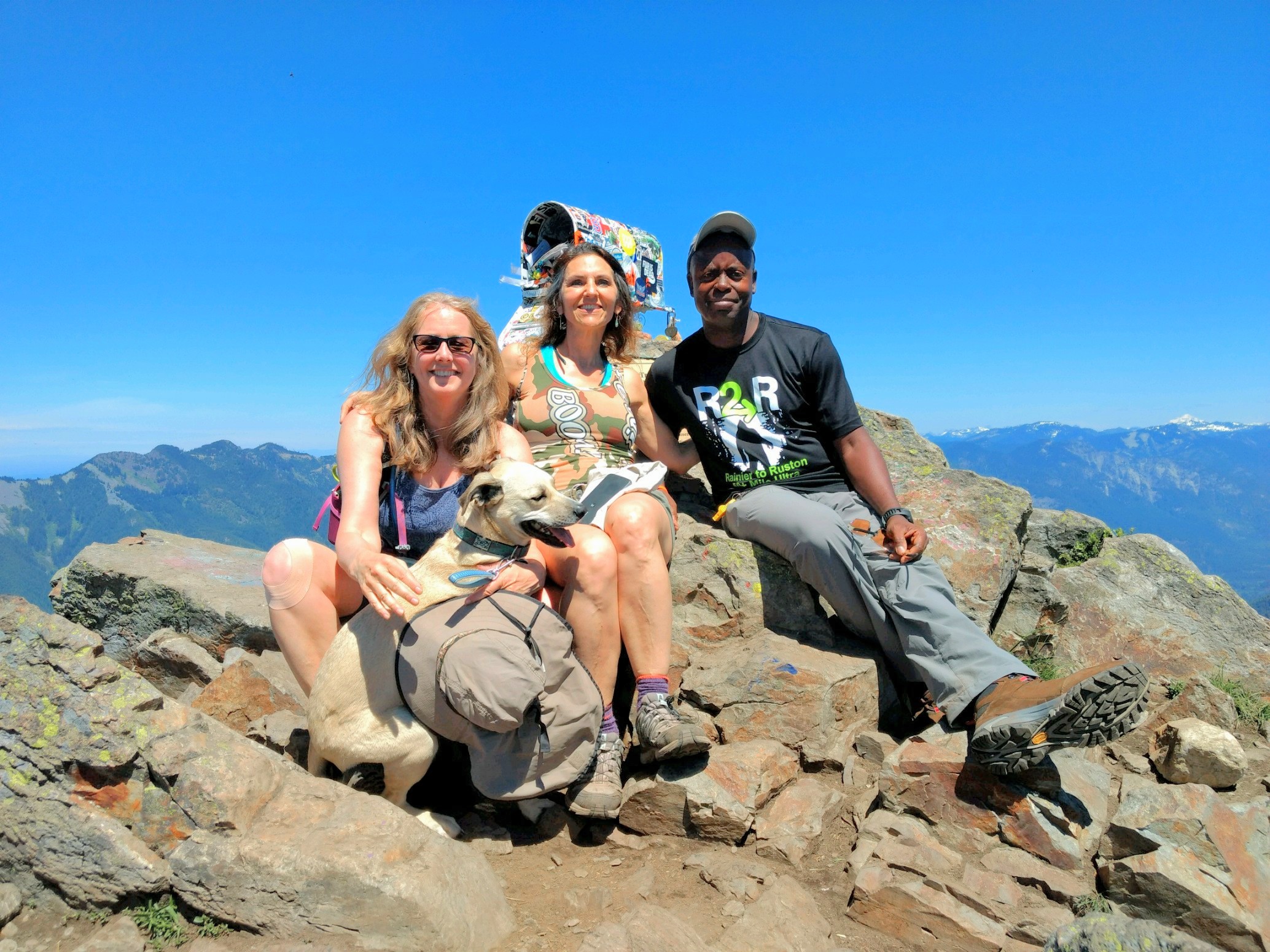
The day after my recital, I climbed Mailbox Peak, a 4K’ gain, with my friend Sally and brand new boyfriend, Tommie.  (That’s right, after years of tortuous dating, I finally met the right guy. ❤   More later.)
Then, just a few days ago, I summited a backcountry wilderness peak, Mount Daniel, with just Sally.  The two of us camped at a frozen lake and navigated this route in partial white-out:

Mount Daniel east peak via SE Ridge .
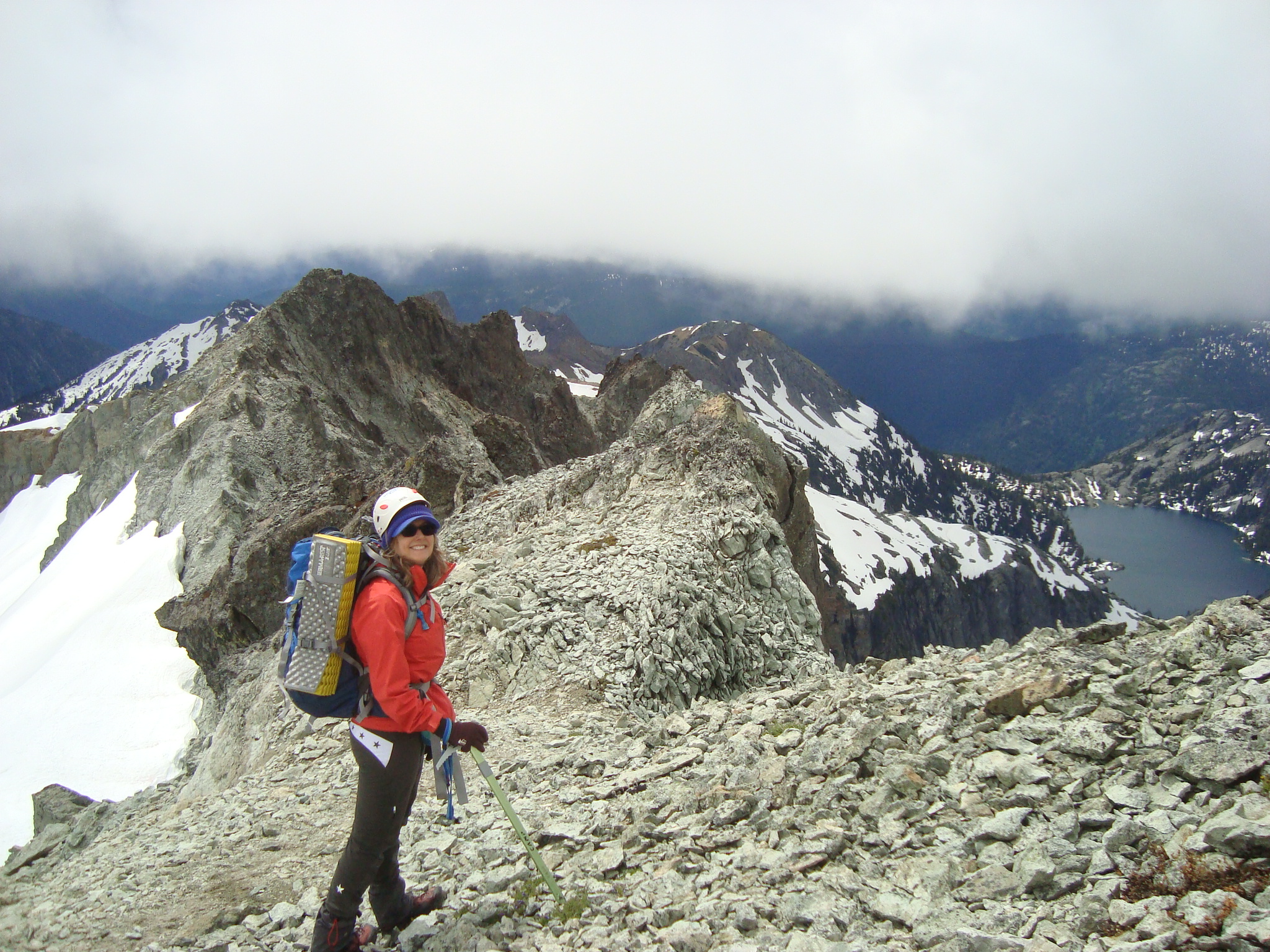
Our route followed the ridge above Sally’s head!

But it’s not all been ballet, boyfriend, and beauteous mountains!  Life happened, too.  My house’s sewer system went kaput, upsetting my — er — delicate financial balance.  To safeguard that balance, I had, in previous weeks, overtaxed my gift for writing, agreeing to edit super-human quantities of text amid an already full work schedule and to conduct and write up an NDE interview for the Seattle IANDS Newsletter.

Long story short: I’ve been so busy savoring/exploiting the flowers of sobriety that I’ve neglected to water their roots.

I should know better.  Around me, dear friends I never dreamed would die or get hooked on alprazolam (Xanax) are doing just that.  One, a former drug and alcohol counselor, is a ghost of his former self, with hollowed-out eyes and tales of demons.  The other, who landed his dream life — wife, kids, big house in the burbs — became addicted to anti-anxiety meds prescribed for his stress over huge mortgage and daycare payments.

How did these friends change from the happy, joyous, and free sober people I knew fifteen years ago in AA meetings?  Both got “too well” for AA — the same tempting path I’ve wandered down these past weeks.

Ironically, the same drive that energizes me to pursue so many activities and take on added responsibilities can kill me if not balanced with humility before my god.

As an addict, I am permanently geared to chase feel-good.  As a co-dependent, I scent feel-good when I say “yes” to people and things, so I say it more and more: YES — I’ll be in the recital!  Climb mountains!  Edit your humongous text!  So what if I’m losing my mind?!

The trouble is, without the humility that god-awareness brings, I cannot be in feel-good; I can only chase it.  No matter how much I get, I want more.  And there’s another problem with feel-good.  The flip side of genuine satisfaction is the trophy-hunting of ego — addiction to the story of adventures, to LIKES on Facebook or Instagram, to praise for fabulous texts and newsletters.

Hey, whatever primes the dopamine pump — right?  I’ll take any hit I can get!  So let’s think: who could it be spurring  this constant chase, urging me to take on more and more?  It’s my old buddy, addiction — disguised, like a villain behind a fake mustache, as enthusiasm and responsibility. It’s refrain?  “We’re so close to feeling good!”

Ultimately, going to AA meetings is like prayer: both require and reinforce humility — that bane of our ego-oriented culture — by freely admitting, “I lack.”  Only when I embrace the fact that I’m a tiny shard of god who can thrive solely via connection do I remember my true mission on earth: to love.  Overcommitting, I leave no time to dwell in that truth.  I’m too busy chasing brain candy.

Anytime I imagine my addiction to be a thing of the past, I jeopardize everything precious to me, everything alcoholism once took away and wants to take again.  I may not wake up with Cheetos-mouth, but I will wake up guided by the very same ego that led me to it.

Bill Gates has no need to acknowledge the deep power of alcoholism, but I do.  Tomorrow I chair a women’s AA meeting.  The next night, I’ll be at my homegroup after meeting with a sponsee.  These commitments, unlike others, allow me to relinquish my illusions of control and seek serenity though god.  It’s what I do.  It’s what I need.  It’s who I am.

PS: Short video of our Mount Daniel climb, 6/30 – 7/1/18 (sobriety ain’t boring!):

Car ride to Mount Adams with AA girlfriends 6/16/18 😀 (feeling close while stone cold sober):


2 Comments

Filed under AA, Addiction, Alcoholism, Happiness, Recovery, Sobriety

What’s it all for?

When I drank, my life was always dramatic — at least to me.  Everything was a big deal.  Drinking both fueled and helped defuse that.  If someone was mad at me, if I’d behaved inappropriately, if some asshole had robbed me of a goal or privilege rightly mine, my emotions would rollercoaster up and down huge swells of anger and careen around curves of righteousness before finally winding down to the self-pity platform to which all things led: poor me.

Booze, by Buddy Nicholson

But in those days, I had a best buddy, wine, along an array of other pals — beer, the gin & vodka twins, and all those whiskey relatives. We’d hang out and they’d fix everything.  Actually, they’d fix my brain; everything else stayed exactly as it had been. But by muting my amygdala so the fear subsided and by impairing my frontal lobe so that all thoughts simply led back to me, drunkenness let me feel brokenly triumphant.  Fuck them.  Fuck everything.

In those days, everything I had going for me was external — or so I believed.  What mattered was out there, so I was constantly keeping score: first it was grades and teachers, then published stories, then impressing my students, and eventually, as my life spiraled downward and I quit teaching to focus on drinking — I mean, writing! — it became impressing all the “cool” cats at the tiny espresso shop where I worked.

Mind you, everything that went on in that espresso shop was colossally big news!  Who was getting together with whom, new policies about whether you could eat behind the counter, hirings and firings.  In the end my main drama centered on the fact that my life partner had read my journal, caught me cheating emotionally, and promptly left, so now I couldn’t pay the mortgage with my joke of a job, even if my shifts hadn’t been cut for coming in stoned.

Drinking enough to make that no big deal nearly killed me.

When I got sober, my focus gradually shifted to who I was within and whatever linked that spirit to a higher power — to goodness in the world.  At first, of course, I had no idea the 12 steps were effecting that change.  I just went through them with a sponsor and discovered harmful patterns in my thinking and behaviors, asking my higher power to help me outgrow them.  And as I began to lay aside increasingly subtle versions of these once precious “coping skills” — deception, manipulation, knowing best (pride), envy, and my favorite, self-pity — the ride of living smoothed out.  A lot.

Today, I have no crises. I don’t wish I were somebody else.  Sobriety’s granted me huge gifts: I’m performing in two ballet recitals this spring and climbing three glaciated mountains this summer, so my life is full.  My home, health, work, son, and friendships are all good.
But smooth sailing can be frickin’ difficult for an alcoholic!!  Without that clamoring, overflowing bucket of piddly-shit drama to seize my attention day after day, my gaze drifts to the horizon and I wonder, what am I doing?  What’s my life for?

I’m getting older.  I haven’t made any big splash lately.  My son has grown up, my dog is old, I have no partner.  What stands out with increasing clarity is that I will disappear from this planet in a number of years.  How many is unknown, but every day I’m closer.  What will my life have meant?

Here’s where near-death experience comes in.  I am so blessed that the inexplicable paranormal phenomena stacking up in my life finally led me to the Seattle branch of the International Association of Near-Death Studies (IANDS), and that I hold a service position there of interviewing near-death experiencers and writing up their stories for our newsletter (snailmailed only at this point, sorry). Every other month, I get to Skype with someone who has, like me, died and come back with wisdom to share.

On the other side, when they are pure spirit, many know their life’s purpose. There’s a role we’re each here to play, and they’re shown theirs.  Yet when they come back, they remember knowing, but they can’t remember what!  This “forgetting” seems to be the price of embodiment.  Enclosed in bodies, we lose 99% of our conscious connection to the expanding web of creation that is god. With little to go on but our hearts and the gossamer strands of love that link us to other hearts, we’re something of a lost boat, a tiny shard trying to work out its place in a 13.8-billion-year unfolding.

When one NDEr was given the choice to stay in the spirit realm or return to her body, she asked what would become of all her half-done life’s work if she died. “None of that matters,” she was told. “What matters is connections. If your work helps someone to strengthen their relationships with others or even to know themselves better, it has value.  The important thing is the wake you leave behind you in the waters of life.  Do you leave a wake of love… or of indifference?”

That’s our job — to love others and love god by generating gratitude for this spectacular pageant of life on Earth. My life is not about what accolades go up on my mental mantlepiece.  It’s about the people (and other beings) I love and the ripple effect of loving them, which touches countless lives of people I will never meet.

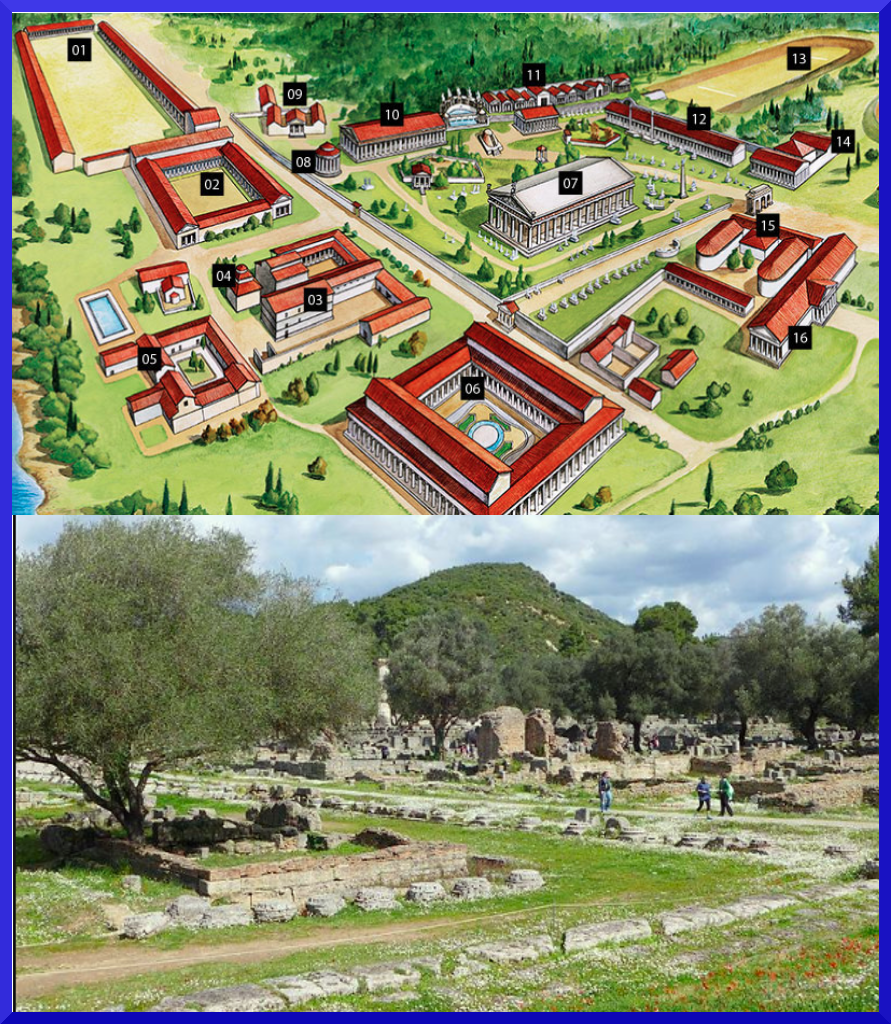
     Olympic games site, then & now

Humility is also key.  In 1995, when I was about 100 days sober, I visited the site of the first Olympic Games — alone.  Wandering from the ruins, which date from 776 BC, I took a nap under a gnarled tree. And when I woke, looking out at the meadow where a sign indicated the Greek athletes’ housing had once stood (6), used centuries later as Roman soldiers’ quarters before god knows what in the Dark Ages, I had a sort of vision. I saw with time-elapse speed hundreds of trees germinating, growing large, and dying; buildings going up and falling to ruin; people slaughtering each other and making love — all in this very same meadow while its grass sprouted green and then dried to yellow over and over, 2,771 times.

The years, I saw, cycled through just like waves on a beach.  So did human lives.  I was no less transient than a blade of grass — but one with a plentitude of choices.

Ultimately, the purpose of my life has to be turned over to god every day as a part of Step Three. In my own version of the famous Merton prayer, I tell god, “I can’t see what I’m doing, but I love you.  Please lead me wherever I can do your will, and lend me the courage and grace to do my best there.”

Life is no more and no less that that.  And that is enough!


.

2 Comments

Filed under Afterlife, living sober, NDE, Recovery, Twelve Steps

Listening for god

In my drinking days, before I was tight with god, I imagined god’s voice as an echoey Morgan Freeman cadence conveying various profundities. Today I believe more that god is all over the place, not only animating every living organism but also circulating among us in spirit forms, and it speaks to us constantly — although we’re largely deaf.

If I were to say, “God has spoken to me, and His word is blah-de-blah!” I’d have my head up my ass, no doubt.  But I have received something.  My conception of what that is comes mainly from my own NDE* and ensuing paranormal experiences, with gaps filled in by what I’ve heard from fellow NDErs.

By paranormal, I mean stuff like this: In 1999 or so, I was spacing out at the end of a freeway offramp in downtown Seattle late at night, waiting for the light to turn green.  It did so.  At the same instant, a “voice” spoke in my mind with a strong message, Don’t go.

Our brains are amazingly quick.  In a millisecond, I thought, “That’s dumb!  I’ll ignore it.” But in the next millisecond, the message came again, underscored, sort of like, DON’T GO; IT’S IMPORTANT.   So… I, well…  checked my rearview mirror.  No car was behind me. What harm could it do to just sit there?  So I just sat there… at the green light… which looked exceedingly green and all about GO.  Quite shortly, I felt foolish.  I asked the voice, “How long don’t go?”

Like this but older and faster!

WHOOSH!!!   Like a bullet fired from behind a building that blocked my view shot an off-white sedan going at least 100 mph. It streaked through the intersection exactly where I’d have been. I remember, first, being amazed that a car could fly by so fast with so little sound, and second, realizing that my life had just been saved.

I thought, “Thank you!”  Still I didn’t go.  I couldn’t.  I was too scared some car in pursuit might be next, or who knows what!  Then I began to hear sirens, first one then several, a ways off.  Shaken, I drove toward home.

Experiences like this aren’t so unusual for NDErs. According to an NDERF survey, 45% of us return with “psychic” aftereffects,** which amounts to many thousands of people. Leaving and reentering the body alters in some way the energy barrier surrounding each of us, so it’s more easily penetrated.  At least, that’s my best guess.

“How can I tell the difference between god’s will and  my will?”  That’s a question we hear in countless AA meetings. I’m gonna offer some pointers.

Each of us has the ability to sense god’s guidance and, as we continue to work our program, increasingly distinguish it from our ego’s.  The most important prereq is that we want to.  We have to be listening for god and willing to hear what we often don’t care to.  Another is that we have to cherish the goodness within ourselves and be awake to its resonance as a compass.  Beyond this, in my experience, what comes from god bears a few telling hallmarks:

  • It’s the opposite of what I was thinking.  If I’m cruising down some avenue of thought that feels awesome in a self-righteous kind of way, and something intercedes and proposes the opposite with a striking ring of truth, it’s probably god. Far and away the most common input I get from god is “Bullshit, honey: you can go deeper.” By deeper, it means thinking more from my heart.  Sigh!  It’s always true!
  • It’s about love, kindness, and service.  The short explanation here is that god is love, as the ultimate power of the universe.  And we are here to god.  (Yep, that’s a verb!) Whenever we feel compassion and act on it, we are growing god. Recently, I found myself exiting a non-AA meeting near a fellow alcoholic with whom I’d just strongly and publicly disagreed on a policy. I so much wanted to jet, clean and easy! But as I looked at his back, something said, “Talk to him; make peace.”  I told him the conflict was nothing personal, that I knew his intentions were good, as were mine.  He looked relieved, I accidentally cried, and we hugged, disagreeing.
  • While you’re actually doing it, it feels right, almost like déjà- vu.  Sometimes when you make an important choice that aligns with god, it feels — and this is hard to describe — like everything has somehow clicked into place.  There’s a “yes” in every second.  When I heard that my former sponsee was pissed at me for never visiting now that she lived far away, I called and headed down there for dinner. So intensely during that drive, I sensed that I was fulfilling something significant.  We shared dinner on Saturday.  Thursday morning, she was struck dead at her construction job.  Our last words had been, “I love you.”
  • Serendipities reinforce it.  These are the “coincidences” we hear about so often in meetings.  “I decided to kill myself, and three guys from the meeting walked in and sat down at my diner booth.” “On my way to relapse, my car quit on me, and the guy that pulls over is my sponsor.”  I, too have many such stories of statistically infinitesimal likelihood.  Chances are, if you’ve been working the program a while, you’ve had a few of your own.
  • It’s constructive.  God is not big on wallowing.  God is growth and unfolding, so for a recovering wallow-holic like myself, it’s been a tad disappointing that god won’t cosign my misery.  Once, hiking alone in major emotional pain, I noticed a lone yellow wildflower on which a large branch had fallen. Smooshed but not broken, the flower had grown around the wood and bloomed anyway.  God as good as told me, “Child, you’re smooshed but not broken: Bloom!”

One final note.  For the reason listed directly above, god mourns the waste of life that is addiction.  Yet god is never into shame or martyrdom. “Oh, I’m such a piece of shit!” or “Gee, I’m such a saint!” both stem from ego, from preoccupation with self.  God wants us only to do our best, share our gifts, love freely.  Beating ourselves up or codependently pouring energy into toxic people to wheedle self-worth — these ain’t about blooming.

I honestly try to live by this stuff.  For instance, I’m aware that posting this exposes me to ridicule from both atheists (especially in my family) and religious folks. But the AA saying nails the truth: What you think of me (or my writing) is none of my business.  My job is simply to click “publish” and then, as a bird lets the air keep its song or a wolf sends its howl to the moon, move on to whatever’s next.

Thanks for reading, open-minded alcoholics!


*NDE: Near Death Experience.  This refers to a vivid experience that takes place while a person is clinically dead or close to death.  IANDS definition here.

** See Jeffrey Long, Evidence of the Afterlife, p. 189.


PS:  I’ll be presenting at the IANDS conference this summer.  I’ll post details when I get them.

9 Comments

Filed under AA, Addiction, Alcoholism, God, NDE, Near Death Experience, Recovery, Spirituality

AA Stigma Misses the Point

Stigma

a archaic: a scar left by a hot iron : brand
b: a mark of shame or discredit : stain  ex: bore the stigma of cowardice
c: an identifying mark or characteristic; specifically : a diagnostic sign of a disease


I remember the fear in my throat when I first spoke the words, “I’m Louisa, and I’m an alcoholic.”  Sitting in my third AA meeting, I felt like I’d been fleeing those words all my life, and now they rang out in the room like the gates of hell clanging shut behind me.

Twenty-three years later, I’m happy to tell the world, “Yeh-yah, baybee! I’m a full-on alcoholic — and thank god!  Cause otherwise, I’d have missed out on the whole point of life!”

Do I sound looney?  Maybe a tad.  But I’m joyfully looney, and that’s a mighty bright candle to try and shit on.

My sober life is rich with AA friends who have each, through touching life’s deepest and loneliest pain, struck the bedrock of their own will to live, so that we can now meet each other’s gaze without pretense.

Mind you, I foresaw none of this when I first spoke those dreaded words. Nobody wants to join AA. Nobody identifies with that bunch of self-blaming, drink-obsessed sots who fart around in church basements. Obviously, AA as Hollywood and society at large envision it is about as cheery as a medieval dungeon.

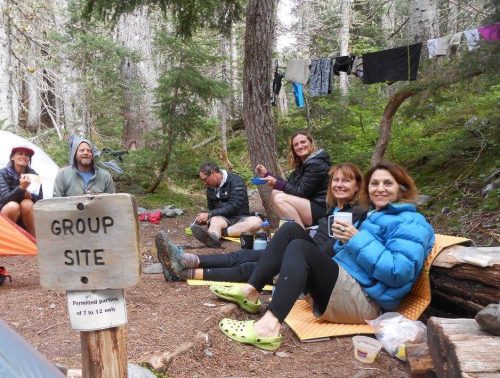
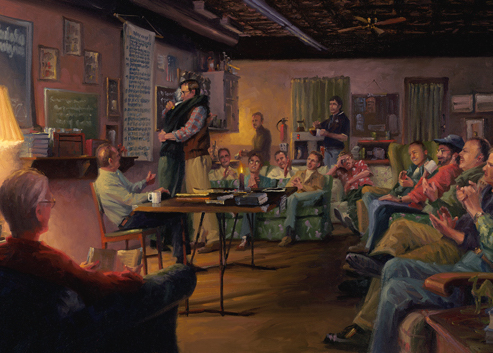
But that’s far from the truth of AA as I’ve come to know and love it.  Below are a few photos from some of the AA meetings/gatherings I’ve been part of in the past three years.


In a sense, all of these images are sacred to me, because I remember how we were all sober together at these meetings despite a disease that wants to kill us — or at least ruin our lives. At times we share tears. Most often, they’re tears of gratitude for having been blessed in ways we can’t believe we deserve.  We still lag on our fourth steps or slip into familiar character defects, but each in her or his own way is pursuing is an ever-stronger connection to the Good.

Yep.  Higher power, flow of the universe, life, love, god:the word doesn’t matter. What matters is that we’ve all nearly killed ourselves solo, and now we’re all intent on seeking help from [god] and each other to experience real life to the fullest.

Nevertheless, AA stigma persists. Despite the millions of lives transformed through AA, many people still dismiss it as contemptible. For instance, I recently came across a video from a lifecoach offering a program for “people who just want to stop overdrinking.” These are “good people,” as opposed to those who “claim that they have a disease or that they’re an alcoholic or that they want to go to meetings.”  Having lost her father and brother to addiction despite the fact that each attended meetings, this coach seems to loathe AA. She recalls her “overdrinking… waking me up in the middle of the night [and] affecting how foggy I was feeling during the day and… creating a lot of cravings… to drink earlier and earlier in the day.”  Yet, she affirms, “I had no interest in becoming an alcoholic or calling myself an alcoholic.  I had no interest in recovery…. I did not see that as the solution to my very mild struggle.”

“Very mild struggle”~!

I’m sorry, but that’s friggin’ hilarious!  What a coincidence!  I, too, had a “very mild struggle” — for about 14 years!

Ego’s Game: the Stigma of Recovery
There’s a good reason why this lifecoach, Hollywood, and most people indoctrinated with popular culture regard AA with such distaste.

When Bill and Bob, AA’s founders, first met in 1935 and, talking for hours and days, hammered out the fundamentals of the 12 steps, they hit upon two little ideas that engendered the defeat of this previously invincible disease.

1) A god-connection blocks alcoholism.

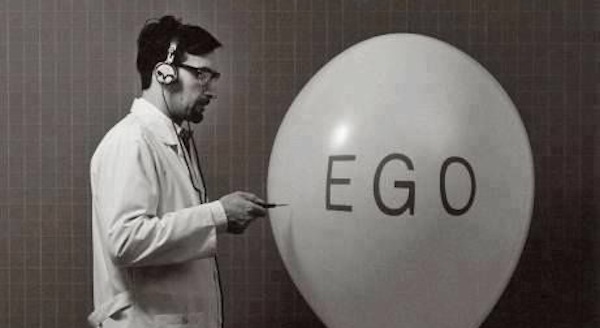
2) Ego blocks god-connection.

That’s all there is to AA, really.

Here’s the whole damn program.  SEEK GOD; DEFLATE EGO; SEEK GOD some more; DEFLATE EGO some more…

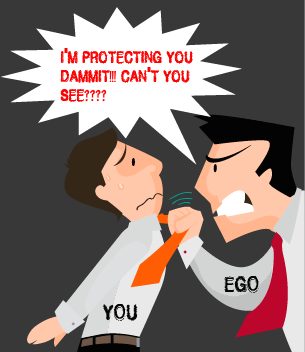
ego-

DO try this experiment at home…


We need these processes broken down into 12 Steps and shared in a community because A) connection to god can be so elusive at the start, and B) ego is a wily, cunning, and stealthy tyrant that does not want to be deflated.

Of course it doesn’t!  It’s fucking EGO.

The problem for most people, including our “very mildly struggling” lifecoach, is a lack of distinction between ego and self-worth.  Ego is mistaken for self-worth by the vast majority of Americans (as epitomized by our arrogant Cheeto in Chief).  In fact, however, the two are diametrically opposed.

Ego separates us from others, relegating them to an onlooker/competitor role at best.  We believe our full experience of consciousness to be unique.  Our thoughts and experiences — whether positive, negative, or just weird — are somehow more intense and complex than those of “ordinary people.”  Ego tells me…

I’m better.

I’m entitled.

I’m doing it right.

and yet I know that in reality I bumble, get confused, hurt, and lost.  Sometimes I fuck up.  So… ego sweeps all that under the rug.  It insists…

If I’m vulnerable, I’m weak.

If I’m humble, I’m less than.

If I’m only human, I’m nobody.

Self-worth, on the other hand, grows from connection and compassion.  I understand that my human experience is little different from yours. I get that we’re in this together. I feel for you, and I trust that you feel for me. Trust emboldens me to tear off my mask and be vulnerable, honest, and fully human — flaws and all.  I’m just me, but maybe I can help you.

Today, everything I love about myself, I hold to be a gift from god — not a feat of my own making. God is generating my mind, my body, my love, my courage, these words — every second I live.  I am god — its flower, its child.

AA stigma is imposed out of fear.  It’s a defense mounted by those fiercely loyal to the tyrant who imprisons their spirit.  Let’s pray for them — for all sentient beings — to be free.


3 Comments

Filed under AA, Addiction, Alcoholism, Recovery, Self-worth, Spirituality

Which Way to Self-Love?

For years and years I’ve put off writing this post.  Why?  Because I frequently suck at self-love.

Originally I meant to write only after I had self-love down.  Self-loving me I pictured as an endearingly geriatric version of myself, her grizzled hair drawn up in a loose bun and her slightly pouchy face lit with a warm smile of knowing.  When I get there, I thought, and I’ve got all this chit figured out, then I’ll crank out a self-love post like, BAM!

Never gonna happen.

My future blogging self will actually be a view of this laptop (or a newer one).  And every day I live, I will wrestle with weird, difficult feelings. So my question will ALWAYS be the same as yours: without using booze or whatever to shut them down, how do we deal with those inner voices of self-loathing, not enoughness, anxiety, awkwardness, shame, envy, self-pity, vulnerability, and drama addiction?

My inner voices get meaner during Seattle winters, when twilight sets in before 4:00 p.m. and the gray rain can drag on for days. They’ve been up lately — super critical of my appearance, abilities, personality, and what little I have to show for the many years I’ve lived — but all mooshed together in a generic “fail” static that hums as a backdrop for my thoughts.
So.  Because I well know, at almost 23 years sober, that such voices are “fake news” (haha), I resolved last month to launch a self-love campaign.  I found a self-love prayer and, er, trimmed it down on my phone (see bottom of this post), and I bookmarked two self-love meditations from Sarah Blondin on Insight Timer (a wonderful free meditation app).  Whenever I’d first wake up, I’d find the onslaught of “fail” static SO LOUD that I’d start blindly fumbling for my phone the way Bill and Bob describe grabbing for a bedside bottle of gin.

“I need help!  I need help!”  This was my constant prayer.

Eventually, the campaign worked — though not in the way I’d intended.  I gained, not any falling in love with myself, but enough gumption to turn and face those inner voices and ask them, “Why are you here?  What, exactly, am I doing so wrong?  Can you guys explain?”

Man, do they hate that!!   Because I saw those assholes for what they were.

Vanity and Ego are the soil in which self-criticism thrives.  Both of them craftily impersonate self-esteem or self-love.  Maybe vanity’s more about narcissism and ego self-importance, but they both tell us, “You’re okay because you have this!”  And THIS is things, material wealth, cool shit.  THIS is intellect, degrees, a fat paycheck.  THIS is looking hot or well dressed.  It’s the social finesse to be interesting and witty.  Being right.  Being wronged.  Lots of tattoos.  A hot partner.  Class.  Whatever vanity/ego can hock to grant us status.

But if you listen closely, what vanity and ego are actually saying is, “Without THIS, you’d be worthlesssssss.”

In truth, criticizing ourselves for insufficient THIS is a tactic we learned to protect ourselves from the stings of criticism we suffered growing up in dysfunctional families.  If our THIS supplies aren’t constantly rising, our worthlessness-hazard gauge is.  But in our hearts we know, THIS is never us.  No matter how persistently we try to amass THIS, we feel no inner worth — no love for self.  That pain is one reason we drank.

“The soul grows not by addition but by subtraction.”

— Meister Eckhart, 1260 – 1327

Eckhart’s subtraction principle, I am discovering, applies to self-love.  Love’s roots thrive in humility, not in awesomeness.  Do vanity and ego claim that, compared to other people or where I ought to be, I’m mediocre, boring, and unimportant?

Okay, fine.  You win, mean voices.  Mediocre is my middle name.

Once I stop fighting, I topple from ego’s tightrope, down and down until I land on the solid ground of being stuck with me.  But it feels pretty good!  What a relief!  Once I subtract the work of defending myself (which isn’t easy), once I chuck any fickle THIS gauge in favor of not caring where I stand, I can focus on being just plain old me — to the fullest.  Sure, the arena where my duels with self-criticism took place will still call to me.  But unconditional surrender, giving up again and again, means I relinquish much emotional busywork and free up that much more bandwidth for what matters: using the gifts I’ve been granted to contribute something positive to this messy, lovable world.

God’s love and self-love are one
I think of a friend with Parkinson-like symptoms caused by an inoperable brain tumor, who tells of waking in the night consumed with terror and praying his guts out in the dark.  He got an answer of two words: Trust me.

I think of an NDE survivor, a father who once dozed while driving 80 mph, lost his adored wife and baby in the same crash that took his leg, and who, struggling to make a home for his surviving boy, sobbed his guts out to god.  He, too, got a two-word response: Choose joy.

And I think of my own NDE, how the instant I found myself on the other side, I’d simply shed all negative emotions.  I had zero self-criticism, zero self-consciousness, zero interest in self-assessment — all the concerns of being human.  I cared only about how cool and amazing my surroundings were, how cool and amazing it felt to get to experience stuff.

Those three elements together, I’ve been thinking, make up a recipe self-love: trust god, choose joy, forget myself.

Here you may notice a major overlap with the basic recipe for sobriety: trust god, clean house, help others.  They’re the same.  Because I can’t choose joy if I carry resentment or guilt, and the best self-forgetting comes from helping others.  So, sort of like Dorothy, I guess I’ve had the way home all along.

Self-love, I’m learning imperfectly and will doubtless forget again, flows from a source that can never be depleted, only obscured by ego’s relentless fear of lack.  I am love.  We are sparks of god, you and I — shards of the light sculpted into cherished artworks by the ultimate love.  To realize my home, which glows with the warmth of self-love, I need only to drop all those thorny false treasures I’ve been trying so desperately to clutch.

2 Comments

Filed under Alcoholism, Faith, Recovery, self-love, Self-worth, Spirituality

Loneliness

True loneliness as a state of mind entails a lot more than just wanting company. It’s a feeling of emptiness, a soul ache with its roots in lack, in longing.  Loneliness casts a dissatisfied pallor over solitude, punches a gaping hole in tranquility, sucking all subtle beauties and gratitude from the moment because none of it is as it should be. Loneliness makes us victims.

When I gaze directly into my own loneliness, I find it to be a soup of emotions.  As with any soup, the flavor can vary from batch to batch, episode to episode, but the same basic ingredients are almost always present.  [Caution: all these ingredients are downers  😥 ]

  • Self pity — poor me that I am alone
  • Jealousy — unfair that others aren’t alone
  • Rejection —  fun people don’t like me
  • Self-loathing — because I pretty much suck
  • Ambition — I could be/have a ton of fun if I had a chance
  • Frustration — life’s not supposed to be like this
  • Pain — I am unloved
  • Hopelessness — I will never be loved
  • Despair — I’m unworthy

Did I just nail that shit, or what?

The antithesis of loneliness is love and belonging.  When I’m surrounded by friends I love, I see in each person (or animal) a unique spirit in action — the tone or frequency of that person’s way.  I can glimpse their goodness, their core beauty, their irreplaceableness in this world.

Mount Olympus

We laughed SO hard… 

And I have faith that they see me to some degree in that same light, so I don’t hide. I may get a little over-the-top with excitement, sometimes at my homegroup, or when I have people over, or if we’re climbing some insanely tough mountain.  I kinda cop a high on love, on sharing life.  But when I do, I know my friends will love me for being so Louisaish, just as I love them.

That trust — the exchange of love — sparks a joy that’s among the truest gems of being alive.

I drank to vanquish loneliness.  So did you, so do millions.  For me, if I was lonesome, alcohol worked on several levels. One was by buffing up my who-gives-a-shit? tough guy.  Another was by swelling my ego, which I used to consider the ultimate Get-Out-of-Jail-Free card. I could slosh myself into feeling I was hella cool to hang out with and maybe just a tad too cool for anyone else to fully get.

Other people living normal, wholesome lives — fuck ’em!  I was an artist.  I was a writer.  All the cool ones lived tortured lives, right?  Lookit Sylvia Plath and Virginia Woolf and Ernest Hemingway. Lookit Van Gogh, who shot himself in the stomach but then could’t find the gun in the damn wheat field where he’d been painting.  What did they all have the balls to see?  That life sucks and then you die, bitches! I, too, had the balls to face that and to live… (let me just light up, here) … with a rebel spark.

Me, late 1994

Then I’d swig some more booze and crank up my music, hating on all those healthy, normal, Friends-type people, and think about some depressing story I wanted to write or brilliant painting I was gonna start pretty soon, but do neither, until I blacked out.

Good times.

Other options include eating compulsively, binge-watching TV/movies, fixating on social media, working, cleaning, or wanking obsessively, online shopping/gambling yourself broke, or just sucking the life out of whatever loyal victim you can secure.

So what’s different now that I’m almost 23 years sober?  Everything.  Sober, I’ve lived through just about every feeling to come down the pike.  And in meeting them repeatedly, I’ve come to befriend some and recognize others as grifters.  I’m not so easily taken in  as I once was: “Hey, self-pity!  How you been?  No, I’m sorry, you can’t stay here…”

When loneliness visits today, I move toward humanity instead of away from it.  I remind myself that I’m human, that no experience is mine alone; it’s yours, too.  Deep loneliness is well-known to that nondescript person walking down the sidewalk, and to the people up in that plane crossing the sky.

SH2 Peptide Complex

On a physical level, we’re made the same way, our inner experiences resulting from the same incredibly intricate systems.  Our brains associate stimuli with memories, and the neurotransmitters so activated release showers of peptides that “swim” throughout the entire body, interacting with every cell to produce profound changes in cell structure and behavior.  Feelings flavor our perception, and we all share the same spice rack.

On a spiritual level, we are all one.  This fundamental truth is brought back time and time again by Near Death Experiencers who make contact with divine wisdom.  We are made of life-stuff, an energy that flows through all living things, whose purest form is love, constantly circulating within and among us.  None are unique or separate — neither in our specific feelings nor in our consciousness in general.

For example, take my specific feeling of last night.  As I drove home alone from Mom’s house Christmas Eve, snow swirled in streetlights’ illumination while The Nutcracker played on KING FM, short pieces to which I used to prance about as a little girl excited to become someone.  The familiar flow of those notes, the car’s gliding on fresh snow, the night’s open space swimming with motion — all of these suffused me with intense feeling.

And I thought, we feel this!  That’s why we’ve held onto The Nutcracker all these years, why we love these melodies of Arabia, Russia, and others woven through.  It’s why we make a big deal of fresh snow, why we paint and sing about this stuff — because we love life, and we love it in these trappings!  Every culture is like a huge family that has passed down to its children what it most prizes.  This is mine.

Loneliness is, ironically, our Humanity ID card, because it’s downright difficult to exist as a tiny shard of god sealed off in a physical body, separated from our source, from love’s unity. Loneliness develops when the flow of life/love energy through and among us is stymied, whether by fear, ego, or resentment.

All the world’s ills stem from this illusion of separation — the stuff I used to believe in.  Connecting despite the god-phobic shells individuating each of us can be difficult, but connect we must.

Whatever it is you’re longing for, think of someone to whom you could give it.  Then take steps to make it so.  Loneliness is never about you.  You’re just a leaf losing touch with the tree.  Reconnect.

Remember what this guy said, because he was right on.

…Lord, grant that I may seek rather to comfort, than to be comforted,
To understand, than to be understood,
To love, than to be loved…

St. Francis Prayer   .   .   .

2 Comments

Filed under Addiction, Alcoholism, Recovery, Sobriety

Getting Through the Goddamn Holidays

‘Tis the season when the spiked eggnog, hard cider, and hot buttered rum are flowing.  At office parties everywhere, coworkers will be pushing drinks, unwittingly or wittingly, on their recovering alcoholic colleagues.  To offer some strategies for getting out of a party with your sobriety intact, I wrote Holiday Parties a few years back.

But that’s not the real bane of Christmas.

There’s also that obligatory holiday spirit crap attacking your serenity.  You’re supposed to feel a certain way.  Something’s wrong with you if those Sinatra/ Crosby/ Cole clichés piped into practically every public space don’t incite in you fond recollections of some Rockwellian ideal you’ve never really lived — the chestnuts not roasting on your open fire, that cheery ring-a-ling of sleigh bells you’ve never even remotely heard, and, of course, your deep reverence for the virgin birth that fuels smiles at… uh… bustling shoppers.  Not so much.

Even if you enjoy it, there’s no denying that, particularly in the US, Christmas amounts to a ridiculous spectacle of compulsory consumerism.  It’s an orgy of buying, an onslaught of marketing, with the omnipresent need to fill wrapped packages under a mandatory tree.  And it’s never quite enough.  Every year, tens of millions of us overspend in an effort to conform — which adds up to financial stress.

Wasn’t it just a few months ago that you packed away those lights, ornaments, and various kitchy nutcrackers, etc., back into their faded, half-torn boxes?  Now you’re supposed to not only get them all out again but feel excited and seasonally schmoozy while doing so.

Please, dear god — why??

Alcoholics need to place their serenity foremost.  This means we recognize the pressures that disturb us, triggering feelings of frustration, not-enoughness, not-a part-of, or just plain loneliness.  For many, the holidays trigger all of the above.  But more than parties or overspending or obligatory cheer in the darkest part of the year, what most threatens our serenity amid the holidays are the stresses of…

FAMILY.
Rarely does the stork drop off a lone alcoholic-addict in an otherwise functional, mindful, emotionally honest and loving family — if any such families exist.

Most of us grew up in homes where one or both parents drank, where the truth remained veiled and no one modeled emotional availability or loved us unconditionally as our authentic, vulnerable selves.  Rather, we and our siblings learned to jump through life’s countless hoops using fabulous springboards like selfishness, self-seeking manipulation, and dishonesty, playing a role nonstop in an effort to wrestle from life what we thought we needed to survive — a battle we drank to escape.

In other words, families were the very hotbeds where we generated all our character defects, all that we’ve since dredged up in our 4th and 5th steps so we could open them to god in the 6th and 7th, asking to be relieved of an approach to life that no longer served us.  Every day and in every meeting, we strive for more rigorous honesty to further our spiritual progress.

But then along come the holidays, and we have to head back to that swampy hotbed where, often, no one else has changed.  Siblings, parents, and other relatives continue to follow whatever works for them — frequently a continuous pursuit of short-term feel-good.  Some will still be chasing feel-good, as we used to, through alcohol and drugs.  But there’s a myriad of other ways to chase it: being smarter than everyone else, or more successful or hip, or politically goading others.  Egos will be crowding the house, overreaching one another, whether in loud, competitive conversation or exchanges of subtle smirks.

So… here we stand on the banks of this oh-so-familiar swamp, the old emotional reflexes itching to kick in, the family calling to us, “Jump on in!  The slime is great!  Play your damn role!”

What do we do, alcoholics?!  Do we chameleon our former selves?  Do we judge with spiritual superiority?   Or do we dig deep and practice…

BOUNDARIES.
Up until 2013, I’d have told you here that “all you need is love.”  I’d have claimed that if you didn’t enjoy yourself around family, the problem lay in your holding on to resentments or self-pity.  But today I call bullshit on that view.

Sick people hurt others.  Toxic people spread poison.  To every wild creature, god has given means of self-defense or escape.  And to sober people dealing with alcoholism-affected family, god has given boundaries.

How do we practice boundaries?  There are two basic steps:

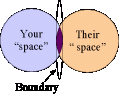
  1. Know who you are and that you’re okay, flaws and all.  In other words, carry with you a sense of what matters to you, how you respect and treat others, and how you require others to respect and treat you.  Claim your space. But… temper this with a sense of humor and awareness that the flaws we notice most in others tend to mirror our own.  For example, if I’m annoyed that my cousin is hogging the dinner table’s attention, it’s probably because I want to do it!  Humor and humility let me replace that annoyance with compassion.
  2. Know when someone is infringing on your dignity/space.  If someone keeps running over your foot with a lawnmower, it’s up to you to move your foot.  If you’ve previously asked the person not to run over your foot, and yet you see them heading down a line that’s gonna intersect with it again, then withdraw your damn foot!  For me, this means I no longer attend functions at which the lawnmowing person will be present.  For you, it may mean leaving before a certain person gets drunk.

Love and tolerance is our code – now and always.  But that love must include ourselves, and that tolerance an admission that some vulnerabilities and triggers persist despite all our work.  Just walking into a house where trauma occurred can be exhausting.

So, as with any dicy situation, have a plan in place before you go.  Bring your own Martinelli’s — lots of it.  If alone, text sober friends ahead of time that you may be calling.  If with a partner, have a “safe phrase” that means “I need to get the hell out of here.”  Then smile, say your goodbyes, and get the hell out!

Looks kinda freaky but it’s not!

If you find yourself out of sorts, get your ass to a meeting.  Most Alano Clubs and big meetings host all-hours alcathons throughout the holidays.  Go.  Sit down.  Be initially disappointed that the group appears small and motley, or huge and you don’t know many.  But just sit there, just listen, and let the feeling of sober sanity and spiritual guidance seep in through your skin.

Reach out to someone with kindness.  We all struggle with this holiday stuff.  You are never alone.  ❤

.

4 Comments

Filed under Al-Anon, living sober, Recovery, Sober Christmas, Sober holidays, Sobriety

Thoughts on god (1)

Maybe the most life-saving aspect of AA and all the 12-step programs it has spawned is that we get to pick our own higher power. We don’t have to consider anyone else’s views of an HP — certainly not religion’s — as we generate an idea of the source in which we’ll place our trust.

I like to think of our conceptions of god as a sort of placeholder – something to represent the “you” we turn to – because it can be easier to reach out to “somebody” if we have some sense of who/what that is.

Reaching out to that power is the core of recovery as I know it.  If you’re dying from addiction, slowly or quickly, it is the solution.  The biggest stumbling block for most newcomers is that our culture still associates “God” with organized religion’s construct of a judgmental deity.

Prior to organized religion, human tribes had for many millennia held a sense of god(dess) that was multifaceted and unified with nature.  But in the shadow of the agrarian revolution, as societal power became increasingly stratified, monotheism arose.  In the case of the Judeo-Christian tradition, this “God” — the grouchy, punishing Dude in the Bible — became a political tool for those in power to cow the subjugated masses into compliance.

Modern goddess image

“Overseer’s Rod,” from Queen Mary’s Psalter, 1320

.
Then, between 1600 and 1945, the Scientific Revolution gradually caused religion to crumble and fall — which was actually a good thing.  But, tragically, we have thrown out the baby with the bath water, god with religion, and the result is the spiritual turmoil now raging throughout the world.

We stand at an extremely perilous in-between era of human history, where billions who have turned away from the rubble of religion suffer anxiety and depression, and billions who still cling to its distorted structures justify judgment, exclusion, and cruelty via its tenets.

Humanity needs a new god — one indivisible from Gaia, the complex life system of which we are a part.  It is my belief that the evidence brought back consistently by Near Death Experiencers (NDEers) can offer humanity an evidence-based foundation for such a god.

I’ve decided to risk offering a series of posts on my own ideas of god, based on my NDE, the many NDE narratives I’ve heard at IANDS meetings over the past five years, and NDE narratives I have read.  If any of these ideas resonate with your ideas of god, take them.  If not, leave them.

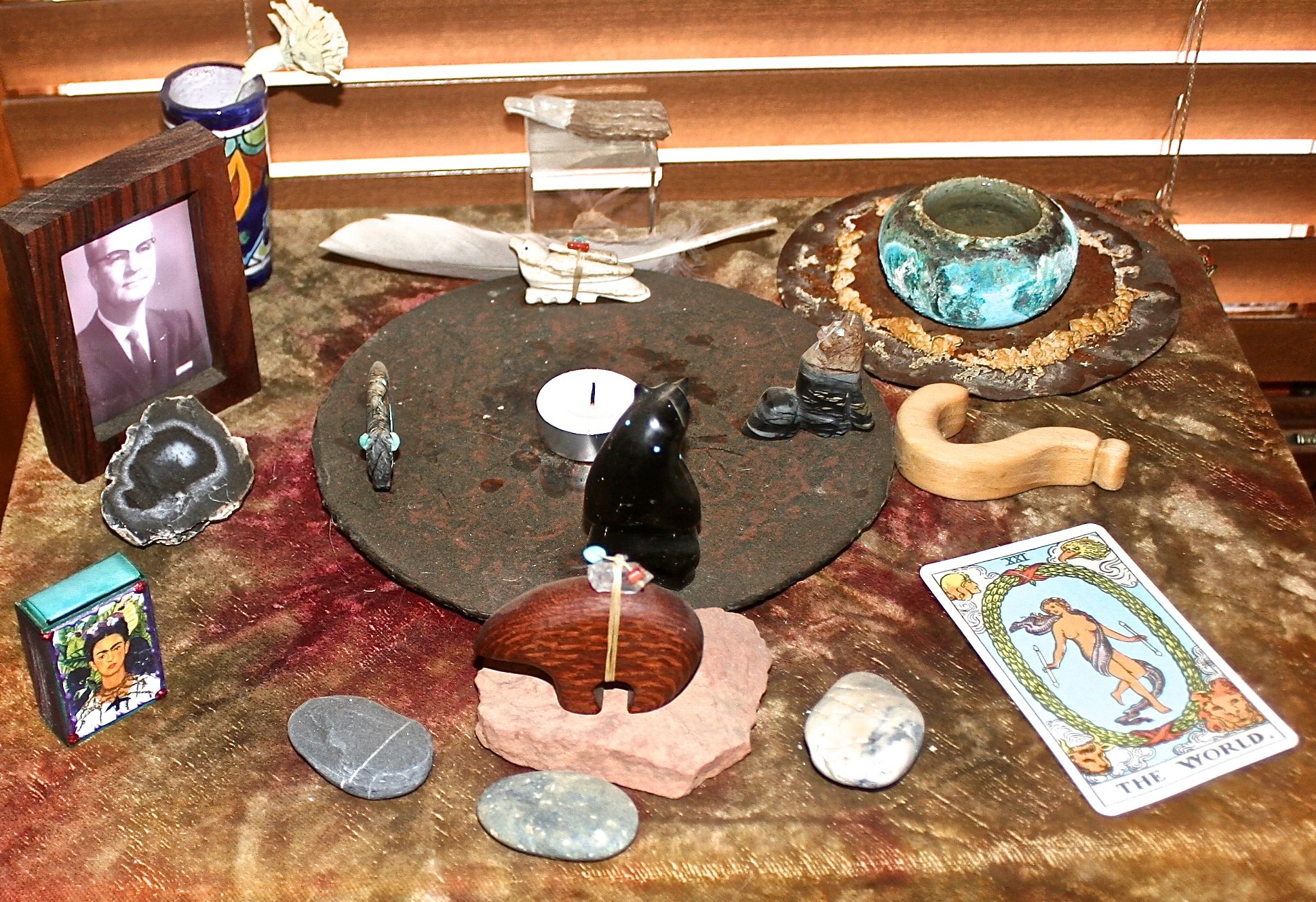
Have you ever created a personal altar? It’s just a sort of sacred place in your home where photos of loved ones or meaningful objects remind you of what matters. It’s in a similar spirit that we can each assemble our concept of god(dess) – as a collection of ideas that call to us personally.  My aim here is just to offer some little crystals or shells you might add to yours.

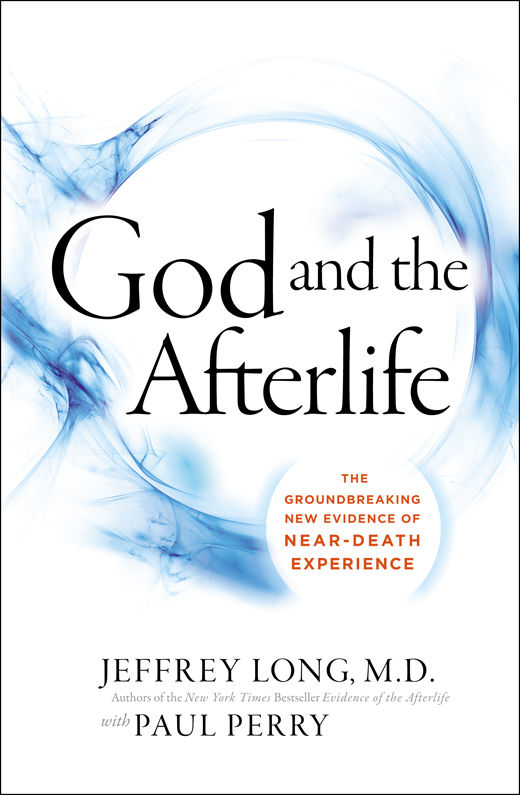
Two excellent books on Near Death Experiences are Jeffrey Long’s Evidence of the Afterlife (2010) and God and the Afterlife (2017).  Both are based on thousands of NDEer’s responses to a survey accessible on the Near Death Research Foundation website.  Responses come from all over the world, and the average time elapsed between the NDE event and filling out the survey is 20 years. (Strangely, NDE memories do not fade with time.)

The upshot of Long’s research is that God loves us with a Love more powerful than words can describe.  Here are some excerpts:

“I knew that the being I met was comprised of a substance I can only call ‘love,’ and that substance was a force or power, like electricity.  Love is the only word I have, but it’s not the right word here” (God, p.53).

“I became aware of a presence vast and unimaginable, everywhere and everything, the beginning and the end, and he was Love.  I came to know that Love is a power to rival all powers — real and perceived — in the universe. (God, p. 174).

“All That Is can be perceived simultaneously as a force and as a consciousness that exists within each individual consciousness and yet is separate from each consciousness or being.  It might be called God, but the ideas of gods that we have are a pale and incomplete shadow of the All That Is that I perceived” (God, p. 175)

Further, many NDEers learn that we are here on this earthly adventure as part of the expanding evolution of Love – though sadly we “forget” what we came here to do.  The challenge of life on earth is to balance the self-preservation instincts we need to keep us housed in our bodies (fear/ego) with our mission of furthering Love by overcoming separation from other sentient beings (who only seem to be “other”).

“I was told that the earth is like a big school, a place where you can apply spiritual lessons you have learned and test yourself to see if you can ‘live’ what you already know you should do” (p. 101).

Many survey respondents (but not I 😦 ) were shown life reviews.  These incredibly detailed yet compressed replays of their life’s events are witnessed by about 22% of NDEers (who in turn comprise about 15% of those who die and come back).

Almost exclusively, these replays focus on acts of kindness and cruelty, along with their effects rippling outward throughout the world.  Most watch them together with a loving spirit who urges learning but not self-rebuke.  Here’s an excerpt:

“I was in the eighth grade, and me and my friends were verbally abusing another one of our friends.  It was cruel behavior, and I was drenched in cruelty. … I experienced the humiliation and pain of the girl we were tormenting.  I didn’t just see her, I got to be her as she huddled next to the lockers, crying alone… My mind and heart were crying out, ‘I’m so sorry!  I’m so, so sorry!’ … I felt a presence with me [that]… expressed amusement over my despair and said, with heart and mind, something to the effect of ‘You were just a kid.  How bad could you have been?’  Then I was embraced by layer upon layer of compassion” (p.100).

Even when we fuck up, we are loved.  No one expects us to ace this.

In short, god is the energy of Love that created and sustains all that is. Addiction cuts us off from god as we bombard our brains with meaningless dopamine, sabotaging our mission.  But when we sincerely ask god for help, we open a channel that allows it to enter us, guiding and strengthening our hearts, healing us from the isolation of addiction.

It does so by slowly teaching us to love others as it loves — unconditionally.  That is the not only the purpose of life, but the cure for all that ails us.

More next time.  ❤

scroll


1 Comment

Filed under Addiction, Faith, God, NDE, Recovery, Sobriety, Spirituality

Half Measures Avail Us Relapse

“Half measures availed us nothing.  We stood at the turning point.”       (Alcoholics Anonymous, p. 59)

If you’re an alcoholic who can find a way to permanently quit drinking outside AA, that’s awesome. Go for it!  As they say in the Big Book, “If anyone who is showing inability to control his drinking can do the right-about-face and drink like a gentleman, our hats are off to him” (p. 31).

AA is for is the person who can’t, who’s tried and failed, then tried and failed some more… and frickin’ can’t stand herself anymore. Here are a few of the ways I, personally, tried. At various times in my drinking career, with all my power of will, I swore the following:

  •  to simply drink less
  • to not drink on certain days of the week
  • to get more exercise, eat a healthier diet, and quit poisoning myself
  • to meditate my stress away instead of drinking
  • to practice affirmations for confidence instead of drinking
  • to stop drinking alone
  • to drink just wine
  • to drink just beer
  • to have no more than one drink with lunch and three in the evening
  • to prove to some asshole that I’m not an alcoholic, so fuck off
  •  to quit for a week starting tomorrow
  •  to quit two weeks except maybe next weekend
  • to drink slower so I’d get less bombed

None of them worked.  None.  Know why?  Because I’m an alcoholic.  That means my brain is, by definition, BROKEN when it comes to controlling my intake of alcohol — or weed or cocaine or any mind-altering substance.  I default to having just a bit.  Once I start, my mind has only one setting:

And… I cannot fix my broken brain with my broken brain.  If I could, it wouldn’t be broken.  I’d just tone my drinking the frick down and get on with life — right?  I would not be an alcoholic. I would not need AA or the steps or a higher power.

But here’s the thing, guys.  We’re kind of pucked.  We’re trying to mentally control a problem over which we have no control.Half Measures = Half Assed
Some of us go to AA because we get it: we’re pucked, and we’ll do everything we’re told — go to any length — to get our lives back.  We take Step 1, admitting we are powerless over alcohol and cannot manage our lives.

Others of us, however, go to AA as one more item on that fucking worthless shit list above.  We just add

  • go to some AA meetings

to our personal “I’m not gonna drink” management scheme.

Doing so is what we call a half-measure, meaning that I still believe I  wield control.  I’m using AA as an aid or support group, but ultimately, my ego maintains I’m taking control of my desire to drink.  That idea is utterly worthless.  AA meetings will do no more for a half-measure drunk than getting a “Sober Forever” tattoo, because, inevitably, we still have that broken brain.

Just ask anyone who repeatedly relapses.  It may sound harsh, but in my experience, except in rare cases complicated by “grave mental disorders,” a vast majority of those who fall back into drinking have not gone at the program from their inmost heart.  Relapse happens when our egos tell us, “I don’t really need to X anymore [insert go to meetings, write inventory, work with a sponsor, etc.]  I’ve got this.”

Going to Any Length
A few weeks ago I was at an early morning meeting sitting near a newcomer.  The meeting’s chair had used a random Big Book quote picker to cite the passage, “Your job now is to be of maximum helpfulness to others…”

“That bothers me,” the newcomer shared.  “I’ve got six months and I feel like I’m struggling.  I can’t be of maximum helpfulness to anyone!  How’m I supposed to devote my life to  — I mean, I can barely take care of myself right now!”

At the break for 7th Tradition, I scooted over to him and said, “Who defines ‘maximum’?  All it means is, the maximum you can do today to be supportive to someone else.  You’re here.  You shared honestly.  Maybe that’s your max today.  The point is that you’re trying your best.”

Trying Your Hardest = Giving Up Control
This may sound like a contradiction, but it’s only when we really give up control that we become willing to try our hardest at spiritual growth, and vice versa. When, after 14 years of trying my hardest to drink less, I realized I was going to die drunk, and after 34 years of trying to make other people like me, I realized I hated myself, I walked into an AA meeting and finally let go.

It didn’t happen all at once.  The first letting-go was just going to meetings.  The next was actually praying to… something.  Next was getting a kick-butt sponsor, then doing everything she told me whether I felt like it or not.  “You’re going to lead an AA meeting in the women’s prison work-release house,” she told me.  Did I want to do that?  Hell no!!  The women seemed huge and thuggish and scary to me!  When they hugged me, I nearly suffocated!  But I showed up each week regardless.

I’d given up calling the shots.  I wanted to change, to have what I saw in Karen, my sponsor.  So I did exactly what she told me.  I wrote my inventory, acknowledged my defects.  I made my amends.  I sponsored.

Last week, my current sponsor, who has 32 years sober, asked me, who have 22 years sober, if I’d drive out with her to Bellevue and (wo)man an AA booth at the National Tribal Health Conference.  This was a big deal, she explained — the first time the Indian Health Board has ever invited AA to attend, though nearly 12% of Native Americans die of alcholism.

Did I feel like driving out there this afternoon and “working” after work?  Hell no.  Did I do it?  Hell yes.  I don’t ask questions or weigh the pros and cons relative to my sobriety.  I just GO.

The result?  I’m in no way special or virtuous; I’m just happily sober… one more day.


6 Comments

Filed under AA, Addiction, Alcoholism, Recovery, Sobriety

Global Fears and the Alcoholic / Al-Anon

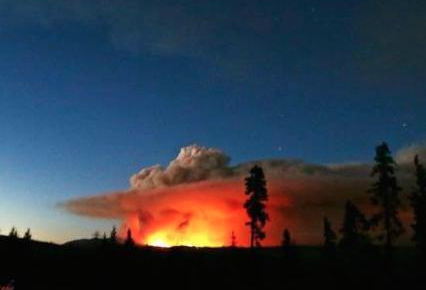
I’m a alcoholic who lives in Seattle, surrounded by the beautiful forested mountains that heal me on long hikes — which are currently going up in flames as never before.

Wildfires Increasing 17

What’s the big deal?  The graph to the right shows the nationwide trend of bigger, more numerous forest fires (in spite of more volunteers and better firefighting equipment).  This year, 2017, scores of wildfires consuming record acreage under “extreme” conditions of prolonged drought and heat have caused all northwestern states to declare emergencies, as has British Columbia.

Fire
Jolly Mountain Jay Milton 6_1504467853050_10574873_ver1.0
2017_09_02-10.14.51.073-CDT

These super-fires incinerating our waning wildlife habitats are not part of the natural cycle: rather, they’re symptoms of climate change.  For many people, the loss may seem nothing major.  But for me, it’s personal. These forests are my church.  Wild creatures are my saints.

So when it “snowed” ash in Seattle this past Tuesday, our sickly yellow skies blanketing everything from Seattle to Portland with flakes of what had recently been verdant, living trees, I felt as though the bodies of dead loved ones were raining down as an omen: if we continue on as we’re going, our planet will die.

Witnessing this phenomenon, unprecedented in my 57 years of living here, has ravaged my serenity.  Also on my mind are the two record-breaking hurricanes striking from the south, which the US president, who does not “believe in” climate change, has eloquently described as follows: “It looks like it could be something that will be not good. Believe me, not good.”  More imminently, this incompetent megalomaniac controls the US nuclear arsenal while a godfather-like thug controls Russia’s — and a madman in North Korea has just announced that he, too, has a nuclear bomb.

What do you do?!  How do you live?!  I’ll tell you what not to do: what I’ve been doing.  I’ve been actively willing the world to change.  Haven’t you felt all the mental and emotional effort I’ve been pouring out, day after day, compelling everyone to see what I see and think what I think~?  Hasn’t Trump’s brain been affected by my constant mental criticism?

Nope.  Not a bit.  The only person impacted by my anguish… is me.  I’ve been carrying the world’s woes in my tightened throat, upset stomach, and continuous low-grade headache.  Today I, like so many Al-Anons, am sickening myself with fear and worry much as I once nearly killed myself with drugs and alcohol — believing again and again that I’ll somehow move closer to what I want using something I know does not work.

I fall again and again for the notion that I can control the world around me.  I forget I’m powerless over people, places, and things. But my inner addict never forgets the care-banishing, fukitol power of a drink or a drug.  “There’s an easy way,” it lobbies from the back of my mind, “to quit giving a shit about anything or anyone.”

What else can I do?  You guys have taught me, I always have access to three super-powers: a) meditation & prayer, b) program, and c) action.  I know, I know — they don’t sound real impressive, but they’re transformative, redirecting my path from a destructive to a constructive direction.

a) Meditation and prayer are, strangely enough, the antithesis of worry.  Sitting with eyes closed, I simply quiet my mind as I get to know the inner space of my consciousness.  It’s a lot like entering a dark room and waiting until your eyes adjust.  I can note how urgently or lackadaisically my thoughts enter; I can note my reactions to them, de-escalating from “Holy shit!  I just remembered this ultra-important thing!!” to “Yup… that’s us thinking again…”

At this point, I can begin to sense the inherent foolishness of my normal state of consciousness. I don’t blame myself for being foolish — I am, after all, just a person with squishy stuff in their skull.  I can see that I’m comically focused on my own world of thoughts, my own little “plans and designs.”  Why?  Because I’m scared shitless! I note the many ways I imagine I’m protecting what I love — my worries. For a few moments, I drop them all. I open to god instead and say, “This world is yours, not mine.  But I’m scared shitless.  Help me.”

NOW comes the point at which I can pray unselfishly, asking god to guide me to be useful beyond myself, and even to guide humanity to live on this planet less destructively.  Prayer, like mass meditation, does have an effect.

b) Program means that I go to extra meetings, talk with my sponsor or sponsees, and seek out ways to be useful to others. (Going to my homegroup tonight, I get to do all three!)  I can also write this blog to help you or maybe remind you to help others.

For instance, I was recently perusing this excellent book on not drinking which I’d forgotten I owned.  It’s kick-ass for folks in early sobriety.  I’m just gonna pass along the TOC here so you can recommend to newcomers either exploring one of these tactics (click to expand) or buying the whole damn book.


c) Action requires that when I say the Serenity Prayer, I be ready to actually change the things I can. I realized yesterday that, while my work used to require driving all over town to meet clients, now so many of them work at Amazon that on certain days I just drive downtown and back.  Guess what.  I live on a bus line. Rather than heroically taking out a huge loan to buy an electric car, I can simply get my lazy, germaphobic ass on the bus on those days to reduce my goddam carbon footprint.  (I promise to post a photo of me on the fucking bus below.)

9/7/17: Record-breaking hurricanes to the south; record-breaking heat and drought to the west.  This isn’t the Olympics, guys.  This is our planet.

I must do what I can… or I’m a hypocrite.

And yes, I’ve already called my congresswomen to express my views, but I can also plant trees, attend protests, and campaign next time around for wiser a president.

When I took Step 3 all those years ago, I made a decision to live a good life, to seek good/god in all things, and to act on its guidance.  Today that means I don’t get to wallow in worry and panic any more than I do in self-pity and resentment.

There’s always a better way.  Seek and we’ll find it.


PS: As promised, a few pictures of me riding the bus to work, which I now do 3 x per week, rain or shine.  A tank of gas lasts me more than twice what it used to.


.

5 Comments

Filed under AA, Addiction, Faith, fear, Recovery, Serenity Prayer, Sobriety, Spirituality