
A worthy life is simply one of honesty with oneself and god…
.
I go through phases when I wake up almost every morning with a gut-level anxiety, a feeling of guilt that I’m somehow not doing all I’m supposed to, shame for lacking “success,” and alarm that I’m getting old at a mile a minute. My whole life, the feeling claims, is a failure. Before I’ve even sat up in bed, this “not-enoughness” jabs at my mind,  prompting vague solutions that pop up like slot machine combos: “Earn more!” “Lose weight!” “Socialize more!”
Whether my not-enoughness, a default setting from childhood, will ever go away I don’t know. What’s changed is how I respond to it. Today I understand that it’s just a feeling launched by the part of me that’s still broken. I return its topspin tennis serve with a quick prayer: “God, please take this away and guide my thinking today.” While I put on my morning clothes and weigh myself, not-enoughness still chides at me. I dismiss it automatically and try to focus on the moment: gift of what I am doing, the good fortune of where I am, and the blessings of my reality. I commit to loving what is instead of lacking what isn’t.
The power for this practice comes from my god, a connection nurtured through many years of working all 12 Steps. Back when I relied on active drinking and codependency, I believed not only the not-enoughness, but the solutions my mind proposed. My high school refrain, “Excel more!” gradually morphed into “Be more liked!” If I could just win your admiration, I’d overcome not-enoughness. Sans alcohol I was terrified to converse with people, not realizing the main obstacle had to do with the coordinates of my head, which was firmly lodged up my ass. I could scarcely hear what you were saying, so preoccupied was I with self: what was up with me, what I thought you thought of me, and what I might say to impress you (usually figured out after you left). Sober socializing was, in short, torture.
Drinking, of course, fixed all that. It made me smart, funny, beautiful, and worthy.  Sure, I was still biding my time while you talked, but who gave a shit? I’d get my turn to blab soon enough and, whether you were impressed or not, I, at least, was fine with whatever the fuck I’d just said. The drunker I got, the wider my range of just fine became. Maybe you didn’t care to hear about ex-partner’s sexual foibles, but fuck it! Lissen! It’s hilarious!

Moi, back in the day
The infatuation addiction detailed in my memoir was really just a souped-up version of that same dynamic, with all my need concentrated on a chosen, magical person whose admiration (or even company) worked like cocaine. Sadly, these worth-seeking projects frequently morphed into real relationships – meaning that the magic one, by committing, lost all magic. Subsequently, when attacks of not-enoughness struck, I had no “soon things will be different!” to counter it with. I could only muffle its penalty buzzer with more booze and great ideas. All I’d end up with was a wreckage of mishaps, huge amounts of money blown, and a hangover like a brain full of puss.
Sobriety has by no means been a picnic. I spent over two years dry and tortured – fleeing the conversation clusters after meetings with mutters of “fuck ’em!” – before I finally worked the steps and became teachable. Slowly teachable, that is: I spent nine years in a codependent cocoon focusing all my anxious attention, from the moment I woke, on fixing my partner’s “problems” and ignoring my own. Really, that morning gong of not-enoughness did not emerge for me as a distinct phenomenon until I found myself waking up alone. “What is this feeling?” I finally asked.
Self-knowledge may not save us from drinking, but it sure helps with other problems! The steps have transformed my economics of worth. The only worth I can feel, I understand now, is self-worth. I am the only agent who can generate that rebuttal to not-enoughness, no matter what anyone else may think of me. God has shown me how to cultivate self-esteem by doing estimable works. It has guided me to grow a loveable life by loving my life. It has taught me to connect with others more through my heart than my words.
Despite what the zillion ads we’re bombarded with would have us believe, a worthy life is simply one of honesty with oneself and god – whatever that may look like for the individual. For me, it means I do the best I can with what’s right in front of me  and trust god that whenever a suitable door approaches, god will not only alert me, but open it. Why did I start up the small business I run today? Doors would not open to the 500+ jobs I tried for following my layoff, whereas with just one little ad, the business practically threw itself at me. Like incremental promotions at a firm called Happiness, Inc., small choices I’ve made have gradually steered my life away from money and prestige toward more time and freedom. Thrift at home is part of my work. True, I drive a beater and shop at Goodwill, but I also get to walk my 13-year-old son to school each morning, laughing about this and that. I get to write instead of wishing to. I see friends. I take loads of ballet classes, raise cute hens, and execute my own half-assed home repairs. Overall, my life today reflects the truth of who I am – a plenitude of what I value and a shortage of what I don’t. That’s the true test.
In fact, by the time I go to bed each night, I’m overwhelmed with gratitude for my beautiful, rich, love-filled life. My only prayer is, “Thank you, god, for all of it. I love you.”
Tomorrow, I know, it all begins again.







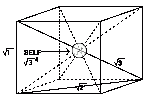 in not laying too much on us at the outset. In chapter 1 Bill W. describes being “catapulted into the 4th dimension of existence,” where we will know “happiness, peace, and usefulness, in a way of life that is incredibly more wonderful as time passes.”
 making coffee, answering phones, helping with set-up or tear-down. Reluctant as I was to take on one of these, I found that, strangely enough, during my duties I experienced a sense of ease and comfort I’d never known before without being drunk. I didn’t get why, but I knew I liked it (and still do). Same thing when I started sponsoring other women. I remember marveling each time I closed my front door at the end of the hour, how was it that “getting out of self” felt so damn good? How had those all-consuming morasses of my own problems dehydrated to little flecks of scum in just sixty minutes? What was this lightness, this joy that let me turn back to my own life with love and gratitude? I didn’t understand it.







 Though I loved my father for joking with me, which he rarely did in his last years, I could barely fathom the mindset involved. Every doctor he’d seen in 30 years had pronounced him an alcoholic with an enlarged liver and advancing wet brain. I’m sure he was warned about his thinning heart walls as well. Mom would confide these medical concerns to me when the mood came over her; more often, she pretended along with Dad that they simply didn’t exist. Despite the thousands of mornings he’d awoken with killer hangovers, Dad’s thinking around alcohol had changed not an iota since the fabulous cocktail parties thrown in my childhood. My father was a brilliant man. How could something so obvious be walled out from his reality?
 tried to seek god, it seemed there was practically nothing there to reach for. “Flimsy reed” described it perfectly – as if I were trying to grasp something too insubstantial to even feel. What I understand today is that god wasn’t the thing under-developed; it was my barely-there true self trying to connect with it! I had no familiarity with my own soul. I’d lived 99% of my life in the realm of ego, constructing myself around comparisons of what I thought you thought of me versus what I thought of you. Was there anything genuine in me, besides fear? I couldn’t find it. But as it turns out, pursuing sobriety is about pursuing the truth of ourselves that is inextricably connected to god.




 A Spiritual Evolution