Category Archives: Spirituality

How a Near Death Experience and its aftermath compelled me to recognize the reality of god and an “other side.”

Compassion – the best thing you can do for yourself

“Think of others as you would have them think of you.”

.

Self-centered like me?  Love others.  Got problems?  Give it all you got.

It may seem counter-intuitive, but practicing “love and tolerance” (p. 84) for all brings enormous spiritual, mental, and even physical benefits.  What I think about you inevitably colors the attitude I have toward myself, which in turn shapes my experience of life. We can know this based on anything from having lived it to abstract theories of quantum physics telling us the universe is made of energy.  What you dish out is ultimately what you get.

Years ago I recognized myself in a share by my friend, Andrew K..  He told about a time near his bottom when some friends Door peepholestopped by to see him.  From the upper story of the split-level where he lived, he silently crept down the stairs as the friends went on ringing and knocking.  Cautiously he peered out through the peep-hole to see them standing on the front slab exchanging conjectures about him.  What did they want?!  Whatever it was, he couldn’t handle it.  He just didn’t have it in him. Pleased at his evasion, he retreated oh-so silently up the stairs.
Andrew contrasted the story with his experience around Step 7:  “The more I judge you, the more I’m sure you’re judging me, so I actually experience that judging and judge myself.  And on the flipside, I’ve found that the more I let you be you and maybe even love you for it, the more I assume you’re okay with me, and so I’m okay with me.”

Our culture of scarcity encourages us to hoard love, but spiritual axioms teach the opposite.  The doors of the heart need to be oiled daily so that they’ll open even for strangers who “don’t deserve” our love and the very people who irritate us, as well as those in our inner circle.

We do pour out love toward a certain class of strangers all the time.  Yesterday during my ballet class, babyfor instance, we could hardly keep dancing for all the affection we were flooding through the studio’s big storefront windows.  With Halloween a week away, neighborhood retailers were holding a “Safe Trick-or Treat,” so the sidewalk featured a constant stream of bumblebees, superheroes, and characters from all kinds of stories.  Dressed as a dolphin, a woman handing out candy stood with her back to us, so the children would pause facing the glass, where we could see them perfectly.
Our teacher couldn’t help interrupting herself again and again.  “Oh my god, it’s Princess Leah!”  We all looked, and what I saw almost overwhelmed me.  She stood about two and a half feet tall in a flowing tunic, the classic dark buns on either side of her head slightly askew.  Tentatively, knowing what she was supposed to do, she approached the dolphin woman, her eyes staring up with a mix of trust and caution.  People flipped her off.  They called her a fucking bitch.  They judged her as a slut or a failure or beneath their concern — not yet, not yet, mind you.  But in her future.

Tiny Princess Leah was only doing her best, as she will throughout her life, and as will the Incredible Hulk who followed her with his impossibly muscled little green chest.  Already, they’re being taught who to be and how to get stuff.  We find it natural never to judge them (greedy little schmucks!) for what they “ought” to know or do.  To love them freely is ingrained in our culture.

Just for today, what if you practiced seeing the toddler in every person you interact with?  The spirit within that person is exactly the same.  Or what if you tried calling up a “legitimate” feeling of love – a glimpse of your loved one’s inner beauty or a sleepy kitten snuggling against you – and purposefully grew that energy in your chest like an expanding sun until it shone on every sight, sound, and experience?  Commit to loving.  Keep it like an inner homefire that must never go out, not even when fear tries to snuff it or anger tries to blast it from you.  Hold onto it as your homage to goodness, and practice radiating what it generates in all you think and do.

Sun

This under your sternum.

What you’ll get is a world transformed by love.  Today I notice small gestures of love from others that I used to discount as empty manners.  I joke with strangers about the dumbest shit, and to me our shared laughter rings out more beautifully than church bells.  I’ll never be some spiritual giant.  I wrestle daily with a shitload of fear.  But love is god’s power, and I’ve found that channeling it actually lends me power over fear: I sense an active energy of goodness all around me.  The world will feels safer.  If you’re coming from a place of love and encounter darkness in others – cruelty or deceit – you feel it as the anti-matter of goodwill and respond with mourning more than angry contempt.  The difference is huge.

Finally, when you least expect it, awareness will slip in that you, too, are loveable.  It’s hard to grasp, but in this moment, you – despite everything you regret in your past – are as innocent as you were at Princess Leah’s age.  Society sells you its weird customs and you suit up and give it a shot.  You look up toward life’s unknown with the same mix of trust and caution.  You, too, are vulnerable and unique.  It’s okay to see that with love.

Loving the good in others and yourself will swing wide the doors of spirit so you can breathe, and play, and thrive in the freedom of generosity.  It’s either that, or keep peering through the peep-hole.  You can choose.

.

.

Leave a comment

Filed under living sober, Recovery, Sobriety, Spirituality

When the Darkness Comes…

Ways to stay chipper

I’m resolved to be happy, to enjoy life.  In the summer months, happiness comes easily.  I’m active, whether alone or with friends, and never short of energy or enthusiasm.  But when fall comes I start to feel the tides of darkness encroaching, dragging me down.  Now’s the time I have to make a note: candleDepression Alert!  Because I’m prone to Seasonal Affective Disorder and live in Seattle, because I suffered depression throughout my 30s and my brain chemistry still teeters on that brink, and because I’m a damn complex and moody alcoholic in recovery, I need to be careful.

I once read that depression evolved as a survival strategy to prevent us from doggedly pursuing unrealistic goals or otherwise squandering energy without a high return.  I envision some primitive humans all gung-ho to build a tower to the gods despite all setbacks; some kind of “fuck this!” switch had to evolve somewhere along the line.  primitive2-1024x681More practically, in fall and winter there’s just not as much food out there for a hunter-gatherer to net, so we developed the impulse to hunker by the home-fires to avoid fruitless expenditures of energy.

The trouble comes when my brain decides to categorize the entire enterprise of living as a fruitless expenditure of energy.  I look around: the house will never stay clean; dishes and laundry never stay done.  My bank account acts like a storage tank with a gaping hole at the bottom.  I gleefully deposit checks only to see that some damn auto-deduction – the gym, car insurance, internet – has slurped up half of it before I even drive home.  I keep getting older and ricketier plus people seem to forget about me if I don’t keep showing up for social stuff.  Doesn’t that make all of these unattainable goals?  Shouldn’t I just give up and hunker by the home-fire?

I choose not to take prescription antidepressant drugs because, lucky for me, my depression is only seasonal and not debilitating. It’s just the daily challenge of my emotional weather. I want to learn to navigate life in stormy as well as in clear sailing.  Wisdom, I believe, gets pounded out in that struggle. I don’t mean to poop on meds or those whose brain chemistry leaves them no other option. Chemistry is chemistry.  For myself, though, I envision my depression as a pit of darkness I have to circle until spring, walking a narrow, angled, and slippery path on its perimeter.  The tactics below help me pick my steps.  But if I were to fall in (become clinically depressed) none of them would do any good.

THE SIGNS

  • I filled with a low-level dread but have no clue what it’s about.
  • I may or may not decide I’m scared of finding myself broke and alone.
  • The prospect of socializing seems an Olympic event, demanding coherent remark after coherent remark like a series of hurdles I barely clear.
  • The prospect of going to work feels like storming a hostile dagwood napempire of steel, concrete, and synthetics, where nothing natural or charming can survive.
  • The world’s goin’ to hell in a handbasket.
  • All I want to do is to eat cookies and nap peacefully.

What to do?  I fuckin’ pray.  I don’t want to, but I do.  I ask god to help me remember how to live.  God, I have found, is all about can-do and positive action.  It doesn’t empathize with lackadaisical whining, but counters, What can you do now?  It tells me I already know the answer.  And I sort of do.

THE CURES

Whether I feel like it or not, I have to FORCE myself to…

  • Exercise – take a ballet class, go for a run, something
  • Make coffee/pho dates and go to more meetings
  • Go outside and do SOMETHING – anything!  Rake leaves, walk the dog
  • Practice gratitude; love others; be of service
  • Meditate more
  • Eat healthy, for god’s sake!
  • If it gets really bad, bust out the Happy Light, St. John’s wort and/or 5 hydroxytryptophan

All these tactics help a little.  But I also have a secret list of unofficial aids that help me – things I’ve never seen in magazines.

 UNOFFICIAL AIDS

  • Make something – bake, draw a picture, knit
  • Light candles to an impractical degree, maybe even in daylightmusicnote
  • Play happy music
  • Smile and yawn more – both give your brain a lift
  • String up indoor Xmas lights irrespective of Xmas
  • Watch no TV; avoid pop-culture magazines; limit social networking
  • Practice mindfulness, focusing on loving what I am doing now

Here’s my thing with mindfulness: sometimes, it can get boring.  I mean, obviously, it’s a discipline, so if I’m getting bored, that means I’m not practicing well.  Still, I’ve developed some tweaks to make it more interesting – and most of them involve pretending.  Recreational pretending, in my opinion, is vastly underrated. My brain chemistry doesn’t seem to distinguish much between real and imagined sources of happy, cozy thoughts.   In fact, pretending, if executed skillfully, can feel like a little uplifting,  drug-free trip to another place.

Bourges-Fiji

MINDFULNESS TWEAKS

  • I pretend…
    • that I live in a charming, romantic country or exotic tropical place.  My home is in some village of France or on the island of Fiji.  I can smell the odors of baguettes or tropical flowers.  This can work when you’re driving if you pretend you’re touring quaint vistas.
    • that I’m super rich but eccentric and choose to live exactly as I do
    • that I live in an amazing dollhouse.  I was once on a ladder fixing a small window that looks in on my living room.  Inside, the evening sun was lighting the space with a warm yellow, and it looked to me like a weirdly classic doll’s house with every detail delightfully realistic.  I can still call up that feeling which changes mess to fantastic precision.
    • that I’m a 14th century monk used to abjuring all physical comforts, but just for today, I’m cheating!

The goal of all these quirky imaginings is actually to practice love and acceptance.  The act of assenting to the circumstances of our lives – calling them good – is what brings contentment.  I’ve developed these roundabout means of doing what you can practice directly: loving everything your senses bring you, loving being alive.rainbow_heart

5 Comments

Filed under Recovery, SAD, Seasonal Affective Disorder, sober, Sobriety, Spirituality

Drama Addiction vs. Emotional Sobriety

Drama – emotional turmoil for its own sake – is one of those things that may entail drawbacks for normal people, but in the mind of an alcoholic, can lead to serious trouble.  When I get too whipped up by anything, real or imagined, I ‘m pulled off the beam spiritually, which means I’m a further from god and closer to a drink.

DSC03002

Self-portrait, 1980 – 1/28/1995

One of my favorite lines in the 12 x 12 is this: “We learned that if we were seriously disturbed, our first need was to quiet that disturbance, regardless of who or what we thought caused it” (47).  In the past, we used to “quiet” our inner disturbances by drinking, which enabled us to excel at not giving a shit.  You remember those days, right?  Nowadays, though, we have to do manually what we once did chemically.  That is, living in sobriety, we have to find ways to become calm by letting go of what we can’t control.

Some call Al-Anon the grad school of AA – at least for those of us who are “Double Winners!”  (Can’t type that with a straight face!)  In any case, Al-Anon is where I finally got it – that axiom in the Big Book that whenever someone else seems to be upsetting me, it’s really me – my reactions – upsetting me.  My instinct is to point at the other person and say, “You’re the problem!”  But in every case, that conflict and pain is actually all coming from me fighting reality.  I can either be RESISTING something real, or MANUFACTURING something unreal, or both.

In years past, I’ve been addicted to infatuation.  While obsessing on that magic person, I’d play all these mind-movies of me doing stuff and them being impressed. “How extraordinary Louisa is!  Look how X and Y!”  As I’d bask in the idea of them thinking this, I’d get a glorious, glowing kickback of what felt like self-worth.  It wasn’t reallyDaydream-Cartoon-1966169 self-worth, though.  It was just a sweet dopamine hit caused by delusion.  (Because, lord knows, I couldn’t just have worth as a human being!)  Anywho – I’ve always assumed that when god took away that infatuation thing, I was also cured of the whole delusional projection business.

Except for something that happened the other night.  See, I write this blog with a lot of trust in you as an open-hearted reader, so when I figured out that a family member highly critical of me had subscribed to it, I became “seriously disturbed.”  My heart pounded.  I called friends.  And that night, I absolutely couldn’t sleep, because I kept imagining this person poring over every word, judging and condemning away.  Toss!  Not going to think about that.  Turn!  Except, what will they think of that part where it says…

God, as I’ve often noted, visits me mostly via a little “BULLSHIT” indicator light somewhere in the back of my mind.  I’m super busy signing onto my bullshit, which seems to be truth, so I’m certainly not going to recognize anything bullshitty about it, myself.  But after years of praying, “Please guide me, please help me grow,” I sometimes get this faint, subtle signal:  “BULLSHIT…  BULLSHIT… BULLSHIT…

It’s like a smoke detector going off when you have no idea what’s burning.  I have to root around for the source.  What, god, where?!

So I sat up, turned on the light, and grabbed my journal. As I wrote, I came to see how I was wrapped up in the opposite of infatuation, which involved just as much projection.  This time I had the little Louisa-hating puppet in my mind reading this or that part of the blog and thinking, “How awful that bitch Louisa is!  Look how X (shitty) and Y (shitty)!”  And this time the kickback was the opposite of self-worth – a hit of self-loathing and guilt.

300px-Flagellants

Good ole’ self-flagellation

Why would my ego want this?  The same reason I worry about stuff I can’t know or control – that delusion of beating pain to the punch, of somehow bracing myself for the worst.  But in shining light on my bullshit, I saw this projection had NOTHING to do with reality.  Yes, I can know this person does not like my blog.  But there I have to stop.  End of topic.  No matter how many times the old phonograph needle of my mind wants to return to that groove of our story in progress, I have to remove it and say firmly, “Not real.”

Maybe my ego’s just addicted to the self-importance of drama.  Compared to my projections, reality’s storyline is pretty tame.  “I’m here now” doesn’t merit much of a compelling soundtrack.  I realize it’s only human nature to imagine what we can’t know and, likewise, to feel emotional reactions to those conjectures.  But as an alcoholic, I can get addicted to just about any diversion from the work of being myself – that ordinary woman wiping down her kitchen counter.  What might it be like to really give up the idea that these projections, these personal dramas, have any bearing on reality?  What if, rather than losing myself in mental commentary and spin-offs, I were willing to be humble one moment at a time, and to live in the simplicity of what is?

God, I’m pretty sure, would click LIKE.  (jk!!)

images

5 Comments

Filed under AA, Alcoholism, living sober, Recovery, Sobriety, Spirituality, Twelve Steps

Service for the Lazy Alcoholic

So here we are, hopeless alcoholics, and we find out we can’t stay sober without god’s help. Dammit. Next, we learn we need to work the Twelve Steps to remove all the clutter blocking us from god, which entails a lot of time and work. Bummer.

But it gets even worse!  Service? Usefulness? These are scary words for the self-centered. The Big Book is kind of craftyhyper in not laying too much on us at the outset. In chapter 1 Bill W. describes being “catapulted into the 4th dimension of existence,” where we will know “happiness, peace, and usefulness, in a way of life that is incredibly more wonderful as time passes.”

Happiness. Yep, that’s on our spiritual shopping list! Peace. Definitely want us some o’ that! But usefulness? What’s so wonderful about that? Hmm. Apparently, we begin to sense, it’s essential to getting the previous two. Chapter 2 tells us, “Our very lives, as ex-problem drinkers, depend on our constant thought of others and how we may help meet their needs.” Yuck! we think. Constant thought? I don’t even like others!  Still, if our sole alternative is misery, we move forward.

Solution-based meetings urge newcomers onto a bunny slope of usefulness via a service position – two-coffee-urnsmaking coffee, answering phones, helping with set-up or tear-down. Reluctant as I was to take on one of these, I found that, strangely enough, during my duties I experienced a sense of ease and comfort I’d never known before without being drunk. I didn’t get why, but I knew I liked it (and still do). Same thing when I started sponsoring other women. I remember marveling each time I closed my front door at the end of the hour, how was it that “getting out of self” felt so damn good? How had those all-consuming morasses of my own problems dehydrated to little flecks of scum in just sixty minutes? What was this lightness, this joy that let me turn back to my own life with love and gratitude? I didn’t understand it.

Now I do.

What flows through us when we’re helping others is the energy of god – no less. We become that “channel” the Saint Francis prayer opens with, and, as the power of compassion, the desire to help, and the love that asks for nothing streams through us, we ourselves are replenished and healed. Beyond AA, almost any spiritual tradition worth its salt tells us helping others is essential to a meaningful life; Christianity and Buddhism are two that come to mind.  My own view of god as the collaborative power behind life works even better.

It’s as if the nutrients our spirit needs to flourish can materialize only in circulation, in flow from and to. The ego, walling us in, promotes stagnation.  By contrast, whenever I pray to feel god’s love for me, the prayer is answered in my flow of love for you.  All this makes sense.  But what it’s taken me years to abandon is that mistaken notion of service I developed early on – that we do X in order to get Y.

I remember the moment when my Al-Anon sponsor pointed out this disturbing passage embedded in step 9: “At the moment we are trying to put our lives in order. But this is not an end in itself. Our real purpose is to fit ourselves to be of maximum service to God and the people about us.”  What?  Not an end in itself?  A smile came over her face, probably in response to the look of puzzlement/ horror on mine. She said, “So many of us put the cart before the horse. We don’t help others so god will fix up our lives. No.  God fixes up our lives so that we can help others.”

So… what starts off as a quest for relief gradually morphs into a reason for being.  My body exists in order to let me move about in the world, and the more I use it, the more it thrives. My spirit exists to express love, and the same principle holds. To love each other is why we’re here. Period. The purpose of life, right there, Charlie Brown.pitfalls

A few quick addenda:

  1. Martyrdom is selfishly oriented, though easy to mistake for service. When I give help based on a preconceived notion of how someone should view/ respond to it, I’m not channeling god. I’m manipulating. I may want their fucking gratitude, or for them to live in a certain way to reinforce my rightness. Love, by contrast, is open-minded, freeing each person to find their own relationship to god.

2) Judging others is kryptonite to the part of you that loves. “Many of us sense that real tolerance for other people’s shortcomings and viewpoints and a respect for their opinions are attitudes that make us more useful to others” (19). Love does not “should” on anyone.

 3) Love is not enabling. “It is not the matter of giving that is in question, but how and when to give. The minute… the alcoholic commences to rely upon our assistance rather than upon God,” we’re both screwed (98).

Today a lot of my service work outside sponsorship involves just answering my phone.  This week alone I’ve gotten three alcoholic HELP! calls. I don’t try to solve anyone’s problems. Instead, I listen and love – and whatever comes out my mouth comes out. They can take it or leave it.

The most difficult of these calls I ever took came from an acquaintance crying almost too hard to speak.  She’d fallen in mutual love with someone she shouldn’t have, and though extremely aware of the moral stakes involved – why she was sobbing uncontrollably – she insisted this love was, for her, non-negotiable.  They hid nothing, but everyone had turned away from her.  She was in a living hell, losing her mind from all this pain!  I’d been weeding when she called, and I remember praying by my flowerbed to be both honest and useful to her.  My own feelings about such romances, having suffered the butt end of one, are intense. So much churned inside me – old hurts, judgments, pronouncements! – but compassion won out.  Pain, I told her bluntly, was the inevitable price for breaking her own morals and causing someone else even more pain. There was no way out.  But that said, I did have a lot of experience with living sober through pain, and I shared what had helped me most.  She was avidly grateful – more, I think, for my clemency than the suggestions themselves.

It’s a far cry from making coffee! And I can’t say I felt joy when I hung up, either. Rather, what I felt was a deeper acknowledgment of the difficulties of being dandelionhuman and compassion for all of us – including myself – who struggle with them. Bad weeds, bad loves!  There’s an element of arbitrariness in all our designations. I appreciated my own life not as an individual effort but as inextricable from my culture, which was in turn part of the larger unfolding of life – all of us trying to find our way. To feel connected with all things is the most profound form of peace, and for the next few hours – still pulling weeds but now a little more merciful – I had it.

Alcoholic or normie, we can’t help but be motivated by the rewards of service.  Today, though, I view them more as a chicken/egg phenomenon.  Being happily sober, we can be lovingly useful, which keeps us happily sober.

images

3 Comments

Filed under AA, living sober, Recovery, Sobriety, Spirituality, Twelve Steps

Robin W., Alcoholic

Note: This is the first time I’ve written about something outside my own personal experience, but it’s been on my mind enough that I felt moved to.

.

When Amy Winehouse’s body was found with a blood alcohol content of .4% (five times the DUI level), lying among scattered vodka bottles like so many smoking guns, most of the media and public understood that her death was caused by alcoholism.

Not so with the loss of Robin Williams – also caused by alcoholism, but in a much subtler sense.  The press does note that he had checked into rehab a few weeks prior, but his prolonged suspension of active drinking causes them to dismiss his addiction as conquered.  It seems to me only my fellow alcoholics are able to intuit the close relationship between his alcoholism, depression, and the unbearableness of being that led him to take his life.

Williams was very open about his 2003 relapse after 20 years’ sobriety.  He told Parade:Screen Shot 2014-08-13 at 3.06.06 PM

“One day I walked into a store and saw a little bottle of Jack Daniel’s. And then that voice — I call it the ‘lower power’ — goes, ‘Hey. Just a taste. Just one.’ I drank it, and there was that brief moment of ‘Oh, I’m okay!’ But it escalated so quickly. Within a week I was buying so many bottles I sounded like a wind chime walking down the street. I knew it was really bad one Thanksgiving when I was so drunk they had to take me upstairs.”

A Guardian reporter asked if friend Christopher Reeves’ death was what triggered his relapse.

“No,” he says quietly, “it’s more selfish than that. It’s just literally being afraid. And you think, oh, this will ease the fear. And it doesn’t.” What was he afraid of? “Everything. It’s just a general all-round arggghhh. It’s fearfulness and anxiety.”

He added, about the demise of his second marriage in 2008, years after he’d managed to get sober again:

“You know, I was shameful, and you do stuff that causes disgust, and that’s hard to recover from. You can say, ‘I forgive you’ and all that stuff, but it’s not the same as recovering from it. It’s not coming back.”

If you’re an alcoholic, you don’t just read these words; you identify with them because you’ve lived them.  You know that wheedling voice of the “lower power,” that all-pervading fear of existence, and the burden of shame Williams describes.  And if you’re like me, you feel tremendous empathy for this man, who had recognized his depression as a spiritual malady linked to his alcoholic disease and had tried his best to combat it by strengthening his spiritual connection in treatment.

According to the press, over the previous year Williams had been shooting movies and shows back to back, maintaining a “manic pace.”  To me, this frenzy of activity seems a way of trying desperately to live, to stay engaged in life.  My friend Dave McC  fought depression in a similar way in the year before his suicide, hiking the Cascade Mountains at a furious pace.  But the disease catches up.  It gets to us when we’re alone, worming into that inmost chamber of self where no one can reach us – except god.  What most pains me and frightens me about Williams’ death is that he knew the solution.  He had a program.  He was trying to help himself.  And yet for reasons we’ll never know, he could not access that “Power which pulls [us] back from the gates of death.”

So often, I want to think of sobriety as a set equation rather than a blessing.  That is, I want to believe that if you take certain actions, working the three sides of the triangle by going to meetings, working with a sponsor, and doing service work, then you’re guaranteed a certain result: lasting sobriety.  Williams’ death reminds me that’s anything but the case.  In fact, it’s all grace.  We’re guaranteed nothing.  We’re never home free – not even with twenty years’ sobriety and all the talent, intelligence, and accomplishment a person could ask for.

Rather, the fact that I – an alcoholic child of alcoholic children going back many, many diseased generations – write this with 19 years and 7 months’ sobriety is nothing short of miraculous.  The fact that you’re reading it with however many days or years you have sober – you, who are also hardwired to drink – is likewise a miracle.  Every day that we live in the light of sanity and sobriety is a gift.  It’s another day we can be grateful not to find ourselves in that tortuous nightmare of spiritually starving depression that led Williams – knowing alcohol and drugs would not help him – to choose the one-way exit of suicide.

From a broader perspective as an Near Death Experience survivor, I do believe Williams found not only relief but bliss in leaving his body.  For whatever reason, though, we are born into these earthly lives with a sense of mission to carry them out, and a love for the material world that anchors us here for their duration.  I’d like to live out mine, certainly.  But my sobriety, my faith in a higher power, directions to love and honor others through kindness and service, and the happiness I’ve been granted by pursuing this path all unite to remind me I am never in charge.  Certainly, I’m not in charge of my sobriety.  I can take the steps I know to nurture it, but the results are out of my hands.

In the end, the loss of this talented, accomplished man who could no longer stand his life reminds me to be grateful for today.  I don’t have a lot of  the stuff our culture equates with success.  But no gifts are more precious than sanity, sobriety, peace of mind, and the strength they grant me to love others freely.


scroll

.

312 Comments

Filed under AA, Alcoholism, Recovery, sober, Sobriety, Spirituality

Living Sober/Awake: True Self vs. Ego

Sobriety is about pursuing the truth of ourselves…

I remember when I was about three weeks sober, a short time after I’d realized the call of the ideal party was a pied piper of vanity that would lead me to my death, I came home snubbed and pissed at someone, opened a near-beer, swigged it, and slammed the bottle down on my kitchen counter, muttering curses as I squinted to light up a smoke.  At that moment, either I or something within me realized: I was drinking.  Or at least, as good as drinking – and would be soon if I didn’t wake up to it.  Some part of me was able to step back and see my posturing: I was cool, he was a bastard, so I would puff up and strut in my own company to feel vindicated.  I could see how incredibly dumb the whole deal was.

And yet I felt lost without it.  How could I navigate reality without my old scripts?

Just a few nights ago I went to my old homegroup for the first time in almost two years and witnessed something of the same thing.  The crowd there is young and hip, and many of the shares anticipate a too-cool mindset: “If you’re sittin’ there thinkin’ I’m a pussy for believing this shit, then maybe you should go drink, dude.  When it kicks your ass, maybe you’ll wanna listen.”  Now, this is a fine message straight out of the big book (p. 31-32).  But my reaction to the meeting told me something had changed in me.  I’d woken up to recognize as affectation what used to seem natural and neutral.  Recovery was present at that meeting, yes, but in the same way balletic grace and agility are present in pro football: you have to look past all the the thuggish aggression to see them.

What is AA’s “vital spiritual experience” that lets us recover from drinking?  Connection to a higher power.  And what part of us connects to that higher power?  Is it our social self, the part of us that negotiates a constant interchange of signals with others?  Is it our thinking self, the part that figures out where we stand relative to the ideas of the world?  Is it our will, the part that tries to manipulate circumstances to achieve whatever we’ve labelled optimal?  No, no, no! – clearly none of the above.  Then what is it?

We touch god with the inmost kernel of our being: spirit, soul, our true self.  When I first got sober andheart-chakra tried to seek god, it seemed there was practically nothing there to reach for.  “Flimsy reed” described it perfectly – as if I were trying to grasp something too insubstantial to even feel.  What I understand today is that god wasn’t the thing under-developed; it was my barely-there true self trying to connect with it!  I had no familiarity with my own soul.  I’d lived 99% of my life in the realm of ego, constructing myself around comparisons of what I thought you thought of me versus what I thought of you.  Was there anything genuine in me, besides fear?  I couldn’t find it.  But as it turns out, pursuing sobriety is about pursuing the truth of ourselves that is inextricably connected to god.

How do you recognize true self?  Here are some handy hallmarks.  Only the true self feels unmitigated compassion.  It loves without neediness or score-keeping.  My true self senses the sacred in every tree, bird, and human being it encounters, feeling connected to the goodness not only of living things but even in the inanimate world of matter.  My ego’s world, by contrast, runs a gamut of competitors, threats, means, and so what?  It’s a barren perspective of need.

I had an experience of a quick turn-around with from ego to true self the other day.  I was browsing on friggin’ Facebook, feeling inferior, convinced everyone was having a more rollicking summer than I was – all of them constantly water skiing, laughing, and carpe-dieming away.  In other words, I was caged in ego.  I came across a friend’s page and was busy envying his social life without even knowing it when I gathered from friends’ posts that he was in prison.  He’d relapsed.  He’d been caught doing something bad and sentenced to four years.

Half of me died and another half came awake.  If you want to say I had an emotion of feeling sorry for my friend, you’ll be missing the entire point, which is that I remembered love – an almost as physical sensation pouring from my heart.  My friend’s voice came to me, his energy, and his sweet shyness at my “18 years sober/get to keep my boob” party soon after my cancer diagnosis, where he was wet-behind-the-ears sober again.  He’d told me my example of constant kindness helped him, and he vied with others to drive me to my surgery.  I knew his goodness, and no one who has not lived as a puppet of addiction, doing things against your higher self, can understand the compassion I felt learning of his fuck up.  The tears his past photos brought to my eyes weren’t just for him – they were for all of us grappling with this disease.  Suddenly, all the brag posts on Facebook transformed.  Now they struck me as courageous: I understood we would all live, suffer, grow old and die alone, and that our show-offy flourishes on Facebook were no different from the exclamations of toddlers: “Look at me!”  “I did it!”  We’re all just doing our best.  We’re all trying to shine, do well, risk falling to grab the gold ring.

In that moment, my authentic self could see as god does – through the eyes of love.

What the Catholics refer to as “Holy Spirit” and Quakers as the “still small voice” does guide us more as we learn, over years of working our programs, to cut the crap and access our spiritual core.  Some of my NDE friends have encountered this voice on the other side as as their guardian angel, a loving spirit to whom ego makes us deaf.  Or maybe it’s the candle of god-energy in us.  Whatever you want to call it, this is the power that nudges us toward goodness, and it seems to me it’s what keeps us sober.  Only something beyond our own brains can guard us from the “curious mental blank spot,” but to connect with it, we have to sometimes let go our thoughts, emotions, and posturing and become, to the extent we can, simply our own aliveness, the bit of god inside.  More and more, I think living from that place is the sole path not only to sobriety, but to a meaningful life.

8 Comments

Filed under AA, Alcoholism, Recovery, Sobriety, Spirituality, Twelve Steps

Solo Hiking as an Alcoholic’s Inner Journey

I drank because I was maladjusted to life, and to a certain extent I still am.  So are you.  Life’s not entirely comfy for anyone, no matter how selfish or spiritual, because we constantly bump up against a reality that doesn’t suit our expectations.  Even Kim Jong-un, supreme leader of North Korea who can send any annoying person to prison with a snap of his fingers, probably has a list of reasons to be pissed at the end of each day.  The Dalai Lama, when I heard him speak, told about a fussy toddler on the plane whose mother kept trailing her up and down the aisle until he reflected, “I’m the Dalai Lama, and this woman has more patience than I do!”

One solution is to drink.  Drinking doesn’t change the world, but it dulls our reactions to it, granting us a temporary peace.  But notice that it’s our reactions to life, not life itself, that cause us pain.  And to go even further, what I called “life” by the end of my drinking was a conception thoroughly skewed by my distorted thinking.

I once worked with a sponsee who kept relapsing because she “needed to take the edge off.”  What was this “edge?” I would ask her.  Together we worked out a definition as “tension that mounts incrementally as I am untrue to myself.”  She felt her job forced her to simulate relationships and attitudes she did not really have, but rather than examining her reactions to people and situations, she A) suffered then B) medicated.

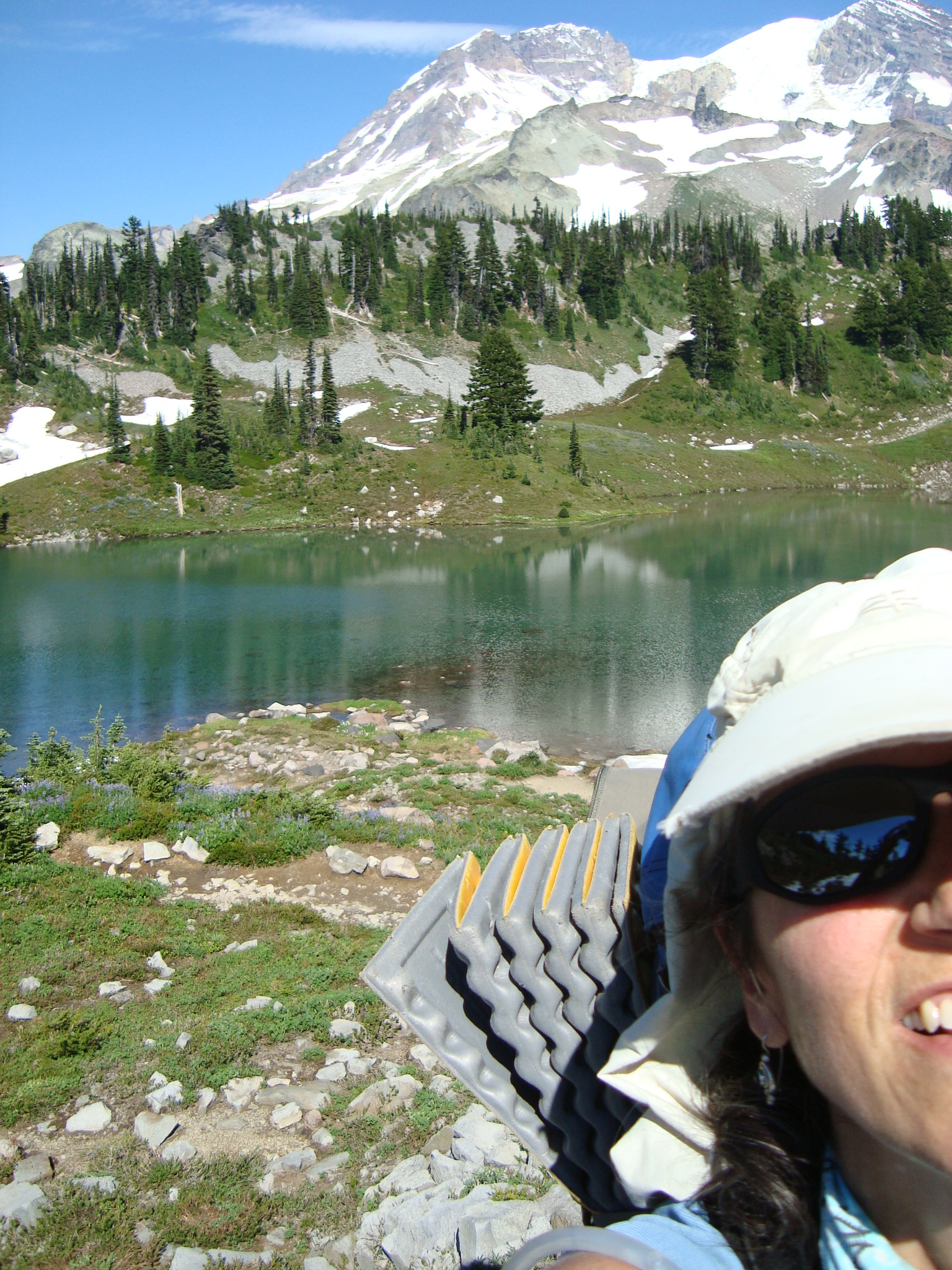
For me to react authentically in life, I have to know who I am and what I’m feeling – a feat easier said than done for a codependent adult child of an alcoholic.  (How do codependents greet each other?  “Hi!  How am I?”)  Hiking alone is, for me, one of the most powerful ways to arrive at this knowledge – especially longer thru-hikes that entail a week or so on the trail.  In 2012 I did the Wonderland Trail, about 100 miles and 22K’ of climbing/descending, and in 2013, still recovering from radiation treatment, I did a section of the Pacific Crest Trail (PCT) covering 75 miles and 16K’ of climbing/descending.  Hiking alone, the only interactions are between you and “nature,” people who’ve made or walked the trail before you, and the present-day hikers you meet.  Many, many hours are spent in your own company.  Incredible beauties are witnessed.  Countless decisions are made.  And each day brings a few hazards that call for courage.

PCT Section J

click to enlarge

Josephine Lake Wonderland


The first days, in my case, are about purging.  On Rainier, I found myself crying for two days.  This was my first major hike after breaking up with my boyfriend, who had taught me nearly every trail skill I knew.  But beyond that, I was coming to terms with the passing of youthful illusions that life stretches on and on.  How did I, Louisa, get to be 52?  Who was this lined, graying woman I’d become?  On the PCT, I expected tears again, but instead met with fear.  I’d begun by traversing Stevens Pass ski resort, and when the trail dropped from there into woods and rounded a hillside to a wholly new vista of indifferent, towering mountains through which I would pass, I got scared.  “What the fuck am I doing?!” I thought.  “What if a bear comes?  Mountain lion?  Rapist?  What if I fall and no one even knows?”  It took me a day or two to realize my deepest fears centered around cancer.  It had struck me, it seemed, out of nowhere, threatening everything I love, forcing me through a prolonged nightmare of treatment from which there was no escape.

In both cases, I had nowhere to run from these feelings.  I had to walk in their company, trudge in their muck until I truly got to know them.  In both cases, I came out on the other side to delight in a freedom so airy and light, I can’t possibly describe it.  The grief for all I’d lost turned to gratitude for the immense wealth I still had – these stunningly gorgeous surroundings plus the strength and know-how to travel though them.  The fear of cancer and all other scariness turned into a reconciliation with god.  Cancer happens, but I could choose to love all the cells on my team striving to protect me from it, and the many generations of medical experts all working to cure people.  I would choose to put my trust in goodness.

PCT J Camp

Dusk – I’ll tidy up! Clothesline strung behind my tent – wash in a large ziplock, dump away from source.

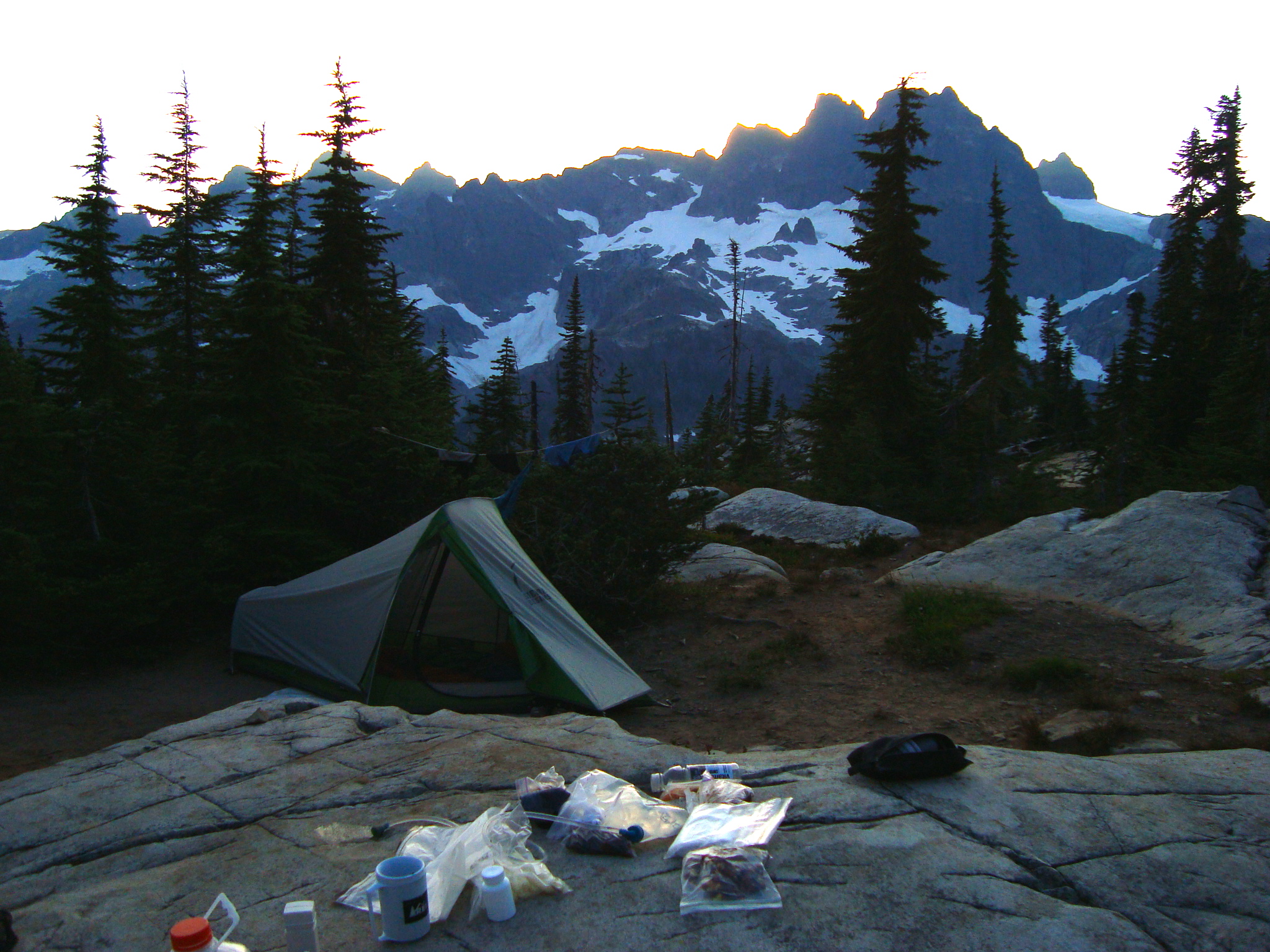
There’s nothing cozier than your own little camp, bedding down in your own tidy one-bitch tent, when you know what you’re doing.  You look at the map and see what’s coming up tomorrow.  Few moments are more empowering than, after passing warning signs of a high creek or a trail damaged by landslide, you gather your gumption and do what you need to.  Amid the roar of rushing water you choose your stepping rocks with care, plant your trekking pole and orient your balance to push off toward the next stance until, somehow, you’re across.  Or refusing to look down on the now tiny creek that wends far below, you focus on the narrow strip of trail that remains and keep moving.  Once you’ve passed these obstacles, they’re behind you.  Damn right, they are!  You don’t look back and analyze; your attention, buoyed by accomplishment, is all for what’s to come.

Finally, on both trips, I acquired an unexpected companion – both young men who loved the wilderness and had cobbled together from REI displays an idea of what they needed to get through it.  How could my pack be that small?  Why was I not wearing boots?  Why no Mountain House food pouches?  They asked to hike with me a few days and bombarded me with questions.  In each case, I developed love for a total stranger – one a butler to the most glamorous movie star couple alive, the other a Taiwanese Christian Electrical Engineer – sharing a grubby, spontaneous sincerity unimaginable in normal life.

The moral is that if I can practice all these skills on a daily basis – know what’s really going on with me, take each challenge as it comes, and love others by sharing whatever I have to offer – I am in tune with life.  And for as long as that is true, I will not develop an “edge” I need to “take off” by self-medicating.  There are ways to be free within the confines of our own skin.

DSC01967

Emerald Ridge, Wonderland Trail 2012

6 Comments

Filed under Alcoholism, Drinking, living sober, Recovery, Sobriety, Spirituality

Sober versus Dry: A Big Difference

Over the course of a life of recovery, the ego dies a slow and painful death.

Alcoholism is a disease of body, mind, and spirit, so for newcomers, the first order of business is definitely to withdraw from physical addiction by simply not taking a drink.  Doing this, however, doesn’t treat the mental and spiritual aspects of our disease.  Few of us drank ourselves nearly to death in the midst of an otherwise hunky-dory grasp of life.

AA doesn’t claim to have “a monopoly” on treating this three-fold disease – only a way that works.  That is, if you’ve tried other ways and they’ve failed you, you can find your answer in the Big Book’s pages.  But a lot of people in AA don’t do this.  Instead, they rely on a combo of “plug in the jug” dryness and regular “dumping” at meetings to relieve their pent-up discomfort.

By contrast, I know several people outside of AA who are progressing in spiritual development.  What characterizes such people is a constant seeking for spiritual insight, a day by day dedication to becoming a better person – with “better” referring not necessarily to “more successful” but to more spiritually healthy.  That would mean more grateful, kind, loving, and unselfish.  The kickback for all this work is inner peace.  And these non-AA sober alcoholics often have it, despite the fact that they don’t go to meetings.

The thing is, I need meetings as a setting where compassion pulls my head out of my ass.  Left to my own devices, my ego begins to regroup and convince me that everything is all about me.  Because of the way my life is set up – by my spiritual values rather than my ego’s agenda – my ego finds it highly unsatisfactory: I should be richer and thinner and get more attention.  I should be “in control.”  When I go to meetings, the pain of newcomers reminds me where chasing these lures will lead me, and the wisdom of oldtimers reminds me of all the ego wants me to forget – the humility, gratefulness, and service to others that fills life with a gentle happiness.

And yet, there’s a layer further you can go – or toward which you can be drawn against your own will.  Spiritual quests of even the most sincere seekers are at heart selfish.  We want that damn chit of inner peace!  I want to be happy!  I want my life to be filled with meaning, so I can feel good about it.  Even in my efforts to diminish ego, it appears to have the last laugh – or would, if it weren’t for another agent involved in this process.

That agent is god.  When we work a spiritual program, however tainted by the interests of “self-improvement” it may be, the act of reaching, seeking, and opening ourselves to something greater than self sabotages all our well laid plans by giving god an opening, a chink in our “control” armor.  God beams in and moves the furniture around in ways we never intended, so that in tripping, in stubbing our toes and falling on our faces, we’re forced low enough to see what it is we truly stand upon.

This happened to me when I wrote my addiction memoir, which I intended to help others.  But god got in and messed everything up.  It moved the coffee table to the middle of my house traffic: my siblings reacted to the book with untempered rage and insult, and then I got breast cancer.  I held onto god through that turmoil, and for a while I could see nothing.  But when clarity returned, I found myself in a wholly different place – a place where I have less sense of control but am more comfortable with it.  Where the phrase, “Oh, well!” seems to contain far more wisdom, whether it’s said before taking a courageous plunge or an evasive nap.  And place more differentiated from my siblings.  This was nothing I thought of or intended.  It resulted from neither program nor self-improvement.  But if I had not been working at both, the shift could not have occurred.

I’ve watched friends in the program not only climb to sweet joys but also suffer collapses similar to mine. I catch glimpses through their shares as they walk through this same Dark Night of the Soul.  Yes, joy is the fruit of spiritual growth, but pain, unfortunately, remains the “touchstone” of that growth.  The alternative is to turn away from god and tighten our grip on the illusions of control, of knowing best, of being right – and wronged.  It is to choose the rigidity of fear over the gentleness of faith.

Over the course of a life of recovery, the ego dies a slow and painful death.  (Of course, it never dies completely until we do.)  For those of us who once embraced it as our only savior, its demotion from the driver’s seat takes not months or years, but decades.  Like anything toxic, it retreats to reveal what appears at first a barren wasteland, a void where what I think is not important; I’m not powerful or authoritative, so life is not fun in a potentially dazzling way.  But the seeds of truer meaning are already germinating beneath that dull surface and will one day sprout: My being alive is precious; I’m both loveable and free, so my life gathers beauty in a quiet way.  This happens not just once, but with every inch of ground the ego surrenders.

2 Comments

Filed under AA, Alcoholism, Recovery, sober, Sobriety, Spirituality

On Cussin’ during Prayer: Separating god from Religion

Step 11

This blog may upset some people, but, oh well.

Over the years I’ve sponsored a lot of women in AA and developed some of my own ways that make me a good fit for some and not others.  For example, many of my newcomer sponsees have a problem with “the god thing” and thus a problem with prayer.  They aren’t sure if they should get down on their knees or clasp their hands, whether to look ceilingward or what to call their god.  It all feels so contrived.

In this case, I suggest they try dropping a few F-bombs while they pray.  That is, if I’ve gotten to know a sponsee a bit and in telling me her story she’s dropped a few, I suggest she do the same with god.  Not in anger, mind you, but as she might with a close friend.  I ask her to try it for a week and check back with me.

Why do I do this?  To help that person separate god from religion.  Religion works fine for some, so if it ain’t broke, don’t fix it.  But for an increasing number of people who desperately need god, religion is not an option.  Fortunately, the 12 Steps give us the freedom to conceptualize god in whatever way works for us.  Chapter 4, “We Agnostics,” urges us: “Do not let any prejudice you may have against spiritual terms deter you from honestly asking yourself what they mean to you” (p. 47).

In my view, many of us assume that our conception of god has to import with it a shitload of trappings from religion.  We carry these prejudices around with us, i.e. ideas based on thinking we have not “honestly” examined.  We may have gotten far enough to let go of the old dude with a white beard image, but many hesitate to go further than that.

Among these imported God-trappings I will, for the purpose of keeping this blog short, limit my discussion to the the assumption that God can get pissed off by a lack of respect.  In this case, to appease Him, we should address God as we would any other authority figure: a police officer, a professor, a judge.  And since God is wa-ay old, we should definitely avoid language that would shock, let’s say, our grandmother.  For that matter, we need to capitalize every friggin’ pronoun referring to the Dude because He, essentially, demands Ass-kissing.

Approach prayer as our regular farting, burping selves?  Heavens, no!  Much of religion involves an effort to partition God off from the vulgarities of real life.  Over the centuries, our urban religious ancestors built temples, mosques, and cathedrals as sanctuaries, in part because there was just too much sheep shit and caterwauling and flies everywhere to let them string two thoughts together in prayer.  Prayer became a solemn supplication devoid of spontaneous personality because religion drilled into us that God wanted it that way.

I am so done with this view of God!  As I explain more fully in my essay, “God Evolved,” this view of God runs counter to my spiritual beliefs in every way.  It’s founded in feudalistic traditions and furthers agendas of classicism, sexism, and species-ism – not to mention personal hypocrisy.  Neither does it match the experience of anyone who has undergone an NDE.  What people experience when they die is an inundation of overwhelming love that exceeds our capacity for description.

There are, however, certain spiritual principles that hold true in life, many of which religion has accurately named.  When you act from unselfish love, you grow.  Any connection between us and god has to be initiated by us.  Anger and fear cut us off from god.  These principles aren’t god’s “judgement.”  They’re just spiritual equivalents of the laws of gravity or thermodynamics.

So, why would I recommend swearing in prayer to my sponsees?  Because… they swear!  And they’re the one who’s seeking god.  What matters when I approach god is that I show up as Louisa, 100%.  Sure, there are times when I feel solemn and ceremonial, but there are others when I’m flippant or pissy or frustrated.  It goes without saying that my god knows and loves all these modes of Louisa.

My sponsees, by contrast, are standing in the shadow of a cold, religious idol that requires thee-and-thou-style grovelling.  Swearing defies that idol, lets it tumble aside, and might just open them to the light of a god they can put their trust in.

As I describe in my addiction memoir (which also contains “God Evolved”),  I was somewhere between atheist and agnostic throughout my first years in the program.  But then from a tattoo artist with a huge afro, I heard these words: “A relationship with god is just like any other relationship: the more you hang out, the tighter you get.”

I hang out with god all the time now – when I’m teaching a class, when I’m peeing, when I’m chopping broccoli.  I talk to it honestly, and I listen.  So far, I’ve been healed of more maladies than you can shake a stick at: active alcoholism, clinical depression/anxiety, sexual obsession addiction, social phobia, (most of my) codependence, and the pessimism that kept me from living the adventures I dreamed of.   Most importantly, god has broken down my walls of isolation and opened me to love freely and try to help others – by posting this, for example, because it may help some reader move a bit closer to grasping their own truth.

1 Comment

Filed under Alcoholism, Near Death Experience, Recovery, Sobriety, Spirituality

The “F*ck it” Prayer

Steps 2 and 3

Drinking was to me what spinach is to Popeye, except that Popeye doesn’t particularly seem to loathe himself without spinach.  But, as I’ve said in previous blogs, the stuff eventually quit working.  Then I loathed myself with or without alcohol.  Essentially, by the end I could drink enough to walk into walls and still feel chained to the dumbest scumbag on the planet.

So I went to AA.

When I first got sober, the world came at me with all its razor sharp edges, angry intensity, and impatient people who seemed to always know what the hell they were doing.  Meanwhile I was constantly frantic, bumbling on stage without a script and faking everything at a furious pace.  I knew no way to slow down.  I had to BE all the damn time.  Aack!  I developed panic attacks and a fear-driven hyperactivity that eventually landed me in a clinical depression – my body’s way of forcing me to stop trying to control EVERYTHING.

Fortunately, over the 19.5 years since then, I’ve gradually learned that I can grant myself a lot of the freedom that alcohol once gave me to flow with life and even ride its rapids with relative serenity.  All I need is two things.  One of those is a very special prayer I offer in times of stress.  Yep.  Fold your hands and say it with me now: “F*ck it.”

But wait a minute!  There are f*ck its and then there are f*ck its.  Without a higher power, when I said “f*ck it,” I meant: “F*ck all you assholes!  It’s no fair!  You’re full of shit anyway!”  It was a cry of anger, attack, and self-pity.

Nowadays, with a higher power, the f*ck it prayer means something more like this: “F*ck my mind’s pointless efforts to control this shit.  I quit.  It’s all yours, god, cause I can’t f*ckin’ deal.  I’m gonna trust that all will be well one way or another.”  (The prayer, as you can see, is way quicker!)  In all sincerity, this is a 3rd Step prayer of humility and acceptance.  It signals the admission that we’re powerless to control the outcomes of situations around us, and willingness to let go and let god.

Here are a few opportune situations where you might try out the “f*ck it” prayer.

PEOPLE #1: SMALL TALK: Social awkwardness.  Wanting not to be left standing dumbassedly alone in a group setting.  Wanting people to like me.  Maybe even to let them know I like them.  So… what is there to say?  Aack!  Around me acquaintances seem to produce bon mots of witty exchange as easily as a gumball machine produces gumballs.  I, meanwhile, can talk about my… um… couch!  It has a lot of dog hair.  Except that would be so boring. I’d be shunned, cupping my social worth like a small dog turd as I wandered away…

Time for the prayer! F*ck it.  “You know, I’ve got so much dog hair on my couch, it’s kinda woven in.”  There, I said it!  Maybe it’ll fly somewhere, or maybe crash and burn.  But if I’ve prayed my “f*ck it” prayer in the right spirit, I don’t care.  Why?  Because “I’m going to trust that all will be well one way or another.”  My world won’t end if this conversation fizzles.

PEOPLE #2: DROPPING INHIBITIONS: Something we rarely stop to think about is that social fun involves trusting others.  It means being spontaneous – saying or doing the silly thing that comes to mind as we dance or Slip n’ Slide or stuff our faces with marshmallows.  Whatever it is, you have to just do it.

EXCEPT… we have inhibitions.  As communal primates, we’re genetically programmed to suppress behavior that might get us ostracized.  That’s why we don’t go to school without pants on or sing really loudly on the bus.  Inhibitions are like little uniformed censors in a brain booth who stamp “denied” on any idea that might make us look like an idiot.  Unless you’re drunk.  Whenever I got shitfaced, so did my censor.  He got a sense of humor, cranked some tunes in his booth, and really didn’t give a rat’s ass anymore what anyone thought about us.

Once we get sober, though, that damn censor is always awake and wary that people might judge.  “Don’t risk it,” he says.  “We can’t pull it off.”  Goofy idea DENIED!

What sober people have to learn to do is manually relieve the censor of his duty.  Like this:

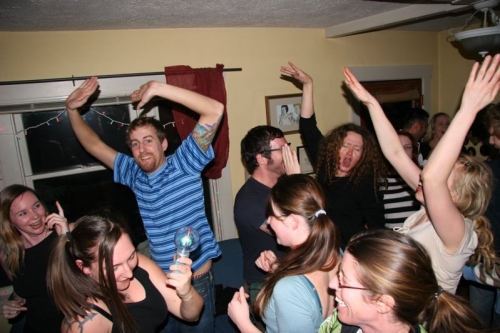
“F*ck it.  The friends around me love me enough to see me and not judge.  Besides, everyone is way too busy thinking about themselves!  I’m gonna tell the joke.  I’m gonna make the face, do the voice.”  Here’s a picture from an AA birthday party at my house years ago.  All these friends are stone cold sober.  We’ve sent the censor packing and leapt from seaside cliffs.  We’re freed not by mood altering drugs, but by our love and trust.

dance2

PEOPLE #3: CONFLICT:  Conflicts come up with family and coworkers, and sometimes even in our programs.   The other person sees things differently because of loads of stuff predating this clash. F*ck it.  I can’t change their childhood or prevailing brain patterns or set ways of responding to whatever.  I can only change myself.

(For advanced studies of the “f*ck it” prayer in this context, go to Al-Anon.)

LIFE’S PIDDLEDY-SHIT, e.g. traffic, messy house, long lines, deadlines, stuff I gotta do:  To me, when this kind of stuff is happening, it’s always a huge deal.  If my son is late for school on a Tuesday, if I’m late to meet a client, if the line I’m in is long, it means ruin and utter devastation will ensue.  That’s why I need to pray…

F*ck it.  I am so not in control, here.  God, it’s all yours!  I’m just here doing my best and leaving the results up to you.

The trouble with life’s piddledy-shit is that it really is life – or the majority of it.  The challenge is to love it as life.  For me, big risks survived have helped take the stress out of piddledy-shit, but the effect is temporary.  Each time I climbed Mount Rainier and made it back, I thought I’d never sweat the small stuff again.  Having gone through breast cancer had something of the same effect.  But I forget!

FINANCIAL FEAR: Every month it seems there’s no way I’m going to make the mortgage.  I often delay until the last day possible, but somehow it gets paid, and while my bank balance reads, say, $7.36 for a while, we just eat whatever’s in the cupboards.  But do I learn that things work out?  No.  I seem to prefer envisioning a future where my son and I reside in our car.

The thing about financial fear is, it’s ALWAYS about the future.  If we stay in the now, we’re okay and needs are met.  Even sober friends of mine who’ve lived through homelessness have come out okay on the other side, so long as they didn’t drink.

God – not people, places, and things (including dollars) – is ultimately what cares for us.

At the beginning of this blog, I said there were two things I need to live with the same freedom alcohol once gave me.  One of them is the “f*ck it” prayer, which I’ve just told you about.  But what about the other?

It’s love.  Love for you.  Love for god.   Love for every detail of life’s experiences.  But I’ll save that for another blog.  Can’t write everything!  F*ck it!

3 Comments

June 2, 2014 · 9:52 am