
A number of people dear to me in AA just can’t seem to stay sober. Their recovery looks hopeful at times: they’ll string together a few months or even a year, but then they go out again. At some point they drag themselves back looking haggard and beat up and often shockingly aged. They share about being totally defeated, about knowing they can’t drink, and about their rock solid determination to stay sober this time. Sadly, though, a few months or a year later, they’re gone again.
The Big Book tells us why: they “failed to enlarge [their] spiritual life” (35). During my drinking, I very much wanted to be a good person so I could be happy – to be true to my partners (at least in everything they knew about), to be honest (enough), and to contribute to the world (so I’d be respected). If I had brought that same approach to getting or staying sober – reliance on self – I’d be drunk today.
Here’s the deal: There are two ways to live in this world – by the guidance of ego, or by the guidance of something greater than ego. Practicing alcoholics, when they look inward, consult with the authority of ego, which has one sole criterion for direction: me. “What will make me feel good/get me what I (think I) want?” I may desire amazing personal experiences, or to feel attractive or valued. I may want money and a sense of importance – the recognition of achieving great things.
The active alcoholic may sincerely wish to live by higher principles because doing so might help  them grab the things they link to happiness – like a career, a relationship, or esteem among peers. But in all their navigation, the joystick always remains firmly in the grip of ego, whose sole objective is to get what it wants. That’s why most practicing alcoholics harbor secrets. That’s why their love is striated with selfishness. And it’s why they’re never immune from the seduction of alcohol, because ego assures them a drink will feel awesome – or at least bring relief – and they take the bait.
What’s the alternative? To be holier than thou? To renounce earthly life and pursue some lofty enlightenment?
No. It’s to admit we’re irreparably flawed, and to commit to trying every day to be a slightly better person than we were yesterday – not by the criterion of what feels good, but by the light of what, in our deepest heart, we know to BE good. Pursuit of goodness – however we define it, however faultily we seek it, and whatever that progress may look like – is the essence of a spiritual path.
Let’s look at this idea in pieces. First, admission. The ego howls against the idea that we are irreparably flawed. “I can fix myself!” it insists. “Really! I know best!” To admit we’re permanently confused and lacking integrity requires the two greatest forms of ego Kryptonite on the planet: honesty and humility. This first step is the foundation on which every alcoholic bases a new experience of living.
Next, commitment. A spiritual path requires that we accept the futility of living by self-propulsion. Though society at large touts “taking control,” a spiritual path requires relinquishing the claim that we’re qualified to call the shots. In AA this means we commit to the steps, the fellowship, and service work. For non-alcoholics, too, some form of spiritual community is often involved, whether a sangha, a church, a yoga or meditation group, or some other family of like-minded people also trying to grow spiritually. We begin to test our own thinking – which we have admitted to be flawed – against the wisdom of this sounding board.
What we know to BE good is the thing we commit to. The Big Book tells us, “deep down in every man, woman, and child is the fundamental idea of God.” Unfortunately, many people assume this idea should equate to the God of religion, which may or may not be found anywhere in them – let alone deep down! My own god has nothing to do the God of any religion – that’s why I forgo the capital ‘G.’
My god is the tremendous power of unconditional love in which all  life is swimming. Not everyone needs to go to AA to find and tap this source, but we all need it to get and stay sober. This power is available to anyone by any name or in any form – as innate goodness or a religious deity or the frickin’ Force from Star Wars: how you conceive of it does not matter. What changes your life is that you trust its goodness and ask it for guidance in all actions, at each juncture.
Of course ego still elbows its way in countless times, because we’re still flawed. But our intention remains to shift our point of reference away from ME! to a deeper sense of what is right and good. We try to pause before we act – especially when we don’t want to – in an effort to discern the two courses. That is the path – intention and effort. We hang onto a faith that if we keep earnestly seeking one day at a time, we will be guided.
Ironically, this course usually brings us a richer life than we could ever have imagined. At my home group last night, the chair took issue with the saying, “My worst day sober is better than my best day drunk.” He pointed out that he’d had some “fuckin’ awesome times” in his early drinking. But when I was called on, I cross-talked a tad: I recalled that all my “awesome” drunken times boiled down to feeling awesome about ME! Even if I said, “I fuckin’ love you, man!” I really meant, “Wow! – I don’t feel alienated and alone!” The spiritual path opened by AA has nurtured in me the gift of genuinely loving others – of living for something larger than myself. That’s what we’re here to do. And really, it’s a high no glory days can touch.




 on the price of a lunch sack or whether someone said X versus Y, for me, it does, because when I lie to others – even in piddly-shit lies or perhaps especially in piddly shit lies – I lose credibility with myself. I get a sense that it might be okay to be just a smidge full of shit. If I don’t need to be honest with others across the board, I can go ahead and compartmentalize, behaving in ways I plan to conceal. What’s the big problem with that? What does it do to me?
 to get it. Withholding the truth from others, even in minor things, is actually using them like game pieces to get what I want. God exists only in genuine reality – the truth of what is. When I lie to anyone, I’m turning my back on that, trying to play god by feeding them a false reality that’s a product of my ego. I can make a cashier complicit in my theft of a freezable lunch sack. I can pose as an expert to get attention. I can cheat on my boyfriend to feed my vanity. And I can take a drink no one needs to know about.





 Sorry, folks! But the X factor, and that alone, is what saves an alcoholic: Connection with a higher power, to god as we understand it. We ask god to help us, and we’re relieved of a compulsion that no amount of self-knowledge can touch.



 ood. I knew my life shouldn’t be what it was. I could read our culture; I could perceive what was rated glamorous or worthy; I understood the goal. Media of all kinds broadcast examples of who and what was interesting and enviable. I internalized all that and judged myself inadequate.






 saying: “Let it begin with me! Your happiness does not depend on what Grayson does. Your life is rich and you are loved by many. Be grateful! Spend time with friends!”






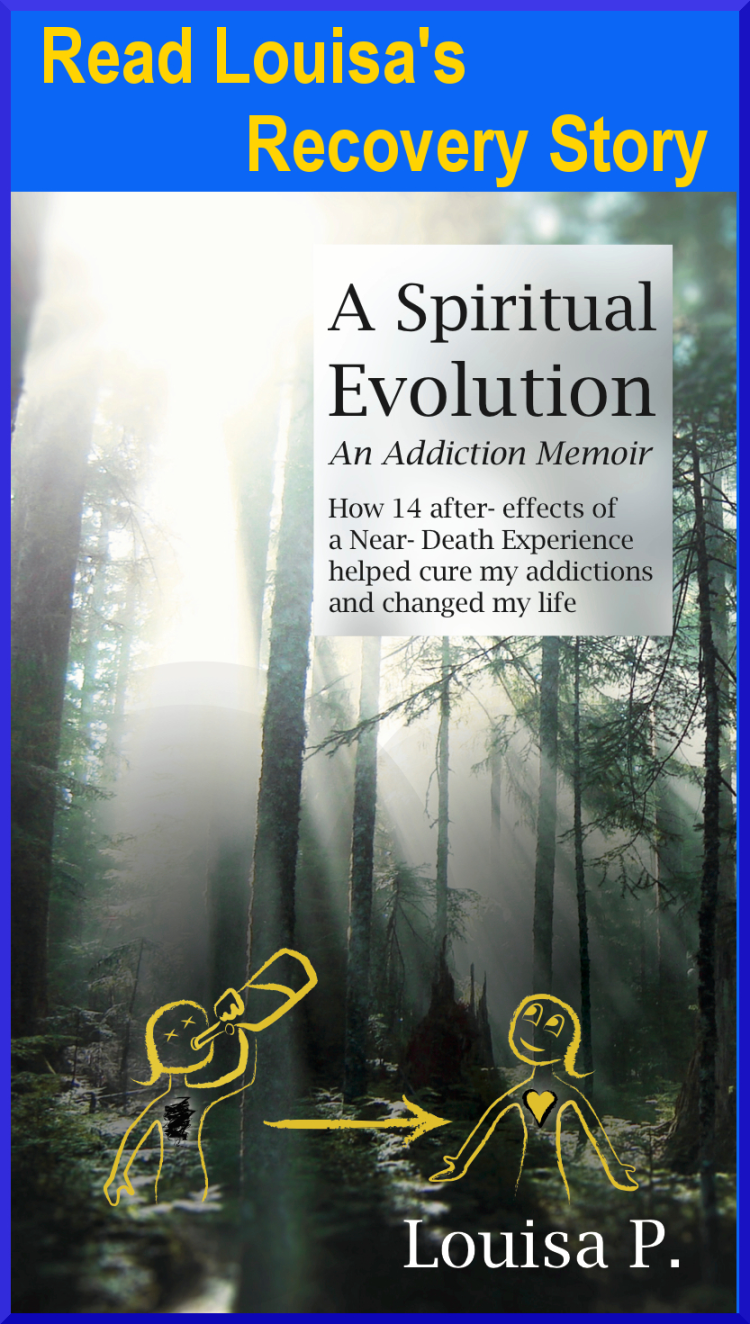
 A Spiritual Evolution