Tag Archives: addiction

Top 10 Lies Alcoholism Tells the Alcoholic

Dying was particularly difficult for my dad. He’d lived a wonderful outward life — excelling in his career, mentoring others, and serving his family — yet he was tortured by one huge regret: He’d never been deep-down honest with himself.  For over 50 years, he’d believed his own lies around how much he drank — although, strictly speaking, they weren’t his lies.  They were the lies alcoholism tells every alcoholic.

I’m an Near Death Experiencer, and as an aftereffect, I occasionally read minds without trying. For two days and one night while my father lay dying, I “heard” his thoughts and dreamed his struggles. He couldn’t speak, but, sensing he was on his deathbed, he saw the truth: “Deep down I knew! Every day I thought, tomorrow I’ll drink less, but every tomorrow I drank away again. Life was so vivid and precious, but I muffled mine under a shroud of alcohol.  And now it’s over!”

Before we list alcoholism’s lies, let’s consider a definition of the disease itself* according to the American Society of Addiction Medicine and Journal of American Medicine:

Alcoholism is a primary, chronic disease [that]… is often progressive and fatal. It is characterized by continuous or periodic impaired control over drinking, preoccupation with the drug alcohol, use of alcohol despite adverse consequences, and distortions in thinking, most notably denial.

Note that this definition says nothing about joblessness or homelessness, the form of alcohol used (Cabernet, Colt 45, everclear), or being a white male.  Alcoholics are everywhere.  Note also that the definition calls out the most important of many distortions in thinking: denial.

Why? Because denial is the superpower that lets alcoholism kick our asses!  If it lacked this power, no one would need a spiritual solution to overcome it.  We’d just say, “Shit!  I’ve got alcoholism!” and go seek treatment as for any other illness.  But addiction in many ways resembles a parasite concealing itself from the host; it makes us say: “I’m not an alcoholic; I just [fill in the blank].”

I said it.  You’ve said it.  We all say it.

Liver dies from removing this poison.

Below are some of alcoholism’s favorite variations on “not an alcoholic!”  BTW, I thought about making nice in my responses, but I’m writing this to save some lives, not to make friends.

1.  I drink a lot because I’m daring

Bullshit.  We drink because we’re scared.  Life in its full intensity overwhelms the shit out of us, so we impair our brains to dilute it. That’s daring?  Swallowing is bold?  The truth is that deep down we have no clue how to live or what the hell we’re doing, but we pretend to have it all down until we just can’t stand the façade any more.  Getting fucked up is way less scary than looking inward.

2.  Drinking helps me live life to the fullest

Good times.

Totally!  No way do we do the same 3 predictable things every frickin’ time we’re bombed: Talk sloppier, emote with a toddler’s self-insight, and decide stupid shit is a great idea. This is crap any dipshit can do.  Living life to the fullest takes love — enough love to dedicate ourselves to something bigger than self.

3.  I’m more fun when I drink

Those with good humor and a zest for life are fun clear-headed.  Those who lack both imagine they’re fun drunk. Fun for others?  Ask ’em.  The sad thing is, if we’ve got to grease our brains with dopamine to lower our inhibitions, chances are we’re battling an inner voice that constantly announces we suck. Until we find the courage to get vulnerable, to risk exposing our fears and weaknesses to trusted others, we’ll never know what it’s like to feel loved for our true nature.

4.  I choose to drink — it’s not a compulsion

Of course we do!  Just, uh… kind of always and, um… soon after deciding NOT to.  But, shit, we just changed our minds — right?  Wank on, my friend.  As Gabor Maté has explained, addiction bypasses the decision-making part of the brain (frontal lobe) by exploiting the “pre-approved idea” feature that governs reflexes.  As sure as we’ll put up our hands to deflect a ball, we’ll “decide” a drink is — hey, y’know what? — a great idea!  The brain is alcoholism’s bitch!
5.  Drinking doesn’t fuck up my brain/body

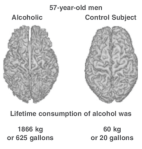
Bad news!  Alcohol is a neurotoxin, poison to every system in the body, and causes cancer of the mouth, pharynx, larynx, esophagus, stomach, pancreas, liver, colon, and pooper.  Anything it touches, baby, directly or through our blood!  Please see How Alcoholism Fucks Up Your Brain and How Alcohol Fucks Up Your Body for specifics.

6.  Most people drink a few times a week

Sorry, Boo.  Turns out 30% of Americans have zero drinks ever. The next 30% have fewer than one per week. The next 30% cap off “healthy drinking” at 1-15 per week. We drunks relate more to that 10% of Americans who guzzle 73.85 drinks per week — in other words, to the 1 in 10 of us addicted to alcohol who will likely die sooner because of it.

7.  My drinking harms no one

If we’re connected to anyone in any way, our drinking hurts them.  Driving, we risk others’ lives and the happiness of all their loved ones; hungover at work, we’re less effective and/or risk our coworkers’ safety; to anyone who loves us, we’re emotionally dulled; and to our maker, we say, “This amazing brain and body that let me be conscious in the physical world –?  I’m gonna shit all over ’em — again! ”

8.  I’m not an alcoholic because I haven’t lost ____

Just keep drinking and watch.  And meanwhile, does it not matter that you’re losing your self respect, the respect of others, and the chance to be fully awake in your own life?  (Parallels “I’m not as bad as [name].”)

9.  People who don’t drink are uptight

Sober summit goofs

I don’t know about lifelong teetotalers, but I do know recovering alcoholic/addicts who really work their program are the most genuine, honest, funny, beautiful human beings I’ve ever had the privilege to call my posse.  We’ve all been to hell and back. We came to AA because we realized we wanted to love life, not trash it; the 12 steps — a design for living — taught us how.

10.  Anyway, in my deepest heart of hearts, I carry no lurking suspicion that I am totally full of shit

Great!  I’m sure nobody else does, either!  I mean, nobody has noticed the pattern of you  poisoning yourself regularly, whether sullenly in front of the TV or “partying” as if you were 17.  And if they have, fuck them, right?  It’s your life to waste wasted.

A sadness beyond human aid.

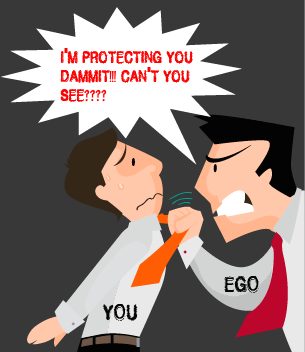
Addiction kills us by getting us to live from our ego rather than our spirit, or higher self.  Ego is about getting what we think we want as soon as possible, even if it means violating every life lesson that pain has ever tried to teach us and trampling dogshit on the hearts of our loved ones.

For years I believed I’d rather die than go to AA.  Turns out I was already dying. Working the 12 steps from Alcoholics Anonymous with an inspiring sponsor taught me how to live — authentically and with a joy that endures.  Today, I know my  dad’s spirit is proud of me.  His love helped me go where he couldn’t.

And if I could do it, you can, too.

* “Alcohol Use Disorder” is the term appearing in the DSM-V.

5 Comments

Filed under Addiction, Alcoholism, Denial, Drinking, Recovery, Sobriety

How Alcohol Fucks Up Your Body

a companion piece to How Alcoholism Fucks Up Your Brain

.

For all those years that I guzzled alcoholically, and even before that when I was a kid, I wholeheartedly believed that alcohol was good for you.  My dad, a tense professor by day and, before alcoholism overshadowed his life, happy winemaker by evening, taught us kids that booze made life sweet: “It’s good for what ails ya!”

After all, what did old-time doctors dose out to patients?  Whiskey!  What did St. Bernards carry in those little casks to people stranded in the snow?  Brandy!  So, liquor must be almost medicine, right?

Actually… uh, no.  The opposite is true.  That shit is poison — literally.

In many parts of the world, alcohol abuse now ranks as the #1 cause of death among people aged 15 to 49.*  Did you just absorb that, my friend? Would you please check out my reference below – World Health Org, 2014.  Sure, there’s a lot of bullshit circulating the internet, but doesn’t WHO sound kind of credible?  Here’s one of many graphs expanding on that fact:

So much for the ole “Drinking’s no problem in Europe” line! (WHO 2014)  Click to enlarge.         EUR = Europe; EMR = Middle East; SEAR = Southeast Asia; WPR = Western Pacific

In recent news, we’ve all heard of studies — most of them funded by the alcohol industry — claiming alcohol is the bee’s knees for some aspect of health.  Rarely is it the actual alcohol — the ethanol in these drinks — behind these supposed benefits.  In red wine, it’s the grape skins’ resveratrol, in beer it’s B vitamins from grains, etc.  True, ethanol dilates blood vessels, which may seem to alleviate symptoms of cold and flu, but even researchers behind such studies admit ethanol “would not have an effect on the virus itself.”**

All of these pro-booze studies stress the condition of small doses, usually about 1-6 drinks per week — a mere thimbleful for heavy drinkers.  In such small quantities, alcohol can’t poison you because your liver nabs it by the short ones and boots it the hell outta your bloodstream.  But suck up enough booze and the stuff overwhelms your liver, wreaking havoc throughout your entire body.

Ethanol is one of the few nutrients that is profoundly toxic, …caus[ing] both whole-body and tissue-specific changes in protein metabolism. Chronic ethanol misuse increases nitrogen excretion with concomitant loss of lean tissue mass. …A variety of diseases and tissue abnormalities… are entirely due to ethanol-induced changes in…  tissue proteins; for example, cirrhosis, cardiomyopathy, and osteoporosis. Ethanol induces changes in protein metabolism in probably all organ or tissue systems.†

Let’s look at them there tissue systems one by one, why don’t we?

Alcohol  fucks up your liver.  In stages.
1.  Fatty liver (steatosis) – doctors call this “enlarged”
2.  Inflammation of liver tissue (hepatitis)
3.  Scar tissue formation (fibrosis)
4.  Fucked to hell liver architecture (cirrhosis)
Gross clickable pictures  

During these disease stages, some of the blood entering the liver through the portal vein cannot penetrate [it] and is diverted directly into the general circulation… not detoxified, [so] blood levels of toxic substances increase.  …Thus, liver dysfunction can… contribute to brain damage.Ω

You know how, when a rainstorm overwhelms a sewage system, raw sewage spills straight into a bay or river or whatever?  Same thing here: that shit-filled blood goes everywhere in your body and brain.

All a hangover means is, your body and brain have been poisoned.  Hey, no big!  But feeling like a sack of dogshit all day doesn’t mean you’ve actually damaged your body, does it?

Alcohol Fucks Up Your Muscles and Bones
It does.  Both skeletal and cardiac muscles are screwed up by alcohol — even from a single binge.

…[T]he most reliable data examining the effects of alcohol on protein metabolism is derived from animal studies, where… the dosing regimen can be strictly controlled. These studies indicate that, both chronically and acutely [i.e. binge], alcohol causes reductions in skeletal muscle protein synthesis, as well as of skin, bone, and the small intestine.

Most full-blown alcoholics treat their bodies like shit in general – doing other drugs, smoking, eating crap – so to isolate alcohol, scientists have to dose it to poor little animals and record how their little muscles, bones, and guts all go to hell.

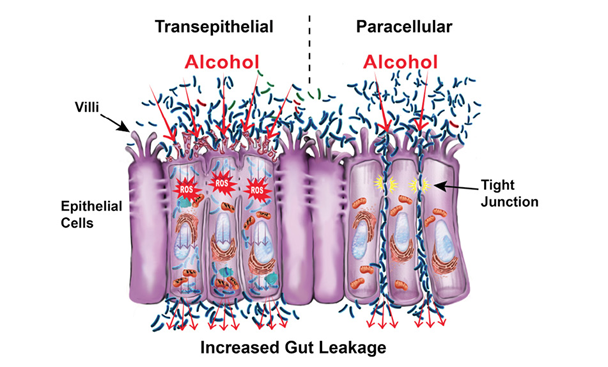
Speaking of your small intestine, can you guess what alcohol does to it?  Yup – fucks it up royally.  First, alcohol decreases the good bacteria (flora) in the gut and increases harmful bacteria.  Worse, the walls of the intestines, which normally allow only nutrients pass through, get all permeable and schlop those bad bacteria straight into your bloodstream.

Alcohol can induce intestinal inflammation through a cascade of mechanisms that subsequently lead to inflammation and organ dysfunction throughout the body, in particular in the liver and brain. One mechanism is by increasing bacterial loads and the permeability of the intestinal wall (see figure) allowing bacteria to leak through, leading to local and systemic effects.

Paneth cells normally police the gut for bacteria, but alcohol suppresses them, “which can allow additional intestinal bacteria overgrowth and allow their byproducts (i.e., endotoxins) entrance through the intestinal barrier. The bacteria, via endotoxins, trigger an inflammatory response by the intestine’s immune system, causing a release of proinflammatory cytokines” that travel to the liver and fuck it up, too.

How alcohol screws up your pancreas & lungs could drag on for several paragraphs, but I’ll just note that about 45% of pancreatitis cases result from alcohol abuse, which increases chances of pancreatic cancer. (If you think I’m making this shit up, just read the damn article.¤)  As for lungs, in the late 1700s, the first US Surgeon General warned that alcohol use was linked to pneumonia.  The dude was right.  Studies today confirm that “alcohol use disorder (AUD) render[s] people more susceptible to a wide variety of lung infections, including bacterial pneumonias and tuberculosis, and increased morbidity and mortality.”§

Endocrine and Cardiovascular Systems
I guess by this point it won’t exactly shock your pants off to learn that drinking buggers your entire endocrine/hormonal system. Interactions among your hypothalamus, pituitary, pineal, thymus, thyroid, and adrenal glands, and even your gonads, area all screwed up.

Alcohol intoxication induces hormonal disturbances that can disrupt the body’s ability to maintain homeostasis and… result in… cardiovascular diseases, reproductive deficits, immune dysfunction, certain cancers, bone disease, and psychological and behavioral disorders.∋ 

alcoholic cardiomyapathy

😦 alcoholic cardiomyopathy

Heartwise, some studies claim a drink or two a day wards off certain types of heart disease.  “But any positive aspects of drinking must be weighed against serious physiological effects, including mitochondrial dysfunction and changes in circulation, inflammatory response, oxidative stress, and programmed cell death, as well as anatomical damage to the CV system, especially the heart itself.”

Are we gonna make a stink about a little cell death and heart damage?  I guess so.  Sad tuba says, wah-wah!

Wouldn’t it be fun to talk about CANCER a bit?  Let’s do!  In women, even one drink a day elevates risk of breast cancer.º  In men, one per day does the same for prostate cancer. And for everybody who swallows the stuff, drinking has been shown to increase cancer of the mouth, throat, larynx, esophagus, stomach, pancreas, liver, colon, and rectum.Δ

Are you thinking what I’m thinking? Pretty much everything that stuff touches, from lips and pooper, takes a giant step or two toward cancer.  Why?  Because “alcohol in your body is converted into a toxic chemical, acetaldehyde, [which] can damage your DNA and stop cells from repairing that damage, which can lead to cancer.”ß

The bottom line is, booze rips through the body like a Warner Brothers Tasmanian Devil.  Sure, some people survive it; my aunt drank scotch every night and lived to 93 — though it made her more puffy than happy. We can all point to such nightcap-taker exceptions, but their livers’ extended kickass performance doesn’t change what alcohol is (poison) and does (destroys healthy cells).

Cultures worldwide frame alcohol, not as a toxic drug, but as a harmless aid to relaxation and conviviality.  Look again at the left side of that WHO graph above — all those people dying in their teens, 20s, and 30s.  For each death, how many survivors’ lives are crippled?  The world’s leading cause of death, illness, injury, and family tragedy is something people choose to consume — until it turns and consumes them.

That, dear readers, is fucked up.

REFERENCES

*http://www.who.int/substance_abuse/publications/global_alcohol_report/msb_gsr_2014_1.pdf?ua=1  See page 57.  

**https://web.archive.org/web/20130211101748/http://abcnews.go.com/blogs/health/2012/12/08/cold-remedy-cocktails-do-they-work/
http://www.sciencedirect.com/science/article/pii/S0899900799000969

Ω https://pubs.niaaa.nih.gov/publications/arh27-3/240-246.htm

https://www.arcr.niaaa.nih.gov/arcr382/article01.htm

¤ https://www.arcr.niaaa.nih.gov/arcr382/article10.htm

§ https://www.arcr.niaaa.nih.gov/arcr382/article04.htm

∋ https://www.arcr.niaaa.nih.gov/arcr382/article05.htm

◊ https://www.arcr.niaaa.nih.gov/arcr382/article03.htm

º https://jamanetwork.com/journals/jama/article-abstract/187252

https://prostatecancernewstoday.com/2016/11/17/drinking-alcohol-increases-risk-of-prostate-cancer 

Δ https://www.cancer.org/cancer/cancer-causes/diet-physical-activity/alcohol-use-and-cancer.html

ß https://www.drinkaware.co.uk/alcohol-facts/health-effects-of-alcohol/diseases/alcohol-and-cancer/

12 Comments

Filed under Addiction, alcohol damage, AUD, Health, Recovery

Half Measures Avail Us Relapse

“Half measures availed us nothing.  We stood at the turning point.”       (Alcoholics Anonymous, p. 59)

If you’re an alcoholic who can find a way to permanently quit drinking outside AA, that’s awesome. Go for it!  As they say in the Big Book, “If anyone who is showing inability to control his drinking can do the right-about-face and drink like a gentleman, our hats are off to him” (p. 31).

AA is for is the person who can’t, who’s tried and failed, then tried and failed some more… and frickin’ can’t stand herself anymore. Here are a few of the ways I, personally, tried. At various times in my drinking career, with all my power of will, I swore the following:

  •  to simply drink less
  • to not drink on certain days of the week
  • to get more exercise, eat a healthier diet, and quit poisoning myself
  • to meditate my stress away instead of drinking
  • to practice affirmations for confidence instead of drinking
  • to stop drinking alone
  • to drink just wine
  • to drink just beer
  • to have no more than one drink with lunch and three in the evening
  • to prove to some asshole that I’m not an alcoholic, so fuck off
  •  to quit for a week starting tomorrow
  •  to quit two weeks except maybe next weekend
  • to drink slower so I’d get less bombed

None of them worked.  None.  Know why?  Because I’m an alcoholic.  That means my brain is, by definition, BROKEN when it comes to controlling my intake of alcohol — or weed or cocaine or any mind-altering substance.  I default to having just a bit.  Once I start, my mind has only one setting:

And… I cannot fix my broken brain with my broken brain.  If I could, it wouldn’t be broken.  I’d just tone my drinking the frick down and get on with life — right?  I would not be an alcoholic. I would not need AA or the steps or a higher power.

But here’s the thing, guys.  We’re kind of pucked.  We’re trying to mentally control a problem over which we have no control.Half Measures = Half Assed
Some of us go to AA because we get it: we’re pucked, and we’ll do everything we’re told — go to any length — to get our lives back.  We take Step 1, admitting we are powerless over alcohol and cannot manage our lives.

Others of us, however, go to AA as one more item on that fucking worthless shit list above.  We just add

  • go to some AA meetings

to our personal “I’m not gonna drink” management scheme.

Doing so is what we call a half-measure, meaning that I still believe I  wield control.  I’m using AA as an aid or support group, but ultimately, my ego maintains I’m taking control of my desire to drink.  That idea is utterly worthless.  AA meetings will do no more for a half-measure drunk than getting a “Sober Forever” tattoo, because, inevitably, we still have that broken brain.

Just ask anyone who repeatedly relapses.  It may sound harsh, but in my experience, except in rare cases complicated by “grave mental disorders,” a vast majority of those who fall back into drinking have not gone at the program from their inmost heart.  Relapse happens when our egos tell us, “I don’t really need to X anymore [insert go to meetings, write inventory, work with a sponsor, etc.]  I’ve got this.”

Going to Any Length
A few weeks ago I was at an early morning meeting sitting near a newcomer.  The meeting’s chair had used a random Big Book quote picker to cite the passage, “Your job now is to be of maximum helpfulness to others…”

“That bothers me,” the newcomer shared.  “I’ve got six months and I feel like I’m struggling.  I can’t be of maximum helpfulness to anyone!  How’m I supposed to devote my life to  — I mean, I can barely take care of myself right now!”

At the break for 7th Tradition, I scooted over to him and said, “Who defines ‘maximum’?  All it means is, the maximum you can do today to be supportive to someone else.  You’re here.  You shared honestly.  Maybe that’s your max today.  The point is that you’re trying your best.”

Trying Your Hardest = Giving Up Control
This may sound like a contradiction, but it’s only when we really give up control that we become willing to try our hardest at spiritual growth, and vice versa. When, after 14 years of trying my hardest to drink less, I realized I was going to die drunk, and after 34 years of trying to make other people like me, I realized I hated myself, I walked into an AA meeting and finally let go.

It didn’t happen all at once.  The first letting-go was just going to meetings.  The next was actually praying to… something.  Next was getting a kick-butt sponsor, then doing everything she told me whether I felt like it or not.  “You’re going to lead an AA meeting in the women’s prison work-release house,” she told me.  Did I want to do that?  Hell no!!  The women seemed huge and thuggish and scary to me!  When they hugged me, I nearly suffocated!  But I showed up each week regardless.

I’d given up calling the shots.  I wanted to change, to have what I saw in Karen, my sponsor.  So I did exactly what she told me.  I wrote my inventory, acknowledged my defects.  I made my amends.  I sponsored.

Last week, my current sponsor, who has 32 years sober, asked me, who have 22 years sober, if I’d drive out with her to Bellevue and (wo)man an AA booth at the National Tribal Health Conference.  This was a big deal, she explained — the first time the Indian Health Board has ever invited AA to attend, though nearly 12% of Native Americans die of alcholism.

Did I feel like driving out there this afternoon and “working” after work?  Hell no.  Did I do it?  Hell yes.  I don’t ask questions or weigh the pros and cons relative to my sobriety.  I just GO.

The result?  I’m in no way special or virtuous; I’m just happily sober… one more day.


6 Comments

Filed under AA, Addiction, Alcoholism, Recovery, Sobriety

Recovery from Alcoholism: Way More than Not Drinking

I recently read an article in The Guardian, a British publication, that broke my heart.  It was written by an alcoholic woman who quit drinking 15 years ago but who has completely misunderstood AA as an ineffectual “self help” group.

She rightly explains,

Alcoholism is a strange condition. If you survive the drinking stage, and many don’t, it has relatively little to do with alcohol, which is merely the drug with which the alcoholic treats herself. It is, rather, a way of thinking, and continues long after you have stopped drinking. It is a voice in the head: a malevolent voice that wants you to die. 

Much of the article describes with startling honesty the havoc this voice has wreaked in Tanya’s life — causing her to hide for years in workaholism and lie her way to extra morphine in the maternity ward to up her high (which I would call a relapse).  Life, for Tanya, is miserable.

Almost none of the article offers a solution.  She maintains,

[F]or the alcoholic there is nothing as prosaic as “better”. There is only a daily remission, based on how you deal with the voice in your head. (“Hello, monster. Where have you been?”)

…If I am unwary, she can plunge me into the deepest despair, and I have learned to construct an obstacle course to thwart her. It is made only of ordinary human love. Nothing else works.

What a tragedy that this woman has suffered for 15 fricking years with virtually no solution!

I wish I could tell Tanya: The path to freedom is encrypted in those 12 prosaic steps posted in your erroneously termed “self-help” group. Clearly you did not grasp the meaning of the first one: We cannot help ourselves.

You’re living proof of that.  If you were to let quality people from AA into your life, you would learn from them that this “voice” your article discusses at length is a commonplace phenomenon we (not “they”) refer to as self-loathing, less-than, not enoughness, or simply the shadow side of a big, fat ego.  Recovery defeats it.

If you could truly listen with an open mind in meetings and work the 12 steps diligently with a sponsor, you could heal more in a year than you could in decades of therapy or a lifetime of introspection — literally.  Pride is all that blocks you.

I was much like Tanya when I first came to AA 22 years ago.  I abhorred groupthink and its cousin oversimplification, and to me the 12 Steps, with their repeated references to “God” as a “He,” smacked of both.  Their God, I assumed, had to be the same God as in the Bible, Torah, Quran or whatever.  The words “as we understood Him” did little to mitigate that.

I was lucky, though.  In early sobriety, I became so miserable without alcohol that living sober became utter torture: I hated being Louisa.

In those days, when I wasn’t working my meaningless data entry job, I found it impossible to get out of bed, at worst, or out of my sweatpants, at best.  So annoyed was I by my happy alcoholic housemate’s assertion that my heart was suffering from a “god-shaped hole” that I went back to AA meetings and got a kick-butt sponsor just to spite him.

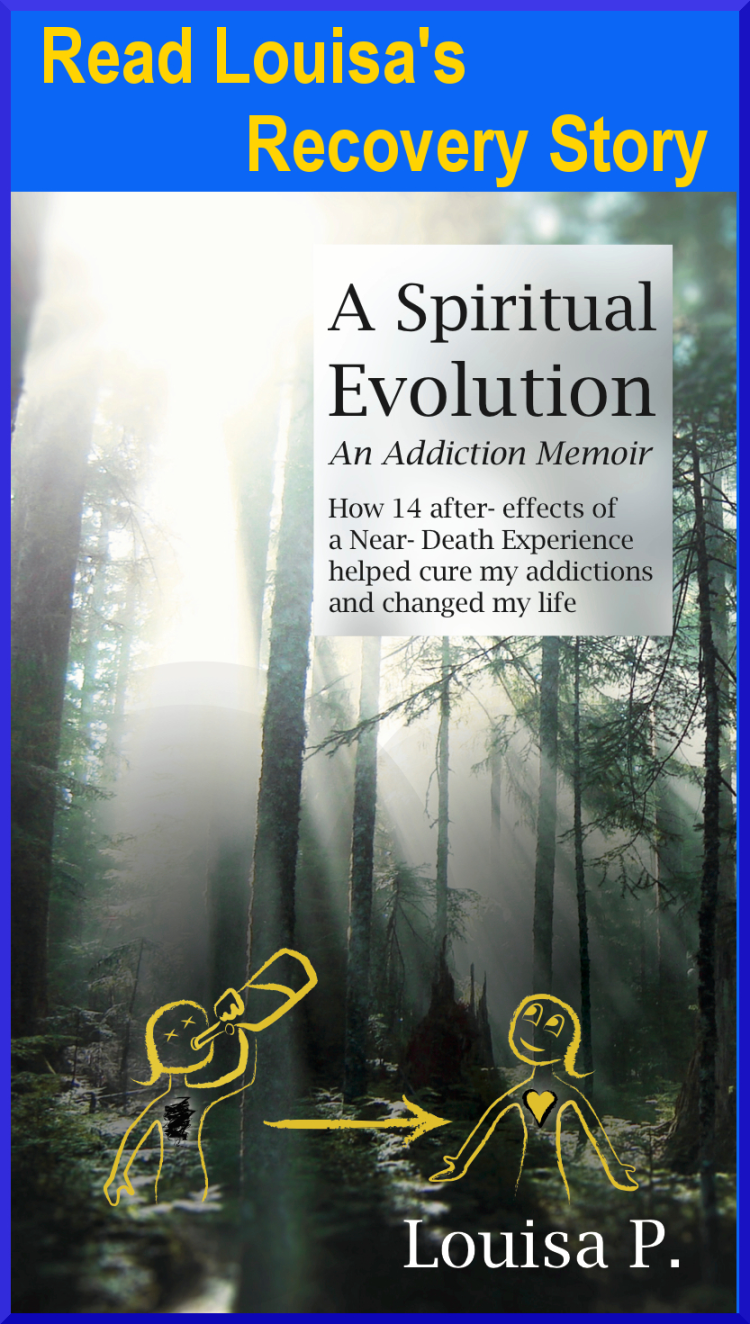
That sponsor impressed on me the crucial importance of seeking god, and seeking god changed everything.  In my case (which, as my addiction memoir attests, was a weird one), god kept popping into my life via a series of paranormal experiences until I finally surrendered to the truth I live by today: god is real, everywhere, always.

My god is the god of nature and biology; the god of life energy; the god of love.  It’s a goodness beyond our wildest imaginings, one that can upstage our ego’s grandiosity as well as self-hate.  God can empower us to love others and life itself so intensely that just being is an overwhelming privilege. As my sponsor Nora says, “I feel more joy today just walking half a block to drop a letter in the mailbox than I did before in all my fanciest vacations put together.”

For me, this love of life’s poignant richness that drowns out my inner demon’s insults can be accessed only through god-aware eyes.  To maintain that vision, I have be up front with god constantly: I need to live by the highest ethics I can muster, eschew lying, and follow the Golden Rule.

In good times, I must offer goodwill as if I had an infinite basket of it (cause I do).  In hard times, I must never succumb to the illusion that my struggles are unique.  AA meetings make both possible.

Mount Adams & wildflowers – last week

I’m just back from hiking 115 stunningly gorgeous miles along the Pacific Crest Trail with my sober friend, Sally.  A little YouTube video I made of our trip is linked below.

God made this experience possible.  First of all, without god buoying my heart, I’d never have found the gumption to take off into Washington’s very wild backcountry with my friend.  Twice, on the trail, I had to draw on courage to accomplish more than I believed I could — once to cross a raging creek on a bunch of flimsy logs and once to get out of my tent during a midnight lightning storm at 6,5oo’ amid ruthless wind and sleet because my tent’s rainfly was getting torn off and all my stuff soaked.

In both cases, I witnessed my fright being eclipsed by a “you can do this” beam of certainty that is the antithesis of alcoholic self-loathing.  It’s not ego, either.  It doesn’t come from me.  It’s about stepping out of the way to become a channel — letting faith power my steps and efforts.

Tanya, I wish I could gift that to you — what god, through my fellow alcoholics, has gifted me.  There’s incremental suicide; then survival; then relief; and finally rejoicing — meaning you figure out what you love doing, and you freaking do it.

But the journey from one to the next is an inside job — and only for those who actively seek.


Music by http://www.bensound.com/royalty-free-music

.

23 Comments

August 22, 2017 · 6:00 am

What’s Normal Drinking?

Suppose I give you an algorithm to figure out whether or not you’re a normal drinker.  I tell you to take the number of drinks you’d consume on an average Tuesday, multiply it by a rough estimate of times you’ve “had too much” and divide that by the number of drinks that would qualify as a “binge” for you; next add the number of times you’ve felt utterly disgusted with yourself the morning after.  If the square route of this number is less than 3, you’re fine – go ahead and drink!  If it’s over 3 – sorry!  You’ve got a problem.

Here’s the real test:  Did you read that whole paragraph, dude?  Did you even consider trying to estimate some of those crazy numbers?  Then, guess what?  You are sooo not normal!  Not only do normies — people with a normal relationship to alcohol — not even have numbers for most of those inputs, they don’t give a rat’s ass about how much they drink or whether they get to.

Try the whole thing again substituting “strawberries” or “croissants” for drinks and you’ll see through a normie’s eyes:  “Take the number of strawberries you’d consume on an average Tuesday…”  Who cares?  Eat ’em or don’t – it doesn’t matter!

Alcoholics love to marvel at normie behaviors like not finishing a drink or leaving half a bottle of wine in the fridge for weeks, behaviors that strike us as incomprehensible.  But getting a handle on how weird our thinking is – why we see normal as strange – is not so easy.

“The idea that somehow, someday he will control and enjoy his drinking is the great illusion of every abnormal drinker.  The persistence of this illusion is astonishing.  Many pursue it to the gates of insanity or death.”  (Big Book p. 30)

Before lasting sobriety, we keep trying and trying to find a way to drink normally.  But the effort itself precludes normalcy.  For instance, here’s a story from my Big Book study group, just after we read the above passage.  Dana – a repeat relapser who works from home – claimed to be able to control her drinking:

“The trouble is, I can control and enjoy my drinking for a long time. I’m really careful.  I’ll drive in the morning to the gas station near my house and buy just one of those little airplane bottles of Jack [Daniels].  I’ll drink it in the car and fucking enjoy the hell out of it.  Then I go home and get the kids off to school; I’m nice and not grouchy.  I’ll get set up for work, go have another little bottle, work for hours, chat with clients – I’m great. Before the kids get home, I’ll zip out and have another.  Maybe one before dinner and bed.  NEVER do I have two!  I’m just calm, smooth, efficient – doin’ my thing for weeks and weeks!  But then one day, I’ll get bombed and mess everything up.  Then I come back to AA.”

About ten of us made up the circle that day, but the room fell silent.  We all looked confused and befuddled, each lost in their own thinking. She did seem to be managing her drinking extraordinarily well!  To me it was like someone able to walk on a super-slick surface, keeping her balance and never slipping.  Dana was drinking and living a normal life as a functional working mom!  Wasn’t that what we all wished we could pull off?

A few of us asked about logistics.  Dana answered confidently.  I recall feeling a subtle mix of jealousy — Dana was able to drink! — and fear that I might decide to try something like that.  But most of all, I recall a fuzzy, confused inability to think clearly, to see something that was right on the tip of my brain’s tongue, so to speak.  I felt as though my mind were stuffed with wool.

Nora, another group leader, inquired tentatively, “How far is the gas station?”

“Five minutes,” replied Dana.

Nora’s forehead knitted. “And you make five trips a day?”

“About an hour out of my day, yeah.”

Nora spoke haltingly: “So isn’t… the alcohol controlling you, rather than… you controlling alcohol — ?”

As if awakening from a trance, we all shifted, seeing that Nora on the brink of something.

“That’s true,” said Dana.  “I never thought of it that way.  I guess I’m not really the one calling the shots!”

Suddenly I could see it – Dana’s system was madness!  She was arranging her entire life around her addiction so she could function in the world.  At that moment, everyone, including Dana, saw it. We also saw that some blindness in our relationship to alcohol had kept us from seeing it.

Brantly, our third leader, spoke up animatedly:  “This is not how normal people behave, you guys!  Arranging our whole life to maintain a buzz because we can’t do life as life?!  That is crazy. For normal people, alcohol is not the answer, so getting it’s not a question!  That’s why we need meetings, why we need the steps and god – because our brains make the insane sound totally normal!”

We were all laughing by this time, at ourselves, at ten people’s incredible alcoholic brain fart.  Brantly held up his phone: “I don’t need an app to tell me it’s been 5,057 days since my last strawberry!”

Here’s the bottom line.  If you hope desperately to find a reason you’re not an alcoholic, you’re an alcoholic.  If you point proudly to periods when you’ve drunk normally, you’re not normal.  Normal drinkers may hide from life in other ways, but not through booze, so they simply don’t care. We for whom alcohol has been a lifesaving magic carpet are incapable of not caring.  Hence the fabulously ironic saying, “If I were a normie, I’d drink every day!”

Step one is the realization, an acceptance to the marrow of our bones that no way out of this maze exists on human terms.  Our faulty minds will always, always “choose” drinking — by however contorted a logic.  We can’t not drink.  Our relief must come from a higher power.

.

8 Comments

Filed under AA, Alcoholism, Drinking, Recovery, Step 1

Afterlife: Is it Too Weird to Talk About?

Death visits frequently in my Seattle circle of sober fellowship. Two friends with years of sobriety died this past Tuesday from heroin relapse; one I knew faintly, the other well.  Jeremy leaves behind the 11-year-old daughter he so intensely adored along with a partner and countless friends who loved his playful yet self-deprecating energy, sarcastic wit, and unflinching, quirky, inspiring shares.  He’s gone.

Gone where?

As someone who’s undergone a Near Death Experience followed up by many paranormal aftereffects, I can tell you what I believe.  (Meanwhile, you believe whatever you believe 🙂 ).

In the minutes before my sister died, I was trying doze in the dark hospital room when into my mind flashed “the light” I had known on the other side: it was seeping in under a window, floating to my sister’s bed, and “pooling” above her, a million tiny points of light swirling, gearing up to receive her.  When I opened my eyes, there was nothing.  Eyes closed, I knew the lights were our extended family ancestors, who loved my sister immensely and were preparing, like a million loving midwives, to guide her “birth” to the afterlife.

As I recount in my book or this short film, I had not yet accepted this crazy stuff into my “normal” paradigm of reality, so I kept trying to dismiss it.  A thought-voice urged me to tell her (my sister) what I knew of the light to help her cross, because her fear (that cancer was god’s punishment) blocked her crossing. “She’s got two weeks!” I insisted, believing her doctors, but the voice simply would not quit.  Finally, I consented.  I knelt close by my unconscious sister, took her hand, and tried my best to describe the the light – she’d feel the warmth of god’s love all through her, it would feel so wonderful…  When the words were out, I sat back down.  Twenty minutes later, in a sudden, violent hemorrhage, she died.

Far from serene, I tore around the hospital floor with my brother screaming, “Help us!” An impassive doctor listened to my sister’s heart… but assured us it would stop soon.  One minute I truly wanted to rip that doctor’s head off; the next, my sister reached me.  Her energy was unmistakable, hovering in the room, loving and trying to calm me, loving my brother, loving the frickin’ doctor and nurse – the whole world!  Somehow she filled me with the light again, a euphoric flashback of the bliss I’d known while I got to be dead.

That was twenty years ago.

Just before my father’s death, I didn’t sense the light, but I knew when he was about to cross. I told the hospice worker to get my family, who were all chatting around the kitchen table with a visiting social worker.  In the minute I had alone with Dad, I remember telling him in thought, “You’re gonna do fine, Dad.  You’re gonna do great!”  I felt proud of him, excited for him.  That’s not how you’re supposed to feel, but it’s exactly the midwifey anticipation those million angels had for my sister – this time filling to me, too.

That was ten years ago.

Weird Things still pop into my life fairly regularly.  Last week, getting ready to leave for work, I resolved to pick up groceries on the way home.  Trader Joe’s or Safeway?  The thought flashed – Trader Joe’s: you’ll see someone you know.  I dismissed it, because  Safeway was right on the way home, so I’d– Trader Joe’s.  You’ll see Mindy.  Along came a faint flash of Mindy’s smiling face backed by the sauces shelf, though in 10 years’ shopping at TJ’s, I’d never once seen her there. Aware of other times I’d been advised in ways that saved my life, I consented: “Okay, fine!  TJ’s – I’ll go!” (I often use this exasperated tone with my guardian angel.)

Six hours later, I’m on the phone with Mom at TJ’s when Mindy sails by in the produce area.  I wave excitedly but can’t talk – I can’t tell her I knew.  I wrap up with Mom, shop a while, then decide I’m gonna track down Mindy.  I hunt through the store – did she leave?  Finally, I see her.  I greet her and explain.  She laughs – she’s a Wiccan – and admits she was thinking “very loudly” this morning that she had to go to TJ’s.  I love her immensely in a strange way – her classic Mindy-ness.  I love life.  It’s right then that I realize, behind her are… the sauces.

What the fuck is going on with this stuff, you guys?  I don’t know!  But I know something is.  I KNOW there is more to this world than the physical.

I believe many of us are steered by guardian angels, even if we can’t tell their input from our own thoughts.  Many NDE survivors can tell – often because the voice contradicts what we want.  One NDE friend of mine descending a staircase “heard” her angel warn, “If someone calls from above, don’t look around.”  A coworker called her name from the top of the stairs.  She tried at first not to look, but it seemed silly.  Turning her head, she mis-stepped, fell down the stairs, and broke her leg. She laughs telling the story.

I believe we’re collectively steered via billions of microdecisions – toward some purpose none of us can know.  I believe it’s thanks to billions of microdecisions that we have not (yet) eradicated life on Earth with our warheads.

I believe we’re Life/Love doing something.

Among adults, 10-15% who survive death bring back memories from the other side.  In young children, the percentage is far higher – more like 80% – perhaps because they’re relative newcomers here.  These figures hold across cultures.

Many NDEers encounter a love a thousand times more powerful than any we’ve felt on earth.  Some who get less far just feel a powerful sense of well-being.  NOBODY I’ve met in the NDE community wanted to get back inside their body.  Nobody!  But heaven, if you like, is not a “better place.”  It’s just a bodiless place – so not really a place.

Anger, fear, and pain are defense mechanisms built into our bodies.  We need them to stay incarnate.  So in a sense, the Puritans were onto something when they blamed “the flesh” for all our woes – for the “hundred forms of fear” and resentment that fuck up our existence with greed, insecurity, envy, etc.

And while it’s true we slough off all these bummers when we exit the body, the state of embodiment is nonetheless an absolutely amazing feat!  We are spirit invested in flesh, energy inhabiting matter – like photons, we’re both! What a crazy stunt that is.  Our emotions carry shadows that give them richness unique to earthly life.  So savor it  – all of it, the buoyancy of joy and the gravity of sadness.  As one childhood NDEer put it: “Life is for living; the light is for later.”

Life is for living, so from our perspective, it’s immensely tragic when one is cut short by addiction.  We’ll never again see Jeremy, never hear his raspy voice or belly laugh.  We all miss and mourn him deeply.  Yet Jeremy has transcended to pure Jeremy-ness.  His unmistakable, unique energy is now at large in the universe.  That I know.

.

.

.

10 Comments

Filed under Addiction, Afterlife, Faith, God, NDE, Near Death Experience, Spirituality

Wait! The Traditions Don’t Suck!

For years I was instantly bored by AA’s 12 Traditions. Read at the outset of most meetings right after the 12 Steps, they tended to have a soporific effect, the words droning past by like train cars as I waited to cross tracks to the actual meeting.

Lately, though, I’ve been listening to them and thinking about how their guidance applies to life. Certainly not a new idea – countless people have advised such – but it’s new to me.  I’m always on the lookout for guidance!

aa-coins

You can look up the traditions in normal and “long form” at the back of your Big Book.  I ain’t gonna list them here because they’d hog up too much of my word count, so I’d have less room to cuss.  😉   Instead, here’s just the gist of what I hear in each.

1. Together we live; alone we die.  I need to stay connected to AA, to join in the unity that sustains “our common welfare.”  Whenever I choose to isolate, deciding my problems are unique or that I don’t need to show up at meetings, I’m dying just a little bit – spiritually if not physically.

2. God’s Guidance is the Shit.  I need to seek god in all things always, to navigate by this North Star of goodness to the best of my ability in all my thoughts and actions.  And when I talk matters over with others who earnestly seek god/good, I should listen for god’s guidance reflected in their words – often unintentionally.

3. Welcome Others as They Are.  That AA’s only requirement for membership is a “desire to stop drinking” is HUGE!  There’s so much more to this tradition than meets the eye! It points to a way of life. For example, in 1960s South Africa, sober alcoholics flouted apartheid laws by holding multi-racial AA meetings and dances; in order to avoid arrest at the latter, Black members disguised themselves as wait staff.  Imagine the secret solidarity of those groups!  AA embraces everyone who desires recovery, regardless of “money or conformity” or how many times they’ve relapsed.  In a similar spirit, I need to recognize and honor the human kinship of every person I encounter.diverse-hands

4. To Thine Own Self Be True.  A spiritually awakened way of life will look different on every individual, so we can live and meet in a wide diversity of styles – provided we’re conscientious about the effects of our actions. In AA meetings we can each think for ourselves, conceive of god as we choose, and talk about sobriety in our own damn vernacular.

5 & 6. Remember Why We’re Here.  Like an AA group, our lives have a primary purpose: “to be of maximum service to God and the people about us” (p. 77).  Helping one another, spreading love and kindness – that’s the frickin’ purpose of life, guys.  Time and time again, I hear from my Near Death Experience (NDE) friends who’ve died and witnessed a life review that they were shown countless instances where they impacted others with kindness or cruelty.  Effects from each act – kind or cruel – rippled outward from person to person into the world.  Accomplishments we consider major did not matter, except in their impact on others’ feelings.  Kindness mattered.  We can’t let a focus on “money, property, and prestige divert us from our primary purpose” of bringing about maximal good.

unconditional-self-love7. Love Ourselves.  How do I get from “fully self-supporting” to self-love?  Because the founders recognized that if AA failed to support itself from within, then favor toward, obligation to, and dependence on those providing the handouts would fuck up everything.  Bill W. initially tried to hit up John D. Rockefeller for money, but Rockefeller, miraculously enough, recognized the risk and refused.  Sure, financial solvency is a fine goal for all adults.  But what really “funds” my day-to-day experience is my emotional well-being.  If I place myself in a position where I’m dependent on others to provide that, I lose all integrity.

I must learn to love and support myself.  I’m progressing toward this goal little by little, slowly and painfully.  (To be honest, I’ve tried to blog on self-love several times and realized I’m just not there yet.)

8 & 9. Be Neither a Role nor Rule Book.  The fact that AA no-bosshas survived over 80 years despite being neither professional nor organized is something many outsiders can’t grasp. We charge nothing, and nobody is in charge.  Rather, our cohesion results from lived experience of our shared plight and solution.  Extending these principles into our lives means that we not identify with the roles or labels we tend to pin on ourselves, that we lighten up and take ourselves less seriously.  Eckhart Tolle writes about the diminished experience we suffer when we identify with a role, class, or even personality.  Living truly awake means seeking to be maximally open to experience right now, not hemmed in by limiting self-definitions.

10. Eschew Conflict When Possible.  Regarding controversial issues, this tradition states that we “oppose no one.”  I do need to know what’s right for me and be faithful to it with boundaries, but I don’t go imposing my will on others.  (Given the current US political climate, though, I think we should extend our personal boundaries to consider the character of our country and who we are collectively – and stand up to those inflicting harm in our name.)

11. Live our Program. This tradition translates pretty directly.  As AA doesn’t self-promote, neither should we.  Rather, we walk our talk.  We work the steps, seek growth and healing through god, and let the results speak for themselves.  I know several people dying of alcoholism.  To each I have mentioned that I’m sober in AA – end of story.  They can seek me out if they want what I have.

12. Stay Humble and Grateful.  Here I do quote the long form: “–And finally, we of Alcoholics Anonymous believe that the principle of anonymity has immense spiritual significance.  It reminds us that we are to place principles before personalities; that we are to actually practice a genuine humility.  This to the end that our great blessings may never spoil us; that we shall forever live in thankful contemplation of [god].”  Can’t improve on that!

.

scroll

2 Comments

Filed under 12 Traditions, AA, Addiction, Recovery, Sobriety

Compassion’s Spark: a 12th Step Call

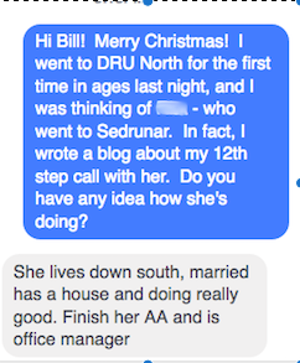
On a dark, rainy winter’s evening about ten years ago, I found myself in a run-down urban trailer park trying to find a particular trailer. I don’t remember how I was supposed to identify it, but I do remember a man stepping in front of me whose face I couldn’t see in the dark.  “I got some stuff.  You want some?”  trailer-park“No, thanks,” I replied, moving on. By the light of trailer windows, I saw more shadowy figures moving about in the downpour, and I remember holding my AA Big Book in front of my heart like a shield, asking god to keep me safe.  I was on a full-fledged 12th-step call, one of only a handful in my life.

Twelfth-step calls are less common today because treatment centers tend to be a first stop for addicts wanting help, but the woman whose trailer I was seeking had just been released from the most labor-camp-like detox/treatment center in Seattle – Sedrunar.  A friend had called me about her. “Lena doesn’t have a car to get to meetings.  She’s got two kids, and she’s gonna lose them if she uses again.”

I called Lena, though I was going to insist she take the bus to my house.  But Lena, like any addict, was persuasive.  She didn’t know anyone in the trailer park she could trust to watch her kids – who were seven and two.  Could I please come just this once?

The seven-year-old opened the trailer door.  She stared at me from eyes circled with dark shadows, silent as a spook.  I heard yelled from inside: “Let her in!”  I tried to greet the child cheerily, though to inhale the stinky, steamy air in there felt like an assault. On the floor was an old TV with a beanbag chair in front of it – that and piles of clothes.  Bare walls.  In came Lena, the toddler on her hip naked besides his diaper, food all over his face.  Lena was a bit shorter than me and chunky, about 25. She shook my hand, apologizing for the mess, and handed the boy off to her daughter, pretty much barking at her to go in the bedroom and shut the door so she could talk to this lady – me.

We sat down at the yellow kitchen table.  On the stove, mac & cheese dribbled from a saucepan stovein a way that reminded me of vomit, and smeared noodles dotted the table.  Lena sat across from me and folded her hands expectantly as though I were about to recite poetry.

All I could say was, “Does that window open?” I gestured toward a dark pane at the the table’s end, the glass dripping with condensation.

Lena looked perplexed.  “I’m trying to save heat.”

“I’d really appreciate it.”

Reluctantly she rose and slid the moldy aluminum frame aside about an inch.  While she was up she grabbed a sponge and wiped away most of the noodles at my place, apologizing that she’d just fed her son.

I’d made up my mind that I would stay 30 minutes only.  I began as I always do, by asking Lena to briefly tell me her story.  Clearly practiced from treatment, she launched right into it – how she’d grown up picking crops in Yakima in a Hispanic community; how she’d gotten into meth as a teen.  She was proud that both kids had the same father, but he was a drug dealer.  She’d lost them twice to CPS – once for leaving them in the car outside a bar.

“I’m clean, now, 60 days.  The judge told me this is an extra chance with my kids.  I shouldn’t even have them now.  I gotta stay clean.  I gotta stay sober.”  Here she changed, muscles in her face and throat working hard.  She looked right at me and spoke distinctly: “I can’t… lose… my kids.”

“Well, you’ll need to find a sponsor,” I breezed, “but, unfortunately, I’m full.”  This was somewhat true – I had a few sponsees.  But, of course, I really said it to push away all this squalor.  I wasn’t even sure whether this woman should have her kids.  All I knew was that only 21 minutes stood between me and escape.

I sketched my own story briefly, Lena nodding attentively at every phrase.  I explained that I couldn’t not drink on my own, but by working the 12 steps I’d accessed a higher power that had removed my craving for alcohol and kept me sober eleven years.

“Eleven years!” Lena marveled.  “That’s what I want!  I wanna know how you did that!”

I was starting to explain how I’d worked with a sponsor when we heard a ruckus and the squalling toddler, chased by the spooky girl, burst out of the bedroom.  Hardly taking her eyes from me, Lena scooped her son into her lap and held him close.  She gave the crown of his head tiny kisses and asked him if he wanted a bottle.

Right then – that’s when the voice started.  Not really a voice, but an urging:  Help her.  Sponsor her.  Love her.

No fucking way! my ego countered.  ticking-clockI was busy.  She was hopeless.  Just eight minutes and I’d be outta this dump, back to the fresh air and my nice, clean life!
“He don’t talk,” Lena told me. “They told me he’s disabled, but it ain’t true.  It’s just all he been through.”  Watching the boy’s eyes, the way they moved from Lena to me and back again, I sensed she was right.  Meanwhile the spooky girl joined us with a coloring book, promising to be quiet and asking where her crayons were.  Lena grabbed them from the same box that had held her Big Book.

“It’s not me,” I heard myself telling her. “God has given me a life better than I ever dreamed of.”  Some of the people who’d helped, giving me time and guidance, flashed through my mind.  “I’m not the same person I was.”  Lena nodded intently.  She was not begging.  She was not pleading.  But every cell in her body was straining to hear me.

Just help her.  Just love her.

But I was helping, dammit!  I was steering her toward the program, right?  Just not toward me.  Anyone but me.  But, with just three minutes to go, I made a big mistake.  I looked into Lena’s eyes.  Really looked.  I saw there desperation and terror, but even more, a fierce love for her children.  My own son was five.  How were we any different?

The wall crumbled, compassion washing over me.  “Okay, I’ll sponsor you,” I heard myself saying.  Lena’s face lit up.  “But not here!  You’re gonna have to come meet me at a coffee shop!”

The rest of the story is like a fairy tale.  Lena and I met every Friday tobig-book read the Big Book at a Starbucks while a sober neighbor watched her kids, after which I’d drive us to a meeting.  She had a job riding in a municipal truck, collecting garbage, and within a couple of months she qualified to drive that truck.  She moved into a shitty apartment not far from the trailer park, where I met with her for a while until she found childcare.  She bought a crappy car and started driving herself to meetings.  Whenever I showed up at her homegroup, her kids would ambush me either in the parking lot or when I came in – the little girl now beautiful and clear-eyed, the little boy talking up a storm.  Their laughter still seemed incredible to me – a miracle.

In a little more than a year, we’d progressed to Step 9 when Lena, who was apprenticing as municipal gardener, leased a nice apartment too far north for us to keep meeting.  I drove up and visited her there once.  It was near Christmas.  I remember white carpets, a new sofa, pictures on the walls.  I remember the children bringing me a gift from under the Christmas tree and grinning while I opened it, and my own embarrassment that I had nothing for them.  But I had given them something – and we all knew it.

Last night after eight years I went again to that meeting – Lena’s old home group. But she wasn’t there.  Where she’s gone, what she’s doing, I don’t know.  But I’m hopeful.  I sent them prayers.  Today, I’m so grateful that god opened my heart, and that it’s still opening.

scroll

Postscript:  I had to find out…  🙂

screen-shot-2016-12-24-at-5-20-03-pm

8 Comments

Filed under Addiction, Alcoholism, Recovery, Sobriety, Twelve Steps

What’s the Point of “Bill’s Story”?

Pledges inscribed on the flyleaf of Bill and Lois’ family bible:

  • October 20, 1928:  To my beloved wife that has endured so much, let this stand as evidence to you that I have finished with drink forever.
  • November 22, 1928:  My strength is renewed a thousand fold in my love for you. I will never drink again.
  • January, 1929:  To tell you once more that I am finished with it.  I love you.
  • September 3, 1930:  Finally and for a lifetime, thank God for your love.

On Christmas day, 1930, Lois’ mother died. Bill was drunk for days before, too drunk to attend the funeral, and drunk for days after. Lois began work at Macy’s for $19/week to support the two of them.

Anyone familiar with the Big Book of AA knows that in its opening chapter, “Bill’s Story,” co-founder Bill Wilson offers his personal narrative of “what it was like” while he was a prisoner of alcohol, “what happened” when his drinking buddy Ebby visited (miraculously sober), and “what it’s like now” – or was like for him and Lois, flourishing in the early days of AA at the time the book was published.

Bill and Lois

Lois and Bill later in life

Standard “homework” for an AA newcomer embarking on the 12 steps is to highlight the passages in “Bill’s Story” to which they relate – at least, that’s how we do it in Seattle (and I expect all over the world).  Sponsees of mine who were sure they’d have zilch in common with some dude of a different race, class, gender, and era writing in terms they consider archaic are surprised to find Bill puts into words experiences, pains, and terrors they’ve suffered but shared with no one.  Identification – that’s how the program works.

It starts from the get-go: “War fever ran high” he opens – each of these four words flashing icons of addiction.  Bill drank when things were awesome: “I was part of life at last, and in the midst of the excitement I discovered liquor.” And he drank when they sucked: “I was very lonely and again turned to alcohol.” By the end of the first paragraph, we can guess Bill drank like we did.  By the end of the first page, we know he turned away from the foreboding doom he felt reading an alcoholic’s tombstone and focused instead on vast faith in his own “talent for leadership” his ability to choose wisely.

 canstockphoto.com

Right there, folks, is the enigma of alcoholism in a nutshell.  Even as we increasingly realize that booze is killing us, we place increasing trust in self-will and self-knowledge, which amount to paper swords in our gladiator’s fight with this powerful, thought-twisting, brain-sabotaging snake.  Why?  Because the curious mental blank spot can override our resolve at any moment.

Though there must have been hundreds of times when Bill rallied all his resolve to quit drinking and found himself shit-faced soon after, his story specifically names five of them.

 1.  Self-will: “Nevertheless, I still thought I could control the situation, and there were periods of sobriety that renewed my wife’s hope.” [Referring to the bible inscriptions]

Blank spot: “Then I went on a prodigious bender, and the chance vanished.”

2.  Self will: “I woke up.  This had to be stopped.  I saw I could not take so much as one drink.  I was through forever.  Before then, I had written lots of sweet promises, but my wife happily observed that this time I meant business.  And so I did.”

Blank spot: “Shortly afterward I came home drunk.  There had been no fight.  Where had been my high resolve?  I simply didn’t know.  It hadn’t even come to mind.”

3.  Self-will: “Renewing my resolve, I tried again.  Some time passed, and confidence began to be replaced by cocksureness.  I could laugh at the gin mills.  Now I had what it takes!”

Blank spot:  “One day I walked into a cafe to telephone.  In no time I was beating on the bar asking myself how it happened.”

4.  Self-will: “It relieved me somewhat to learn [in the hospital] that in alcoholics the will is amazingly weakened when it comes to combating liquor… Understanding myself now, I fared forth in high hope… Surely this was the answer  self knowledge.”

Blank spot: “But it was not, for the frightful day came when I drank once more. The curve of my declining moral and bodily health fell off like a ski-jump.”

5. Self-will: “No words can tell of the loneliness and despair I found in that bitter morass of self-pity.  Quick sand stretched around me in all directions.  I had met my match.  I had been overwhelmed.  Alcohol was my master.  Trembling, I stepped from the hospital a broken man.”

Blank spot: “Fear sobered me for a bit.  Then came the insidious insanity of that first drink, and on Armistice day 1934, I was off again.  Everyone became resigned to the certainty that I would have to be shut up somewhere, or would stumble along to a miserable end.”

But instead of drinking himself to death, Bill receives a visit from his old drinking pal, Ebby, who tells him of the Oxford Group and opens the door to freedom – as the rest of the chapter swiftly summarizes.  Because the focus here, at the book’s beginning, is on defining the problem.

The point of Bill’s story is that we can’t fix ourselves.  No matter how disciplined in other respects, our minds cannot combat our alcoholism, which resides in the mind.  No amount of decision, resolve, moral fiber, determination, or even dedication through the deepest love for a partner can come to our aid at the junctures of the curious mental blank spot, when these thoughts don’t “even come to mind.”

Repulsed by the Oxford Group’s religiosity, Bill did indeed drink himself back into the hospital after Ebby’s first visit, but NOT after Ebby’s hospital visit, because at that time Bill had a white light experience that not only struck him sober for the remaining 36 years of his life, but empowered him to persevere in the difficulties of co-creating a program that would save the lives of millions of fellow alcoholics.

God alone can relieve our addiction, if we ask.  I’m not talking about a god named in any religion,spiritenergy though such gods work fine for some, which is cool.  For me, god is the life force, an energy which flows not only through the matter of our bodies and among all living entities – animal or vegetable – but indeed throughout the order of the universe.  Cut off from this energy flow by ego and hostility, our spirits languish and we find ourselves puppets of addiction.  Yet it’s right there – an energy of immense love and intelligence that we can tap into if we sincerely open to it.  It’s living you right now.  It’s living the planet.  You can write it off as “shit happens” or…

You can start where you are.  Whether you’re hungover as hell right now or sober but in pain, you can ask it for help and guidance.  You might start like this: “I don’t know what you are, but I know that I hurt, and that I need you.  Help me.  Please guide me toward goodness and love and light.  I will look for you in the depths of my heart.”

I guarantee you it will answer.

scroll

Post to Facebook

..             .


13 Comments

Filed under Addiction, Alcoholism, Recovery, Sobriety, Spirituality

Thinking in Sobriety: A Suggested Playlist

A thought is harmless unless we believe it.  It’s not our thoughts, but the attachment to our thoughts, that causes suffering.  Attaching to a thought means believing it’s true.   (-Byron Katie)

One of the greatest gifts I’ve been granted in sobriety is a thin layer of mental insulation between having a thought and believing it’s true.  Back when I was drinking or newly sober, I used to experience a barrage of hopeless, self-deprecating, and judgemental thoughts that seemed to come at me from nowhere.

And they still do!  The miracle now is that today I know I’m thinking. I’m also aware that my thoughts are fickle: sometimes they’re guided by my higher self, and others they’re broadcast by that parasitic asshole camped out in my amygdala: Addiction.

Thoughts in themselves are just mental activity – nothing we have to sign on with.  But doing so becomes habit. As Eckhart Tolle explains, “Strictly speaking, you don’t think: Thinking happens to you… Digestion happens, circulation happens, thinking happens.  Most people are possessed by thought… [while] the greater part of [their] thinking is involuntary, automatic, and repetitive. ”

The majority of my thinking, unfortunately, tends to diagnose what’s not right.  (For instance, I’m telling you now what’s not right with my thinking.)  Why is that?  For one thing, as a human I’ve evolved to be on the constant lookout for survival problems. As an academic, I’ve been trained to evaluate everything critically.  Add the fact that, as a codependent, whoamiI’ve always had a hell of a time gauging where I stand relative to you, who I think you want me to be, and my fleeting sense of self.  (Are you disappointed?  Bored?  How do I fix it?)  And lastly, as an alcoholic, I’m prone to self-centered extremes of self-aggrandizement and self-loathing: I’m the best or the worst, totally the shit or a total piece of shit.

Maybe that’s why I experience so much downright back-assward thinking.  I kid you not: this morning I got up for a second cup of tea, and as I crossed the threshold of the kitchen, the thought came to mind that my entire life was a pathetic failure.  Why?  That’s hard to say. My thinking voice was wielding some punishing club, like: “Why do you constantly deny this?!  Why don’t you just quit your strained pretensions and admit you’re nothing but a fuck up?!” Further back I sensed accusations about my lack of material wealth and a relationship, but I didn’t look into them.  Instead I pulled away, thought: “Wow!  Harsh!” and focused on my lovely, cozy tea.

The thing is, I was once addicted to that harsh voice.  I used to grab at those thoughts saying, “AHA!  Now I face the TRUTH!”  Granted, the harsh voice possessed a dismally limited supply of diatribes or, if you will, a chintzy jukebox of dark songs it played over and over.  But I knew them all so well that, whether about your faults or mine, it was great fun to sing along.  For years, they all led to a frame of mind that clearly called for a drink.  I drank not so much to vanquish them as to join with their story: “I don’t give a shit anymore.  Cheers!”

table-jukeboxHere are some of the dark jukebox’s Greatest Hits, sequenced from inner to outer attacks:

  • You Suck  (verses include your life sucks; you’re incompetent; your job/ creativity / social skills suck; no one likes you)
  • You’re Gross  (includes you’re fat; your clothes/ hair/ belongings are stupid; your ____ is too ___)
  • Poor, Poor You~! (includes cruelly denied X;  you’ve tried so hard; never even had a chance; assholes always win; god is frickin’ mean)
  • Your Way’s Right  (includes you told them X ! ; they think they’re so smart; they’ll be sorry; fuck those bastards)
  • That Bitch (includes why is shit so easy for her?; why do all the guys like her?; why won’t she just shrivel up and die?)
  • How D’they Like You NOW??  (includes a myriad of stellar comebacks, snide putdowns, and scathing witticisms to put assholes in their place)
  • Some Day You’ll Show ‘Em (includes Academy Award-winning footage of you accomplishing great things amid vast admiration, or talking thoughtfully with vanquished rivals about your victories)

As I noted above, I still have all these thoughts.  But… by virtue of having worked the steps and listened to a variety of 5th steps, I’ve learned to recognize their hackneyed tunes as part of the human condition – nothing unique to me.  And by a miracle of grace, I’ve actually grown bored of them.

Sometimes, to break a dark train of thought, you need a light one.  The Saint Francis Prayer rocks, of course, but it’s a bit abstract.  Here’s a playlist of thought trains I pursue when I’m having trouble shutting down the jukebox.

  • Be grateful.  I’m not in a war-torn country; I’m healthy; I’m sober; I know my god; I have friends; all I need to live has been gifted to me, plus a wonderful son, home, and abilities.
  • Send love to someone struggling.  I call to mind friends having a hard time and pray for them, maybe text some kind words, or decide on something I could do to help.
  • Plan something happy.  This past kidless weekend I saw the blues coming, so I took my dog, drove 2 hours, and climbed 4,000 feet from old growth forest to a snowy peak – sheer heaven!  All it cost was gas and gumption. I also throw parties, meet for coffee, and play at silly sober stuff (like sober karaoke this weekend).
  • Remember I’m going to die, as are you.  This may sound morbid, but holding in mind that life is finite renders every detail of the present moment infinitely precious.  The more loved ones I lose, the more easily I love all of us – this uppermost layer of humanity like fresh spring grass on an ancient prairie.

Living sober doesn’t mean just not drinking.  It means cultivating a beautiful life with the help of a loving god – and saying no to those habits that drag us back toward our dis-ease.

dsc04697

Me not watching TV alone last weekend (across from Glacier Peak, tagged last summer)

scroll

Post to Facebook

8 Comments

Filed under AA, Addiction, Codependence, Recovery, Sobriety, Twelve Steps