
A thought is harmless unless we believe it. It’s not our thoughts, but the attachment to our thoughts, that causes suffering. Attaching to a thought means believing it’s true. (-Byron Katie)
One of the greatest gifts I’ve been granted in sobriety is a thin layer of mental insulation between having a thought and believing it’s true. Back when I was drinking or newly sober, I used to experience a barrage of hopeless, self-deprecating, and judgemental thoughts that seemed to come at me from nowhere.
And they still do! 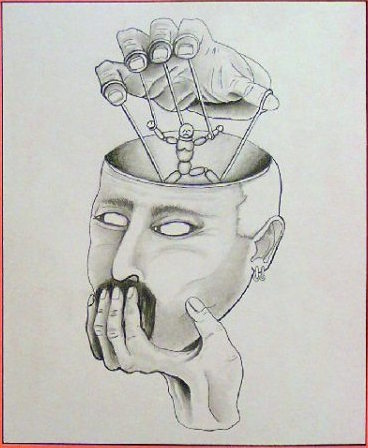 The miracle now is that today I know I’m thinking. I’m also aware that my thoughts are fickle: sometimes they’re guided by my higher self, and others they’re broadcast by that parasitic asshole camped out in my amygdala: Addiction.
Thoughts in themselves are just mental activity – nothing we have to sign on with. But doing so becomes habit. As Eckhart Tolle explains, “Strictly speaking, you don’t think: Thinking happens to you… Digestion happens, circulation happens, thinking happens. Most people are possessed by thought… [while] the greater part of [their] thinking is involuntary, automatic, and repetitive. ”
The majority of my thinking, unfortunately, tends to diagnose what’s not right. (For instance, I’m telling you now what’s not right with my thinking.) Why is that? For one thing, as a human I’ve evolved to be on the constant lookout for survival problems. As an academic, I’ve been trained to evaluate everything critically. Add the fact that, as a codependent,  I’ve always had a hell of a time gauging where I stand relative to you, who I think you want me to be, and my fleeting sense of self. (Are you disappointed? Bored? How do I fix it?) And lastly, as an alcoholic, I’m prone to self-centered extremes of self-aggrandizement and self-loathing: I’m the best or the worst, totally the shit or a total piece of shit.
Maybe that’s why I experience so much downright back-assward thinking. I kid you not: this morning I got up for a second cup of tea, and as I crossed the threshold of the kitchen, the thought came to mind that my entire life was a pathetic failure. Why? That’s hard to say. My thinking voice was wielding some punishing club, like: “Why do you constantly deny this?! Why don’t you just quit your strained pretensions and admit you’re nothing but a fuck up?!” Further back I sensed accusations about my lack of material wealth and a relationship, but I didn’t look into them. Instead I pulled away, thought: “Wow! Harsh!” and focused on my lovely, cozy tea.
The thing is, I was once addicted to that harsh voice. I used to grab at those thoughts saying, “AHA! Now I face the TRUTH!” Granted, the harsh voice possessed a dismally limited supply of diatribes or, if you will, a chintzy jukebox of dark songs it played over and over. But I knew them all so well that, whether about your faults or mine, it was great fun to sing along. For years, they all led to a frame of mind that clearly called for a drink. I drank not so much to vanquish them as to join with their story: “I don’t give a shit anymore. Cheers!”
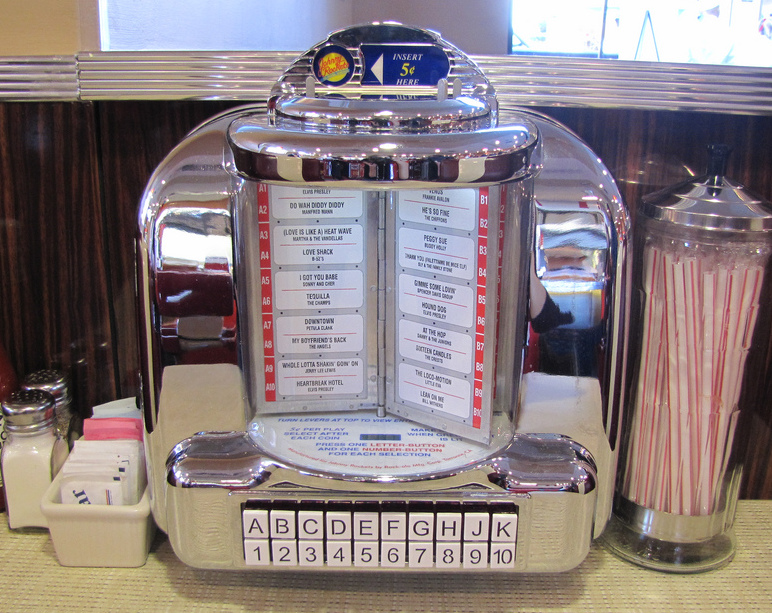 Here are some of the dark jukebox’s Greatest Hits, sequenced from inner to outer attacks:
- You Suck (verses include your life sucks; you’re incompetent; your job/ creativity / social skills suck; no one likes you)
- You’re Gross (includes you’re fat; your clothes/ hair/ belongings are stupid; your ____ is too ___)
- Poor, Poor You~! (includes cruelly denied X; you’ve tried so hard; never even had a chance; assholes always win; god is frickin’ mean)
- Your Way’s Right (includes you told them X ! ; they think they’re so smart; they’ll be sorry; fuck those bastards)
- That Bitch (includes why is shit so easy for her?; why do all the guys like her?; why won’t she just shrivel up and die?)
- How D’they Like You NOW?? (includes a myriad of stellar comebacks, snide putdowns, and scathing witticisms to put assholes in their place)
- Some Day You’ll Show ‘Em (includes Academy Award-winning footage of you accomplishing great things amid vast admiration, or talking thoughtfully with vanquished rivals about your victories)
As I noted above, I still have all these thoughts. But… by virtue of having worked the steps and listened to a variety of 5th steps, I’ve learned to recognize their hackneyed tunes as part of the human condition – nothing unique to me. And by a miracle of grace, I’ve actually grown bored of them.
Sometimes, to break a dark train of thought, you need a light one. The Saint Francis Prayer rocks, of course, but it’s a bit abstract. Here’s a playlist of thought trains I pursue when I’m having trouble shutting down the jukebox.
- Be grateful. I’m not in a war-torn country; I’m healthy; I’m sober; I know my god; I have friends; all I need to live has been gifted to me, plus a wonderful son, home, and abilities.
- Send love to someone struggling. I call to mind friends having a hard time and pray for them, maybe text some kind words, or decide on something I could do to help.
- Plan something happy. This past kidless weekend I saw the blues coming, so I took my dog, drove 2 hours, and climbed 4,000 feet from old growth forest to a snowy peak – sheer heaven! All it cost was gas and gumption. I also throw parties, meet for coffee, and play at silly sober stuff (like sober karaoke this weekend).
- Remember I’m going to die, as are you. This may sound morbid, but holding in mind that life is finite renders every detail of the present moment infinitely precious. The more loved ones I lose, the more easily I love all of us – this uppermost layer of humanity like fresh spring grass on an ancient prairie.
Living sober doesn’t mean just not drinking. It means cultivating a beautiful life with the help of a loving god – and saying no to those habits that drag us back toward our dis-ease.

Me not watching TV alone last weekend (across from Glacier Peak, tagged last summer)


 has its ups and downs, riches and ruins. The quality of our sobriety varies with our connectedness to god and our fellows, depending on the rigor with which we cultivate both. Many of us long to be gung-ho about sobriety all the time – and we can be! It’s just that what gung-ho looks like is going to change over time, which is why I like the analogy of seasons in sobriety.






 A Spiritual Evolution