
Lost in a spiritually empty world, we alcoholics relied for many years on a 12-Step program of our own making. We just didn’t know it! Our 12 Steps Backward, a cycle still ‘guiding’ the lives of countless alcoholics, went about like this:

These can stand alone just fine, but I’ll go ahead and comment briefly on my own experience with them.
Steps 1-3
I took Step 1 at some point in high school. I’d been uncomfortable in my skin since the age of 7 or 8, but the pain spiked unbearably in my late teens. I hated being Louisa. The first time I got shitfaced, I found instant relief and happily took Step 2, amazed that something as simple as booze could set everything right in my world. Now that I had a new way to live and feel good, I drifted into Step 3, believing superficially that alcohol and drugs were fun, and at a deeper level that I needed them to feel okay.
Steps 4-9
Alcohol/drugs inflated my ego with a sense of power that led me to harm others, whether by intentionally abusing their trust or by thoughtlessly overlooking their feelings. During college, I tried to minimize the guilt that began to accumulate in the back of my mind — Step 4 — a policy I kept up for as long as I drank. Any lurking notion that my approach to living was faulty I dismissed by imagining pretty much everyone did the same — Step 5.
 My sense of dramatic unfairness swelled alongside my unhappiness: life was not rewarding me as it should — Step 6. Other people (cool peers? fickle authorities?) had to be at fault — Step 7. Didn’t my problems really start with that kindergarten teacher who embarrassed me so badly and continue right up through current family and coworkers? — Step 8. I wished I could set those people straight! — Step 9.
Steps 10-12
Living by Step 10, I never grew up emotionally because I never absorbed the lessons pain had to teach me. I simply doused pain with booze, stirred it into a soupy ‘woe is me!’ drama, and learned nothing. Step 11 flourished as a result — mind-movies rehashing the past or dreaming up glorious futures. By age 34 my life still looked okay on the outside, but I felt more depressed, abhorrent, and hopeless than I could stand, drinking in solitude, lowering my bar for company, and toying with suicidal ideation — Step 12.
At my first Alcoholics Anonymous meeting,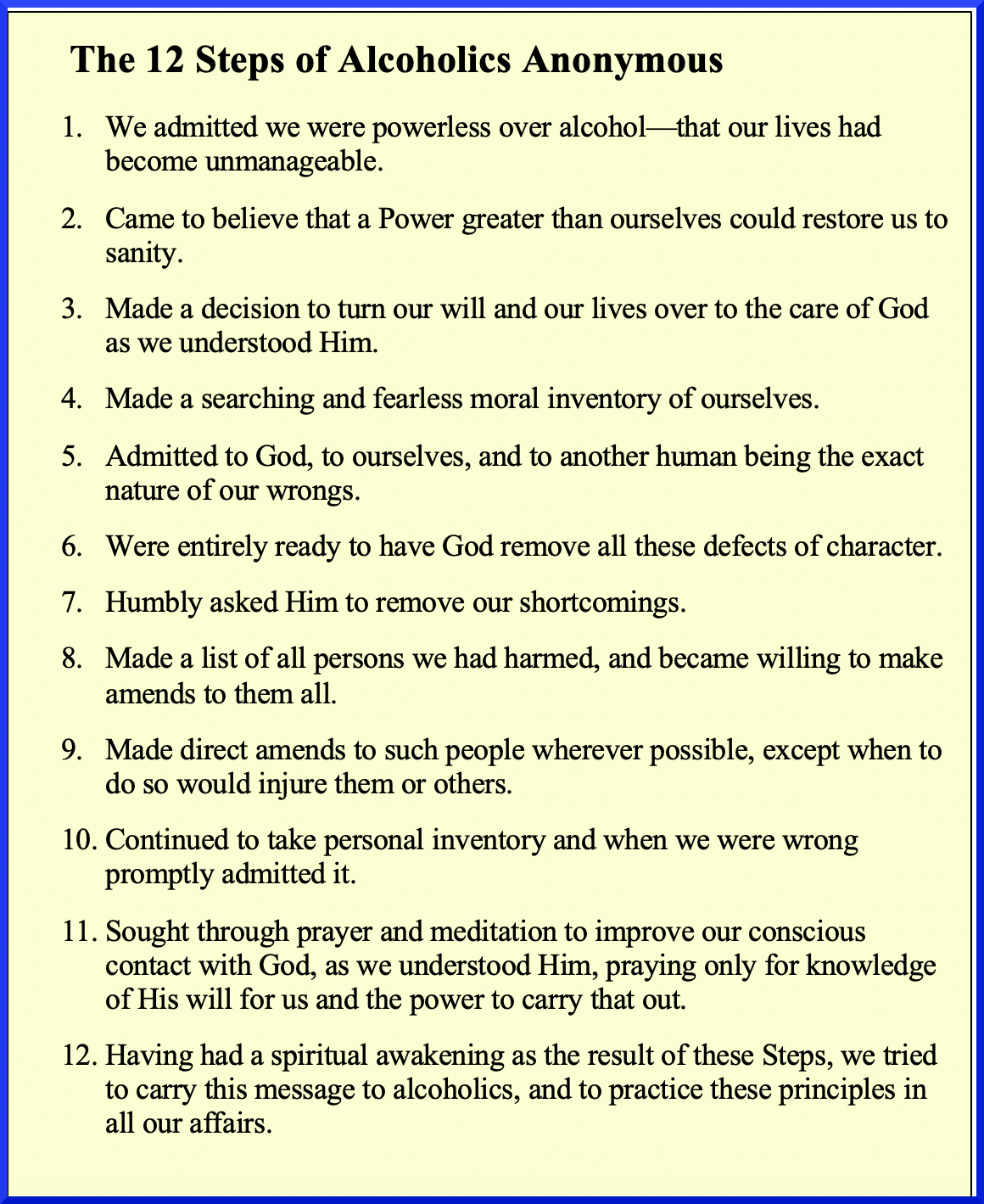 I read the real 12 Steps off the wall in less than a minute and dismissed them as worthless platitudes — seeing as I had all the emotional depth of a 15-year-old. That stayed true for almost 3 years, until I hit a sober bottom grieving my sister’s death and found a rigorous sponsor who helped me apply them. The reversal of my life’s trajectory, from plowing ever deeper into misery to climbing ever higher toward gratitude and joy, came about through thoughtfully, truthfully, and thoroughly working these simple steps.
Initially, the “God” word freaked me out, as it does everyone, even though I’d once died briefly from drug overdose, crossed over to the other side, and journeyed to the Light. (I recently gave an interview about losing my atheistic battle to deny my NDE and its paranormal aftereffects (see NDE interview playlist) Eventually, though, what I call “god” (i.e. the spirit world) showed itself to me so persistently and undeniably that I finally caved, embracing the fact that god — the loving intelligence animating all life — is everywhere in everything always.
NDE or no NDE, almost everyone who works the 12 steps in long-term recovery develops gratitude and comes to see how their god has been with them all along.
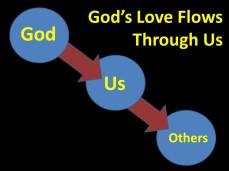
For me, the 12 steps not only cleared resentments blocking me from god, but also triggered a sort of Copernican Revolution. Where I once strove to pull GOODNESS from other people to serve me as the center of the universe, I came to see that all GOODNESS flows from GOD, the true center of the universe, through me toward others. When I act as god’s conduit for love, my spiritual batteries get charged, and I feel joy.
That’s the mission we’re here to accomplish, folks: Overcome ego’s fears of vulnerability to connect with others in love and kindness — not only with those closest to us, but with all humans, animals, and the Earth as a whole. Religion still pisses me off a bit because, by humanizing god, it distorts with pomp, cliquishness, and carrot-on-a-stick heavenly rewards what the 12 steps lay out with such humble clarity.
The goal of loving others freely enough to be of service can seem out of reach if we’ve been badly wounded; we need god’s help first to find our wounds, obscured under layers of drinking and denial, and then to heal them. And that’s exactly what the 12 steps are designed to help us do.
.

.
Note: I’m indebted to Bill L’s 11/8/19 share at our homegroup, Salmon Bay, referencing his “backward 3rd Step.” Thanks also to my friend Dawna H, who replied, “Get your ass over here!” when I texted that I felt too full and lazy to show up at the meeting and, with 22 years sober, helped me tweak the wording of these steps.
.





 A Spiritual Evolution