
When I was new to AA, some of the 12 steps struck me as filler to make an even dozen. Being smarter than anyone else in the world, I could see that just 6 steps would’ve done the trick: 3, 5, 7, 9, 10 & 12. These steps all tell us to do something. The others deal with internal shifts that, it seemed to me, could be made instantaneously.
As usual, I was totally wrong.
The founders of Alcoholics Anonymous who, in 1938, created the 12 steps understood that spiritual change is no overnight matter, and that  actions carried out with no internal change are meaningless. Rather, the steps are about collaborating with a higher power to gradually transform who we are, how we perceive our place in the world, and how we treat others. It’s a metamorphosis that lasts all our lives.
For example, Step 9 involves action: we make amends to those we have harmed, but without an internal Step 8, we can inadvertently inflict more harm. Someone recently asked me to look over a draft of a 9th step amends letter that — I found — was actually a more-about-me letter. It opened, not with well wishes for the recipient or acknowledgement that hearing from one who hurt them years ago might come as a surprise, but what was up with the writer: “I’ve been thinking about….” After a quick note that “I am not proud of the way I…,” the writer summarized what she was doing to heal herself. The next paragraph explained the family of origin stuff from which she needed to heal. In closing, she urged the recipient to celebrate family events together with her for the sake of their adult children.
Now for you reading this, it’s probably not rocket science to see that the letter was self-centered. The goal of the 9th step is to repair harms we did to others. The first part of doing so is to speak the truth about what happened. But what if we still can’t see the truth because we’re still trapped in our self-centered view of the world?
 To the writer of this letter, the fact that she was even daring to contact this person and acknowledge that she struggled with emotional issues seemed an amends. I know because 24 years ago, just a few months into sobriety, I sent an identically selfish letter to someone I’d hurt in much the same way.
Neither of us had taken time to work through Step 8 — the inner process of “became willing to make amends.” We assumed that “willing” meant only mustering the gumption to dive in. But part of willing is becoming able. If I claim, for example, that I am willing to recite the Gettysburg address from memory, and I jump right in saying, “Four score and seven years ago our fathers…” but then run out of steam after a few lines, was I ever really willing to recite it? Doesn’t that willingness entail respect for the content, for the work involved in learning it fully?
By the same token, Step 8 means we become willing to re-see our past behavior through the new lens god has helped us craft via Steps 1 through 7. We put ourselves in the place of the person we harmed, and we break down exactly what we did wrong. Years after sending that half-baked “amends” letter, when I actually reached Step 8, my kickbutt sponsor had me write the words selfish, dishonest, and thoughtless as three headings under which to categorize my actions with a given person. If and only if the person knew of these harms, when I met with them or wrote them a letter, I said, “I was selfish when I chose to…. I was dishonest when I…,” etc. At the end, I had to ask them what, if anything, I’d omitted and what, if anything, I could do to set things right. Last week, I tried to steer the letter writer in that same direction.
God is not stoked for us to beat up on ourselves. God doesn’t want us to grovel. But god is huge on honesty — HUGE! — because god is all about the truth. To be more precise, god is the truth, the foundation of all that is. But honesty with ourselves is no easy matter! It’s a frontier, a journey of removing delusion after delusion, because we’re born self-centered and, experiencing life subjectively, grow up with a foundational conviction that “it’s all about me.”
To reprogram that operating system even a little requires god’s help. As the Big Book says, “Neither could we reduce our self-centeredness much by wishing or trying on our own power. We had to have God’s help” (p. 62).

Keno and Cos, 2011
When my son was little, I used to try to teach him about self-centeredness by having our dog say (he talks like Patrick from SpongeBob), “It’s such a waste of food when you guys eat, because things only taste good when I eat them!” My son would get so upset arguing with Cosmo (well, me), trying to explain that he, too, tasted things! “No you don’t,” Cosmo’s voice would counter. “It never tastes when you eat. Not even a little!”
In some ways, my old “amends letter” and this new one were coming from Cosmo’s mindset: “Dear person: All these things were going on (for me) when I deceived you for as long as possible before jettisoning you for someone else. You should figure out how it felt to be me, and have compassion, and that will change your perspective of how it was to be you, so I’ll be helping you.”
No. God’s truth is far more simple: “There is a right way to treat people, and there’s a wrong way — and I did wrong. I deeply regret those selfish choices, but I no longer live that way. I am here in a new spirit to ask what reparations I can make.”
Boom! Powered by god’s love, we can step out of Cosmo’s me-world. All the internal steps are essential to right action. How can we admit or ask god to remove character defects that we can’t see or are still practicing? The most powerful prayers are always requests for guidance: “Help me see where I am bullshitting myself. Help me see more as you see.”





 I’d stick out my hand: “Hi, I’m Louisa. That’s a such a cool tattoo on your arm. What does it say?” After a bit of an awkward start, I’d learn three things. To young, pretty women who were stealing all the goddamn sexy, I might say, “I like your earrings. Where’d you get them?”


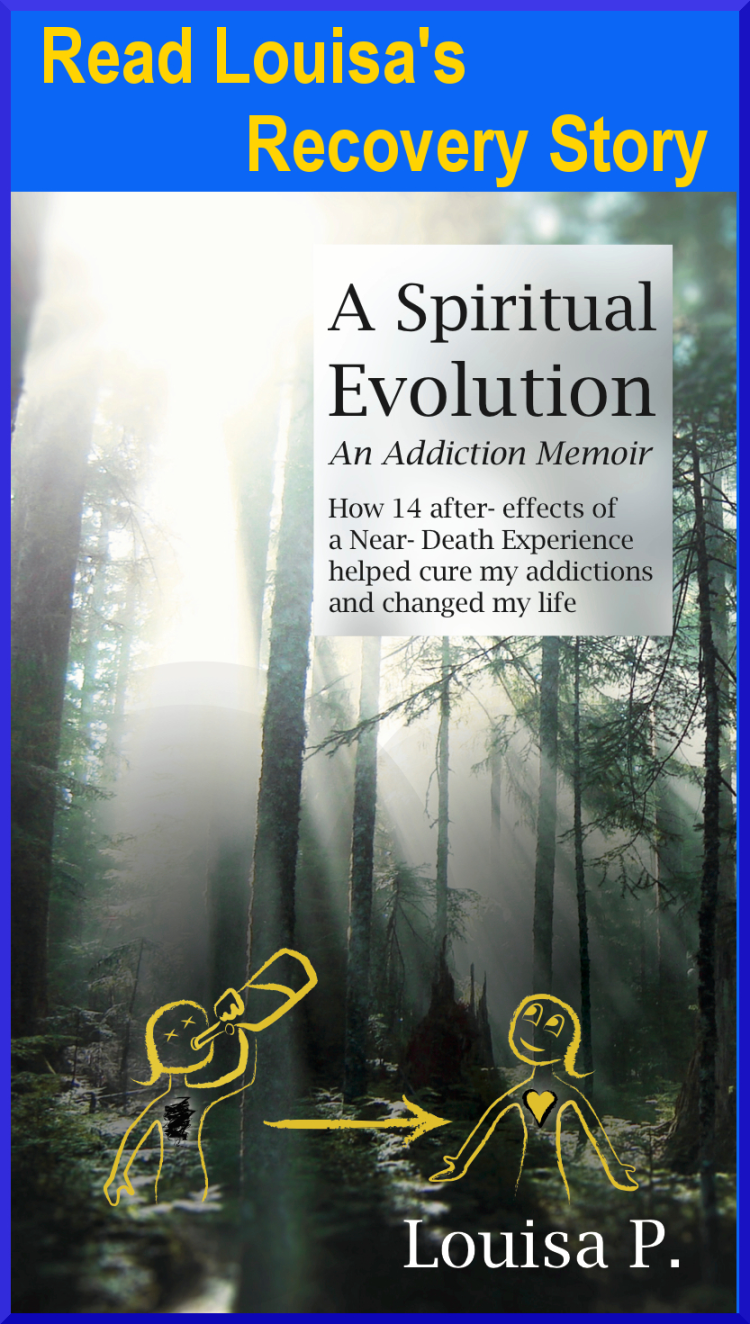
 A Spiritual Evolution